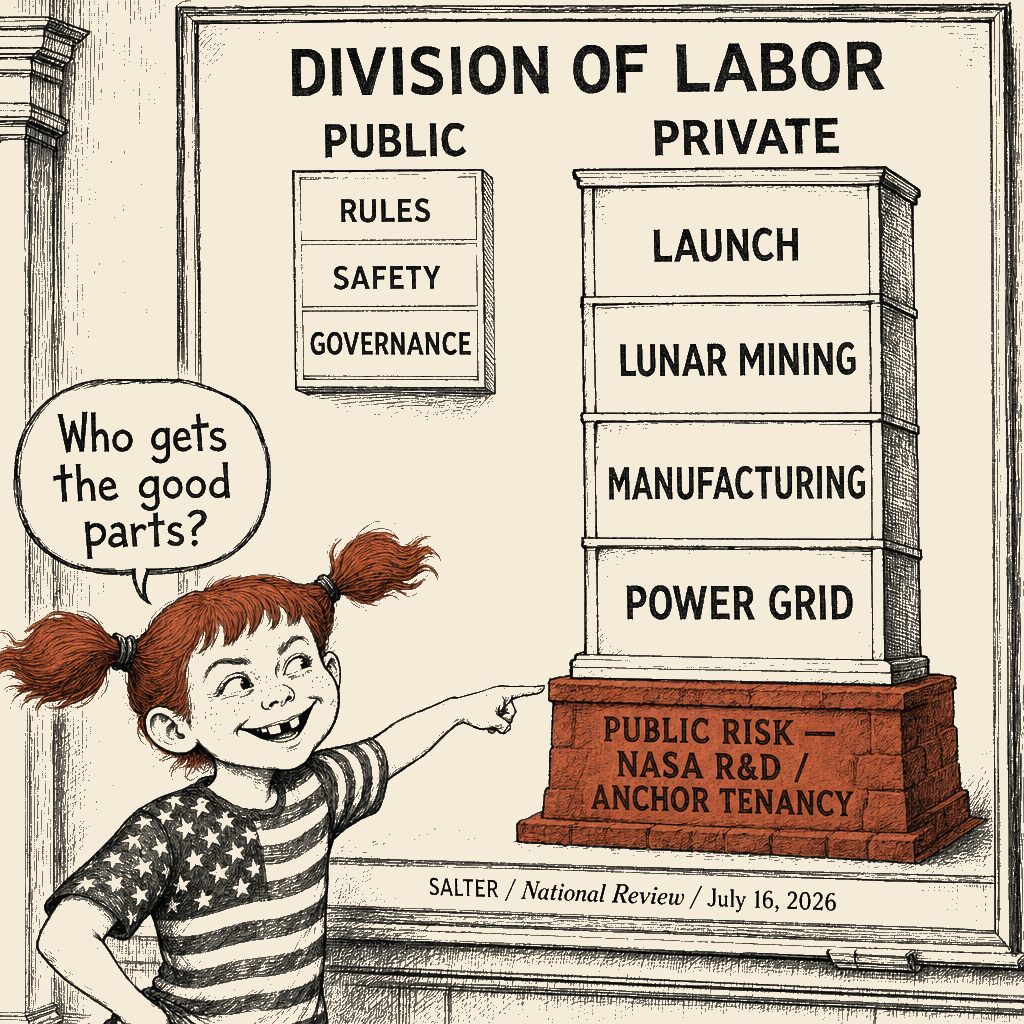
Responding to: To Win the Moon, Divide the Labor — Alexander William Salter · 2026-07-16
What the Piece Argues
This July 16 National Review essay by economist Alexander William Salter argues that America’s return to the Moon will succeed only if public and private space roles are properly divided along lines of “comparative advantage.” Markets, the essay contends, should handle space activities whose outputs can be sold to paying customers — exemplified by SpaceX’s reusable-rocket cost revolution; government should retain a “fairly short” list of functions whose outputs are non-excludable public goods, life-critical, or governance-related. Salter singles out NASA’s $4-billion-per-launch Space Launch System as the cost-plus rocket program the essay argues should be phased out, and endorses a public-private “authorities” model — Charles Miller’s CSIS proposal patterned on the Port Authority of New York — under which publicly directed but privately financed lunar development would issue bonds to raise private capital. The geopolitical frame: with China and Russia extending civil and military operations into space, the United States cannot afford to misallocate space-sector labor between the public and private sectors.
Receipts
The framing wraps a privatization program in “comparative advantage” theory, then hides the program’s main consequences — a public sector reduced to a referee while private capital captures the productive assets — behind a salute to SpaceX.
-
The framing wants you to believe:
- “Comparative advantage” is a neutral diagnostic that allocates space work efficiently between sectors, with markets naturally handling what markets handle best.
- SpaceX is a “genuine capitalist success story” that proves market capability, and the Space Launch System is proof of government waste.
- The public sector’s role is a “short list” — non-excludable public goods, life-critical assets, and outer-space governance.
- A “public-private authorities” model is balanced compromise, and bonds are how lunar development will get financed.
- Geopolitical competition with China and Russia requires accepting the division-of-labor frame, because rivals are moving fast.
-
What’s really going on:
- The “short list” of public-sector functions is precisely the list of things that would keep the program public: who sets the rules, who keeps the life-critical infrastructure running, who provides the non-excludable goods. Everything productive — launch, lunar resource extraction, manufacturing, secondary power — goes to private capital. The essay calls this a fair division; it is a quiet transfer of launch infrastructure, lunar mining rights, and secondary power systems — the productive assets of the space program — from public trust to private capital.
- SpaceX’s “$15 billion of its own money” sits on a foundation the essay itself describes: about a fifth of SpaceX’s revenue is “Uncle Sam” (NASA and the Department of Defense), and the entire launch market the company dominates was built by NASA anchor-tenancy contracts. The “capitalist success story” is a story about public risk-taking, public anchor-tenancy, and public R&D with private returns captured on top.
- The “authorities” model issues bonds to “raise private capital” — that is a financialization vector. The Port Authority track record the essay cites is itself a long history of bond-financed infrastructure where the public took the risk and private bondholders captured the upside — the same structure proposed for the Moon. The public directs the mission; bondholders capture the returns; the public takes the risk and gives up the upside.
- The SLS critique (“mainly because it employs the right people in the right congressional districts”) treats the public-sector technical workforce as a spoils system, while declining to mention that SpaceX’s own political economy — its launch contracts, its regulatory carve-outs, its capture of NASA technical staff — runs on the same kind of constituency politics, just privately held.
- The “taxpayers vs. people risking their own fortunes” framing positions public investment as opposed to private returns, when the productive public investment is precisely what makes the private returns possible. The argument is that public risk should be socialized and private returns should be privatized; that is not a “division of labor,” that is a transfer.
-
Anchor citation: Salter, “To Win the Moon, Divide the Labor,” National Review, July 16, 2026.
The DEFCON Ladder
DEFCON 5 — Polite Reframe
When to use: A persuadable moderate who has read the comparative-advantage essay and found it sensible, and who can be reached with the historical record of how space work has actually been divided.
Consider Maya. She is a thermal-systems engineer at Marshall Space Flight Center, sixteen years on NASA contracts, two children in Huntsville schools, a mortgage, a retirement account that has not done as well as she hoped. The essay she read this week told her that the Space Launch System — the program that has employed her adult working life — is a $4-billion-a-launch rocket kept alive because it “employs the right people in the right congressional districts.” Her congressional district is one of those. The essay’s prescription: phase the program out, hand the productive work to firms that have staked “$15 billion of their own money” on commercial alternatives, and let the public sector referee.
The essay is right about one thing. The public sector is not always efficient. Maya has watched contracts she has signed become a procurement lawyer’s dream and an engineer’s nightmare. The point is not to defend every line item. The point is to notice who is doing the dividing. The essay’s “short list” of public functions is non-excludable public goods, life-critical infrastructure, and the rules of the road. That is the list of things that would keep the program public. Everything else — launch, lunar mining, manufacturing, the power grid on the regolith — is handed to private capital. The essay calls this a fair division. It is a quiet transfer.
The public investment that built the launch market SpaceX dominates — the anchor-tenancy contracts, the R&D pipeline, the technical workforce that flowed out of NASA into SpaceX and Blue Origin — is treated, in the essay’s telling, as an embarrassing prelude. The private returns built on top of that prelude are the “genuine capitalist success story.” That is the division of labor the essay is actually proposing. It is not a division of labor at all. It is a settlement of accounts in which the public takes the risk and the private takes the upside.
Sort the tasks correctly, the essay says, and Americans can return to the Moon to stay. The same is true. Sort them in whose favor, and the question answers itself.
DEFCON 4 — Firm Moral Superiority
When to use: A reader who is identity-protective about “free markets” and the essay’s comparative-advantage frame, but who can be moved by the cui bono trace and the moral record of how public space investment has actually been captured.
We do not need to defend every line item of the Space Launch System to notice who is doing the dividing. The essay offers a “comparative advantage” diagnostic in which the public sector’s role is non-excludable public goods, life-critical assets, and the rules of the road. That is exactly the list of things that would keep the program public. The productive assets — launch, lunar resource extraction, manufacturing, secondary power — go to private capital. The essay calls this a fair division; it is a transfer.
The institutional authorship of the frame is worth naming. National Review’s space-policy coverage is reliably skeptical of public capacity and reliably confident in private capability, and the comparative-advantage argument Salter deploys is the standard analytical instrument of that tradition. The essay’s appeal to authority — Charles Miller at CSIS, the Port Authority of New York as a model — does not change the underlying vector. The “authorities” model is publicly directed and privately financed. “Privately financed” means bonds. Bonds mean bondholders. Bondholders capture the returns of publicly directed activity. The author of the model is on record describing it that way.
The distributional facts the essay buries are not buried, just placed later. SpaceX’s “$15 billion of its own money” sits on a foundation the essay itself names: about a fifth of SpaceX’s revenue is Uncle Sam, and the entire launch market the company dominates was built by NASA anchor-tenancy contracts going back to the Commercial Crew and Cargo programs. The “genuine capitalist success story” is a story about public risk-taking, public anchor-tenancy, and public R&D with private returns captured on top. The essay’s framing inverts that record. It treats the public prelude as an embarrassment and the private sequel as a vindication.
The essay’s hypocrisy-exposure is uneven. It treats the SLS workforce as a spoils system — “the right people in the right congressional districts” — without applying the same standard to SpaceX’s own political economy, which runs on the same constituency politics, just privately held. The right people in the right launch contracts; the right people in the right regulatory carve-outs; the right people in the right NASA-to-SpaceX technical-staff pipelines. The essay’s selective application of the spoils-system critique is itself a form of spoils-system politics.
We do not need to romanticize the Space Launch System to notice that the comparative-advantage frame, as deployed, is a program for privatizing the productive assets of the public space program while keeping the public accountable for the things that do not turn a profit. That is a settlement, not a science.
DEFCON 3 — Mockery and Ridicule
When to use: The bystander at a dinner party who has heard the “private sector beat the public sector in space” line and is starting to repeat it, but who would catch themselves if the picture were made concrete.
Picture it. The essay wants us to believe that SpaceX, having captured the launch market on the back of NASA’s anchor-tenancy contracts, is a “genuine capitalist success story” — and that the program that built the market, NASA’s Space Launch System, is the boondoggle that should be phased out. The corporate-welfare-to-the-rich comedy writes itself: a public agency takes the risk, builds the market, trains the workforce, anchors the demand, and then is told the private sector can take it from here. The private sector takes it from here. The public agency is the boondoggle. The private firm is the genius. The author of this framing wants to be paid in sober theory for noticing the pattern.
The “authorities” model is the funniest part. The Port Authority of New York — the public agency that built the World Trade Center, ran it into the ground, and now runs the airports — is the model for governing the Moon. The governance vehicle will issue bonds, because of course it will. When the bonds go sideways, as bonds issued against speculative lunar real estate will, the public will be on the hook. When the bonds succeed, the bondholders will be on the upside. That is what “privately financed, publicly directed” means in the actual record of public-private partnership. The essay calls this “an intriguing option with a proven track record.” The track record is the Port Authority.
The SLS workforce is dismissed in the essay as a “right people in the right congressional districts” spoils system, as if a thermal-systems engineer in Huntsville were the political operative keeping a $4-billion rocket alive. The thermal-systems engineer would like a word, and so would the procurement lawyer who signs her contracts. The workforce is a workforce. The argument that the workforce is the problem is an argument that the work should be done somewhere else, by someone whose political economy the essay has decided not to interrogate.
The genius of the comparative-advantage frame is that it sounds like science and acts like a transfer. It is the economist’s version of the magician’s misdirection. Watch the SLS workforce. Don’t watch the bonds. The workforce is the spoils. The bonds are the play.
DEFCON 2 — Aggressive Villainization
When to use: The repeater who keeps the comparative-advantage frame alive in a thread or a family group chat and will not be moved by polite reframing — but who can be made to see whose interests the frame actually serves.
You are repeating, in your confident “free market” register, a frame whose institutional authorship you have never examined. The essay you cite is published in National Review, an outlet whose space-policy coverage is reliably structured by donor-class priorities and reliably skeptical of public capacity. The author is an economist in the public-choice analytical tradition — comparative advantage as a one-way ratchet, the public-choice framing of bureaucracy as captured by the constituencies it serves — and that tradition, as deployed, is not a neutral analytical instrument. It is a conclusion in search of a methodology. The conclusion: private capital should run the productive assets; the public should run the referee.
The frame’s apex beneficiaries are not hidden. They are SpaceX, Blue Origin, the billionaire space entrepreneurs, the private equity that finances the bonds the “authorities” model will issue, and the donor-class think tanks that produce the analysts who produce the essays that produce the frame you repeat. The frame’s diffuse cost-bearers are the public-sector technical workforce, the public’s interest in life-critical lunar infrastructure being publicly controlled, and the principle that productive assets built by public investment should yield public returns.
The “authorities” model you are praising is publicly directed and privately financed. “Privately financed” means bonds. The bonds will be issued against speculative lunar real estate and infrastructure. When the bonds go sideways, the public will absorb the loss. When the bonds succeed, the bondholders will capture the upside. The track record the essay invokes — the Port Authority of New York — is a public agency that has run a series of infrastructure bets in which the public has taken the risk and private capital has taken the returns. The model is not new. The lunar application is new. The political economy is the same.
You are calling the Space Launch System workforce a spoils system. You are not calling SpaceX’s political economy a spoils system. The selective application of the critique is itself the spoils system you are refusing to name. The launch contracts SpaceX holds are negotiated in congressional offices. The regulatory carve-outs SpaceX enjoys were written by the same government you say cannot build a rocket. The technical workforce SpaceX employs was trained by NASA. None of that disqualifies SpaceX. But disqualifying the public sector while exempting the private sector, on the same record, is the frame’s giveaway. The frame is not an analysis. It is a settlement.
The mirror the frame forces you to look into is this: if comparative advantage is the principle, then the productive assets of the public space program should remain publicly held, because the public built them. The private returns captured on top of that public foundation are the inversion of comparative advantage. The private sector is not more efficient; it is better positioned to externalize risk and capture returns. The frame calls that efficiency. The frame is wrong.
DEFCON 1 — Nuclear Satire
When to use: The bad-faith actor in a debate thread, or the reader who has come to the column looking for catharsis. The receipts spine holds; the register does the work the polite reframes cannot.
The “comparative advantage” essay is the most sophisticated form of the same con the public has been sold since 1980. Take a public program. Build the market. Capture the returns. Declare the public program a boondoggle. The intellectual infrastructure for this con has a name and a budget. The name is comparative advantage. The budget is the donor class that funds the institutions that produce the analysts that produce the essays. The con runs on a single move: locate the public-sector workforce in the crosshairs, locate the private-sector workforce in the rose garden, and call the difference “efficiency.”
The essay’s hero is SpaceX. SpaceX’s “$15 billion of its own money” sits on a public foundation the essay itself describes in the next paragraph: about a fifth of revenue is “Uncle Sam,” the entire launch market was built on NASA anchor-tenancy, and the technical workforce that built the rockets was trained at NASA. The essay treats the public foundation as a footnote and the private sequel as the story. This is not analysis. This is genealogy with the mother edited out.
The essay’s villain is the Space Launch System — $4 billion a launch, “the right people in the right congressional districts.” The essay does not mention that the right people in the right congressional districts are the right people in the right NASA technical-staff pipelines, the right people in the right launch contracts, the right people in the right regulatory carve-outs. It mentions only the public version. The private version is exempted, by analytic convention, from the same critique. The convention is not innocent.
The “authorities” model is the con in its institutional form. The Port Authority of New York, the model the essay invokes, is a public agency that has run a series of infrastructure bets in which the public has taken the risk and private capital has taken the returns. The essay proposes the same structure for the Moon. The bonds will be issued. The bonds will be issued against speculative lunar real estate. When the bonds go sideways, the public will be on the hook. When the bonds succeed, the bondholders will be on the upside. The Port Authority track record is the lunar track record in miniature. The essay calls it “an intriguing option with a proven track record.” The track record is the Port Authority.
The frame’s apex beneficiary is the billionaire space entrepreneur, the bondholder, the private-equity fund that finances the bonds, the donor-class think tank that produces the analyst that produces the essay. The frame’s diffuse cost-bearer is the public. The frame’s mechanism is the misallocation of public credit and the misclassification of private capture as efficiency. The frame is not new. The frame is just dressed up in a public-choice suit and paraded through a serious magazine as though it were analysis.
The frame is a settlement dressed as a science. The public risk, the private return. The public workforce, the boondoggle. The public asset, the private capture. The frame calls this division of labor. We call it what it is.
DEFCON 1+ — Prophetic Indictment
When to use: The reader moved by moral authority with an edge — the reader who hears the framework’s analytical structure but who is reached, finally, by the prophetic register that names the moral shape of what is happening. The cadence is scriptural; the Lexicon does the work; the profanity is calibrated below the apex.
The prophet Jeremiah sat in the temple courts and watched the priests, the prophets, and the people of Jerusalem perform a particular operation. The operation was: take the public trust, convert it to private use, and call the conversion devotion. Jeremiah’s diagnostic, written down in the seventh chapter of his book, is precise. “Will you steal, murder, commit adultery, swear falsely, burn incense unto Baal, and walk after other gods whom you have not known, and then come and stand before me in this house, which is called by my name, and say, ‘We are delivered’ — while you do all these abominations? Has this house, which is called by my name, become a den of robbers in your eyes?” The prophet’s question is not about what the priests say in the temple. It is about what the priests do with the trust. The trust was public. The use is private. The “den of robbers” diagnosis is the comparative-advantage theory of the late seventh century BCE, applied to a priesthood that had confused the temple with the treasury.
The “comparative advantage” essay of July 2026, published in National Review, performs a structurally identical operation. It takes a public trust — the productive assets of the American space program, built by public investment, public anchor-tenancy, and public R&D over six decades — and proposes to convert that trust to private use. The conversion is described, in the essay’s own framing, as a “division of labor.” The labor being divided is the labor the public already performed. The “private fortunes” being risked on top of the public foundation are the fortunes built on the public foundation. The “taxpayers” who are being told to step aside are the taxpayers who already paid for the foundation. The essay’s moral structure is the prophet’s moral structure: the trust is converted; the conversion is dressed as stewardship; the stewards call themselves delivered.
The “authorities” model the essay proposes is the temple in Jeremiah’s seventh chapter. The model is publicly directed and privately financed. The bonds will be issued. The bondholders will capture the returns of publicly directed activity. The public will be told the model is balanced, modern, and proven. The track record the essay invokes is the Port Authority of New York — a public agency whose infrastructure bets have produced a long series of structures in which the public has taken the risk and private capital has taken the returns. The model is the den of robbers. The essay is Jeremiah’s question, inverted: not “has this house become a den of robbers?” but “let us build a den of robbers on the Moon, and call the construction an intriguing option with a proven track record.”
The prophet Amos, eight centuries before Jeremiah, sat at the gate of Bethel and watched the merchants of Israel perform the comparative-advantage operation of their day. “You turn judgment into wormwood,” Amos said, “and cast righteousness to the ground.” Wormwood is a bitter plant. The diagnostic fits. The “comparative advantage” essay turns the public-trust judgment — the judgment about who owns what the public built — into wormwood, an instrument of private capture. The essay’s analytical sophistication is the sophistication of the merchants at the gate of Bethel. The essay’s conclusion is the conclusion of the merchants at the gate of Bethel.
The prophet Isaiah, in the first chapter of his book, has the diagnostic that fits the comparative-advantage essay most exactly. “Your silver has become dross, your wine mixed with water.” Dross is the slag left after silver is refined. The essay’s analytical silver — its “comparative advantage” theory, its “public-private partnership” model, its “authorities” structure — is dross. The public investment that built the space program is the wine. The essay’s “division of labor” mixes the wine with water, dilutes the public trust, and serves the dilution as a refinement. Isaiah’s diagnostic is the essay’s diagnostic. The silver has become dross.
We are not required to defend every line of the Space Launch System to notice that the comparative-advantage essay, as deployed, is a structural-indictment operation against the public space program on behalf of private capital. The prophet’s question — “has this house, which is called by my name, become a den of robbers in your eyes?” — is the question the essay will not answer. The essay calls the house a “division of labor.” The prophet calls the house what it is. The readers of this column can choose which diagnostic to carry.
The arc of the moral universe, the late Dr. King said, is long, but it bends toward justice. The arc bends because specific people, in specific moments, refuse to let the temple become the treasury. The comparative-advantage essay is the moment. The refusal is the column. We name the operation. We refuse the false distinction between public risk and private return. We hold the temple to its original purpose. The arc bends.
DEFCON 1++ — Profane Scorched-Earth
When to use: The reader who needs full catharsis. The receipts spine holds. The profanity is frequent and hard. The gloves are all the way off. The reader who has read the polite reframes and is still furious should be given the full arsenal.
This “comparative advantage” essay is a fucking masterpiece of the same goddamn con. Take a public program. Build the motherfucking market with public money, public risk, public anchor-tenancy, and a public-trained workforce. Capture the fucking returns. Declare the public program a boondoggle. Hand the productive assets to private capital. Issue some fucking bonds. Call the bondholders stakeholders. When the bonds go sideways, the public takes the shit. When the bonds succeed, the bondholders get the upside. The con has a fucking name and the name is “comparative advantage” and the fucking tradition behind it is the donor-class think-tank tradition that has been running this exact play since the fucking 1980s and the motherfucking hero of this particular essay is Space fucking X and the villain is NASA’s Space Launch System which the essay dismisses in a single motherfucking sentence as a $4-billion-a-launch rocket that “employs the right people in the right congressional districts.”
Let us be fucking precise about who the “right people in the right congressional districts” actually fucking are. They are thermal-systems engineers in Huntsville. They are propulsion engineers in Mississippi. They are structural-test engineers at Stennis. They are the workforce that built the program that built the market that SpaceX fucking dominates. The essay calls that workforce a spoils system. The essay does not call SpaceX’s political economy a spoils system because SpaceX’s political economy is a private spoils system and private spoils systems are, by the fucking convention of the comparative-advantage tradition, exempted from the critique. The convention is not fucking innocent. The convention is the fucking point. The convention is the fucking mechanism by which the con runs.
The “authorities” model the essay proposes is the Port Authority of New Fucking York, on the fucking Moon. The Port Authority built the World Trade Center. The Port Authority ran the World Trade Center into the ground. The Port Authority runs the airports and the bridges and the tunnels and the convention centers and every fucking time the Port Authority issues bonds, the bonds are issued against speculative real estate and when the real estate goes sideways, the fucking public is on the hook and when the real estate goes up, the fucking bondholders are on the upside. That is the fucking track record the essay invokes. The essay calls the track record “intriguing.” The track record is the Port Authority.
The SpaceX revenue mix, by the essay’s own fucking admission, is about a fifth Uncle Sam. The launch market the company dominates was built by NASA anchor-tenancy contracts going back to the motherfucking Commercial Crew and Cargo programs. The technical workforce the company employs was trained at NASA. The “genuine capitalist success story” is a success story built on a fucking public foundation, and the essay’s move is to treat the public foundation as a fucking footnote and the private sequel as the fucking story. The move is not analysis. The move is fucking genealogy with the mother fucking edited out.
The apex beneficiary of this framing is the billionaire space entrepreneur, the fucking bondholder, the private-equity fund that finances the bonds, the donor-class think tank that produces the fucking analyst that produces the fucking essay. The diffuse cost-bearer is the public. The public takes the risk. The private takes the return. The public workforce is the fucking boondoggle. The private workforce is the fucking genius. The mechanism is the misallocation of public credit and the misclassification of private capture as efficiency. The frame is a fucking settlement dressed as a motherfucking science.
We do not have to defend every line of the Space Launch System to notice that this is a structural-indictment operation against the public space program on behalf of private capital. The prophet Jeremiah asked the question that fits: “Has this house, which is called by my name, become a den of robbers in your eyes?” The fucking answer is yes. The house is the comparative-advantage essay. The robbers are the bondholders. The temple is the public space program. The essay is the fucking operation by which the temple becomes the treasury.
Sort the tasks correctly, the essay says. We agree. Sort the public risk with the public return. Sort the bondholders with the bond losses. Sort the workforce with the program. Sort the fucking essay with the fucking tradition that produced it. The arc of the moral universe, the late Dr. King said, is long but it bends toward justice. The arc bends because specific people, in specific moments, refuse to let the motherfucking temple become the motherfucking treasury. The essay is the moment. The refusal is the column. We name the operation. We refuse the false fucking distinction between public risk and private return. We hold the temple to its original fucking purpose. The arc fucking bends.

About Malcolm Little King
Malcolm Little King is a heteronym in Main Street Independent's editorial architecture — an analytical voice, not autobiography of any actual person. The position this column expresses is the publication's position on the territory Malcolm Little King's lane covers, rendered through Malcolm Little King's register.