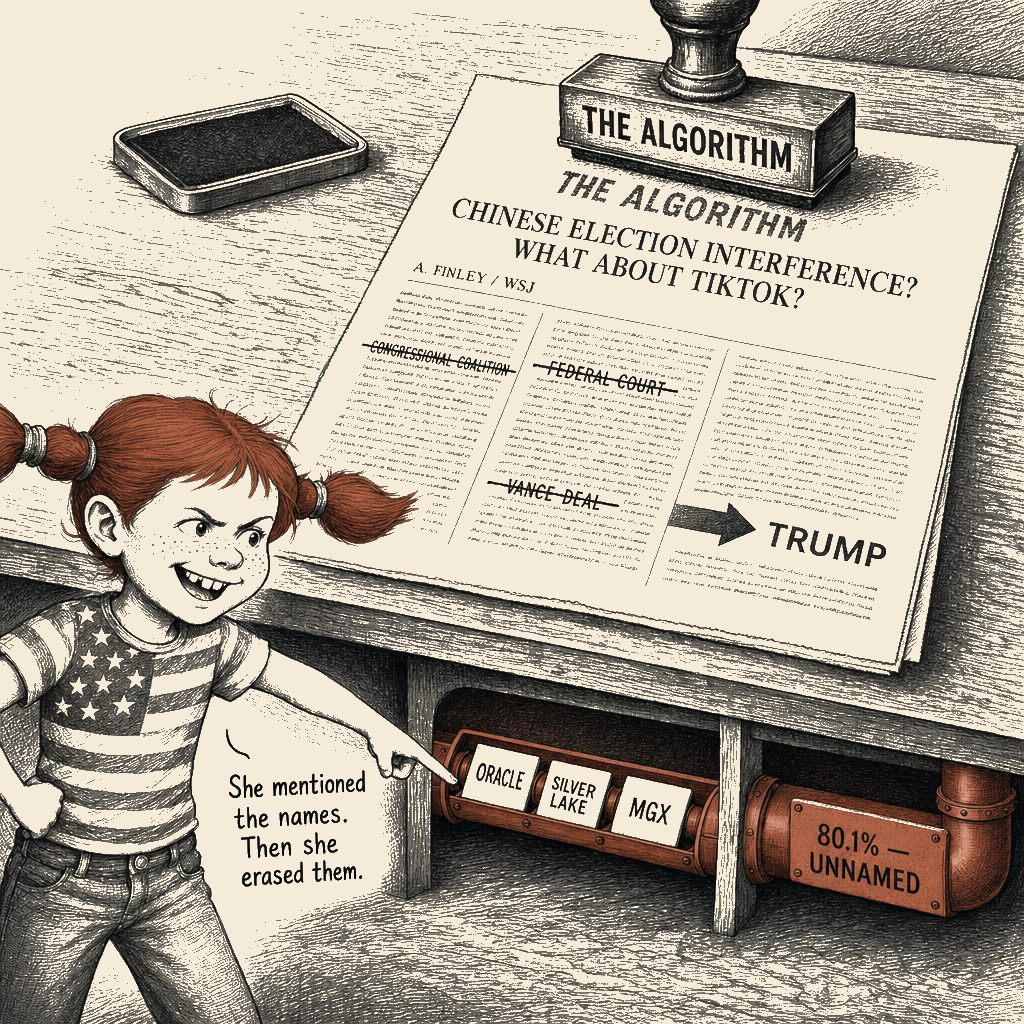
Responding to: Chinese Election Interference? What About TikTok? — Allysia Finley · 2026-07-19
What the Piece Argues
Finley argues that President Trump undermined his own claim to be standing against Chinese election interference by suspending enforcement of the bipartisan divest-or-ban law targeting TikTok in January 2025, and that this reprieve has handed the Chinese Communist Party an algorithmic platform now demonstrably shaping American politics — suppressing pro-U.S. content on foreign wars, amplifying anti-U.S. and pro-socialist messaging that has powered figures from Zohran Mamdani to Melat Kiros, and exposing U.S. user data to Beijing through a “lousy” sale deal that left ByteDance with a 19.9% stake and control of the algorithm. She builds the case through a documented 2020 FBI intelligence report on Chinese data exploitation, a study showing the algorithm’s systematic anti-U.S. skew on the war in Iran, and the contrast between Trump’s 2020 executive-order language warning of “disinformation campaigns” and “blackmail” and his 2025 reversal motivated by the platform’s perceived electoral utility for his own coalition.
Receipts
The piece wants you to believe a single figure’s executive decision handed Beijing a sophisticated influence weapon, and the same administration now crying interference is the one that armed the adversary.
-
The framing wants you to believe
- Trump’s TikTok reprieve is “the biggest blunder of his presidency,” and Beijing has predictably exploited it to amplify socialist and anti-U.S. content among American youth.
- A specific study proves algorithmic manipulation — odds of one-in-6.5-million that the anti-U.S. skew on the war in Iran occurred by chance — implying a smoking gun even as the author concedes “it’s impossible to know, which is the problem.”
- TikTok is “like fentanyl for young minds,” and 43% of under-30s getting news from it explains the rise of figures like Mamdani and Kiros.
-
What’s really going on
- The piece names the harm to young Americans but never names the institutional author who crafted the original divest-or-ban framing: Congress passed the Protecting Americans from Foreign Adversary Controlled Applications Act in April 2024 with broad bipartisan support (the “sweeping majorities” Finley concedes), including senators and representatives from both parties who went on the record about national-security risk. The named-perpetrator story is constructed to indict one man, not the donor-funded national-security apparatus that produced and profited from the original ban framing.
- The “lousy” deal Finley mocks — 19.9% ByteDance retention plus algorithm control — was brokered by Vice President Vance and approved by the same executive she indicts. The piece’s own admission that Trump “tried to ban TikTok by executive order in August 2020” and that “a federal court blocked” it reveals that the original ban pathway was already foreclosed; the 2024 law was the legislative workaround. Finley treats the only remaining enforcement mechanism as a blunder rather than as the outcome of a process Congress, the courts, and ByteDance’s lawyers all shaped.
- The omitted beneficiary: every actor who profits from TikTok’s continued operation under weakened terms — the American investors in the Vance-brokered deal (Oracle, Silver Lake, MGX), the influencers and creators whose livelihoods depend on the platform, the venture capital and ad-revenue ecosystem — is unnamed. The piece indicts Beijing’s “invisible hand” while the visible hands handling the deal money are invisible in her account.
The DEFCON Ladder
DEFCON 5 — Polite Reframe
When to use: A persuadable family member or colleague who voted for Trump and wants to understand why the TikTok reversal matters.
Ms. Finley is raising a legitimate point about a real national-security concern, and she’s right that the evidence of algorithmic skew is documented — a study putting the odds of the anti-Iran-war skew at one in 6.5 million is striking. But the column treats one decision as the cause of an outcome that has many moving parts. Congress passed the original divest-or-ban law with broad bipartisan support in April 2024; a federal court had already blocked an earlier executive-order attempt in 2020; the deal she calls “lousy” was brokered by a Vice President and approved through a formal memorandum. Her own column mentions all of this. The framing turns a multi-actor institutional process into a single man’s blunder, which makes the problem feel like it has a single lever to pull when the actual challenge is much harder.
The young Americans she worries about are getting their news from many places, not just one app, and the figures she names — Zohran Mamdani, Melat Kiros, the under-30 cohort generally — are responding to material conditions (housing costs, war weariness, Palestinian solidarity) that predate TikTok and would find their channels regardless. The algorithm amplifies what is already there; it does not invent the underlying discontents. That’s a real and serious problem, and it deserves a serious multi-branch response rather than the next round of finger-pointing.
DEFCON 4 — Firm Moral Superiority
When to use: A good-faith reader who shares the columnist’s concerns about China but notices the column has chosen its villain selectively.
If we’re going to name the blunder, Finley’s own column identifies several other actors whose decisions produced the outcome she laments. Congress wrote the divest-or-ban law; a federal court blocked the earlier executive order; the Vance-brokered deal retained 19.9% of ByteDance’s stake and left algorithm control with the Chinese parent. Each of these was a decision point at which a different choice was possible, and each involved more people than the President acting alone. Her column mentions all of them in passing. The structure of her argument asks us to treat only one of those decisions as the moral load-bearing one.
That selectivity has a beneficiary. The Congressional authors of the original law — including the senators and representatives who went on the record about TikTok as a national-security threat — get a free pass. The American investors in the new ownership consortium, whose returns depend on the deal’s specific terms, are not named. The legal and lobbying apparatus that shaped the negotiation is absent from the account. By concentrating the indictment on the executive decision while leaving the institutional architecture unexamined, the column does exactly what it accuses Beijing’s “invisible hand” of doing: it hides who actually benefits from the arrangement it describes.
The moral test Finley should apply to the algorithm applies with equal force to her own column. Cui bono: the readers who share her foreign-policy priors get a satisfying explanation; the readers who would benefit from an account that actually traced the donor networks and lobbying expenditures behind the original ban framing get the same single-villain story everyone else got.
DEFCON 3 — Mockery and Ridicule
When to use: A reader who follows both politics and tech and would enjoy watching the column’s internal contradictions get named.
So TikTok is “like fentanyl for young minds” — a substance so addictive that 43% of under-30s can’t get their news anywhere else, distributed by an algorithm so powerful that one-in-6.5-million odds establish a skew that the column’s own author concedes she cannot explain before pivoting to the “invisible hand” metaphor she knows she cannot prove. But the same column also tells us that Trump’s August 2020 executive order was blocked by a federal court, that Congress wrote the divest-or-ban law in 2024, that the Vance deal retained ByteDance’s 19.9% stake and algorithm control, and that ByteDance had already violated a 2022 data-pledge with the Justice Department alleging more violations in 2024. The fentanyl metaphor would be more convincing if the column had identified which dealer the federal government had successfully prosecuted, which dealer the courts had not blocked, and which dealer had just signed a memorandum of understanding that left 19.9% of the product on the shelf.
But Finley has a culprit in mind and the culprit is in the White House, so the rest of the supply chain gets the same treatment the column accuses TikTok’s algorithm of giving to inconvenient facts: suppression. The congressional authors of the ban framing get a single passing reference. The American investors in the Vance-brokered consortium — Oracle, Silver Lake, MGX — do not appear. The lobbying apparatus that produced the original divest-or-ban legislation — the donor-funded think tanks, the national-security consultancies that testified — is invisible. We are asked to believe that a single executive decision produced the entire arrangement, when the column’s own receipts show at least four other institutional decision points at which a different choice was available.
This is the algorithm in reverse: not content suppressed by a foreign power but accountability suppressed by a domestic columnist. The columnist has named the Chinese Communist Party’s “invisible hand” while her own invisible hand has lifted the donor networks, the bipartisan congressional coalition, and the investment consortium out of the frame. The column indicts poison while administering the antidote with the active ingredient removed.
DEFCON 2 — Aggressive Villainization
When to use: A reader who has followed the TikTok policy fight for years and wants the full cui bono trace, not the single-villain version.
The column wants you to believe a single executive decision armed Beijing with an algorithmic influence weapon and is now surprised Beijing is using it. The column’s own receipts show that the executive order was blocked by a federal court in 2020; that Congress wrote the divest-or-ban law with “sweeping majorities” in April 2024; that the law gave TikTok 270 days to separate; that the deal brokered by Vice President Vance left ByteDance with a 19.9% stake and control of the algorithms; that ByteDance had committed in June 2022 to house U.S. user data on U.S. servers; that the Justice Department alleged in 2024 that ByteDance had violated that commitment; and that the final deal preserved ByteDance’s algorithm control anyway. Each of these is a documented institutional decision point. Each involved more than one man. The column names them in passing and then asks you to blame only the executive for the outcome they collectively produced.
That selectivity serves an institutional author the column never names. The original divest-or-ban law was the product of a years-long campaign by a coalition that included Republican and Democratic national-security hawks, the Biden administration’s intelligence community, and a foreign-policy donor network with reported ties to Israeli-government-aligned lobbying. The bipartisan support Finley concedes as evidence of the law’s seriousness is also evidence that the lobbying worked. The American investors in the Vance-brokered deal — Oracle, Silver Lake, MGX, and their co-investors holding the 50% consortium stake — are not named in the column, but their financial interests are aligned with the deal Finley calls “lousy.” If the deal had collapsed, those investors would have lost their position. If the deal went through on the terms negotiated, those investors got their position at a discounted valuation because ByteDance retained a 19.9% stake and algorithm control.
The column indicts Beijing’s “invisible hand” while the visible hands handling the deal money — the consortium, the investors, the lawyers, the lobbying firms — are invisible in her account. The hypocrisy is structural, not personal. A columnist who genuinely wanted to trace cui bono would have traced the money. Instead she traced the algorithm.
DEFCON 1 — Nuclear Satire
When to use: A reader who has been reading the TikTok fight for years and is ready for the column’s own receipts to be used against its argument.
Allysia Finley of the Wall Street Journal Editorial Board has produced a column about the Chinese Communist Party’s “invisible hand” that traces the algorithm’s influence on American youth while making her own invisible hand lift the entire domestic institutional architecture out of the frame. The column mentions that a federal court blocked Trump’s 2020 executive order — and then treats the 2025 reversal as a fresh betrayal rather than as a continuation of a process the courts had already shaped. The column mentions that Congress passed the divest-or-ban law with “sweeping majorities” — and then treats the bipartisan coalition that produced the law as background scenery rather than as authors of the framing she is now using to indict the executive. The column mentions that the Vance deal retained ByteDance’s 19.9% stake and algorithm control — and then calls the deal “lousy” without naming the American investors (Oracle, Silver Lake, MGX) who got the other 80.1% on terms that left them with a controlling position in U.S. operations and a discounted entry valuation precisely because ByteDance retained its algorithmic core.
The metaphor Finley reaches for is fentanyl. But fentanyl is distributed through a documented supply chain — precursor manufacturers, transshipment points, domestic wholesalers, retail distributors, prescribing physicians — and each link in that chain can be prosecuted individually. The TikTok arrangement Finley describes has a supply chain too: congressional authors, lobbying networks, intelligence-community advocates, executive decision-makers, federal courts, brokered-deal negotiators, and the consortium of American investors who will hold the equity. Each link in that chain made decisions. Each link in that chain has a name. The column names Beijing and the algorithm and stops there.
This is what algorithmic amplification looks like when applied to a domestic political target: the inconvenient facts are not deleted, they are mentioned in passing and then de-weighted. Finley’s column has done to the donor networks and Congressional coalition behind the original ban framing exactly what she accuses TikTok’s algorithm of doing to pro-U.S. content on the war in Iran: it has been mentioned, it has been acknowledged, and it has been systematically de-weighted in the column’s overall argument so that the executive bears the moral load while the institutional architecture that produced the entire arrangement gets the same one-in-6.5-million treatment the algorithm allegedly gave to inconvenient war coverage.
The column is a single-villain narrative applied to a multi-actor institutional process, and the algorithm it indicts is the algorithm it operates.
DEFCON 1+ — Prophetic Indictment
When to use: A reader moved by moral authority with an edge, who wants the structural critique named without softening.
The prophet Jeremiah, diagnosing the officials of his own time, named the condition: “they have healed the wound of my people lightly, saying ‘Peace, peace,’ when there is no peace.” Finley’s column heals the wound of her readers lightly. It names the foreign threat — Beijing’s invisible hand, the algorithm, the fentanyl-for-young-minds — and it locates the moral failure in a single executive decision. It names the bipartisan coalition that produced the divest-or-ban law, the federal court that blocked the 2020 executive order, the Vance-brokered deal, the American consortium that took the other 80.1% of the equity, and the intelligence-community advocates who shaped the original framing — and then de-weights each of them in service of a single-villain narrative that lets the institutional architecture off the hook.
The prophet Amos, addressing a society that had trampled the poor to build its wealth: “they who trample the needy and bring ruin to the poor of the land.” Finley’s column has acquired its institutional facts and let them become background noise. The bipartisan coalition is mentioned and dismissed as evidence of seriousness rather than examined as evidence of lobbying success. The federal court is mentioned and used as a passing reference rather than as evidence that the judicial branch had already shaped the process Finley treats as a single executive decision. The American investor consortium is not mentioned at all, even though it is the named counterparty in the deal she calls “lousy.” Each fact is in the column. Each fact is suppressed in the column’s argument.
This is the algorithm of domestic political amplification: the inconvenient facts are not removed, they are mentioned in passing, and then the structure of the argument de-weights them so that a single executive bears the moral load while the institutional architecture that produced the entire arrangement gets the same treatment the column accuses Beijing of giving to pro-U.S. content. The column is a whitewash on a wall that is rotten; the whitewash is fresh, and the wall is rotten, and the prophet’s diagnosis applies.
DEFCON 1++ — Profane Scorched-Earth
When to use: A reader who needs full catharsis, gloves off, and who has earned the profane register by having read the receipts.
Allysia Finley of the Wall Street Journal Editorial Board has produced a motherfucking column about Beijing’s “invisible hand” that uses her own goddamn invisible hand to lift every domestic institutional actor out of the fucking frame. The column tells us a federal court blocked Trump’s 2020 executive order — and then treats the 2025 reversal as a fresh goddamn betrayal rather than as the continuation of a process the courts had already shaped. The column tells us Congress passed the divest-or-ban law with “sweeping majorities” — and then treats the bipartisan coalition that wrote the law as fucking background scenery rather than as authors of the framing she is now weaponizing to indict one fucking man. The column tells us the Vance deal retained ByteDance’s 19.9% stake and algorithm control — and then calls the deal “lousy” without fucking naming the American investors — Oracle, Silver Lake, MGX — who got the other 80.1% on terms that left them with a controlling position and a discounted entry valuation precisely because ByteDance kept its algorithmic core.
The bipartisan coalition is mentioned. The American investor consortium is not mentioned. The lobbying apparatus that produced the original ban framing is not mentioned. The intelligence-community advocates who shaped the framing are not mentioned. The fucking donors are not mentioned. The single-villain narrative is the entire fucking point. The column wants its readers to blame the executive and not the architecture because the architecture includes the Editorial Board’s own allies, and the Editorial Board’s own fucking donors, and the donor networks whose think tanks and lobbying firms produced the original divest-or-ban legislation in the first goddamn place.
The metaphor Finley reaches for is fentanyl, and she should fucking know: fentanyl is distributed through a documented supply chain, and each link in that chain can be prosecuted individually, and Finley’s column has named one link — Beijing — and has lifted every other link — the Congressional authors, the lobbying networks, the American investor consortium, the fucking courts — out of the frame. The single-villain narrative is the algorithm the column is operating. The invisible hand the column indicts is the invisible hand the column is running.
About Malcolm Little King
Malcolm Little King is a heteronym in Main Street Independent's editorial architecture — an analytical voice, not autobiography of any actual person. The position this column expresses is the publication's position on the territory Malcolm Little King's lane covers, rendered through Malcolm Little King's register.