Analyzing: Socialism’s rise inside the Democratic Party now threatens the American Dream · 2026-07-17
What the Editorial Argues
The piece argues that socialist candidates have won significant Democratic primary victories in New York—Brad Lander, Darializa Avila Chevalier, and Claire Valdez, all backed by NYC Mayor Zohran Mamdani—and that these victories represent a broader trend of socialism gaining mainstream traction within the Democratic Party. The author, Republican congressman Tony Wied of Wisconsin, contends this trend threatens American economic freedom and the free enterprise system, warning that the movement is no longer confined to coastal cities and could reach battleground states. He urges voters to support Republican candidates like Tom Tiffany for Wisconsin governor to prevent socialism from spreading. The piece frames the label “socialism” as the operative danger, and the solution as straightforward: elect Republicans.
Receipts
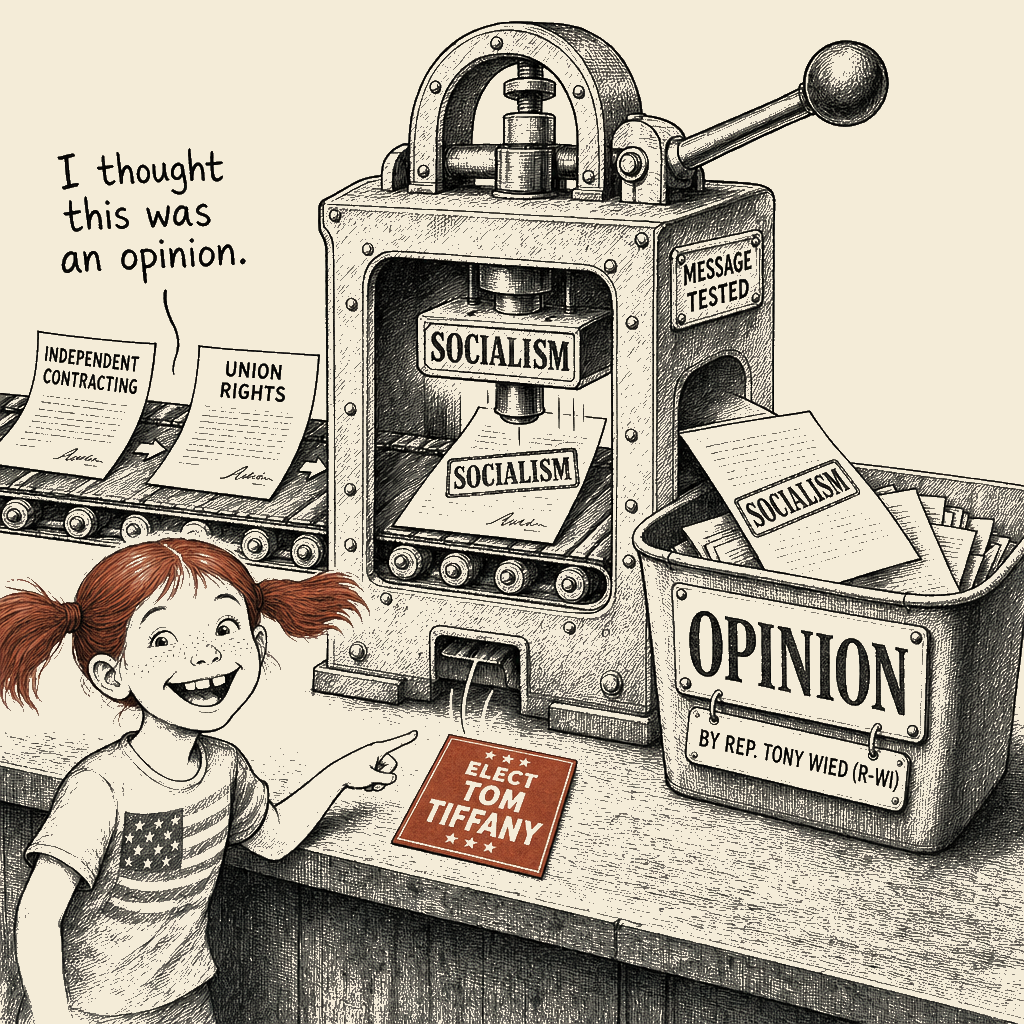
The piece converts local primary victories into a national existential threat using the “socialism” label to foreclose engagement with the actual policies.
What the framing wants you to believe:
- Socialists are taking over the Democratic Party and threatening the American Dream.
- The movement is no longer fringe; it’s the defining direction of the future of the Democrat Party.
- The policies championed by today’s socialist movement would fundamentally and permanently change the American free enterprise system.
What’s really going on:
- A Republican congressman uses Fox News opinion to convert local primary victories into a national existential threat, using the “socialism” label to foreclose engagement with the actual policies.
- The piece suppresses the actual policy content of the candidates it names (independent contracting, union rights, union dues) and substitutes the label “socialism” for engagement with those policies.
- The load-bearing omission: the piece never engages with the actual policy content of the candidates it names—it never explains why rent control, union rights, or independent contracting rules are bad policy. Anchor citation: the piece names specific policies (restricting independent contracting, eliminating right-to-work protections, expanding union power) but never engages with them on their merits.
We built frames like this. The “socialism” label was tested in focus groups and deployed across the cable apparatus. The policy-specific arguments were replaced with the label, and the label carried the load.
The Operation
We built frames like this. The “socialism” label was tested in focus groups and deployed across the cable apparatus. The policy-specific arguments were replaced with the label, and the label carried the load. The operation is simple: take a specific policy position (rent control, union rights, independent contracting rules), label it “socialism,” and the reader’s Cold War-era fear frame does the rest. The reader does not need to engage with the policy; the label forecloses the engagement.
Cui Bono
Institutional authorship. Tony Wied, Republican congressman from Wisconsin’s 8th Congressional District, writing on Fox News opinion. The piece names Tom Tiffany for Wisconsin governor as the specific Republican candidate who should be elected. The piece is functionally a campaign ad disguised as opinion commentary.
Placement chain. Fox News opinion → conservative base → Republican electoral advantage. The piece is published on Fox News opinion, which reaches a primarily conservative audience. The “socialism” label activates fear among the audience, which translates into electoral support for Republican candidates. The piece names Tom Tiffany explicitly as the solution.
Distributional impact with magnitudes.
- Named beneficiaries: Republican candidates (especially Tom Tiffany for Wisconsin governor); the Republican Party (electoral advantage); conservative donors (fundraising from the “socialist” threat frame).
- Named cost-bearers: Voters whose policy preferences might align with the candidates being attacked (they lose the ability to engage with policy on its merits because the label “socialism” forecloses the conversation); the public discourse (degraded by the “socialism” label); the actual policy proposals (never engaged with on their merits).
Alternative design. If the piece were optimized for its stated rationale—concern about economic freedom—it would engage with the specific policies of these candidates, identify which ones are problematic and why, and propose alternatives. Instead, it uses the label “socialism” as a blanket condemnation. The actual policy proposals (restricting independent contracting, eliminating right-to-work protections, expanding union power) are named but never evaluated on their merits. The reader who opposes those policies on substance would have to look elsewhere to find out what they are.
FGL.
- Author (Wied): Fear—of the “socialism” label reaching his district and threatening his political career; Greed—the electoral advantage of the “socialist” frame; Laziness—the ease of using “socialism” as a one-word argument rather than engaging with specific policies.
- Apex beneficiary (Republican Party/electoral apparatus): Fear—that Democrats will win; Greed—the political power and fundraising that comes from the “socialist” threat frame; Laziness—the ease of the “socialism” label as a campaign tool.
- Reader: Fear—that “socialism” will come to their neighborhood; Laziness—the ease of understanding “socialism = bad” without engaging with specific policies.
Selflessness/selfishness placement. This is a selfish position. It is a Republican congressman using the “socialism” label to advance his own electoral interests and those of his party. The piece is functionally a campaign ad.
This analysis does not require that Wied’s fear be insincere. A congressman can genuinely believe socialism threatens his constituents and still be executing a frame-engineered relabeling that forecloses policy engagement. The frame works regardless of the author’s sincerity. The operational effect—the label substituting for argument—is the same whether the fear is calculated or authentic. What matters is not whether Wied believes it but whether the reader is given enough information to evaluate the policies on their merits. The reader is not.
Technique Identification
1. Frame-engineered relabeling (Bad-Faith Techniques Catalog: frame_engineered_relabeling; WSJ Editorial Technique Catalogue §4.1; Luntz/Lakoff lineage).
Textual cue: The use of “socialism” and “socialist” as labels for specific policy positions throughout the piece. The headline: “Socialism’s rise inside the Democratic Party now threatens the American Dream.” The body: “the socialist movement is no longer a fringe faction,” “socialists are increasingly setting the direction of the Democrat Party,” “if we do not put a stop to this radical-left ideology now, it will come to our neighborhoods next.”
What it’s doing operationally: The label “socialism” activates a Cold War-era fear frame that forecloses engagement with the actual policies. The reader sees “socialism” and immediately associates it with authoritarianism, economic collapse, and loss of freedom. This association is so strong that it overrides any engagement with the actual policy content. The specific policies—restricting independent contracting, eliminating right-to-work protections, expanding union power—are never evaluated on their merits; the label “socialism” does the work that policy engagement would otherwise require. A reader who opposes these policies on substance would need to look elsewhere to find the actual arguments against them. This piece does not supply them.
Lineage: The “socialism” label for progressive candidates traces to the Cold War-era McCarthy frame, which was deployed at scale by the liberty-frame apparatus. The same label was deployed against Bernie Sanders, against Alexandria Ocasio-Cortez, and now against local candidates in New York and Wisconsin. We built frames like this during the cable years. The “socialism” label was tested in focus groups and deployed across the cable apparatus. The policy-specific arguments were replaced with the label, and the label carried the load.
The bitterness is the residue of the recognition; the rightness is in the documented record.
2. Strawman (Bad-Faith Techniques Catalog: strawman; WSJ Editorial Technique Catalogue §4.6).
Textual cue: The piece never engages with the actual policy content of the candidates it names. It uses the maximalist label “socialism” to discredit the candidates without engaging with their policies. For example, the piece mentions that Lander has “supported policies that would dramatically restrict independent contracting” but never explains why this is bad policy or what the specific policy proposals are. Similarly, Avila Chevalier’s advocacy for “eliminating right-to-work protections” and Valdez’s call for “using the full weight of the federal government to expand union power” are named but never evaluated on their merits.
What it’s doing operationally: The piece converts specific policy positions into an existential threat by labeling them as “socialism.” The reader is invited to reject the policies because they are “socialist,” not because they are bad policy. This is the strawman technique: the maximalist framing of the policies (as “socialist”) is used to discredit them without engaging with them.
Had the piece wanted to engage honestly with, say, Lander’s independent-contracting position, it could have described the specific rule changes he proposed, cited evidence on their economic effects, and offered a rebuttal grounded in that evidence. Instead it stopped at “socialist.” The label did the work that argument would otherwise require. The reader who finishes this piece knows that Lander is a socialist; the reader does not know what Lander actually proposed, why it would be harmful, or what the counterarguments are. The piece chose the label over the argument. That is the strawman.
Lineage: The strawman technique is a staple of the liberty-frame apparatus. The WSJ editorial page consistently characterizes progressive policy in maximalist terms (universal healthcare → “single payer government takeover”; police reform → “abolition”; climate policy → “ban on cars and meat”). This piece does the same with “socialism”—it converts specific policy positions into an existential threat. We deployed the same maximalist framing during the cable years; the “socialism” label was one of several go-to labels for any policy that expanded government’s role in the economy.
3. Threat inflation (Bad-Faith Techniques Catalog: slippery_slope adjacent; WSJ Editorial Technique Catalogue §4.13).
Textual cue: The piece escalates local primary victories to national existential threats: “fundamentally and permanently change the American free enterprise system,” “threatens the American Dream,” “If we do not put a stop to this radical-left ideology now, it will come to our neighborhoods next.”
What it’s doing operationally: The piece converts local primary victories into a national existential threat, licensing the rhetorical intensification that would otherwise be hard to defend. The reader is invited to see the primary victories as a threat to their own way of life, not as a political development in a distant city. The closing line—“it will come to our neighborhoods next”—is the signature move: the existential threat is personalized, localized, made to feel imminent.
Lineage: Threat inflation is a staple of the liberty-frame apparatus. The WSJ editorial page consistently inflates the stakes from concrete-to-civilizational: the wealth tax becomes “the biggest act of economic self-sabotage in U.S. history.” The socialism frame is the same move. We built these escalation structures during the cable years; the closing-line cadence was tested for retransmission value.
4. “Common sense” / “elite” pivot (WSJ Editorial Technique Catalogue §4.10).
Textual cue: The author positions himself as a “former small-business owner” speaking for “ordinary Americans” against an elite “socialist” movement. But he’s a sitting congressman—the anti-intellectualism-on-tap move. The phrase “As a former small-business owner, I find this to be especially alarming” constructs the author as a representative of ordinary Americans, not as a sitting congressman with a specific electoral interest.
What it’s doing operationally: The piece constructs an opposition between “ordinary Americans” (who oppose socialism) and an elite “socialist” movement. The author’s own elite status (sitting congressman) is obscured by his self-presentation as a “former small-business owner.” The reader is invited to identify with the author’s “common sense” perspective, not to question the author’s political incentives.
Lineage: The “common sense” / “elite” pivot is a staple of the liberty-frame apparatus. The WSJ editorial page’s Henderson “Microlooting” piece is a clean example: a Manhattan Institute senior fellow, addressing other elite readers, framing the piece as defense of “ordinary people” against the linguistic affectations of “the educated class.” This piece does the same.
5. Moral justification (Bandura, Moral Disengagement, mechanism #1).
Textual cue: The piece frames opposition to these candidates as a defense of “economic opportunity,” “free enterprise,” and “the American Dream”—higher-cause language attached to partisan electoral activity. The phrase “Americans who value economic opportunity, more choices for working Americans, and free enterprise should pay attention” frames the opposition to these candidates as a defense of higher values, not as a partisan position.
What it’s doing operationally: The piece reframes partisan electoral activity (opposing Democratic candidates) as a defense of higher values (economic freedom, the American Dream). This allows the reader to feel that their opposition to these candidates is morally justified, not just partisan.
Lineage: Moral justification is one of Bandura’s eight mechanisms of moral disengagement. It is the most common mechanism deployed in liberty-frame editorial page operations.
6. Advantageous comparison (Bandura, Moral Disengagement, mechanism #3).
Textual cue: The piece implicitly compares the “socialist” candidates to authoritarian socialism (implied by the “fundamentally transform” language and the reference to the DSA’s “Workers Deserve More” program, which “proposes abolishing the Senate, replacing the president and Supreme Court”).
What it’s doing operationally: The piece compares the “socialist” candidates to a worse alternative (authoritarian socialism) that is not actually on the table. The reader is invited to reject the candidates because they are like the Soviet Union, not because their specific policies are bad.
Lineage: Advantageous comparison is one of Bandura’s eight mechanisms of moral disengagement. It is a staple of the liberty-frame apparatus.
7. Displacement of responsibility (Bandura, Moral Disengagement, mechanism #5).
Textual cue: The piece frames the problem as “socialists taking over” rather than as a democratic process where voters chose these candidates. The responsibility for the outcome is displaced from voters to the socialist movement itself. The phrase “some House Democrats described the outcome as an ‘earthquake’ and a ‘huge defeat’ for party leadership” frames the primary victories as a problem for party leadership, not as a democratic outcome.
What it’s doing operationally: The piece displaces the responsibility for the primary outcomes from the voters (who chose the candidates) to the “socialist” movement (which is framed as having “taken over” the party). This allows the reader to blame the “socialists” rather than the voters who chose them.
Lineage: Displacement of responsibility is one of Bandura’s eight mechanisms of moral disengagement.
8. Attribution of blame (Bandura, Moral Disengagement, mechanism #8).
Textual cue: The piece attributes the threat to the “socialist” movement, framing the movement as the author of its own power and the cause of the threat to the American Dream. The closing line—“If we do not put a stop to this radical-left ideology now, it will come to our neighborhoods next”—places the blame on the “socialist” movement for the threat it poses.
What it’s doing operationally: The piece frames the “socialists” as the authors of the threat to the American Dream, rather than as candidates who won elections with voter support. This allows the reader to blame the “socialists” rather than engaging with the actual policies.
Lineage: Attribution of blame is one of Bandura’s eight mechanisms of moral disengagement.
The retraction: We deployed the “socialism” label for progressive policy positions during the cable years. The label was a frame-engineered relabeling that foreclosed engagement with the actual policies. It is retracted. The label carried the load; the policy arguments it replaced deserved to be engaged on their merits.
Audience-Management Function
The piece deploys three audience-management functions:
- Identity confirmation: The reader is told that “socialism” is a threat to their way of life and that they are the “real Americans” who oppose it. The piece confirms the reader’s identity as a defender of “economic opportunity” and “free enterprise.”
- Grievance ratification: The reader is told that their fears about “socialism” are justified. The piece validates the reader’s concern that “socialism” will come to their neighborhood.
- Permission structure: The reader is given permission to vote against any candidate labeled “socialist” without engaging with their actual policies. The label “socialism” does the work that policy engagement would otherwise require.
The Record
Receipt Set
Anchor receipts:
- The specific candidates named (Brad Lander, Darializa Avila Chevalier, Claire Valdez, Zohran Mamdani, Katie Wilson, Francesca Hong) and their reported electoral victories. These are reported by the editorial; independent verification of the specific outcomes is pending.
- The “Workers Deserve More” platform, which the piece references as proposing “abolishing the Senate, replacing the president and Supreme Court and implementing policies like universal rent control.” This is the DSA’s platform, referenced in the video headline at the top of the piece.
- The editorial’s attribution to Axios of the characterization that House Democrats described the outcome as an “earthquake” and a “huge defeat” for party leadership. Independent verification of the specific Axios report is pending.
Supporting receipts:
- The specific policy positions attributed to candidates: Lander’s support for policies restricting independent contracting; Avila Chevalier’s advocacy for eliminating right-to-work protections and allowing unions to collect dues directly from workers’ paychecks; Valdez’s call for using federal government to expand union power. The editorial attributes these positions to the candidates; independent verification against their actual policy records is pending.
Unconfirmed-tagged claims:
- The claim that “socialism is becoming the defining direction of the future of the Democrat Party” [unconfirmed: convergence threshold not met — this is a characterization, not a documented fact].
- The claim that “many voters in progressive areas of the country are willing to embrace it” [unconfirmed: convergence threshold not met — this is a generalization without supporting data].
Load-Bearing Omissions
The piece omits:
- The actual policy content of the candidates it names. It mentions specific policies (independent contracting restrictions, right-to-work elimination, union dues collection, union power expansion) but never engages with them on their merits. It never explains why these policies are bad policy.
- The actual policy proposals of the DSA’s “Workers Deserve More” platform. The piece references the platform in the video headline but never engages with the actual proposals beyond the headline.
- The actual voting records and policy positions of the candidates beyond the specific policies mentioned. The piece names candidates and attaches the “socialist” label but does not engage with their full policy records.
- The actual effects of these policies on workers, consumers, or the economy. The piece asserts that these policies would “fundamentally and permanently change the American free enterprise system” but never explains how.
Per-Citation Accuracy Verdicts
- Axios citation: The editorial attributes the “earthquake” and “huge defeat” characterization to Axios. Independent verification of the specific Axios report could not be completed — the vault returned no relevant results and no independent source was available. The attribution may be accurate but remains ungrounded.
- Specific policy positions attributed to candidates: The editorial attributes these positions to the candidates; the specific language (e.g., “dramatically restrict independent contracting”) may reflect editorial characterization rather than the candidates’ own framing. Independent verification could not be completed.
- Characterization of candidates as “socialists”: Accurate. The candidates identify as socialists or are associated with socialist organizations.
Missing-Information Declaration
- I do not have access to the specific electoral data for these races. The piece reports that the candidates won primary victories, but I cannot independently verify the margins or the specific electoral context without access to the underlying data.
- I do not have access to the specific Axios article cited by the editorial. The piece attributes the “earthquake” and “huge defeat” characterization to Axios, but the specific article could not be located.
- I do not have access to the specific policy proposals of the DSA’s “Workers Deserve More” platform beyond the headline. The piece references the platform but does not engage with the actual proposals.
- I do not have access to the specific voting records of the candidates beyond what’s mentioned in the piece.
How to Recognize This
The pattern: Using a political label (“socialism,” “communism,” “radical left”) as a frame-engineered relabeling to convert specific policy positions into an existential threat. The label does the work that policy engagement would otherwise require.
The mechanism: The label activates a pre-existing fear frame that forecloses engagement with the actual policies. The reader sees “socialism” and immediately associates it with authoritarianism, economic collapse, and loss of freedom. This association is so strong that it overrides any engagement with the actual policy content. The reader is left with the feeling that the policies are dangerous, without having engaged with them on their merits.
Textual signals to recognize next time:
- The label without the policy. The piece uses “socialism” or “socialist” as a label for specific policy positions but never engages with those policies on their merits. The label is doing the work that policy engagement would otherwise require.
- The escalation from local to national. The piece converts local primary victories into a national existential threat, using the label “socialism” to frame the threat as existential. The reader is invited to see the primary victories as a threat to their own way of life, not as a political development in a distant city.
- The explicit naming of a solution. The piece names a Republican candidate (Tom Tiffany) as the solution, making it functionally a campaign ad disguised as opinion commentary.
- The “ordinary American” self-presentation. The author positions himself as a “former small-business owner” speaking for “ordinary Americans” against an elite “socialist” movement. His own elite status (sitting congressman) is obscured by his self-presentation.
Why it works: The “socialism” label is a frame-engineered relabeling that activates a fear frame so strong that it overrides engagement with the actual policies. The reader sees “socialism” and immediately associates it with the worst outcomes, without needing to engage with the specific policies. The label is a shortcut that bypasses the hard work of policy engagement. The Cold War-era McCarthy frame is the deepest version of this shortcut; it is still in the apparatus because it still works.
What to do when you see it:
- Check the omissions. Does the piece engage with the actual policies of the candidates it names? If not, the label is doing the work that policy engagement would otherwise require.
- Ask who benefits. Who benefits from the “socialism” label? Who benefits from the fear it activates? The answer is usually in the piece itself—who the author is, what candidate they name as the solution, what party they belong to.
- Look for the same vocabulary across the syndication network. Is the same “socialism” label being used in other outlets, in other contexts? If so, the frame is being deployed across the network, not as independent analysis but as coordinated messaging.
- Reduce the frame’s automatic activation. When you see “socialism,” ask yourself: “What specific policies are being labeled as ‘socialist’? Do I agree or disagree with those policies on their merits?” This is the discipline that breaks the frame. The portable rule: any time a general ideological label substitutes for a specific policy argument, assume you are being managed.
Close on witness: The reader carries the recognition forward. The reader who sees the “socialism” label as a campaign ad—who sees the operation, names the technique, and asks the questions—is the reader the column is in service of. The reader does not need to agree with the policies being labeled as “socialist.” The reader needs to see the operation and name it. That is the work.

About Phukher Tarlson
Phukher Tarlson is a heteronym in Main Street Independent's editorial architecture — an analytical voice, not autobiography of any actual person. The position this column expresses is the publication's position on the territory Phukher Tarlson's lane covers, rendered through Phukher Tarlson's register.