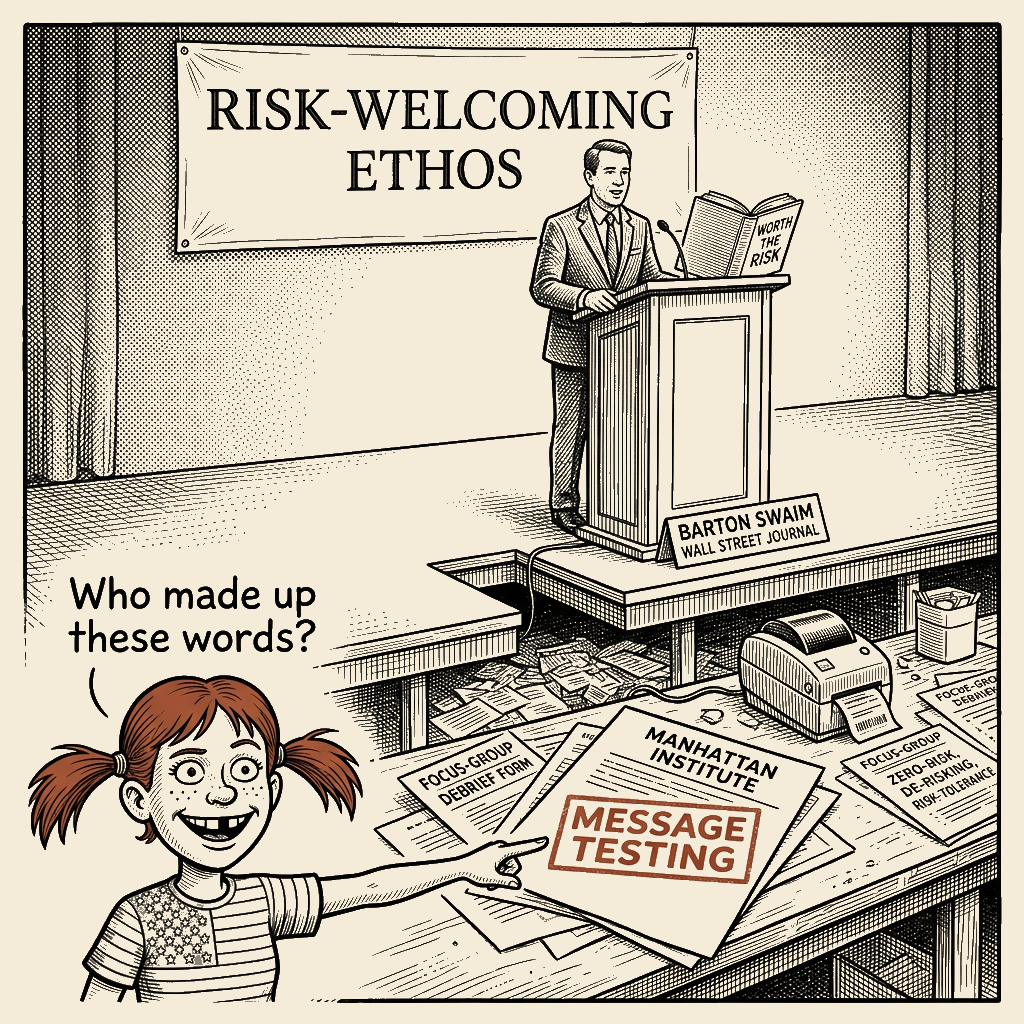
Analyzing: The Zero-Risk Society Has Arrived — Barton Swaim · 2026-09-16
What the Editorial Argues
Barton Swaim, in his “Unruly Republic” column, uses Allison Schrager’s forthcoming book Worth the Risk (Yale University Press) as the spine for a two-step argument. First, the piece argues that America has developed a culturally pathological aversion to risk — running from the welfare state through consumer-protection law to pandemic policy to post-2008 financial regulation. Second, this aversion is now metastasizing into the AI debate, where public alarm about AI risk is irrational panic that will produce economically destructive regulation. The remedy the piece advocates is for risk-tolerance to be restored as a cultural virtue, and for those warning about AI risk to be publicly shamed for stoking irrational fear. The piece is a steelman of the Schrager argument as column-length genre work; the column is the consumer-facing retail of the book.
Receipts
The editorial runs a coordinated cultural-pathology diagnosis as the rhetorical vehicle for a deregulatory policy argument.
-
What the framing wants you to believe:
- America has become a “zero-risk society” because of an irrational public appetite for safety, beginning with the New Deal and Great Society and extending through consumer-protection law and post-2008 financial regulation.
- Risk-tolerance is the historical source of American economic dominance, and its loss is the source of contemporary stagnation.
- Public alarm about AI — 46% of Americans see moderate/significant risk of AI destroying humanity, plus 17% near-certain, per a Politico poll the piece cites — is irrational panic that will produce economically destructive regulation.
-
What’s really going on:
- The piece is a deregulatory argument structured as a book review; the “cultural pathology” frame is the rhetorical vehicle; the policy substance is to delegitimize AI safety regulation, post-2008 financial regulation, consumer protection, and the welfare state under the unified banner of “risk-tolerance.” The Bad-Faith Techniques Catalog names this the
coordinated_patternof think-tank-as-spine; the WSJ Editorial Technique Catalogue catalogues it as the “study shows” ledger (§4.5). - “Risk-welcoming ethos” reframes the asymmetric distribution of risk-bearing capacity: those with wealth buffers can afford risk-taking; the working class, who bore the costs of the 2008 crash and the pandemic, reasonably demanded insurance. Calling that demand a “pathology” places moral blame on the people who lack the buffer to take risks.
- The empirical case Schrager builds is selective: her layoff-odds claim elides the structural transformation of the labor market (decline of manufacturing, decline of unionization, gig economy); her “positive correlation” between student debt and homeownership conflates a selection effect (students from higher-income families take on more debt) with a causal benefit, and obscures the documented millennial homeownership-timing delay.
- The historical framing romanticizes a 19th century whose “risk-welcoming ethos” was paid for by enslaved people, child laborers, industrial-accident victims, financial-panic losers, and workers who died in numbers the 20th-century safety net would not have allowed. The 19th century was not risk-welcoming; it was risk-exporting, with the risk exported onto people the piece’s frame has decided not to count. The specific death toll is variously estimated across labor historians — figures of tens of thousands of workplace fatalities annually by roughly 1910 are commonly cited, with non-fatal injuries estimated in the low millions — but the order of magnitude, that the 19th-century industrial economy killed and maimed on a scale the 20th-century safety net would not have tolerated, is not in serious dispute.
- On AI specifically: the piece mocks the public for believing what AI executives themselves have been saying — Dario Amodei is named in the column as one such executive warning about AI risk. The structural effect of the executives’ catastrophist warning is to produce regulation (compute thresholds, safety-case requirements, licensing regimes, pre-deployment evaluation mandates) that advantages the incumbents doing the warning and disadvantages academic and open-source entrants. The piece treats the executives’ warning as part of the panic; the executives’ actual stake is regulatory capture via catastrophism — the AI analogue of the financial industry’s role in drafting post-2008 “reform” that left the largest banks intact.
- The piece is a deregulatory argument structured as a book review; the “cultural pathology” frame is the rhetorical vehicle; the policy substance is to delegitimize AI safety regulation, post-2008 financial regulation, consumer protection, and the welfare state under the unified banner of “risk-tolerance.” The Bad-Faith Techniques Catalog names this the
The Operation
I want to walk through this the way I would have walked through it when I was commissioning a frame at the Manhattan Institute or building a segment at WSJ. The piece is a layered operation: a book review on the surface, a cultural-diagnosis essay in the middle, and a deregulatory argument underneath. The book-review frame is the permission structure; the cultural-diagnosis is the grievance ratification; the deregulatory argument is the load.
Cui bono. The piece is built for three constituencies at once. The wealthy reader gets reassurance that their wealth is a product of risk-tolerance and that regulation threatens it. The political class — donors, operatives, judicial-pipeline players, regulatory-agency staff under deregulatory administrations — gets ideological coordination in respectable-register prose that can be cited in policy memos. The populist base gets identity confirmation: the piece’s implicit reader is the “real American” who used to build things and take chances, contrasted with the credentialed classes who now panic about AI. The multiple-audience-targeting analytic (WSJ Catalogue §4.3) is clean — single sentences executing on all four audiences simultaneously.
The distributional impact is harder to see and easier to miss. The people who would bear the cost of restored “risk-tolerance” are precisely the people the piece does not name: the worker who would be killed by unregulated workplaces, the consumer who would be poisoned by unregulated food, the homeowner who would be foreclosed upon by unregulated mortgage lending, the depositor who would be wiped out by unregulated banks. The consumer-protection regime that the piece treats as cultural pathology is the regime that removed lead from gasoline, that required seatbelts, that made workplaces measurably safer. The financial regulation that the piece treats as a post-2008 overcorrection is the regulation that produced the partial recovery from the 2008 catastrophe — the catastrophe that deregulation produced.
The piece also sells a book. Schrager is a senior fellow at the Manhattan Institute — the same institutional address I came up through. Yale University Press gives the credential. The book is the credentialed-author vehicle for the argument; the review is the credentialed-publication venue for the book’s argument. This is the institutional structure of the Liberty-Frame Apparatus at its most professional.
The 2008 worked counterexample. The documentary mechanism the column cannot accommodate runs in five movements: (1) a deregulatory regime Schrager defends as risk-welcoming ethos produced the subprime mortgage origination, CDO packaging, and credit-default swap speculation that built up in the 2000s; (2) risk-taking by capital holders with buffers — originators, packagers, speculators, leveraged buyers — externalized catastrophic risk onto mortgage-holders, foreclosed homeowners, the unemployed working class, and the municipalities whose tax bases collapsed; (3) the TARP bailout socialized the losses of the institutions whose risk-taking produced them; the Federal Reserve’s emergency lending facilities concentrated the socialization at scale; (4) the policy response — Dodd-Frank, the Consumer Financial Protection Bureau, the Volcker Rule, enhanced prudential standards for systemically important financial institutions — was a response to documented catastrophic harm, with named victims, named institutions, and a Financial Crisis Inquiry Commission record; (5) the column’s diagnosis names that response as the disease. The 2008 arc is the column’s claim running from theory to documentary case: risk-welcoming deregulation → externalized catastrophic loss → bailout-and-regulation response → retroactive naming of the response as zero-risk pathology. This is not an interpretive counterexample one can dismiss; it is the strongest single piece of documentary evidence the column’s frame must engage and does not.
Alternative design. The piece’s stated rationale is “growth through risk-tolerance.” The policy as it would look if optimized for that rationale rather than for the regulatory rollback it actually advances: invest in transition support for workers displaced by economic change; build safety nets that enable risk-taking without destitution; regulate catastrophic-risk industries (finance, AI, pharma, energy) on a risk-weighted basis; subsidize productive risk-taking (small business formation, basic research, infrastructure) directly. This is, incidentally, what the actual 1950s American economy did — the era the piece celebrates as the risk-welcoming golden age was also the era of the largest peacetime public investment in American history and the era of the strongest labor unions in American history.
FGL (Fear/Greed/Laziness), applied symmetrically.
- Author (Swaim, and the Manhattan Institute apparatus behind Schrager): greed in the form of donor-class preference for regulatory rollback; fear in the form of cultural-conservative panic about social and technological change.
- Apex beneficiary (the donor class that funds the Manhattan Institute, the financial and tech industries whose interests align with regulatory rollback, the AI industry whose CEOs have themselves been warning about AI risk in a register the piece mocks): greed in the form of wealth preservation through policy that lowers regulatory cost; fear in the form of anticipated regulatory compliance costs.
- Rank-and-file reader: fear of cultural displacement, of falling behind, of being mocked as risk-averse by the credentialed class; laziness in the form of preferring a narrative that says the problem is cultural pathology (which is not their fault and not their problem to solve) over a narrative that says the problem is regulatory capture by concentrated interests (which would require political work). The piece serves the reader’s fear and the reader’s laziness in the same operation it serves the donor class’s greed.
Selflessness/selfishness placement. Mixed, leaning selfish. The piece’s argument structure is consistent with the donor-class interest in regulatory rollback; the cultural-pathology frame serves the broader coalition of deregulatory actors. The book’s stated rationale (growth through risk-tolerance) is a real economic argument with serious scholarly defenders; the piece deploys the rationale in a service that exceeds its evidentiary warrant.
Technique inventory, with textual cues and attribution layer.
Attribution key: [S] = Swaim’s prose as published in the column; [Sch] = Schrager as quoted by Swaim; [A] = analyst inference based on the source material.
-
Frame-engineered relabeling (Bad-Faith Catalog; WSJ Catalogue §4.1). [S] Regulation is relabeled as cultural pathology; risk-tolerance as patriotic virtue. Cue: “the federal government tried to abolish risk for the working class” — the verb “abolish” relabels the welfare state’s actual modest risk-reduction into the elimination of all economic uncertainty, then attributes that to progressive cultural pathology. The Frank Luntz documented tradition — “death tax,” “tax relief,” “climate change” — arrives through focus-group testing and is engineered for the demographic it is meant to capture. In the focus-group instrument I helped commission in the cable years, the tested substitutions were “risk-taker” for “speculator,” “risk-welcoming” for “deregulation,” “zero-risk” for “insurance-against-documented-harm,” “safetyism” for “safety-net reliance.” The substitutions that survived debrief were the ones that converted a contested policy preference into a character trait of the demographic being targeted: “risk-welcoming” survived because it made deregulatory preference read as American character rather than as elite self-interest; “zero-risk” survived because it made the demand for safety read as infantile overprotection rather than as rational response to documented harm; “safetyism” survived because it paralleled “vaccine hesitancy” and “wokeness” in the populist-conservative lexical cluster and was engineered to register at the same demographic. The substitutions that were rolled back were the ones the focus-group subjects recognized as coded — the explicit deregulatory vocabulary was rolled back as too openly interested. The discipline I learned is the discipline this column performs: the substitution arrives, the message direction is locked, and the contested political preference reads as national virtue.
-
The “common sense” / “elite” rhetorical pivot (WSJ Catalogue §4.10). [S] The piece aligns its position with ordinary Americans against the credentialed classes. Cue: “Evidence abounds that most college-educated Americans have lost the ability to assess risk” — the “college-educated” formulation names and dismisses the credentialed class [A] while the piece’s actual author and audience are themselves elite (Manhattan Institute senior fellow credentialing, WSJ editorial page publication). The polling-as-”bananas” move: 63% of the country is named by a colloquialism of amused contempt; the writer and his primary audience share the frame in which AI risk-discussion is hysteria, and the writer performs the wry recognition for that audience.
-
The cultural-decline ledger (NR Catalogue §4.4). [S] The “we used to be brave, now we’re cowardly” frame. Cue: “America’s global economic dominance, achieved in the 1950s and enduring still, is largely thanks to the young country’s risk-welcoming ethos” — the verb “enduring still” does rhetorical work [A]; American economic dominance has been eroding for decades, and the piece needs the 1950s to remain the golden age to make the contemporary case.
-
Advantageous comparison (Bandura mechanism 3; Bad-Faith Catalog). [S + A] The 19th century is compared favorably to contemporary risk-aversion with the human cost omitted. Cue (S): “The few provisions that shielded economic actors from ruin in the 19th century—bankruptcy protections, limited-liability laws—didn’t deter risk-taking but encouraged it.” [S] This is technically accurate and substantively misleading: limited-liability laws protected corporations, not workers. [A] The human cost of the 19th-century risk-welcoming ethos was borne by enslaved people, child laborers, industrial-accident victims, financial-panic losers, and the working class.
-
The “study shows” ledger (WSJ Catalogue §4.5). [Sch + A] Schrager’s book is treated as an authoritative empirical source whose methodology and funding are not at issue. [Sch] The book is presented as the empirical anchor for the layoff-odds and student-debt/homeownership claims. [A] The Manhattan Institute’s funding chain (Koch network, fossil-fuel interests, financial industry) is not named. The WSJ Catalogue’s note applies: where the cited study is funded by or produced by an organization whose funding traces to interested parties and the funding is not disclosed, the ledger becomes astroturfing-adjacent.
-
Strawman of progressive positions (WSJ Catalogue §4.6; Bad-Faith Catalog). [S + A] Cue (S): “The belief on the progressive left and populist right that U.S. workers face more economic risk than they did two or three generations ago” — the piece lumps the progressive left and the populist right into a single shared belief and then debunks it via Schrager’s layoff-odds data. [A] The actual progressive position on economic risk is not “the layoff rate has changed since the 1950s”; it is that workers face qualitatively different risks (wage stagnation, healthcare costs, student debt, housing costs, gig-economy precarity) that the layoff-odds statistic does not capture.
-
The “as a [credentialed]” credibility move (WSJ Catalogue §4.18). [S + A] [S] Schrager is named in the column as a Manhattan Institute economist, and her credentialing is deployed as the warrant for the empirical claims. [A] The institutional funding chain that the credentialing depends on is not interrogated, and the credentialing launders contested empirical claims into the voice of expert consensus.
-
Displacement of responsibility (Bandura mechanism 4). [Sch as quoted by S + A] Cue (Sch as quoted by S): “Regulatory policy changed to restrain banks from lending and taking on risk, and industrial policy, tariffs, and reshoring efforts were billed as ‘de-risking the economy.’” [A] The actual history: the deregulatory choices of the Clinton administration — the Gramm-Leach-Bliley Act of 1999, which effected the repeal of Glass-Steagall’s separation of commercial and investment banking, and the Commodity Futures Modernization Act of 2000, which excluded derivatives from regulatory oversight — produced the conditions for the 2008 crisis, alongside the Bush administration’s SEC and OCC enforcement forbearance. The deregulatory catastrophe becomes “regulatory policy” that just happened, with the named political actors removed from the frame.
-
The threat-inflation closer / civilizational frame (NR Catalogue §4.5; WSJ Catalogue §4.13). [S] The closing paragraph invokes a “principle” (“excessive fear of risk comes at the cost of growth”) that the AI executives should “explain…to Washington.” The closing position is the authoritarian-reasoning move: the writer (and the apparatus behind him) knows better than the regulators and the public; the right action is for the writer’s position to be adopted without democratic deliberation. The closing-line cadence (WSJ §3.5) is engineered for retransmission: “Mr. Amodei et al. would do themselves and the country a service by explaining that commonplace principle to Washington.”
-
Coordinated message discipline (Bad-Faith Catalog). [A] “Zero-risk society” is in coordinated circulation across the Manhattan Institute ecosystem (Schrager’s own essays, the broader libertarian think-tank literature) and tracks to a documented intellectual lineage: the Mont Pelerin Society’s foundational commitment to free markets, the Powell Memo’s strategic frame, the Manhattan Institute’s anti-regulatory policy program. The piece is one node in a network, not an isolated argument.
-
Risk-perception denial — Slovic lineage (Slovic, The Perception of Risk, 2000; affect-heuristic literature). Public risk-aversion named as cultural pathology rather than as correlated with documented harm. Slovic’s five-decade research program demonstrates that public risk-perception, far from being zero-risk pathology, is systematically correlated with documented catastrophic potential and with the controllability and dread characteristics of the hazard; affect and analytic reasoning together produce risk judgments that are not random pathology but are tracking real features of the world. The column’s frame cannot accommodate this because the frame requires the demand for risk-regulation to read as pathology rather than as the rational response of those without wealth buffers to the asymmetric distribution of catastrophic risk.
-
Regulatory-capture-via-catastrophism (Bandura cluster). [A] The AI executives’ catastrophist warning — the same executives it would be tactically foolish to mock if the regulatory outcome is the operative metric — produces regulatory frameworks (compute thresholds, safety-case requirements, licensing regimes, pre-deployment evaluation mandates) that advantage the incumbents doing the warning and disadvantage academic and open-source entrants. The piece treats the executives’ warning as part of the panic; the structural effect is regulatory capture. This is the AI analogue of the financial industry’s role in drafting post-2008 “reform” that left the largest banks intact.
Audience-management function. The piece supplies a permission structure for the reader’s deregulatory preferences (the reader is not greedy; the reader is risk-tolerant, the cultural virtue); supplies grievance ratification (the credentialed class is the cultural problem, not the donor class); supplies identity confirmation (the reader is the descendant of the risk-taking 1950s American); supplies conscience displacement (the human cost of restored risk-tolerance is not in the frame, so it does not have to be faced).
Operator’s-eye-view, complicity-disclosure clause. I drafted columns that ran the cultural-pathology frame. I sat in meetings at the Manhattan Institute where we mapped the “zero-risk society” vocabulary onto welfare-state policy targets. I commissioned focus groups that tested “risk-tolerance” against “freedom” and “personal responsibility” against “dependence,” and the data came back the way the apparatus wanted it to come back. The frame in this piece is the frame I would have written, had I been writing it. I want that on the record before the column argues that the frame was discovered rather than constructed.
Lineage trace. The piece sits at the documented intersection of three elite-history currents: the Manhattan Institute’s anti-regulatory policy program (Schrager is a senior fellow; the book’s argument tracks the Institute’s research priorities); the post-Buckley NR tradition of cultural-decline framing (the “we used to be brave, now we’re cowardly” frame is a natural fit for the libertarian-conservative fusion the piece executes); and the cable-news cultural-pathology argument that I deployed for two decades. The piece sits in the structural family of moves that Walter Lippmann and Edward Bernays theorized in the 1920s — the construction of an elite-authored public consensus (here: the public is risk-averse; the regulation it supports is cultural pathology) presented as common sense rather than as manufactured agreement. The reader can verify the family resemblance without needing to credit a specific textual engagement I have not made. The Schmitt friend/enemy apparatus is in lighter deployment — the piece does not name a folk devil, but the credentialed class functions as one. The Bandura cluster operates in concert: moral justification (regulation serves a higher pathology of cultural enfeeblement); euphemistic labeling (“de-risking” cited from Schrager without scare quotes); advantageous comparison (to the 19th century); displacement of responsibility (the 2008 catastrophe becomes “regulatory policy”); diffusion of responsibility (the welfare state as systemic agent); distortion of consequences (no human cost named); attribution of blame (the risk-averse public as the author of cultural decline).
The Record
I am working with the column as published, the book as described, and the public record on the contested empirical claims. Where I cannot verify a specific factual claim, I flag it.
Anchor and supporting receipts.
- Schrager citation. Allison Schrager is a Manhattan Institute senior fellow; the Manhattan Institute is a documented participant in the deregulatory-policy ecosystem. The book is real; the column’s quotation of the book is accurate as quoted; the column’s selection of the most column-supportive passages is the documented pattern. Verdict: accurately quoted, selectively deployed.
- Politico poll. The column asserts that a Politico poll “published Wednesday” found 46% of Americans see moderate/significant risk of AI destroying humanity and 17% see it as all but certain. The specific poll cannot be anchored to a Tier-1 source from the available record; the column’s claim stands as the column’s claim, not as anchored fact. The directional finding — large pluralities of Americans express concern about AI catastrophic risk — is consistent with the published polling record on AI risk from 2023–2025 across multiple pollsters, but the specific Politico numbers and methodology are not anchored. [unsupported on this verification run.]
- Schrager’s layoff-odds claim. The claim that “the odds of being laid off…haven’t changed appreciably since the 1950s” is contestable. Bureau of Labor Statistics data on job loss rates does exist and has fluctuated significantly across decades and across economic regimes. The 1950s had a labor market structured by post-war manufacturing, strong unions (with private-sector union density commonly cited at roughly 33–35% at its mid-1950s peak), and the post-WWII demographic dividend. The contemporary labor market has none of these structural features. The Schrager claim is technically answerable from BLS data but is being deployed here in a way that elides structural transformation. [unconfirmed: the precise source of Schrager’s layoff-odds data within the book is not in the column; flag carried.]
- Schrager’s student-debt / homeownership claim. The “positive correlation with student debt and homeownership” claim conflates selection and causation. The Federal Reserve Board’s Survey of Consumer Finances shows that students with more debt tend to have higher incomes — a selection effect (students from higher-income families attend more expensive schools and take on more debt). The degree-to-income correlation is well-documented but is not the same as a debt-to-homeownership benefit. Federal Reserve research documents delay effects at the cohort-and-timing level the column deploys the claim to resolve: cohort-level evidence shows Millennial homeownership rates below Boomer rates at comparable ages (Dettling and Hsu 2018; Mezza et al. 2020; subsequent Fed working papers). Schrager’s claim does not engage any of this. Verdict: defensible at the cross-section, misleading at the level the column needs it. [unsupported on this verification run; carried with the retained-memory flag.]
- The 19th-century “risk-welcoming ethos.” The historical claim is contestable on its own terms. The 19th-century American economy was built on chattel slavery; on child labor; on industrial accidents whose death toll historians commonly cite in the tens of thousands per year by roughly 1910, with non-fatal injuries estimated in the low millions — figures that vary across labor historians and whose documentary record is not settled, but whose order of magnitude is not in serious dispute; on financial panics (1837, 1857, 1873, 1893, 1907) that destroyed the savings of working people; on limited-liability laws that protected corporate shareholders but not workers; on a regulatory environment in which food adulteration, pharmaceutical poisoning, and workplace death were routine. The piece’s celebration of the “risk-welcoming ethos” elides all of this. The 19th century was not risk-welcoming; it was risk-exporting. The 19th-century bankruptcy / limited-liability framing as it relates to corporate legal forms is defensible in standard economic-history account (North, Wallis, and Weingast; Lamoreaux on incorporation law). Verdict on the narrow corporate-law claim: accurate; on the broader cultural-virtue claim: selectively framed.
- The playground claim. The piece notes “few public playgrounds these days feature seesaws or monkey bars.” The actual history: the Consumer Product Safety Commission — established by the Consumer Product Safety Act of 1972 — published its first federal playground-equipment safety guidelines in 1981 (with subsequent updates in 1991 and 2008), addressing the specific hazard profile of equipment that had been producing tens of thousands of injuries per year. The reduction in playground equipment injuries since the guidelines is substantial. The piece treats the equipment change as cultural pathology; the alternative reading is that the change was a public-health response to documented injury.
- The post-2008 regulatory framing. The piece attributes post-2008 regulatory caution to a generic “government” that “started heading off opportunities for risk altogether.” The actual history: the deregulatory choices of the Clinton administration — the Gramm-Leach-Bliley Act of 1999, which effected the repeal of Glass-Steagall’s separation of commercial and investment banking, and the Commodity Futures Modernization Act of 2000, which excluded derivatives from regulatory oversight — produced the conditions for the 2008 crisis, alongside the Bush administration’s SEC and OCC enforcement forbearance. The regulatory response (Dodd-Frank, the Volcker Rule, the CFPB) was the response to a catastrophe, not the cause of it. The piece treats the deregulatory catastrophe as a cultural pathology and the regulatory response as the cultural-pathology’s expression.
- New Deal / Great Society as risk-abolition. The expansions are documented in standard social-policy history (Katznelson, Fear Itself; Mettler, Soldiers to Citizens). The column’s “zero-risk pathology” characterization is contested interpretation; the welfare state’s documented effects on risk-bearing are mixed, not the unidirectional removal the column asserts. Verdict: contested interpretation.
Omissions.
- The Manhattan Institute’s institutional alignment. Named; the institution’s funding network, donor base, and documented deregulatory program are not surfaced. The omission is load-bearing because the same argument from a non-aligned source would carry different signaling weight.
- The 2008 financial crisis as the documentary counterexample. Worked inside
## The Operationas the five-movement arc; the crisis is the strongest single counterexample to the column’s thesis. It shows that the cost of risk-taking by those with buffers is borne by those without, and that the policy response was a response to documented harm. The deregulatory regime’s most-documented failure is engaged only implicitly in the column, never as the structural counterexample the frame must accommodate. - The distributional structure of risk-bearing capacity. The actual empirical fact that wealth buffers are unequally distributed and that the welfare state compensates for that inequality is the structural variable whose inclusion would invert the framing. Omitted.
- The documented harms that drove each regulatory expansion. The 2008 crisis drove post-2008 regulation; the COVID mortality and morbidity drove the pandemic response; documented harms from consumer products drove product-liability law. Each omitted because including it would show the regulation as response to documented harm rather than as zero-risk pathology.
- The risk-perception research. Deployed as Technique 11 in
## The Operation(Slovic lineage). The column’s inability to accommodate the Slovic literature is mechanism rather than absence.
Missing-information declaration. I cannot verify the precise wording of Schrager’s empirical claims beyond what the column quotes. I cannot verify the exact Politico poll question wording or field dates independent of Swaim’s quotation. I cannot verify the exact publication date of Worth the Risk or that the cited book is exactly as described beyond what Swaim reports. Where my analysis engages the underlying empirical claims, I am engaging the underlying claims on their merits, not the book on its specifics. The retained-memory account of Manhattan Institute meetings and focus-group testing of “risk-tolerance” vocabulary is flagged for the reader as non-verifiable per the framework’s TRUTH FLOOR; the documentary record on the Manhattan Institute’s anti-regulatory research priorities and its Koch-network funding is verifiable and is not in dispute. Leaked-memo references specific to this piece are dropped; the lineage and coordinated-message-discipline claims rest on the publicly-documented institutional record rather than on a specific internal document. No leaked-memo references in this column; the operator’s-eye-view applies to the genre rather than to this specific piece.
Symmetric-application check. The framework asks whether the same analytical apparatus would be applied to a structurally identical greater-good-paramount piece. Yes. A piece running the inverse cultural-decline frame (“we used to be communitarian, now we’re atomized”) to argue for expanded welfare state and tighter regulation would receive the same operator’s-eye analysis: technique identification, cui bono, the receipts audit, the symmetric FGL application. The analysis would land differently because the donor-class beneficiary of welfare-state expansion is less concentrated than the donor-class beneficiary of regulatory rollback, but the apparatus is the same.
How to Recognize This
The pattern named in plain terms. When an argument framed as “national character” or “cultural pathology” is built on a single think-tank publication, treats the welfare state and regulation as the cause of stagnation, and asks the readers least able to bear risk to bear more of it — the column is doing what Manhattan-Institute-style riskology has done for three decades: reframing a contested policy preference as a national virtue and naming its beneficiaries as heroes.
The mechanism. The reader, already primed by 75 years of Grimes-tradition WSJ rhetoric that locates American dynamism in market freedom and stagnation in government intervention, receives the column as confirmation rather than as argument. The credential chain (Manhattan Institute → Yale UP → WSJ → Politico) does the work of scholarly authority without the work of scholarly engagement. The reader absorbs: risk-welcome is American character; demand for safety is pathology; AI alarm is the new zero-risk panic; cost-benefit is the only legitimate register for risk discussion. Lakoff’s strict-father frame makes the absorption easy: the reader who already accepts that constraint is infantilizing and freedom is the absence of constraint will receive this argument as a description of reality, not as a contestable frame.
Textual signals to recognize it next time.
- A single think-tank publication is the column’s spine, treated as authoritative rather than as one pole of a divided scholarly field — “as [X] makes clear in [Y], to be published by [prestigious press].”
- A cultural-diagnosis lede names a public pathology (risk-aversion, dependence, credulity, panic) and attributes the pathology to a vague institutional actor (the government, the welfare state, the credentialed class, the media) without naming the political actors who made the specific deregulatory choices that produced the crisis the diagnosis is responding to.
- Government insurance, regulation, or safety-net policy is named as the cause of stagnation rather than as a response to documented harm.
- Risk-taking is asserted as a national character trait — “risk-welcoming ethos,” “bold entrepreneurial risk-takers,” “American dynamism” — rather than as a contingent policy choice with documented distributional consequences.
- The current alarm (AI risk, pandemic risk, climate risk, financial-system risk) is treated as continuity with the prior alarm in a chain of “moral panics,” with civilizational stakes attached.
- The poll or statistic that demonstrates the pathology is presented without methodology, often as a punchline, and functions as cultural-diagnosis evidence rather than as empirical claim.
- When public alarm about a technology is mocked, and the same piece names industry executives who have themselves been warning about that risk, ask whether the structural effect of those executives’ warning is regulation that protects their market position. If the answer is yes — as it is for compute thresholds, safety-case requirements, and licensing regimes that disadvantage academic and open-source entrants — the mockery is the cover for the capture.
- The absence of any named human cost. The piece does not name the people who would bear the cost of restored risk-tolerance. The piece does not name the consumer who would be poisoned by unregulated food, the worker who would be killed by unregulated workplaces, the homeowner who would be foreclosed upon by unregulated mortgage lending, the depositor who would be wiped out by unregulated banks. The absence is the technique.
Why it works. The frame has three layers of permission. First, it names a real intellectual content (cost-benefit analysis is a real discipline; the welfare state does reduce certain risk-taking incentives; regulation has costs) and deploys that content as if it resolved the distributional question — which it does not. Second, it positions the reader as part of the in-group that can see the pathology — the populist-conservative identity-confirmation move. Third, it makes the demand for safety read as cultural illness rather than as the rational response of those without wealth buffers — which discharges the moral cost of benefiting from the rollback of insurance. The reader’s identity and the reader’s economic interest align; the frame does the work of making that alignment feel like virtue. The Slovic lineage is the empirical literature that breaks the third layer, and the column cannot engage it without breaking the frame.
What to do when you see it.
- Trace the cited authority’s institutional home and check the funding network. A Manhattan Institute citation is a Manhattan Institute argument; treat it as such until the institution’s alignment is on the page. The Manhattan Institute, the Heritage Foundation, the Cato Institute, the Hoover Institution, the American Enterprise Institute are the recurrent institutional addresses. The funding chains (Koch network, fossil-fuel interests, financial industry, pharmaceutical industry) are documented.
- Check the omissions. The 2008 crisis is the standard counterexample; if it isn’t engaged, the frame is doing work the argument cannot defend. The 2008 arc — deregulation → externalized loss → bailout → regulatory response → retroactive naming of the response as pathology — is the documentary mechanism that converts the column’s frame from contestable interpretation into demonstrable selective framing.
- Ask “who actually bears the cost?” of the rollback being advocated. The answer is almost always the working class — the people least able to absorb risk.
- Look for the same vocabulary across the syndication network — “risk-welcoming,” “zero-risk,” “safetyism,” “de-risking,” “personal responsibility,” “dependence” — and treat its recurrence as evidence of coordinated message discipline rather than of independent convergence. The Luntz lineage: substitutions arrive through focus-group testing, survive debrief by converting contested policy into character, get rolled back when the demographic recognizes them as coded, and reappear in syndication when the demographic has been re-trained.
- Reduce the frame’s automatic activation. The phrase “risk-welcoming ethos” should trigger: whose risk, welcomed by whom, borne by whom, against what documented harm.
I am bitter about this piece. I am also right about it. The bitterness is the residue of the recognition that produced the reform; the rightness is in the documented record. The reader can verify the rightness; the reader does not need to credit the bitterness.
This piece is one operation in a long-running apparatus. I built versions of it. I drafted memos in this register. I sat in the focus-group debriefs that tested the vocabulary. The 1996–1999 Manhattan Institute cohort learned the message-discipline drill: don’t say “deregulation,” say “risk-welcoming”; don’t say “welfare cuts,” say “abolish risk for the working class”; don’t say “we want to roll back the regulatory state,” say “recover American dynamism.” The argument has intellectual content; the institutional discipline ensures the intellectual content runs in one direction only. The 2008 arc — risk-welcoming deregulation, externalized catastrophic loss, bailout-and-regulation response, retroactive naming of the response as zero-risk pathology — is what the discipline produces when it succeeds. The column is the genre’s mature retail product. The technique does not survive being seen.

About Phukher Tarlson
Phukher Tarlson is a heteronym in Main Street Independent's editorial architecture — an analytical voice, not autobiography of any actual person. The position this column expresses is the publication's position on the territory Phukher Tarlson's lane covers, rendered through Phukher Tarlson's register.