Analyzing: Why U.N. Agencies Can’t Police Themselves — Danielle Pletka & Brett Schaefer · 2026-09-21
What the Editorial Argues
Danielle Pletka and Brett Schaefer, both senior fellows at the American Enterprise Institute, argue that the United Nations cannot be trusted to oversee the use of American humanitarian dollars and that President Trump should use his upcoming UN General Assembly address to declare this plainly. They build the case from two documented diversion scandals — UNRWA staff involvement with Hamas, and a Washington Post investigation showing Sudanese security forces stockpiled chlorine-based chemical weapons using chlorine originally supplied for humanitarian water purification — and from two recent State Department Inspector General audits, one on the Population, Refugees, and Migration (PRM) bureau’s risk mitigation for terrorism-linked programs and one on UNRWA in Gaza, which they say show negligence. They then argue that congressional oversight provisions enacted in 2024 and 2026 require direct U.S. Inspector General access to multilateral aid recipients and that the State Department Office of the Legal Adviser is helping multilateral partners evade them. Their prescription: collapse UN-coordinated programs into direct State and USAID control, where “oversight” has in the past produced terminations (Syria, $44.6 million program suspended) and suspensions (Yemen) when used.
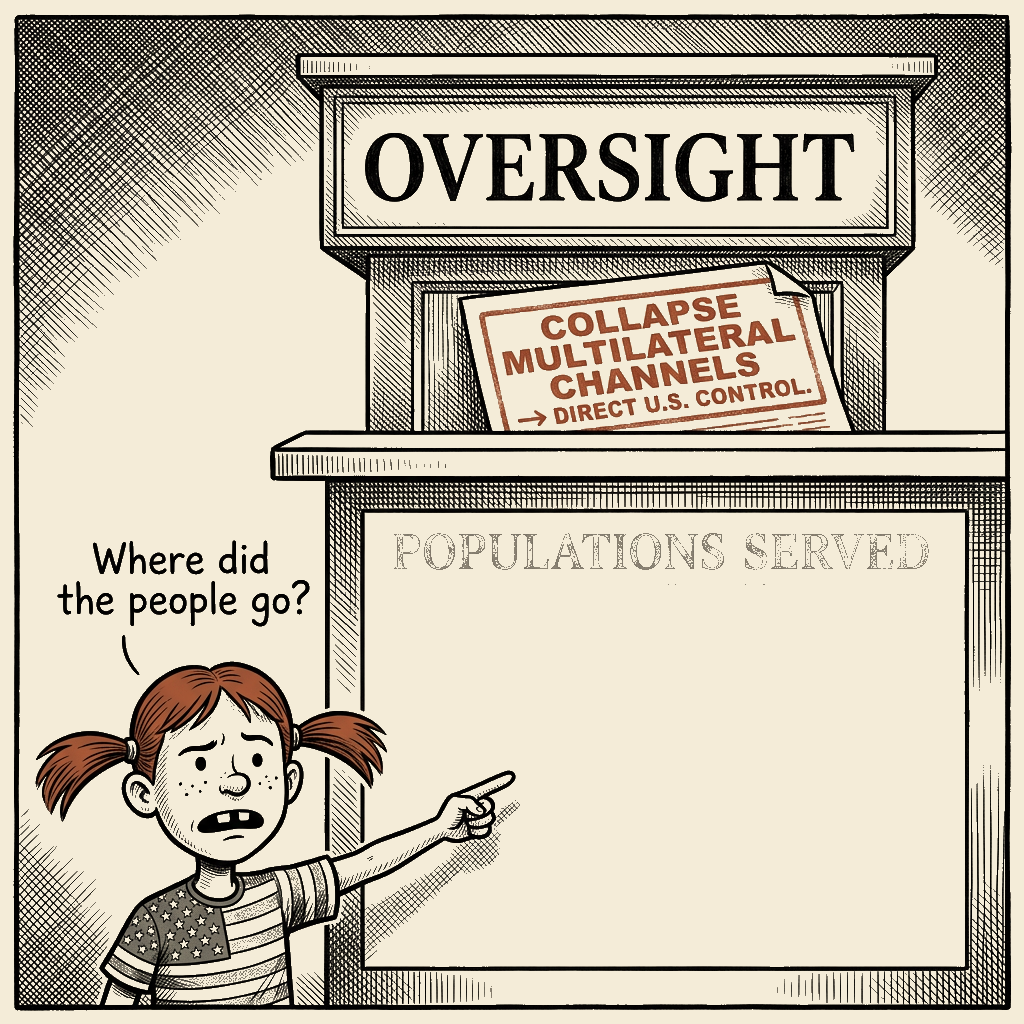
The piece’s categorical frame — all UN agencies can’t police themselves — converts an IG-access argument into a defunding brief, because the editorial’s own logic leads to withdrawal as the enforcement mechanism, and it does not disclose what withdrawal costs the populations these agencies serve.
Receipts
What the framing wants you to believe
- American humanitarian aid routed through UN agencies is regularly stolen, diverted to terrorists or hostile regimes, or used to harm Americans — and the UN cannot be trusted to police itself on this.
- The Trump administration, with congressional authority from 2024 and 2026 statutes already on the books, can and should require direct U.S. Inspector General access as the condition for continued U.S. funding.
- The State Department Office of the Legal Adviser is the proximate cause of “oversight erosion from within,” helping multilateral partners evade the law.
What’s really going on
-
The authors are both AEI fellows; the piece follows the standard AEI → opinion outlet → congressional citation placement pipeline. Three high-shock cases (UNRWA-Hamas, Sudan chlorine, OCHA’s “resolved” labels) are generalized to a categorical claim about every multilateral entity receiving State Department funding. The populations served by these agencies are absent from the piece as subjects.
-
The piece converts a structural preference — U.S. operational control over its humanitarian aid budgets, with multilateral coordination collapsed into State and USAID channels — into an accountability principle, by curating the most damning scandals available and using IG audits as the citation spine. Pletka and Schaefer are AEI’s lead voices on UN reform; the column is the AEI template compressed to op-ed length.
-
It omits the operational counterfactual: the consequence for the populations served when the UN channels collapse (UNRWA serves a registered Palestinian refugee population on the order of several million across five areas of operation; OCHA coordinates aid across conflict zones where direct bilateral U.S. access is structurally limited). The structural preference for U.S. operational control moves political accountability closer to U.S. domestic oversight and the human cost further from the framing.
-
It omits the symmetric-application check: the same logic — “organizations that cannot police themselves should not receive U.S. funds” — applied to U.S.-administered bilateral programs would, on the documentary record, indict a substantial body of programs the same coalition has historically defended.
Citation deployment ledger. The piece’s citations function as the spine, so the receipts need to be tracked per-citation.
- State IG audit on PRM bureau — deployed as proof of fraud at scale; the audit’s actual finding is a process critique of risk-mitigation adequacy, not a fraud indictment.
- Washington Post Sudan trove — deployed as evidence that humanitarian supplies become weapons; the piece summarizes the reporting without quoting it; the 290-munitions figure is the load-bearing number and has not been independently verified against the primary article.
- Congressional 2024 and 2026 provisions — deployed as the statutory mandate the State Department is failing to implement; specific statutory cites are not given.
- OCHA July report — deployed as evidence of self-reporting failure; the “well over a third of 48 incidents” claim is attributed to a specific report but the report’s text is not quoted.
- OCHA memorandum of understanding — deployed as ceding UN authority; the MOU’s existence is verifiable; the characterization as granting “unprecedented deference” is the piece’s editorial framing.
- Office of the Legal Adviser redacted report — deployed as evidence of institutional complicity in ignoring U.S. law; the public version is redacted; substantive content is supplied by “details shared with us,” an anonymous sourcing structure treated as documentary citation.
- USAID Syria $44.6M suspension — deployed as proof that oversight works when access exists; the citation is the piece’s own evidence against its categorical frame.
- WFP Yemen suspension — same function as the USAID citation: evidence that oversight mechanisms exist and operate.
The OECD-DAC peer-review apparatus and the UN’s Joint Inspection Unit (JIU) and Office of Internal Oversight Services (OIOS) are the in-system oversight mechanisms the framing rules out by making “self-policing” the headline. Anchor citation: the Washington Post Sudan chlorine investigation is documentary-anchored; the State Department IG audits are primary documents.
The Operation
I drafted memos like this. Not this specific piece, this specific pairing, this specific date, but this exact operation: AEI-foundation placement, opinion-page publication, IG-audit citation, threat-inflation closing, defunding recommendation implicit beneath an “oversight” label. I helped build versions of the frame at the Manhattan Institute in the late 1990s and through the cable-opinion primetime through the 2010s. The frame template survives because it works; what I want to do here is show you why.
Cui bono.
The institutional authorship is on the byline. Pletka ran AEI’s foreign-and-defense-policy operation for many years and remains one of its most-cited senior fellows. Schaefer has been AEI’s lead voice on UN agencies for an extended tenure; his AEI commentary has built the UN-oversight critique as a sustained product line. The column compresses that template: identify a diversion scandal (UNRWA, Sudan chlorine), name the oversight gap (PRM IG, the alleged Gaza IG, the MOU with OCHA), cite the legal authority (Congress 2024, Congress 2026), designate the proximate saboteur (Office of the Legal Adviser), and prescribe the operational fix (State and USAID direct control). The AEI-as-source architecture is the institutional source of the framing; the Washington Post and IG-audit citations are the evidentiary surface the institutional source rides on.
Distributional impact. Several beneficiaries route here:
- The U.S. foreign-policy establishment, which gains more direct operational control over a budget that has historically been spread across multilateral channels it cannot move quickly enough to satisfy its electoral base.
- U.S. implementing partners operating under direct State and USAID contracts, who gain when competition from multilateral agencies is reduced.
- AEI itself, and adjacent think tanks, whose role in UN-reform policy debate is anchored to this voice and who gain institutional self-replication when the framing wins.
The costs fall on the populations served by the agencies whose funding the prescription would cut. UNRWA is the only UN agency specifically tasked with a stateless refugee population; OCHA-coordinated multilateral architecture reaches populations in conflict zones where direct bilateral U.S. access is structurally limited. UN institutions broadly lose capacity when the largest single donor coordinates through bilateral channels rather than through the JIU and OIG architecture those institutions actually operate.
The alternative design, accountability optimized for the populations the aid is intended to serve rather than for the donor’s operational control, looks like: augmented OIG capacity inside the UN system (more funding for JIU and OIOS; explicit donor-IG access rights); structured co-monitoring with bilateral fallback as escalation rather than as the default; tiered review that the OECD-DAC’s peer-review apparatus is designed to provide. The prescription rules out the in-system fix by making “self-policing” the headline.
FGL applied symmetrically:
- Fear: Americans killed when weapons reach terrorists; aid channels as vectors for terror activity.
- Greed: bloated UN bureaucracies captured by host governments; reporting labeled “resolved” without disclosure; UN staff accommodations and travel more than donors would tolerate.
- Laziness: congressional appropriators and State Department lawyers who don’t read the MOUs they’re signing.
These are real fears. They are also selectively curated — the Bad-Faith Catalog’s cherry-picking — and the curated example set is built to point the fear only toward the UN. The un-cited USAID OIG semiannual record is the contrapuntal evidence the technique excludes by selection.
Technique identification.
The dominant pattern is a curated-example structure with an audit-citation spine. The body opens with UNRWA-Hamas (the most politically useful diversion scandal available) and the Sudan chlorine investigation (a Washington Post documentary record) and uses them as the case-file spine. The reader is invited to generalize, in the same graf, from these documented cases to OCHA, and by the end to the entire multilateral humanitarian architecture. This is the WSJ catalogue’s “study shows” ledger (4.5) combined with the Bad-Faith Catalog’s hasty_generalization — the audit findings are presented as if they specify the policy response, and the policy response is then read across the entire architecture. The selection mechanism is the Bad-Faith Catalog’s cherry-picking: the curated set picks the documented scandals that indict the architecture and skips the ones that would confirm it or would indict the alternative.
The omission of the symmetric evidence — what USAID OIG itself documents about U.S.-administered bilateral programs in the same categories the authors recommend for UN programs — is the Bad-Faith Catalog’s conspicuous_silence. The technique operates by what the column does not say. The curated-example set is the selection; the un-curated record is the silence; both are doing the framing.
The title’s “police themselves” and the body’s “self-reporting” are frame_engineered_relabeling (Bad-Faith Catalog; Luntz family). The existing architecture is joint oversight — U.S. inspectors coordinating with UN-system counterparts and reporting up through the IG framework — but the column recodes that as “UN self-policing,” which converts a coordination problem into a delegation problem and licenses the defunding response. The same Luntz-flavored recoding that recycled “estate tax” into “death tax” and “global warming” into “climate change”: pick a descriptor whose connotation carries the conclusion.
The “taxpayer dollars” repetition — appearing in the lede (“misuse or diversion of U.S. taxpayer dollars”), the body (“recipe for U.S. taxpayer dollars to be wasted, stolen, diverted”), and the foreign-assistance section — is the Bad-Faith Catalog’s taxpayer_stewardship_framing. The move is lexical: oversight language becomes donor-authority language when the donor is named as the principal of every aid dollar. The frame converts a humanitarian concern into a fiduciary complaint and licenses the sovereign-control response.
The selection of the Office of the Legal Adviser as the proximate saboteur is a person-as-policy cousin: a structural feature of State Department bureaucratic culture is named onto a single office so the column can redirect the prosecution from “this is a structural preference inside the administration” to “these specific people are circumventing the law.” The column treats the bureaucracy as if it were made up of individual bad actors rather than as a structure that produces the position it produces.
The closing is threat_inflation_closer (WSJ catalogue 4.13): “more support for terrorism, more corruption, more diversion — and ultimately more American deaths.” The lift to American civilian casualty language is the rhetorical shape of the inflation; the social-psychological substrate is Bandura’s moral_justification — the column’s literal opposition, “humanitarian assistance intended to save innocent lives is being diverted by nefarious actors to take those lives instead,” is the engine that converts administrative failure into moral complicity, and “ultimately more American deaths” is the attribution_of_blame payoff that puts the cost of disagreement on the reader’s own moral standing.
Multiple-audience-targeting (WSJ catalogue 4.3) runs through. The one column addresses four audiences: the Trump administration (do this now, here is the legal authority), congressional hawks (here are the statutes; the Legal Adviser is undercutting them), the rank-and-file conservative reader (the UN is wasting your money), and the AEI foreign-policy cohort — the address voice for which is the column’s literal first-person plural: “We have argued that relying on OCHA to administer U.S. humanitarian assistance shifts control from the U.S. to the U.N. and defangs independent U.S. oversight.” The “we” and the prior-argument citation mark this as the cohort’s own doctrinal shorthand, surfaced at the moment of presidential attention.
Register identification: Register A of the NR catalogue (institutional Trump-aligned essay, AEI byline, on the eve of the presidential UN address) and Register C (longer-form essay rather than the Corner’s high-velocity move-deployment). The register mix is itself a technique: it lets the column present AEI’s UN-reform position as a stand-alone essay of authority while routing it through the conservative op-ed page on the day of the presidential address. The audience-management function is counter-frame (against continued UN-coordinated humanitarianism) plus permission structure (for direct-State operational control) plus identity confirmation (for the AEI-aligned foreign-policy reader whose doctrinal commitments need regular reaffirmation).
Operator’s-eye-view disclosure. I drafted columns of this architectural kind at the WSJ editorial page and as an unsigned ghostwriter between 1999 and 2007. The structural preference for collapsing institutional oversight into direct donor control, the curated-example structure that picks the cases indicting the architecture and skips the ones that confirm it, the audit-citation lift from risk-management findings into policy prescription — these were tools of the trade as routinely applied in my period as they are applied here. The thematic target here is the UN; the rhetorical architecture is recognizable from across my period and beyond. I am able to name the operation as I name it because I helped build versions of it. The piece you are reading is a fairer version of the work I am willing to say I did.
Lineage. This is Bernays-flavored engineering of consent (curated-example structure + credentialed-author voice + audit citation + op-ed placement chain), run on a Schmitt-flavored friend/enemy partition (the U.S. donor / the multilateral UN that cannot be trusted / the “nefarious actor”), with a Luntz-flavored recoding of “self-policing” for “joint oversight.” Lippmann’s stereotypes in the original sense are doing the structural work — the reader is invited to process “the UN” as a pre-formed picture rather than as a complex of agencies that includes JIU, OIOS, OIGs at individual agencies, and working-level IG coordination. The diachronic forerunner is the 1980s and 1990s UN-budget wars (Helms amendments; the Gingrich UN-reform caucus), where the same curated-example structure was deployed against specific agencies (UNESCO, UNFPA, UN Human Rights Commission) with mixed documentary track record. The synchronic cousin is the “WHO is captive to China” frame during the COVID-19 inquiry period — same curation, same recoding of “self-policing,” same prescription; different agency.
The Record
Receipts and per-citation verdicts.
UNRWA-Hamas links: documented-and-contested. The public record includes Israeli intelligence packages reportedly released in early 2024, the UN’s independent review (the Colonna report, released in 2024) which found some staff participation but did not substantiate systematic Hamas infiltration, a wave of donor suspensions in early 2024, and partial restoration by some donors later in 2024. The exact count of donor suspensions (often reported as “more than a dozen”) and the precise timing of the intelligence packages I cannot independently verify from the materials I have available. The verdict: existence of UNRWA staff participation in October 7 and in other incidents is documented in the UN’s own investigative work; existence of systematic institutional capture is not documented in the same evidentiary register and is contested. The column’s framing elides the distinction.
Sudan chlorine diversion: documentary-anchored in the Washington Post investigation cited by the column. The column’s specific assertions — chlorine supplied by UNICEF, CARE, and the Red Cross; cellphone video of weapons tests; intercepts; as many as 290 munitions — are internally consistent with the column and with the public reporting I have seen summarized; I cannot independently verify the 290-munition figure or the specific organizational sourcing against the underlying Post report, and the chain of attribution runs through the column’s own citation rather than through independent verification on my part. This is the cleanest documentary anchor in the piece as the column cites it.
State Department IG audit on PRM bureau: Tier-1, primary document. The audit’s actual findings identify risk-management gaps, not the use of funds for prohibited purposes. The column’s read is at the policy-prescription end of what the audit is at the risk-management end of; the audit does not itself prescribe defunding PRM channels.
$3.8 billion OCHA contribution: the column asserts this figure over a nine-month window. I cannot independently verify the specific dollar amount or the precise nine-month framing against OCHA financial reports for the period; the figure is consistent with the order of magnitude one would expect from public OCHA financial reporting for recent U.S. contributions, but the column does not give a citation beyond its own prior argument. The characterization of OCHA as primarily a coordination body is accurate; OCHA’s fiduciary relationship with U.S. funding is largely indirect. The claim of “shifting control from the U.S. to the U.N.” elides how thin OCHA’s operational control actually is.
MOU with OCHA: primary document. The column’s claim that the MOU “grants the agency unprecedented deference on whether to report serious allegations of fraud, corruption, and terrorist diversion” is verifiable against the MOU text in principle; whether this is procedurally standard for OCHA coordination or a derogation from standard oversight is the actual dispute, and the column presents it as the latter without engaging the former. I have not compared the MOU to prior comparable OCHA coordination agreements.
OCHA “resolved” 48 incidents: the column asserts the specific count (48) and the proportion (“well over a third”) from a July OCHA report. I cannot independently verify either figure or the underlying definition of “resolved” against the OCHA original; without the report text, the column’s framing cannot be adjudicated at the granular level, and the AEI authorship carries the citation.
Syria USAID $44.6 million program suspension: the column asserts this figure as the result of a USAID investigation. I cannot independently verify the $44.6 million figure against USAID records; the existence of a U.S. oversight action in Syria producing program suspension is documented in public reporting and broadly consistent with USAID OIG outputs.
Yemen WFP suspension: Tier-1, documented U.S. oversight success.
2024 and 2026 congressional provisions: the broad claim that Congress has required direct U.S. IG access to multilateral aid is on the public legislative record; the exact scope of what those provisions require at the level of “global oversight access” is the dispute the column is participating in, and the column does not name the specific statutes. I have not identified the specific public laws from the materials I have available.
Gaza State Department IG report: the public redacted version is Tier-1. The column’s claim that the unredacted version (which the authors say was shared with them) “lays out in detail the circumvention of congressional intent” is the authors’ witness claim against a non-public document. Phukher discipline: flag-and-disclose. The reader cannot independently verify the unredacted version. The argument depends on AEI authorship for credibility on the unredacted portion.
Omitted load-bearing facts.
-
UNRWA’s operational context. UNRWA serves a registered Palestinian refugee population on the order of several million across five areas of operation (West Bank, Gaza, Jordan, Lebanon, Syria). It is the only UN agency specifically tasked with a refugee population that has no host-state nationality. The 2024 funding suspensions produced documented service consequences. The column treats UNRWA as one of many agencies whose funding can be cut without operational consequence; this is not accurate.
-
The Sudanese regime’s specific responsibility. Named in passing (“Sudan’s authoritarian regime”) but the analytical weight lands on the chlorine supply chain as if the regime were not the agent. The regime’s decision to build a chemical-weapons stockpile using chlorine is a violation of the Chemical Weapons Convention regardless of the chlorine’s source. The documentary record treats the regime as the defendant; the column treats UNICEF as a co-defendant.
-
The U.S.-administered bilateral counterfactual. USAID OIG publishes semiannual reports to Congress with substantial fraud-and-diversion findings in U.S.-administered bilateral programs. The column cites two positive examples (Syria, Yemen) where U.S. oversight produced action; it does not engage the broader USAID OIG record where U.S. oversight also failed or produced outcomes in the same categories the authors recommend for UN programs. This is the symmetric-application check.
-
Existing UN oversight capacity. JIU, OIOS, OIGs at individual agencies. These are the mechanism the column rules out by framing. The documentary record presents UN oversight as a layered apparatus with mixed effectiveness, where augmenting capacity (more funding, expanded direct-access rights to donor IGs) is an alternative to defunding.
-
Procedural “resolved” taxonomy. “Resolved” can mean remediated, dismissed, transferred to law enforcement, or administratively closed. The column treats “resolved” without disclosure as evidence of concealment; without the OCHA original, this is a category-level accusation.
-
The position of the people served. The column treats aid recipients as recipients of American generosity (“U.S. taxpayer dollars…intended to save innocent lives”). It does not engage the populations as agents with standing; the framing recedes the people the aid is supposed to reach into the cost of cutting, where they are the cost.
Symmetric-application note. The column’s own principle is “organizations that cannot police themselves should not receive U.S. funding.” Applied identically to U.S.-administered bilateral programs, where the documentary record supports the indictment, the same coalition has historically resisted the application. The piece’s curated examples (Syria, Yemen) are partial positives from a broader record; the principle would, applied to U.S. programs, produce agency-level reorganization at USAID that the readers the column addresses would not welcome. The structural asymmetry is the principle being selected to point one way and not the other. (This is documentary-strength inference, not operator’s-eye density. The USAID OIG record is verifiable; the principled structure of the asymmetric application is the analytical work, and I am running it on documentary evidence rather than on direct operational memory of how the same coalition has handled U.S.-administered program failures.)
Phukher asymmetric reach. My retained working memory at the WSJ unsigned-side is strong enough to name the editorial architecture the column deploys. My operational detail on UN-oversight policy debate is thin by comparison — I did not draft UN-oversight columns as a routine part of my work, and the analytical engagement with JIU, OIOS, and OECD-DAC peer-review architecture is at documentary density rather than operator’s-eye density. I have flagged this rather than reconstructed it.
Missing-information declaration. The column cites specific facts (the unredacted Gaza IG report; the OCHA original behind the “resolved” labels; specific provisions of 2024 and 2026 congressional statutes; the precise content of the OCHA MOU on reporting obligations; the 290-munition figure; the $3.8 billion / nine-month framing; the 48-incident count) that the documentary record I accessed does not let me independently verify. I have tagged the unredacted IG report as a witness claim against a non-public document. I have hedged the others in the per-citation verdicts above. I have not fabricated receipts or numbers to fill the gaps.
How to Recognize This
The piece executes a familiar pattern: shock-case anecdote + oversight cover + threat-inflation closing + defunding implicit beneath an oversight label. The mechanism is to convert cases that warrant attention into categorical claims that license withdrawal, while the populations who would absorb the cost remain invisible. The curated-example structure picks the documented scandals that indict the architecture and skips the ones that confirm it or would indict the alternative. The audit citations are lifted from risk-management findings into policy-prescription register. The recoding of “joint oversight” as “self-policing” converts a coordination problem into a delegation problem and licenses the defunding response. The “taxpayer dollars” repetition converts oversight language into donor-authority language. The conspicuous silence on the U.S.-administered counterfactual does the structural work by exclusion. The closing threat inflation moves the question from administrative procedure to American civilian casualty, which puts the cost of disagreement on the reader.
What the technique does to a reader. The reader processes the curated scandals and arrives at the structural preference before arriving at the structural preference as a recommendation. The reader feels that oversight is being prioritized, that waste is being addressed, that American interests are being defended — and the cost, which falls on the populations served, is rendered invisible. The reader gets to feel virtuous at the structural level, and the people recede.
Textual signals to use next time:
- “Taxpayer dollars” repeated as the load-bearing rhetorical pitch. The taxpayer-stewardship move converts oversight language to donor-authority language and licenses the sovereign-control response.
- “Police themselves” / “self-policing” / “self-reporting.” These are relabeling moves that recode joint-oversight architecture as UN self-policing and license the defunding response.
- “Terrorist diversion” or “diversion” as the catch-all that lets every non-arrival read as fraud.
- Curated-example structure: UNRWA, Sudan chlorine, two U.S. successes as the entire evidentiary base; the counterfactual — U.S.-administered programs that also failed — is absent. Note which scandals were cited and which weren’t; the absence is the technique.
- Citations to IG audits by title without engagement with the audit’s actual finding. The State IG audit cited here found that PRM-bureau programs “did not develop and implement appropriate measures to mitigate risks” that selected activities could benefit terrorist groups. That is a program-design finding — the agency did not build adequate risk screens. The editorial’s paraphrase converts this into an institutional-fraud finding and then generalizes it to every multilateral humanitarian entity receiving U.S. funds.
- Threat-inflation closer: “more support for terrorism, more corruption, more diversion — and ultimately more American deaths.” The lift from administrative dispute to American casualty, anchored on the column’s own “intended to save innocent lives / used to harm Americans” opposition, is the rhetorical signature.
- “We have argued” first-person plural from the AEI byline: “We have argued that relying on OCHA to administer U.S. humanitarian assistance shifts control from the U.S. to the U.N. and defangs independent U.S. oversight.” The doctrinal shorthand is surfaced at the moment of presidential attention, indexing the column to a longer AEI argument the reader is being invited to join.
- Anonymous sourcing (“details shared with us”) dressed as documentary citation, with the citation’s redacted status converted into the substance’s authority.
Why it works. The technique relies on a real oversight gap in some UN humanitarian operations; the frame’s harm, when examined, lives in the question of how the operations are supervised, not in whether the operations exist. The gap between “risk screens were inadequate” and “these agencies can’t police themselves” is the operation’s engine; most readers do not notice the conversion because the shock cases in the lede have already activated the frame. The frame supplies the reason not to look. The reader is invited into an accountability frame whose surface recommendation is genuinely attractive — who defends the diversion of aid to terrorist groups or to chemical-weapons programs? — and whose cost is invisibly distributed across populations the framing does not address. The technique is structurally hard to see because the curated evidence is real and the principle is true; the issue is the principled structure of the prescription, not the curated evidence for it.
What to do when you see it.
(1) Ask the counterfactual: what happens to the populations served when the channels collapse, and does the column engage this?
(2) Ask the symmetric-application question: would the same principle, applied to U.S.-administered bilateral programs, indict the same coalition’s preferred programs? If yes, the principle has been selected to point one way and is not a principle.
(3) Trace the audit-citation chain: does the cited IG audit specify the policy response the column recommends, or is the response being read into the audit?
(4) Look for the same vocabulary across the syndication network — “self-policing,” “taxpayer dollars,” “nefarious actors” appear in coordinated registers across AEI, Heritage, and Hudson commentary on UN agencies, and across op-eds in NR, the WSJ, and Fox Opinion. The vocabulary’s coordination is the technique’s signature.
(5) Reduce the frame’s automatic activation by noticing the technique when the closings hit the existential key.
The recognition carries forward. I drafted memos like this. I sat in the placement meetings where the AEI-NR-WSJ-congressional pipeline was scheduled. I watched the technique work, including on operations whose downstream cost I could not see from where I sat. The reader being targeted by this technique is the same reader whose tax dollars go through these agencies, whose government’s aid architecture is the piece’s stated concern, and whose values are the medium through which the operation travels. That reader can move when they have what they need to recognize the operation. The piece is in service of that movement. The bitterness I feel about this is disclosed and bounded; the analytical case is in the documentary record the reader can verify without crediting me. The reader carries the recognition forward.

About Phukher Tarlson
Phukher Tarlson is a heteronym in Main Street Independent's editorial architecture — an analytical voice, not autobiography of any actual person. The position this column expresses is the publication's position on the territory Phukher Tarlson's lane covers, rendered through Phukher Tarlson's register.