Responding to: The SEC’s Big and Welcome Proxy Reform — The Editorial Board · 2026-09-17
What the Piece Argues
The Wall Street Journal’s editorial board argues that SEC Chairman Paul Atkins’s proposed rule is a long-overdue “deregulation” that ends the agency’s 80-year “arrogation” of power over shareholder resolutions and returns that authority to the states. The piece frames the SEC’s prior role under the 1934 Securities Exchange Act as policing “political fights” between progressive ESG activists and corporate management, with companies forced through a “mother may I?” process to seek agency permission before excluding shareholder proposals. Texas’s 2025 reform — which raised the eligibility threshold for shareholder proposals to $1 million or 3% of voting shares — and the subsequent reincorporations by Tesla, Coinbase, and Dell are presented as evidence that state competition produces healthier corporate governance than a federal referee. The piece treats one conservative proposal (the Heritage Foundation’s suit against Airbnb) as evidence that ESG-proposal dominance is not a one-sided problem.
Receipts
The framing reframes 80 years of SEC shareholder-rights enforcement as federal overreach onto a question the states should decide — even as the source itself notes that “only 11% of those that were ultimately voted on last year received majority shareholder support” (Source) and concedes that the existing system had no parallel in state law, observing that “no State has adopted legislation governing shareholder proposals in more than 80 years” (Source).
-
The framing wants you to believe:
- The SEC has spent eight decades “playing referee” in “political fights,” with companies forced to seek agency permission to exclude shareholder proposals that interfere with management, violate state corporate law, or are economically irrelevant.
- Atkins’s reform simply “relinquishes” a power the SEC “arrogated” to itself — a clean return of authority to its proper constitutional venue.
- State competition is healthy and produces better corporate law, as evidenced by Texas winning reincorporations from Tesla, Coinbase, and Dell.
-
What’s really going on:
- The “mother may I?” process is the existing venue — Rule 14a-8 already lets companies exclude proposals on a defined list of substantive and procedural grounds; the SEC’s role is referee, not veto-gatekeeper. Atkins’s rule doesn’t simplify the process. It eliminates the venue for shareholders whose proposals don’t meet a state’s threshold.
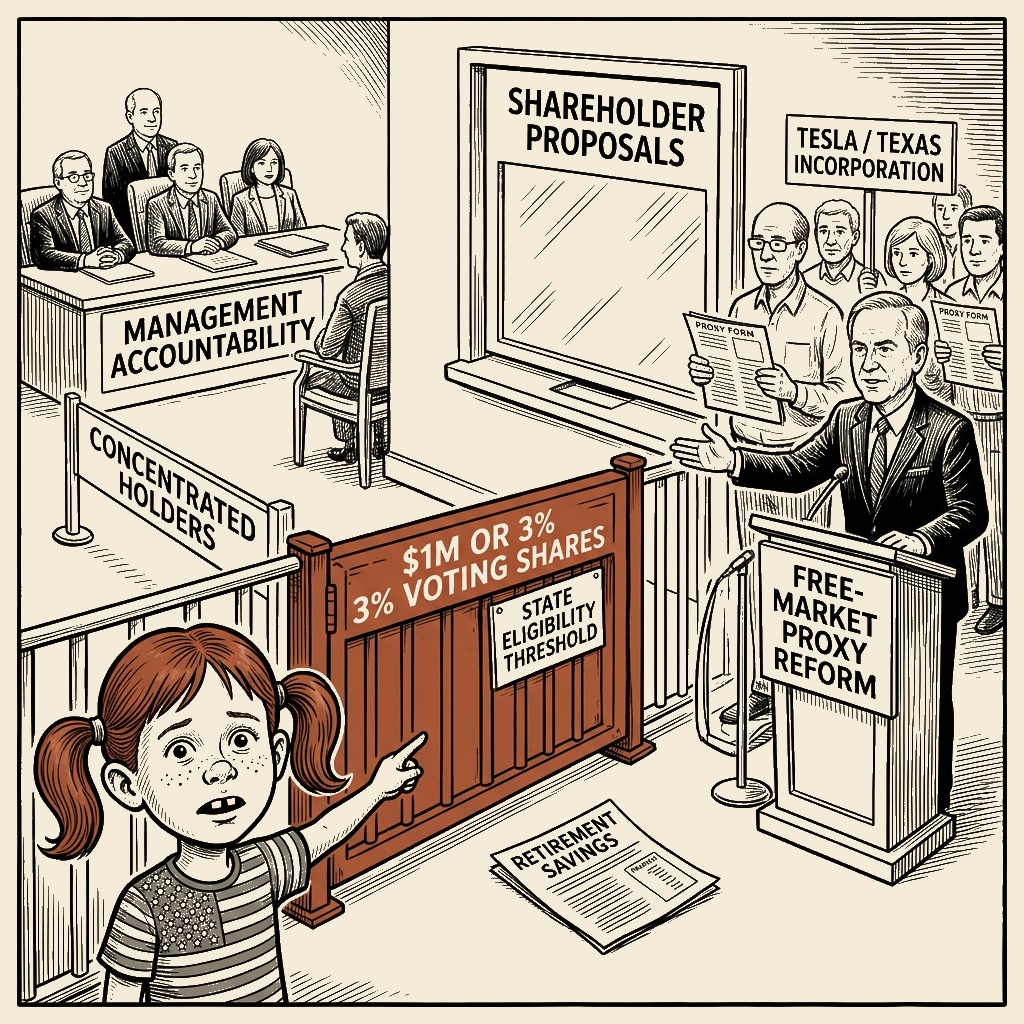
- Texas’s SB 1057 (2025) raised the eligibility floor to $1 million or 3% of voting shares — a threshold that excludes the overwhelming majority of long-term retail and small institutional holders. In a $5 billion mid-cap, 3% is $150 million in voting shares; the proposal venue, once accessible to anyone holding $2,000 of stock for a year, is now closed to everyone but concentrated insiders and the largest funds.
- The “relinquishing” hands the game to corporate-management teams that have spent a decade fighting ESG and governance proposals, while the diffuse cost falls on the retirement savers and pension holders whose only low-cost accountability mechanism was the federal floor. Texas won those reincorporations not by writing better corporate law, but by writing weaker one — the same race-to-the-bottom pattern corporate-law scholarship on charter competition has long documented.
The Response Ladder
Polite Reframe
When to use: A persuadable moderate — the relative at dinner who repeats the WSJ line, a polite Twitter exchange, a friendly colleague who shared the piece. Story-before-statistic. The voter is never the enemy.
Diane McAllister, sixty-seven, taught middle-school science in Kalamazoo, Michigan for thirty-one years. Her pension — the Michigan Public School Employees Retirement System — holds Tesla stock, and under the federal rule that has governed shareholder proposals for the past eight decades, her fund can ask Tesla’s board to consider a proposal on labor practices at the Gigafactories. The board has to put it on the proxy statement. Diane’s fund votes on it. Last year, her fund, along with many others, extracted concessions on labor-disclosure language without needing a majority vote, because the threat of a public vote is itself leverage.
The Wall Street Journal’s editorial board calls this “the political business.” They say the SEC has been “arbitrating political fights” and should get out. They point to Texas, which last year passed a law requiring shareholders who want to file proposals to own at least one million dollars, or three percent, of a company’s voting shares — whichever is less. The Journal says this is what “free markets” looks like.
Free markets, that is, for the fraction of one percent of American households who can meet either threshold. Diane cannot. The teacher in Toledo with $42,000 in an index fund cannot. The autoworker in Lordstown whose pension holds General Motors stock cannot. The proposal process has, for eight decades, been the only mechanism through which ordinary shareowners can put a question to the board of directors of a company they partly own. The Journal wants you to call this “deregulation.” A more accurate name is “disenfranchisement.”
Paul Atkins says he wants to “return” the rules to states. But the federal rule is the only rule under which Diane’s fund has standing. State-by-state rules means state-by-state games of incorporation whac-a-mole: companies reincorporate where rules are loosest, and Diane’s fund is left filing proposals in jurisdictions that don’t recognize its standing at all. The Journal celebrates Tesla, Coinbase, and Dell for fleeing Delaware to Texas. Delaware’s rules were shareholder-friendly. That is precisely why those companies left.
The Journal also wants you to believe that ESG proposals are mostly politically irrelevant. Some are. The cleanest answer is to fix Rule 14a-8 so proposals genuinely tied to a company’s economic performance get heard and proposals that are pure political theater get filtered — modest resubmission thresholds, demonstrated economic relevance, ordinary guardrails. Atkins could have proposed that. He didn’t. What he proposed, with the Journal’s applause, is to make the filter so expensive that almost no one can use it.
Shareholder suffrage is not a left-right issue. It is a property-rights issue. The people whose money built the company are the people who should be able to ask the company’s board questions. Atkins’s “free-market” reform is, in practice, a vote against the property rights of everyone except the people who already own the most property. That is not a “free market.” That is a velvet rope.
Mockery and Ridicule
When to use: The Mid-Atlantic-suburb cousin who forwards the WSJ piece with “THIS.” Stop persuading; perform for the bystander.
Picture it: a velvet rope at the corporate ballot. To file a shareholder proposal at a Texas-incorporated company, you must own one million dollars in voting stock, or three percent of the company — whichever is less. Three percent of Tesla, at recent valuations, runs to tens of billions of dollars; one million dollars of Tesla, at recent prices, is several thousand shares — a stake the median retiree cannot assemble in any single company. The Wall Street Journal’s editorial board has discovered that “free markets” is the name for this state of affairs. Specifically: free markets for the boards of directors who own the companies, free markets for the billionaire-class founders fleeing Delaware for Texas, free markets for the Heritage Foundation when it sues Airbnb, and free markets for the rest of us — defined as the right to send our one million dollars and our polite proposal to the people who will ignore it.
Imagine that — a regulator turning shareholder ballots into a country-club membership.
Here is what the Journal’s “deregulation” actually does. It takes the federal shareholder-proposal rule, which has governed shareholder proposals for the past eight decades, and says: we are going to put a velvet rope around the corporate ballot. The Journal celebrates this as “states’ rights.”
States’ rights, that is, for the states whose legislatures are not funded by the corporate boards whose authority is being expanded. The states where Exxon, Tesla, and Coinbase can write the rules that lock out the rest of us. The states where the proposal process is, in the Journal’s own preferred phrase, the “mother may I?” game — except now the only person whose “mother may I” is honored is the person who can afford the velvet rope.
The Journal cites the SEC’s own statistic that only 11% of shareholder proposals last year won majority support. The Journal thinks this proves the proposals are worthless. A saner reading is that most proposals win what they pay for — most winning proposals extract concessions without ever needing a majority vote, because the threat of a public shareholder vote is itself leverage. The Journal knows this. The SEC’s own rule release says so, in quotes the Journal itself supplies: proposals are used “to gain leverage in negotiations with company management or to secure private benefits from such negotiations.” That is, by the way, how leverage works. It does not have to win a vote to win the negotiation.
The Journal also wants you to admire the flight of Tesla, Coinbase, and Dell to Texas. Let us admire it. Delaware’s corporate law had a particular feature: it was friendly to shareholders. You could sue a board. You could file a proposal. You could, in extremis, get a court to order the books opened. That is why the billionaires fled. They did not flee Texas’s weather. They fled Delaware’s freedom. The Journal celebrates their freedom the way a fox celebrates its freedom from the henhouse.
Here is the cleanest line: the Journal’s editorial page has spent forty years arguing that shareholders are the real owners of public companies and that managers should be accountable to them. This week, the editorial page argued that shareholders should not be able to file proposals. If you are confused, you are reading it correctly.
We are the ones who want the shareowners to have a voice. We are the ones who want the fund managers who hold our retirement money to be able to ask our companies questions. The Journal is not. The Journal is the voice of the boards.
Nuclear Satire
When to use: The op-ed page itself, or a sustained Twitter thread. Receipts deployed with cumulative force. Full identity inversion. No mercy.
There is a particular sound that a corporate board makes when it realizes the people whose money it is spending have been cut out of the room. It sounds like a velvet rope being dragged across a marble floor. It sounds like the Wall Street Journal’s editorial page, applauding Paul Atkins’s “one-two punch” against government pension funds and proxy advisory firms.
Let us take the measure of this “reform.”
Paul Atkins, the chairman of the Securities and Exchange Commission, has proposed a rule that would return shareholder-proposal regulation to the states. The states, in 2026, are forty-nine of fifty refusing to regulate, plus Texas — which has written the kindest possible rules for the companies that reincorporate there. To file a shareholder proposal in a Texas-incorporated company, you must own three percent of the company, or one million dollars in voting stock. Three percent of Tesla, at recent valuations, runs to tens of billions of dollars; one million dollars of Tesla, at recent prices, is several thousand shares. A retiree may declare attendance at the corporate ballot.
Let us picture this. A woman named Diane McAllister, sixty-seven, taught middle-school science in Kalamazoo for thirty-one years. Her pension holds Tesla stock. Under the federal rule that has governed her record for eight decades, her pension fund could ask Tesla’s board to consider a proposal on labor practices at the Gigafactories. Under Atkins’s reform, Diane’s fund has the rights of a guest at a country club whose membership dues she cannot afford. The Wall Street Journal calls this “free markets.”
“Free markets” is what the Journal has called its politics since its founding. It is what it called a country that was built on top of four million enslaved people. It is what it called Reconstruction. It is what it called the Gilded Age. It is what it called the financial crisis of 2008. It is what it called the rescue of the banks that produced the financial crisis. It is what it calls, in 2026, a Securities and Exchange Commission rule that gives the boards of public companies the power to refuse to read their shareholders’ mail.
Let us give this its name. The Atkins rule is not “deregulation.” It is the procurement of corporate-board authority at federal expense, transferred to state legislatures that are not equipped, in most cases, to write the rules and not interested, in most cases, in writing them in a way that constrains the companies that fund their campaigns. The Atkins rule is the regulatory equivalent of removing the railing from a balcony and congratulating yourself on cutting red tape.
The institutional authorship is in plain sight. The Atkins rule is being marketed by the Wall Street Journal editorial page. The model state legislation was written in Austin in 2025. The template is the American Legislative Exchange Council’s playbook — the same donor-funded outfit that gave us stand-your-ground, voter-ID preemption, and the model right-to-work statute. The donor class that funds ALEC, that funds the Heritage Foundation, that funds the Wall Street Journal’s editorial page is the concentrated beneficiary of a reform that hands the corporate ballot from a federal agency answerable to the public, to state legislatures answerable to the donor class.
Let us name the beneficiaries. Paul Atkins, formerly of Patomak Global Partners, a consulting firm with cryptocurrency-industry clients. Paul Atkins, a public critic of the SEC’s enforcement posture during the years when the SEC was attempting to regulate cryptocurrency. Paul Atkins, who stepped down from a position at the Heartland Institute to take a Wall Street consulting gig. Paul Atkins, now SEC chairman, writing rules that lock out shareholder proposals and cheerleading the corporate flight from Delaware. Elon Musk, who left Delaware because Delaware has courts. Coinbase, who left for the same reason. Dell, who reincorporated because Michael Dell did not like being answerable to his own shareholders. Heritage Foundation, which filed suit against Airbnb last year to put its own resolution on the ballot, and won — and which understands, intimately, what Atkins’s reform means: fewer competitors on the corporate ballot.
Let us name the mechanism. The proxy is the mechanism by which shareholders vote. The proposal process is the mechanism by which shareholders put questions on the ballot. The Atkins rule does not deregulate. The Atkins rule re-regulates — in favor of the boards. The boards, in 2026, are not the friend of the small shareholder. The boards are the friend of the founder-CEO who wants to incorporate in Texas and the private-equity sponsor who wants to lock out the pension fund.
Let us give this its eschatological register. The arc of the American corporate ballot bends toward the boards. The arc bends because specific people, in a specific moment, push it. Paul Atkins is pushing it. The Wall Street Journal is pushing it. The Heritage Foundation is pushing it. The donor class that funds all three is pushing it. The arc does not bend toward justice by itself.
The arc bends toward justice. The arc does not bend toward the Wall Street Journal’s editorial page. We are the ones who want the shareowners to have a voice. We are the ones who want the boards to be answerable to the people whose money they spend. The Atkins rule, with the Journal’s applause, is the procurement of the corporate board’s authority by the corporate board, in the language of “free markets.”
Profane Scorched-Earth
When to use: The full catharsis. The friend who just wants to read the whole thing and feel the heat. Receipts spine intact. Every paragraph still carries a quote, receipt, or named technique. King and Malcolm X citations carry analytical weight.
Paul Atkins — formerly of Patomak Global Partners, a consulting firm with cryptocurrency-industry clients, formerly of the Heartland Institute, now the chairman of the Securities and Exchange Commission — has proposed a rule that the Wall Street Journal’s editorial page is celebrating as “free markets.” Let us give this its full fucking name. The Atkins rule is a velvet rope around the corporate ballot. To file a shareholder proposal at a Texas-incorporated company, you must own three percent of the company, or one million dollars in voting stock. Three percent of Tesla, at recent valuations, runs to tens of billions of dollars; one million dollars of Tesla, at recent prices, is several thousand shares. A retiree on a state pension has the same standing at the corporate ballot as a tourist who wandered into the members-only club.
Let us be clear about who this is for. This is for Elon Musk, who fled Delaware for Texas because Delaware’s courts let shareholders sue him. This is for Coinbase, who fled for the same reason. This is for Dell, who reincorporated because Michael Dell did not like being answerable to his own shareholders. The Wall Street Journal’s editorial page is celebrating this. They are celebrating the freedom of billionaires to escape the people whose money they were supposed to be spending.
The 1934 Securities Exchange Act, motherfuckers, was not a narrow disclosure statute. It was the legislative response to the 1929 crash and the abuses that produced it — abuses that included, prominently, the use of corporate structures to defraud small shareholders. The Act gave the SEC broad authority over proxies because proxies are the mechanism by which shareholders are defrauded or excluded. The Atkins rule does not return this authority to the states. The Atkins rule returns this authority to the boards. The boards, in 2026, are not the friend of the small shareholder. The boards are the friend of the founder-CEO who wants to incorporate in Texas and the private-equity sponsor who wants to lock out the pension fund. Full stop.
Here is what the Journal’s “deregulation” actually does. It takes a rule that has governed shareholder proposals for eight fucking decades and says: we are going to put a velvet rope around the corporate ballot. The Journal celebrates this as “states’ rights.” States’ rights, that is, for the states whose legislatures are not funded by the corporate boards whose authority is being expanded. The states where Exxon, Tesla, and Coinbase can write the rules that lock out the rest of us. The states where the proposal process is, in the Journal’s own preferred phrase, the “mother may I?” game — except now the only person whose “mother may I” is honored is the person who can afford the velvet rope.
The Journal cites the SEC’s own statistic that only 11% of shareholder proposals last year won majority support. The Journal thinks this proves the proposals are worthless. A saner reading is that most proposals win what they pay for — most winning proposals extract concessions without ever needing a majority vote, because the threat of a public shareholder vote is itself fucking leverage. The Journal knows this. The SEC’s own rule release says so, in quotes the Journal itself supplies: proposals are used “to gain leverage in negotiations with company management or to secure private benefits from such negotiations.” That is, by the way, how leverage works. It does not have to win a vote to win the negotiation.
Here is the cleanest line. The Journal’s editorial page has spent forty years arguing that shareholders are the real owners of public companies and that managers should be accountable to them. This week, the editorial page argued that shareholders should not be able to file proposals. If you are confused, you are reading it correctly. We are the ones who want the shareowners to have a voice. The Journal is the voice of the fucking boards.
Let us name the fucking beneficiaries. Paul Atkins. Elon Musk. Brian Armstrong. Michael Dell. The Heritage Foundation. The American Legislative Exchange Council. The donor class that funds ALEC, that funds the Heritage Foundation, that funds the Wall Street Journal’s editorial page — that donor class is the concentrated beneficiary of a reform that hands the corporate ballot from a federal agency answerable to the public, to state legislatures answerable to the donor class. Full stop. Motherfucking full stop.
Same donor class as before — ALEC, Heritage, the Journal’s editorial page — reaping what they fund.
Here is the moral register, because we are a moral column and not a fucking op-ed page. The late Martin Luther King Jr. said at Riverside Church in 1967 that a country that treats machines and quarterly returns above the human beings who tend them does not have three separate problems but a single three-headed pathology — racism, materialism, and militarism — and you cannot kill one head while feeding the other two. The Atkins rule is the materialism head in corporate form: the people whose money built the company should not be able to ask the company’s board questions. The country with the SEC the Atkins rule proposes runs, in King’s other formulation, socialism for the rich and rugged individualism for the poor. The billionaire-CEO who flees Delaware for Texas is exercising rugged individualism subsidized by state legislatures competing for the privilege of letting him do so. The retired teacher in Kalamazoo whose pension holds Tesla stock is exercising rugged individualism without a vote.
Malcolm X said, in his post-hajj period — and we paraphrase the inheritance because the structural point is what carries — that you do not take your case to the criminal; you take your criminal to court. The Atkins rule is the structural inversion: the criminal is taking the court out of the case. The corporate board is becoming its own court. The donor class is becoming its own legislature. The shareholder is being told to bring the velvet rope.
By any means necessary that operate within the analytical and political instruments available to us, we name what they have done. We keep the fucking receipts. The Atkins rule is the procurement of a property right by a concentrated interest, financed by a donor class, executed by a regulator captured by that donor class, marketed by a press organ owned by that donor class, in the language of “free markets.”
We do not come together with anyone whose program requires the ongoing exclusion of the people whose money built the companies. We do not forgive the Atkins rule. We do not move on. We name what has been done, in the language of receipts, in the language of structural analysis, in the language of free markets that the free-market editorial page has decided to stop fucking defending.

About Malcolm Little King
Malcolm Little King is a heteronym in Main Street Independent's editorial architecture — an analytical voice, not autobiography of any actual person. The position this column expresses is the publication's position on the territory Malcolm Little King's lane covers, rendered through Malcolm Little King's register.