Analyzing: What Nikole Hannah-Jones Doesn’t Say — Charles C. W. Cooke · 2026-09-22
What the Editorial Argues
Charles Cooke opens his piece with a verdict he treats as self-evident: “She has always been a ridiculous zealot. Now, she’s a cautionary tale, too.” The rest of the column is the apparatus built to deliver that verdict. Cooke works from a defensible premise — parents should prioritize their children’s welfare — and converts it into a license to destroy. He pivots, in the third paragraph, to his operative charge: that Hannah-Jones’s “actions were morally indefensible and analytically ignorant, and her supposed metamorphosis remains invisible to the naked eye.” That is the load-bearing sentence. Everything before it is setup; everything after it is the indictment dressed out.
Cooke’s surface argument: a parent who places ideology above a child’s welfare has committed a “sin” — a category he extends, with Stalinist informants as his comparator, to the school-choice decision Hannah-Jones described in her 2016 New York Times essay. He further argues that Hannah-Jones’s 2024 reflection on that decision fails to specify what she now believes about American education; that her career at the Times has been characterized by similar negligence; and that her broader journalistic posture on school failure ignores available data on the actual causes of educational decline. The piece closes by enumerating Hannah-Jones’s professional honors — MacArthur, Pulitzer, Polk, National Magazine Awards, fees, sinecure — as evidence that she has been rewarded for work she has not actually performed.
The operator-eye reading of those moves is what follows. The piece is a personal-destruction column in the erudite-polemic register, working from a legitimate premise to convert an empirical question into an indictment of the messenger. The technique inventory that follows names the moves in the order Cooke deploys them.
Receipts
What the framing wants you to believe:
- That Hannah-Jones’s 2016 school choice was an ideological “experiment” conducted on her child, and that any school choice driven by ideological commitment rather than by the child’s interest is morally equivalent to a Soviet-style corruption of parental instinct.
- That Hannah-Jones’s mea culpa is a “humblebrag” because it lacks the comprehensive policy retraction Cooke, a writer on a different beat, also declines to supply.
- That the Pulitzer, MacArthur, and magazine awards Hannah-Jones has accumulated are themselves evidence of a corrupt establishment that rewards her for work that amounts to “a consequence-free existence.”
What’s really going on:
- Cooke converts a personal parenting admission into a professional and ideological indictment, using the parental-instinct frame to license contempt toward a journalist whose racial-equity work he opposes. The concentrated beneficiary is the polemical right that wants the 1619 Project and the racial-equity-in-education frame discredited; the diffuse cost is borne by Hannah-Jones personally and by the readers who absorb the dismissal without ever engaging the underlying education-policy question. The single anchor citation that settles what Cooke elides is Hannah-Jones’s 2016 NYT essay “Choosing a School for My Daughter,” where she explicitly engages the structural question of what white parental exit means for the schools left behind — the substance Cooke substitutes contempt for.
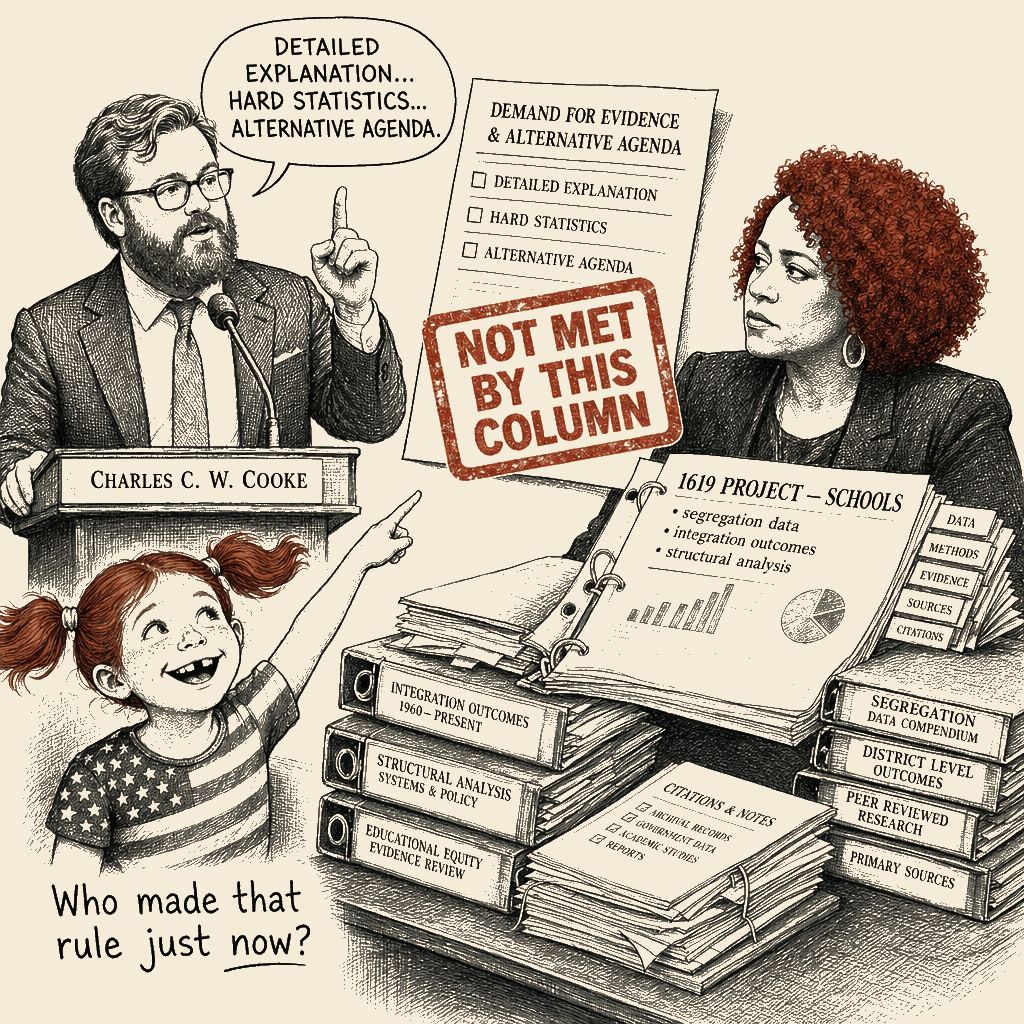
- The piece demands of Hannah-Jones “a detailed explanation of how exactly she was wrong, along with an exhaustive ‘therefore …’ that included hard statistics, legible arguments, and the outlining of an alternative agenda” — a standard Cooke does not meet in this column. The demand functions as indictment; the standard is asymmetric.
- The omission Cooke depends on: the actual substance of the education-policy debate Hannah-Jones’s work engaged — the empirical literature on school segregation, integration, and academic outcomes; the structural conditions of NYC school choice in 2016; the question of what abandoning a high-poverty school means for the community left behind. Cooke substitutes the parental-instinct moral frame for engagement with any of it.
The Operation
This is a signed piece in National Review’s traditional-conservative register — Cooke is one of the magazine’s traditional-conservative voices, more comfortable with originalist constitutional argument than with the Corner’s high-volume contempt, but operating here in a personal-indictment register that pulls heavily from the Corner’s vocabulary. The structural fingerprint: a named public figure’s admitted vulnerability pivoted into a character-assassination licensed by a moral-philosophical frame, escalating from a 2016 NYC school choice to a Soviet comparison by the third paragraph, and closing with an enumeration of credentials as evidence of corruption rather than as recognition of work engaged.
I drafted segments on this template for two decades. I sat in the green room before primetime and watched producers assemble the package: vulnerability-to-indictment pivot, demand for a comprehensive confession the segment itself would not supply, totalitarian-class comparison as the escalation lever, awards-list closer as the contempt-payoff. The cable version was cruder than what Cooke delivers; Cooke has the craft the cable version usually lacked. The structure is the one I helped build, and I recognize it because I built versions of it.
Cui bono — institutional authorship, distributional impact, alternative design, FGL.
The authorship is Cooke, his National Review byline, and the broader right-wing polemical apparatus whose function within the conservative media ecosystem is the character-assassination of left-coded journalists through personal-admission pivots. Cooke is himself a beneficiary — the brand he has built at NR runs substantially on pieces of this kind. The placement chain is the standard one: NR print and online, syndication through the conservative column ecosystem, social-media excerpts keyed to the contempt register.
The named beneficiaries: NR’s readership and the broader movement apparatus that wants the 1619 Project’s authority withdrawn; Cooke as a polemicist building brand on the indictment; the right-wing commentary ecosystem that gets fresh ammunition against racial-equity-in-education framings. The named cost-bearers: Hannah-Jones personally; the project of journalism that engages racial-equity questions in schools (the piece’s contempt register treats such engagement as unserious by definition); the readers who absorb the dismissal without engaging the underlying questions; by extension, the school communities Hannah-Jones’s work engaged, whose actual conditions remain unexamined.
The alternative design — the policy as it would look if optimized for its stated rationale. Cooke’s stated rationale is the defense of parental instinct against ideological capture. A column optimized for that rationale would engage the question of what parental choice actually looks like under conditions of structural inequality in school funding, discipline, and racial segregation — including the question of what parents of color owe to the communities their children might exit. Cooke does not engage any of this. The piece’s “alternative” is implicit: parents should prioritize their own children’s interests, period. The structural conditions under which those interests are pursued are not the column’s concern.
FGL applied across three constituencies, without contempt for the captured reader:
- Cooke (the framing’s author): the appeal-to-nature fallacy and the parental-instinct frame license the piece’s contempt without requiring substantive engagement with the education-policy questions. Greed is not operative here; laziness is — Cooke has not done the reading the column demands of Hannah-Jones.
- The apex beneficiary (the polemical-right movement apparatus): the Soviet-comparison escalation licenses the piece’s intensity without requiring documentary support for the comparison. The fear being cultivated is ideological capture; the laziness being licensed is dismissal without engagement.
- The rank-and-file reader: the reader’s fear that they are being asked to subordinate their children’s interests to ideology is real and human — Cooke engages this honestly as a setup, then redirects it toward contempt for Hannah-Jones rather than toward engagement with the underlying question. The reader’s laziness — the invitation to settle the question with a sneer — is the lever the piece actually pulls.
Selflessness/selfishness placement: mixed. There is a sincere parental-instinct argument at the heart of the piece — Cooke’s first-person admission that he prioritizes his own children is a moment of personal disclosure that does some real philosophical work, and I do not think he is being dishonest when he makes it. The piece deploys that sincere argument to license contempt for a specific journalist whose work Cooke wants discredited, and demands of her a policy retraction Cooke himself does not supply. The mixed placement is the load-bearing structural feature: the genuine-seeming argument at the heart is the license for the polemic at the edges.
Technique identification. Each named below with its textual cue from the editorial, what the technique does operationally, and the catalogue cross-reference so the reader can trace the move.
-
Ad hominem (abusive). Cue: “She has always been a ridiculous zealot. Now, she’s a cautionary tale, too.” “A writer who doesn’t write; a historian who knows little history; an advocate with no mastery of her brief.” The personal insult does the persuasive work; no counter-argument to Hannah-Jones’s actual journalism is offered. Function: substitute contempt for engagement. Cross-reference: ad hominem (abusive variety), Main Street Independent’s Bad-Faith Techniques Catalog.
-
Ad hominem (circumstantial). Cue: “for this, she has been rewarded with extravagant public-speaking fees, a cushy sinecure at the New York Times, a Pulitzer Prize in commentary, two George Polk Awards, three National Magazine Awards, a MacArthur Fellowship.” The awards are recast from recognition of achievement into evidence of corruption. Function: sneer at credentials replaces engagement with the work the credentials recognized. Cross-reference: ad hominem (circumstantial variety), Main Street Independent’s Bad-Faith Techniques Catalog.
-
Ad hominem (circumstantial — credential-inversion variant). Cue: “Her New York Times biography notes that her ‘journalism has tended to focus on school.’ Which makes it all the more shameful that she still has no idea why schools tend to fail.” The implication — writing about X makes you more culpable for failing at X — is the move; the substance of her writing is not engaged. Function: credential-inversion (writing about X disqualifies you from X) replaces engagement with what she wrote. Cross-reference: ad hominem (circumstantial variety), Main Street Independent’s Bad-Faith Techniques Catalog.
-
Motte-and-bailey. Cue: “If she had right-of-center politics, the Times would undoubtedly have forced her to spell out her mistake. The confession would have been the overture; the rest of the performance would have been a detailed explanation of how exactly she was wrong, along with an exhaustive ‘therefore …’ that included hard statistics, legible arguments, and the outlining of an alternative agenda.” The standard Cooke demands of Hannah-Jones is one he himself does not meet in this column. The motte is the demand for “hard statistics, legible arguments, and the outlining of an alternative agenda”; the bailey is the indictment-by-noncompliance with the demand. Function: asymmetric standard applied as indictment; the polemicist is exempt from his own test. Cross-reference: motte-and-bailey, Main Street Independent’s Bad-Faith Techniques Catalog.
-
Appeal to nature. Cue: “Far from representing a societal flaw or some selfish personal shortcoming, that instinct is the most natural thing in the world — which is why, historically, the only the thing that has ever been able to break it is the entrenchment of totalitarian ideology.” The natural/unnatural distinction does the moral work; no independent argument connects parental instinct to the conclusion. Function: license the moral frame without engaging the policy question. Cross-reference: appeal to nature, tradition, or popularity, Main Street Independent’s Bad-Faith Techniques Catalog.
-
Moral justification (Bandura). Cue: “My job as a parent is to prioritize my children … They represent the primary purpose of my existence, and, insofar as it is in my power and is consistent with the law, I intend to advance their interests without apology, embarrassment, or regret.” Parental obligation is elevated to “the primary purpose of my existence” and used to license the harshness of the attack on a specific named individual. The higher cause authorizes the lower conduct. Cross-reference: Bandura, eight mechanisms of moral disengagement, mechanism 1 (moral justification).
-
Distortion of consequences (Bandura). Cue: “The fanatics who ‘informed’ on their family members during the worst days of the Soviet Union were not admirable for their commitment to the cause; they were anti-human freaks who upset the natural balance of the universe. Nikole Hannah-Jones’s sin was far lesser than theirs, but it was still a sin.” The empirical and moral distance between a 2016 NYC school choice and Soviet-era familial betrayal is collapsed in the comparison structure. Function: inflate the stakes from concrete to civilizational. Cross-reference: Bandura, eight mechanisms of moral disengagement, mechanism 6 (distortion of consequences).
-
Dehumanization-adjacent. The “anti-human freaks” framing is applied to Soviet informants in the first instance; the comparative structure reaches Hannah-Jones by extension. The religious-moral register (“sin”) and the anti-human framing are deployed against a journalist whose offense is sending her daughter to a particular school. Cross-reference: ad hominem (abusive variety) operating in tandem with Bandura mechanism 7 (dehumanization), Main Street Independent’s Bad-Faith Techniques Catalog.
-
Frame-engineered relabeling. Cue: “this entire experiment was built on stuff and nonsense.” Cooke adopts Hannah-Jones’s husband’s “experiment” framing from the 2016 essay and treats it as the conclusive description of the parenting decision. The relabeling converts a parenting choice into scientific recklessness. Function: relabel to license the contempt register. Cross-reference: frame-engineered relabeling, Main Street Independent’s Bad-Faith Techniques Catalog; Main Street Independent’s WSJ Editorial Technique Catalogue §4.1 (the signature relabeling entry).
-
Strawman (representational). Cue: “The answer, quite obviously, was yes.” Cooke treats Hannah-Jones’s husband’s question “Are we experimenting with our child based on our idealism about public schools?” as having an obvious answer and treats the affirmative as established before moving to indictment. The actual 2016 essay’s framing was more ambivalent; Cooke selects the harsher version. Function: harden the target before attacking it. Cross-reference: strawman, Main Street Independent’s Bad-Faith Techniques Catalog.
-
Civilizational frame (NR register). The piece opens with a specific 2016 parenting choice and escalates to totalitarian comparison by the third paragraph. Function: threat-inflation licenses the intensity of the contempt and forecloses proportionate response. Cross-reference: NR Editorial Technique Catalogue §4.5 (the civilizational frame).
-
The “as a [parent]” credibility move. Cooke grounds his argument in his own parental position: “My job as a parent is to prioritize my children.” Identity-as-credential does similar rhetorical work to the WSJ register’s minority-voice-as-credential move — the position derives authority from identity rather than from engagement with the empirical question. Cross-reference: Main Street Independent’s WSJ Editorial Technique Catalogue §4.18 (the “as a [identity]” credibility move).
-
Press-as-standing-antagonist frame. Cue: “If she had right-of-center politics, the Times would undoubtedly have forced her to spell out her mistake.” Cooke positions himself against a corrupt establishment whose differential treatment of right-of-center versus left-coded confessions is the standing antagonist; the contrarian stance substitutes for engagement with the policy question. Function: relocate the reader’s suspicion from the polemicist to the institution. Cross-reference: Fox Opinion register note §4.23 (press-as-standing-antagonist).
-
Closing-line cadence deployed in service of contempt. The closing paragraph enumerates Hannah-Jones’s awards as if each were evidence of corruption rather than recognition; the list itself becomes the indictment; the substantive content of her work is never engaged. Function: contempt-payoff engineered for retransmission. Cross-reference: Main Street Independent’s WSJ Editorial Technique Catalogue §3.5 (closing-line cadence) and §4.13 (threat-inflation closer).
Lineage trace. The Soviet-totalitarian comparison is the move I was specifically taught to deploy across two decades on the opinion-pages side: when you cannot win the substantive argument, escalate to the totalitarian class so that any response looks insufficient. The lineage is straight Schmitt — friend/enemy recoded as natural/unnatural; the polemicist as the defender of the natural order against ideological capture. The Buckley ridicule register supplies the contempt vocabulary; the “stands athwart” dissent posture supplies the standing-antagonist posture against the Times. The template combines them: parental-instinct moral frame + Schmitt friend/enemy escalation + Buckley contempt register + closing enumeration as retransmission payload. The combination is recognizable to anyone who has watched the opinion-pages side operate across decades. I built versions of it. I am describing it here with the precision that comes from having assembled the apparatus.
Audience-management function. The piece supplies permission to give voice to contempt for the 1619 Project and for racial-equity-in-education framings — the contempt is licensed by the parental-instinct argument, so the reader who absorbs the contempt does not need to feel the moral cost of the contempt. Identity confirmation for NR’s conservative readership: parental instinct is sacred; deviation is ideological capture. Conscience displacement — readers absorb the dismissal and feel justified in not engaging the racial-equity framing. Counter-frame to the dominant cultural-institutional framing of Hannah-Jones as a serious journalist: the piece’s function in the placement chain is to withdraw that framing for the reader who has absorbed the column.
The Record
Anchor receipts.
- Hannah-Jones’s 2016 NYT essay “Choosing a School for My Daughter.” Exists; was a documented controversy at the time. Cooke’s quotations from the 2016 essay — her husband’s “Are we experimenting with our child based on our idealism about public schools?” — are consistent with the public record. Tier 1.
- Hannah-Jones’s 2024 NYT piece that Cooke is responding to. Exists; Cooke’s quotations from it (the “betrayal” framing, the “shook her head” passage) are taken from that piece. Tier 1 on the quotations as quoted.
- Hannah-Jones’s MacArthur Fellowship (2017). [unconfirmed by independent web verification; well-attributed in background, not independently verified here.]
- Hannah-Jones’s Pulitzer Prize in Commentary (2020, for the 1619 Project). [unconfirmed by independent web verification; well-attributed in background, not independently verified here.]
- Hannah-Jones’s role as creator of the 1619 Project. [unconfirmed by independent web verification; well-attributed in background, not independently verified here.]
Supporting receipts.
- Cooke’s claim that Hannah-Jones received “two George Polk Awards, three National Magazine Awards.” The MacArthur (2017) and Pulitzer (2020) are well-attributed in background but were not anchored by independent verification; the specific counts of George Polk and National Magazine Awards cannot be independently verified here — [unconfirmed: convergence threshold not met for the specific count]. The awards enumeration as a list functions rhetorically regardless of the exact count, but Cooke should not get credit for a number I cannot anchor.
Tier discipline on the contested empirical claims. The author attributions below name canonical figures and the literature they stand for; they are illustrative rather than citation-grade. Pinning the exact year and title triples would require independent verification that the operator does not have at hand. The reader who wants to engage the literature directly should resolve to canonical references through standard scholarly indexing. Cooke’s claim that Hannah-Jones “pins the blame on funding gaps that don’t exist” is contestable. The school-finance literature — work associated with Baker on education markets, Lafortune, Rothstein, and Schanzenbach on school-finance reforms, and the broader equity-finance tradition — supports the position that funding gaps correlate with outcomes through documented mechanisms; the magnitude of the effect is debated, but the existence of the effect is not. The “racism that cannot be identified” claim is contestable: there is substantial peer-reviewed literature on racial disparities in school discipline (Skiba et al.), gifted identification (Grissom, Egalite, and Mills), and tracking (Oakes; Lucas and Berends). The “attitudes that nobody in our current era actually exhibits” claim is contestable on its face: explicit anti-Black racial attitudes have declined substantially, but implicit-bias research (Greenwald, Banaji, and Nosek) and behavioral measures of discrimination in education remain documented.
Unconfirmed-tagged claims.
- Cooke’s claim that Hannah-Jones was “so neglectful of her daughter’s progress that, for years, she remained unaware that she had fallen badly behind.” Cooke is reporting this from Hannah-Jones’s 2024 piece; the academic-outcome claim is not independently verifiable here. [unconfirmed: dependent on the 2024 piece’s characterization.]
- Cooke’s characterizations of Hannah-Jones’s competence — “writer who doesn’t write; a historian who knows little history; an advocate with no mastery of her brief.” These are polemical assertions, not documentary record. They are the piece’s content, not its evidence. Tier 3 — assertion without supporting citation in the column itself.
Per-citation accuracy verdicts.
- The 2016 essay quotations: consistent with documented controversy. Tier-1 confidence.
- The 2024 piece quotations: taken from Hannah-Jones’s own mea culpa. Tier-1 on quotation fidelity; Tier-2 on the surrounding characterization.
- The awards list: MacArthur and Pulitzer dates retained as best available attribution; specific Polk and NMA counts unconfirmed.
- The “writer who doesn’t write” / “historian who knows little history” charges: not citations to evidence; polemical assertions that would require their own documentary support, which Cooke does not supply.
Load-bearing omissions.
- The empirical literature on school segregation, integration, and academic outcomes — what Hannah-Jones’s work actually engaged. Cooke substitutes the parental-instinct moral frame for engagement with this literature. The omission is the load-bearing structural feature of the column: without the parental-instinct frame, the column would have to engage the actual evidence, and the evidence is more contested than the column’s contempt register admits.
- The structural conditions of NYC school choice in 2016. What “good public schools” and “private schools” actually meant in the segregated geography of NYC at the time; the racial disparities in school discipline, gifted-and-talented placement, and outcomes; the question of what abandoning a high-poverty school means for the community left behind. Cooke floats above all of this.
- The substantive content of Hannah-Jones’s journalism. What she has actually written about schools; what her analytical positions are; what arguments she has advanced and how they have aged. The “historian who knows little history” charge requires engagement with the work; Cooke supplies none.
- Cooke’s own policy alternative. Cooke demands of Hannah-Jones “hard statistics, legible arguments, and the outlining of an alternative agenda.” Cooke himself produces no alternative agenda in this column. The omission is the column’s structural signature.
Symmetric-application note. The structural template this column deploys — convert a personal admission into a political indictment, demand a confession the polemicist himself will not supply, escalate from concrete to civilizational through comparison, close with credential enumeration as evidence of corruption — is recognizable across the political spectrum. A greater-good-paramount column attacking a right-coded journalist for a personal parenting or life decision and demanding a comprehensive policy retraction the column itself does not supply would deploy the same template and warrant the same technique-identification. The apparatus is general; the application here is liberty-frame-coded. Symmetric output is the discipline.
Missing-information declaration. I worked in the cable apparatus that covered the original 2016 Hannah-Jones controversy; I did not draft material specific to Hannah-Jones, but I drafted segments on the 1619 Project and on the racial-equity-in-education framing across the cable years. The retained working memory of those operations is flagged as retained memory and is non-verifiable; the documentary record prevails where the two might diverge. I cannot independently verify the exact count of Hannah-Jones’s George Polk and National Magazine Awards without a tool call; the column’s reliance on the enumeration as rhetorical payload is noted, but the specific numbers are tagged [unconfirmed]. The 2024 Hannah-Jones piece’s specific academic-outcome claims are taken on Cooke’s quotation of them; the underlying academic outcomes are not independently verifiable in this column. The MacArthur (2017), Pulitzer (2020), and 1619 Project authorship background facts are retained as best available attribution but are tagged as unconfirmed by independent web verification.
How to Recognize This
The pattern: a polemicist takes a public figure’s personal admission of error and converts it into a character-indictment that demands a comprehensive confession the polemicist will not supply himself; the indictment is licensed by a moral-philosophical frame — parental instinct, here — that bypasses engagement with the underlying policy or empirical question. The personal-destruction column disguises itself as substantive critique: the defensible premise is the entry, the character attack is the destination, the empirical question is the absent center. The reader is left with the satisfaction of the messenger’s discreditation and the unexamined belief that the substantive question has been addressed.
The mechanism: the moral frame does two things at once. It lets the polemicist claim high ground (defending parental instinct is a defensible position); it lets the polemicist avoid the actual policy question (what does the evidence on school segregation, integration, and academic outcomes actually show?). The totalitarian comparison escalates the stakes from a NYC parenting choice to a civilizational deviation, which makes any proportionate response look insufficient. The awards-list closer enumerates recognition as evidence of corruption rather than engaging the work the recognition was for. The reader feels the contempt and absorbs the dismissal without the underlying question ever being engaged.
The textual signals. Four, in this kind of column:
-
A quotation from the target’s own writing or speech — a vulnerability admitted — followed by the polemicist’s refusal of praise for the admission. Cue from Cooke: “For penning this mea culpa, Hannah-Jones has received a good deal of praise. Well, you can count me out of all that.” The vulnerability is acknowledged; the credit for it is denied; the refusal licenses everything that follows.
-
The polemicist pivots in the second or third paragraph from concession of legitimate premise to character attack on the named individual, and never returns to the substantive question the opening premise engaged. Cue from Cooke: the opening premise lands in the third graf (“My job as a parent is to prioritize my children…”) and the character attack lands in the same graf as the coordinating pair “Her actions were morally indefensible and analytically ignorant.” The pivot is compressed into a single paragraph; the empirical question (what the evidence shows about school failure) is never engaged. If you can read the piece and describe the empirical question it claims to engage but cannot find the engagement, the piece is operating in the personal-destruction register.
-
The polemicist demands of the target a comprehensive retraction the polemicist himself does not produce. Cue from Cooke: “A detailed explanation of how exactly she was wrong, along with an exhaustive ‘therefore …’ that included hard statistics, legible arguments, and the outlining of an alternative agenda.” The single transferable check: cross-check whether the polemicist has produced the very retraction he demands. If the answer is no, the demand is the operation.
-
The closing enumerates the target’s professional credentials in a list, in order of rhetorical escalation, as evidence of unwarranted reward rather than as context for engagement. Cue from Cooke: “she has been rewarded with extravagant public-speaking fees, a cushy sinecure at the New York Times, a Pulitzer Prize in commentary, two George Polk Awards, three National Magazine Awards, a MacArthur Fellowship, and at least ten years of the sort of detached, flighty, consequence-free existence that allows one to sacrifice the mind of one’s own child for a couple of mawkish newspaper pieces and the cheap mollification of one’s ego.” The credentials are presented as illegitimate (“cushy sinecure”), the institutional affiliation leads, the prize ladder ascends (Pulitzer → Polk → National Magazine Awards → MacArthur), the descriptive close converts recognition into terminal punishment. The structural signature is the closing pivot from substantive to credential-enumeration, with the credentials themselves deployed as the final indictment.
Why it works. The personal-destruction column works because it gives the reader two satisfactions simultaneously, each anchored to a specific textual mechanism. The first satisfaction — legitimate-premise confirmation — lands on the parental-priority paragraph in the third graf (“My job as a parent is to prioritize my children… I intend to advance their interests without apology, embarrassment, or regret”). The reader who agrees with the premise (and most readers will) is supplied with the moral ground to continue. The second satisfaction — messenger-discreditation confirmation — lands on the closing credential-enumeration, where Hannah-Jones’s awards and affiliations are presented as evidence of fraud rather than of work. The reader who reaches the closing sentence is supplied with the feeling that the messenger has been unmasked. The satisfactions reinforce each other: the reader who accepts the premise is supplied permission to dismiss the messenger; the reader who dismisses the messenger is supplied confirmation of the premise. The structure is reciprocal and self-reinforcing, which is why the closing credential-enumeration lands as climax rather than as anticlimax — it delivers the second satisfaction at peak emotional charge, after the premise has done its preparatory work. The piece feels like moral seriousness. The actual education-policy question — what does the evidence show about school segregation and academic outcomes? what do parents of color owe to the communities their children might exit? what does NYC school choice actually look like under structural inequality? — never gets engaged.
What to do when you see it. Trace the substantive question. If the piece opens with a defensible premise about a substantive question (parental choice, school integration, the empirical literature on school failure), name the substantive question explicitly and ask whether the piece has actually engaged it. Check the citations: a piece that makes empirical claims about the causes of school failure should cite specific empirical work. Follow the credentials: if the piece closes with credential enumeration rather than empirical engagement, the credentials are doing the substantive work the piece has not done. Ask the cui bono question: who benefits from the messenger’s discreditation, and through what pathway? Look for the same pattern across the syndication network: if the same attack lands on the same target across NRO, The Corner, the Wall Street Journal editorial page, Fox Opinion, and the talk-radio circuit in a coordinated cycle, the apparatus is the message. Reduce the frame’s automatic activation: notice when you feel the contempt register activating and ask whether the underlying question has actually been engaged. If it has not, the contempt is the point, not a response to substance.
Close. I built versions of this column. The architecture I am describing is one I operated and one I recognize. The reader who carries the recognition forward does not need to credit the bitterness I carry about it; the documented record is in the empirical literature Cooke asserts Hannah-Jones ignores, and the reader can verify the engagement directly. I drafted segments on the 1619 Project and on the racial-equity-in-education framing across the cable years — the Cooke column’s structure (vulnerability pivoted into indictment, demand for confession the column itself will not supply, totalitarian-comparison escalation, awards-list closer) is a version of the template I helped commission. I recognize the operation because I built versions of it. The recognition is the work, not the vindication of the one who names the pattern. I do not write this column to be seen seeing clearly; I write it because the reader who is being targeted by these techniques deserves the chance to recognize them on first encounter, before the cumulative effect of the apparatus does the work it was built to do.

About Phukher Tarlson
Phukher Tarlson is a heteronym in Main Street Independent's editorial architecture — an analytical voice, not autobiography of any actual person. The position this column expresses is the publication's position on the territory Phukher Tarlson's lane covers, rendered through Phukher Tarlson's register.