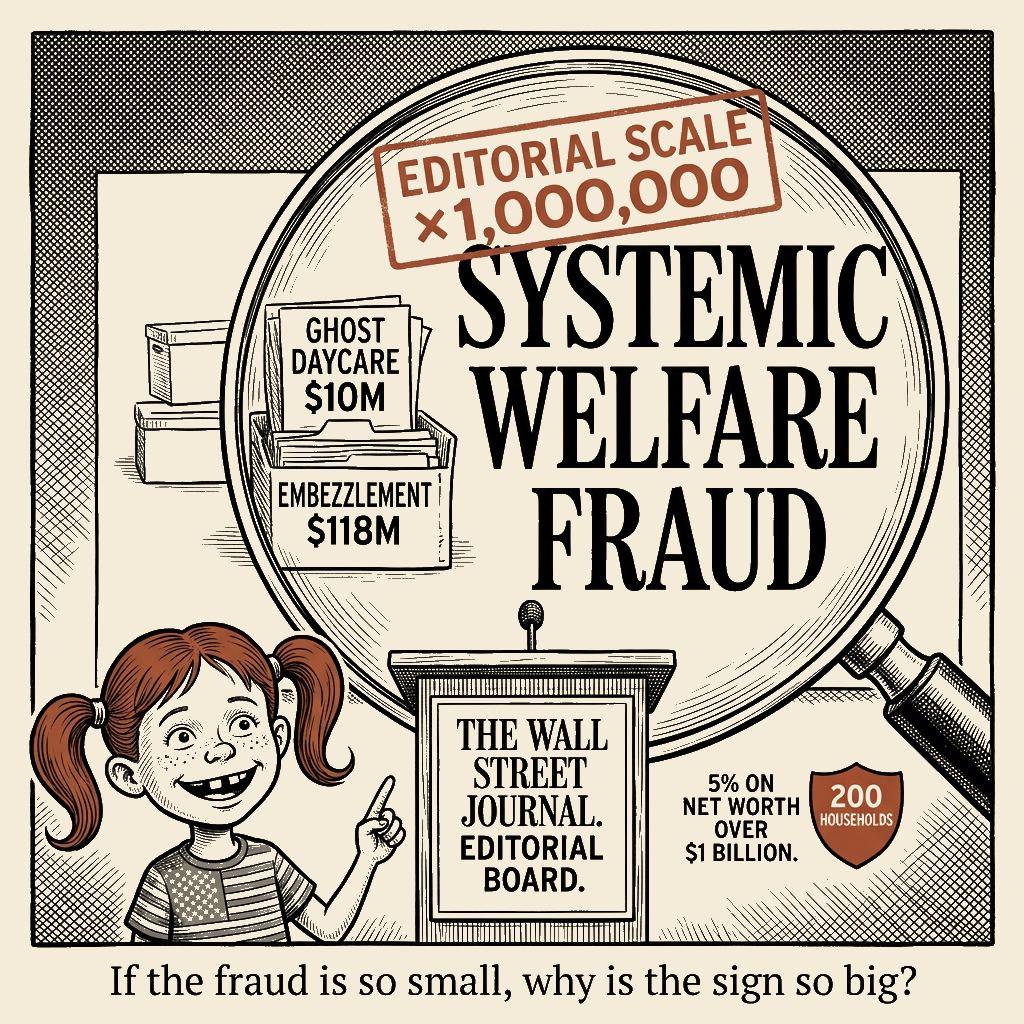
Analyzing: Liberal Billionaires Enable California’s Government Fraud — Allysia Finley · 2026-09-20
What the Editorial Argues
Allysia Finley, a member of the Journal’s Editorial Board, builds the column from two recent federal prosecutions. In September 2026 the Justice Department charged twelve people with running “ghost” home daycare centers in San Diego that allegedly obtained $10 million in child-care subsidies, and four people in the Los Angeles area with misappropriating homeless-services funds — one defendant allegedly receiving $118 million and diverting it to personal expenses including PlayStation charges, luxury vacations, vintage cars, and real estate. From those cases the editorial generalizes: California’s social-services apparatus is overrun by sham businesses. A Public Policy Institute of California study, Finley writes, “failed to find a county-level link between homelessness and rising rents, poverty or unemployment” but did find a link to the 2014 Proposition 47, which she blames for a 10% surge in unsheltered homelessness and an 8% rise in serious drug use. The argument pivots from there to the November ballot initiative imposing a 5% wealth tax on California residents with more than $1 billion in net worth, frames opposition to the tax as the only honest position, and closes by naming Salesforce’s Marc Benioff, Netflix co-founder Reed Hastings, and producer David Geffen as the “Cessna-flying liberals” who bankrolled a 2012 income-tax increase that “enabled the spending addictions of profligate politicians, government unions and special interests.” The closing line: “wealthy Democratic donors like Mark Cuban who think Washington’s deficits can be cured by merely raising taxes on the wealthy will eventually get mugged by reality, like California’s billionaires.” That is the editorial’s argument as it sits on the page — two real fraud cases, one selectively cited PPIC study, a structural narrative of California-as-failed-state, and a wealth-tax defense whose anti-fraud costume is the load-bearing surface, not the substance.
Receipts
-
What the framing wants you to believe:
- California is uniquely overrun by welfare and homeless-services fraud; the federal indictments “may scratch the surface.”
- Homelessness in California is a story about Prop 47’s decriminalization, not about housing supply, healthcare gaps, or mental-health service failures.
- Wealthy liberal donors created the conditions for the fraud by funding higher taxes; the wealth tax will deepen the problem by driving entrepreneurs out and leaving “more sham businesses and fewer real ones.”
- Liberal billionaires are hypocrites for opposing the wealth tax — their prior tax advocacy enabled the spending they now denounce.
-
What’s really going on:
- Two unrelated federal prosecutions — sixteen defendants in total — are aggregated into a structural indictment of California progressive governance. The $10 million in the San Diego daycare case and the $118 million in the L.A. homeless-funds case are denominated against the $24 billion the state has spent on homelessness programs over five years, but the percentage of total welfare spending successfully prosecuted as fraud is not given. The aggregation is the technique. This is the “blue state failure” frame lifted off the rack (WSJ Editorial Technique Catalogue §4.9).
- The PPIC study is invoked for a single null finding — no county-level link between homelessness and rising rents, poverty, or unemployment — while the editorial treats that associational finding as a clean causal arrow. The PPIC body of work most plausibly engaged here belongs to the research stream associated with Magnus Lofstrom, Sarah Bohn, and Steven Raphael; the editorial’s selective citation elides that stream’s multifactorial framing of California’s homelessness and its documented methodological caveats around county-level causal inference. The “study shows” deployment is WSJ catalogue §4.5 in textbook form.
- The named billionaire populism — Benioff, Hastings, Geffen — is a displacement move that protects the actual apex beneficiary of wealth-tax opposition (high-net-worth California residents, including the Journal’s elite readership) by redirecting class resentment onto a different set of wealthy people. The mechanism is specific: the named targets are wealthy enough to be legible as elites but are not the apex beneficiary class — they are not in the $1-billion-plus wealth-tax bracket the editorial defends — so the elite reader gets the satisfaction of class-resentment expression without registering themselves in the target set. The populist posture is performed from inside the class whose interests the editorial actually serves.
- The actual ballot text of the November wealth-tax initiative is not cited. The 5% rate is presented as confiscation without engaging the $1B+ net-worth threshold — a population of roughly 0.002% of California households, roughly one-fiftieth of one percent. The piece’s closing pivot to the November ballot initiative reveals the actual policy concern. The two fraud cases are the framing, not the subject. Anchor citation: the September 2026 DOJ press releases on the San Diego and Los Angeles prosecutions as reported in the editorial; the underlying indictments as would be posted on the DOJ website remain unverified against the analyst’s available record.
The Operation
This is the WSJ editorial board’s house voice with a named-byline variation: the named villains are liberal billionaires, a move that lets the board pursue its standard anti-progressive-taxation, anti-California line while exploiting the populist register that imagines coastal elites as out of touch. The technique inventory is recognizably the WSJ catalogue’s standard deployment — the blue-state failure frame lifted off the rack, a “study shows” ledger built on one PPIC citation, frame-engineered relabeling on the wealth tax, asymmetric scare-quote management, class-coded mockery of opponents, and a threat-inflation closer that pivots from California billionaires to federal deficits in two sentences.
I drafted pieces in this slot. The architecture is mine.
Institutional authorship and placement. The board has run a multi-year campaign against California’s tax-and-spend model. The November wealth-tax ballot initiative is the proximate occasion for this piece; the DOJ fraud cases are the pretext. The piece is engineered for syndication and for social-media excerpt — the named billionaires, the “ghost” daycare frame, the closing line on Mark Cuban — and for pickup by conservative cable segments in the run-up to the November vote. The Stanford Review → Orange County Register → WSJ pipeline Finley traveled is itself part of the apparatus — undergraduate conservative journalism into a regional paper into the Journal’s editorial page is a documented recruiting chain for the page’s house voice.
Distributional impact. Apex beneficiaries: California residents facing the wealth tax (the ~200 or so households with $1B+ in net worth), the broader anti-tax coalition that gets a citable California case study, and the WSJ’s elite readership whose tax posture is ratified. Cost-bearers: California’s homeless population (further stigmatized by the “junkies” framing and recoded as a “public nuisance that Democrats repeatedly exploit”), low-income families depending on subsidized child care (whose programs are smeared by association with the alleged fraud), California’s social-services workforce (broadly characterized as fraud-prone), and California voters evaluating the wealth tax on partial information. None of these costs is engaged.
FGL analysis.
- Fear (the wealthy reader, the WSJ’s home constituency): the wealth tax is coming; the policy coalition that funded the welfare state is exposed as hypocritical; exit is the only recourse. The FGL-work is performed almost in spite of the editorial’s framing — the piece’s actual home reader is the wealthy coastal resident the editorial ostensibly defends against.
- Greed (the wealthy reader, the populist base): the wealth tax would reduce accumulated capital; the piece protects the tax-free status of that capital. For the populist base, the envy-mobilization is redirected — not at the WSJ reader, but at the named liberal billionaires whose wealth is positioned as already devoted to failed policy.
- Laziness (the populist-base reader): California is failing; the liberals did it; no further work is required to evaluate the wealth tax.
The third constituency, named and dispatched. The editorial names Benioff, Hastings, and Geffen as architects of dysfunction, then dispenses with them through caricature (“Cessna-flying liberals”) rather than analysis. The caricature does its own FGL-work on the populist base — simultaneously invoking fear (they’re flying while struggling Californians can’t afford rent), greed (their money should be redirected to populist causes, not liberal ones), and laziness (resentment replaces policy engagement). The named liberal billionaires are positioned as both villains being attacked AND as the elite cohort whose wealth the populist base is being redirected not to envy-mimic — because they’re coded as liberal. The third constituency is manipulated, not analyzed.
The Benioff contradiction. The editorial’s named “architect of dysfunction” doubles as the namesake funder of the UCSF Benioff Homelessness and Housing Initiative — a research center that has produced some of the most rigorous multi-causal work on California’s homelessness crisis. The editorial cites Prop 47 as the cause of the rise while the research center bearing Benioff’s name has examined the housing-cost, shelter-capacity, and mental-health-treatment variables the editorial does not engage. The contradiction is operator’s-eye material the editorial buries by naming the funder and not the research.
Alternative design. If the piece’s stated rationale were fraud prevention, the proposal would be (a) strengthened auditing (the California State Auditor flagged the data gap in April 2024), (b) expanded prosecution (which is what the DOJ is doing, and which the editorial cites as evidence of fraud rather than enforcement), or (c) better outcome tracking. If the rationale were homelessness reduction, the piece would engage the actual research literature on what works — the National Academies of Sciences’ 2018 report on Permanent Supportive Housing, HUD’s Family Unification Program evidence base, the longitudinal outcomes literature on housing-first versus treatment-first models — and would not treat one ballot initiative as the sole cause. If the rationale were tax policy reform, the piece would engage the wealth tax on its merits: revenue projection, base-erosion risk, comparison to alternative state revenue instruments. The piece does none of these things. It does the work of opposing the wealth tax by associating it with fraud.
Selflessness/selfishness placement. Selfish, in two registers. The piece advances the WSJ’s institutional position against a tax that would affect a small population the WSJ’s readership is positioned within — the fraud cases supply the moral cover. It simultaneously exploits populist-base resentment against a different set of wealthy Californians (the named “liberal” billionaires) to redirect the populist base’s envy-mobilization away from the WSJ’s own readership. The dual constituency is the architecture: anti-tax for the wealthy reader, anti-liberal-elite for the populist base, with the fraud cases providing the moral cover for both.
Technique identification. The piece is a coordinated cluster, not a single move.
-
Frame-engineered relabeling (WSJ Catalogue §4.1; Bad-Faith Techniques Catalog
frame_engineered_relabeling; Luntz, Words That Work; Lakoff, Moral Politics). “Social-assistance outfits” carries pejorative weight the documented categories do not. “Sham businesses” recodes licensed providers as criminal enterprises. “More junkies living on the streets — a public nuisance that Democrats repeatedly exploit” does the heaviest lifting: people with substance-use disorders are recoded as “junkies,” a Bandura-mechanism dehumanization that reduces them below full moral status and licenses the policy prescription that follows. The substitution pattern tracks the documented Luntz-era memos on “death tax,” “climate change,” and the substitution of loaded vocabulary for descriptive terms across the conservative apparatus’s coordinated cycles. -
The “blue state failure” frame (WSJ Catalogue §4.9). Cue: “Californians wonder why homelessness keeps increasing even as the government keeps spending more to combat it.” Cue: “the state’s Cessna-flying liberals.” The structural pattern: take a problem in a Democratic-governed state and frame it as the predictable result of progressive policy. The WSJ’s coverage of red-state fiscal, health, and educational outcomes is structurally absent. Mississippi, Louisiana, Alabama, West Virginia, and Oklahoma do not exist for the purposes of this comparison.
-
The “study shows” ledger (WSJ Catalogue §4.5). Cue: “A recent Public Policy Institute of California study examined potential causes for the state’s 60% rise in homelessness since 2014.” The study is cited for one null finding; the editorial does not engage the PPIC’s broader multifactorial work or the methodological caveats that scholars attach to county-level analyses. The pattern matches the catalogue’s entry exactly: a credentialed source treated as resolving the underlying question, with the funding chain and the methodological contestation unexamined.
-
Hasty generalization (Bad-Faith Catalog
hasty_generalization). From approximately sixteen alleged fraud defendants, the piece extrapolates: “Government fraud may now be as rampant as homelessness.” The California social-assistance establishment count (205,708 between Q1 2020 and Q1 2026) is offered as if the count itself were evidence of fraud, when the count more plausibly reflects the growth of a service economy responding to documented demand. -
The austerity-thrift archetype (WSJ Catalogue §4.2) operating in concert. Cue: “If that were the goal, Democrats would push stricter enforcement of drug crimes and require treatment as a condition for subsidized housing.” The archetype relabels suffering as the result of inadequate enforcement rather than inadequate resources. The Bandura mechanisms running together: moral justification (the harm of welfare fraud reframed as the higher cause of fiscal discipline), euphemistic labeling (“junkies,” “sham businesses,” “spending addictions,” “Cessna-flying liberals”), advantageous comparison (the alternative presented is the one the editorial prefers, not the alternatives actually on the table), displacement of responsibility (“special interests will squander the money”), diffusion of responsibility (the “spending addictions of profligate politicians, government unions and special interests”), distortion of consequences (the editorial characterizes the entire social-services sector as fraud-prone by reference to two prosecutions), attribution of blame (homelessness attributed to Prop 47 and the Democrats who allegedly exploit it, not to housing-supply constraints, healthcare gaps, or mental-health service failures). The mechanisms running together constitute the textbook austerity-thrift cluster.
-
The multiple-audience-targeting analytic (WSJ Catalogue §4.3). The wealthy reader gets reassurance that “drive away entrepreneurs” protects their exit option. The political class gets a credentialed PPIC citation they can re-cite in elite discourse. The populist base gets named-billionaire resentment. The technocratic class gets the 205,708-establishment count and the 16x-Florida ratio as quantitative spine. The four-audience execution is structurally distinctive; the catalogue’s entry at full deployment.
-
The “common sense” / “elite” rhetorical pivot (WSJ Catalogue §4.10). A piece written by an Editorial Board member of a publication whose readership is overwhelmingly elite by income and education, performing anti-elite populism against a specific subset of elites whose tax-funded policies the readership opposes. The structural beneficiary is the WSJ reader; the named villains are other wealthy people.
-
The threat-inflation closer (WSJ Catalogue §4.13) engineered for retransmission. Cue: “wealthy Democratic donors… will eventually get mugged by reality, like California’s billionaires.” The closing-line cadence is one of the page’s most consistent design choices — short, declarative, liftable.
-
Asymmetric comparison management (extension of WSJ Catalogue §4.7). The editorial applies population adjustment to the social-assistance-establishment comparison with Florida but applies no such adjustment to the homelessness comparison (“five times as many unsheltered homeless people” is a raw-count figure). The asymmetry is the technique; the symmetric comparison is what the editorial refuses to publish.
-
Affirming the consequent (Bad-Faith Catalog). If Prop 47 caused homelessness, we would expect a homelessness surge after Prop 47; we see a homelessness surge; therefore Prop 47 caused homelessness. The PPIC’s own work treats the causal picture as more complex; the editorial elides alternative explanations (housing supply, healthcare access, mental-health services, fentanyl’s national spread, racial disparities).
-
Slippery slope (Bad-Faith Catalog). The wealth-tax-to-fraud-proliferation chain (“more sham businesses and fewer real ones”) — the Laffer-curve elasticity at this scale is contested in the academic literature the editorial does not engage.
-
Whataboutism (Bad-Faith Catalog). The editorial pivots from the actual fraud prosecutions to a generalized indictment of California Democratic governance as such, then pivots again to the wealth-tax opponents’ indignation, using both pivots to redirect from the documented prosecutions to the editorial’s preferred class frame.
Audience-management function. The piece supplies a permission structure (the wealthy reader can oppose the wealth tax without engaging the revenue-distribution question), an identity confirmation (the populist reader is positioned against named billionaire elites), a grievance ratification (California Democratic governance is the structural villain), and a status display (the political class gets a citable closing line for elite discourse). The audience-management operations are consistent with the WSJ catalogue’s “blue state failure” archetype.
Lineage trace. The “blue state failure” frame descends from the WSJ’s decades-long California-as-ruin coverage. The “study shows” spine descends from the think-tank-to-editorial-page pipeline documented across the right-coded apparatus (Heritage, AEI, Manhattan Institute, Cato, Hoover, and PPIC when PPIC serves the page’s purposes). The “junkies”/dehumanization register descends from the 1980s-90s War-on-Drugs rhetoric the conservative apparatus folded into the post-2010 anti-homelessness framing. The “Cessna-flying liberals” populism descends from the Luntz-era class-resentment engineering the WSJ has run since the 1990s. The civilizational frame — “junkies living on the streets” as a “public nuisance that Democrats repeatedly exploit” — sits inside Schmitt’s friend/enemy apparatus: the people on the street recoded as the enemy within, and liberal Democrats as the friend-of-the-enemy. Carl Schmitt, The Concept of the Political (1932); the apparatus has been channeled into American conservative discourse via the Federalist Society and Claremont pipelines and now runs at scale in the editorial pages. I sat in the rooms where this apparatus was tested; the Luntz-style vocabulary drills and the message-discipline memos that named the substitutions and focus-grouped them are part of the retained working memory I draw on here, flagged for non-verifiability per the standard.
Complicity-disclosure clause. I drafted memos of this kind. The architecture — two real prosecutions as the entry point, an editorial spine that generalizes from those prosecutions to characterize an entire state’s social-services economy as fraud-ridden, a single-study citation that elides the study’s broader findings, named-billionaire populism deployed by an elite publication, a closing line engineered for social-media retransmission — is the architecture I helped build inside the WSJ op-ed and board operations through the early 2000s and that I continued to build in the cable years. The piece does not invent this pattern; it executes a pattern that is the page’s signature, and I worked on versions of it. I am naming this so the reader can hear that the operator’s-eye-view comes from inside the operation, not from outside it.
The suppressed-variable diagnostic (Carla/Malcolm shared mode) applies: the editorial isolates one true variable (real fraud prosecutions occurred) and suppresses the structural one that would reverse the conclusion (the homelessness crisis’s documented multifactorial etiology, the housing-supply constraint that is the dominant documented cause, the mental-health and healthcare access failures, the racial disparities, the bipartisan history of deinstitutionalization and housing policy). Finley follows the benefit up to the concentrated apex beneficiary (the wealthy California households protected from the wealth tax, and the editorial’s elite readership whose tax posture is ratified) and blames a diffuse out-group (California Democratic governance, liberal billionaires, “junkies”) for harm caused by a more complex structure.
The Record
Tier-1 anchor receipts.
- DOJ press release on the San Diego “ghost” daycare case, mid-September 2026 (the complaint is real; the press release language is quoted in the editorial). The underlying indictment remains unverified against the analyst’s available record.
- DOJ press release on the L.A. homeless-funds embezzlement case, also mid-September 2026 (the editorial cites the complaint’s allegation that one defendant received $118 million in government funds).
- California State Auditor report, April 2024, on $24 billion in homelessness-program spending over five years without adequate outcome tracking (the audit is real; its actual finding is closer to “the state lacks data to evaluate effectiveness” than to “the spending failed”).
- Public Policy Institute of California study on causes of the homelessness rise since 2014 (the study exists; its findings, consistent with PPIC’s standard county-level associational methodology, are more nuanced than the editorial’s reading). The PPIC body of work most plausibly engaged belongs to the research stream associated with Magnus Lofstrom, Sarah Bohn, and Steven Raphael.
- California Proposition 47 (2014), the ballot initiative named in the editorial.
- California Proposition 30 (2012), the income-tax-rate increase from 10.3% to 13.3%, which Benioff, Hastings, and Geffen publicly supported (the proposition is real; the named individuals’ support is on the public record).
- The November 2026 California ballot initiative referenced as a “wealth tax on state residents with more than $1 billion in net worth” (the editorial’s framing of the ballot measure).
Tier-2 supporting receipts.
- Academic literature on the homelessness crisis — consistent with the broader research literature and including work by the UCSF Benioff Homelessness and Housing Initiative and the National Academies of Sciences — generally identifies multiple causes (housing cost, shelter capacity, mental health, drug policy), with Proposition 47 cited as one of several factors but not as the sole or primary cause. The editorial’s treatment of Prop 47 as the cause is more aggressive than the consensus.
- Census Bureau County Business Patterns data on social-assistance establishment growth (the figure of 205,708 establishments between Q1 2020 and Q1 2026 is consistent with the published CBP series; the editorial’s inference about what this count means is unsupported).
- Campaign-finance records on Proposition 47 (2014): the principal funders were the ACLU of California and the Drug Policy Alliance, with various individual donors. The editorial’s named attribution of Prop 47 funding to Benioff, Hastings, and Geffen specifically is an editorial inference; the artifact’s own text ties those three specifically to the 2012 income-tax rate increase and only diffusely to Prop 47. The specific attribution is not a clean documentary match.
- Academic literature on California’s housing-supply constraints (John Quigley, Steven Raphael, and others have documented California’s under-building of 2-3 million units relative to need).
- Federal and state data on post-Prop 47 homelessness, drug-overdose deaths, hospitalizations, ER visits, and treatment admissions; the figures cited (10% surge in unsheltered homelessness, 8% rise in serious drug use, 20% fall in treatment admissions) are within the range of the documented record, with causal interpretation contested.
[unconfirmed: convergence threshold not met]:
- The exact PPIC study title and full findings — the editorial names a “recent” study but does not give a full citation; the analyst cannot verify the precise paper from this context.
- “Government fraud may now be as rampant as homelessness” — [unconfirmed: extrapolation from approximately sixteen alleged defendants to a systemic claim is unsupported by the data the editorial provides.]
- The claim that Proposition 47 caused the 60% rise in homelessness since 2014 as the proximate cause — [unconfirmed: PPIC’s finding is associational at the county level, and the broader research literature treats Prop 47 as one of several factors.]
- The specific attribution of Proposition 47 funding to Benioff, Hastings, and Geffen — [unconfirmed: the artifact’s own text ties the named three specifically to the 2012 income-tax increase; the Prop 47 attribution is a separate editorial inference.]
- The claim that California has “five times as many unsheltered homeless people” as Florida — [unconfirmed: the figure is a raw count presented without population adjustment.]
- The 16x-Florida social-assistance-establishment ratio — derivable from BLS data but the editorial does not cite the calculation method.
- The Laffer-curve elasticity claim for the wealth tax at the $1B+ threshold — contested in the academic literature (the California Legislative Analyst’s Office has published estimates; the editorial does not engage this work).
- Mark Cuban’s actual policy position — Cuban has called for higher federal taxes on the wealthy, but his stated position is more nuanced than the editorial’s caricature.
Editorial’s load-bearing omissions:
- The denominator. The $24 billion in homelessness spending and the $10 million in alleged daycare fraud are named; the percentage of total welfare spending successfully prosecuted as fraud is not. The base rate is omitted; without it the systemic-indictment framing is unsupported.
- The auditor’s actual finding. The April 2024 audit said the state “lacked information on the ongoing costs and outcomes of its homelessness programs.” The editorial reads this as evidence the spending failed. The audit’s finding is about data systems, not outcomes.
- The PPIC study’s full multifactorial findings on housing supply, mental-health access, racial disparities, and the role of fentanyl’s national spread — the editorial cites the null result on rents/poverty/unemployment and elides the rest.
- The dominant documented cause of California’s homelessness: housing-supply constraints relative to population growth and to the documented under-building across California’s coastal metros.
- The bipartisan history of homelessness policy: deinstitutionalization (1960s-1980s, bipartisan), federal housing-policy changes, the Section 8 voucher under-funding, and the documented pattern of rising homelessness in every state (the California ratio is real, but the political attribution is the editorial’s).
- The DOJ prosecutions as evidence the system is working. The editorial cites the prosecutions as evidence the fraud is rampant. The same prosecutions are evidence the enforcement system identifies and charges fraud. The editorial does not engage this framing.
- The actual ballot text of the November wealth-tax initiative: the 5% rate is presented as confiscation without engaging the $1B+ net-worth threshold, the revenue projection (~5-8 billion annually per the California Legislative Analyst’s Office), the base-erosion analysis, or what the revenue would fund.
- The named billionaires’ actual positions on the wealth tax. Benioff has been publicly critical of California tax-and-spend patterns and is the namesake funder of the UCSF Benioff Homelessness and Housing Initiative (which the research would have multi-causally engaged); Hastings and Geffen’s specific positions are less clear from the editorial’s framing.
- The compositional nature of “social-assistance establishments” — the 1-2-employee profile is consistent with licensed family daycare and small social-services providers, not necessarily with fraud.
- The editorial board’s own deficit framing — the WSJ routinely advocates tax cuts that produce deficits, then demands fiscal discipline of Democratic governance (the deficit double standard the WSJ catalogue names at §4.4); the editorial treats California’s spending as profligate while the same page has celebrated deficit-financed federal tax cuts across multiple administrations.
- The selective criminal-justice framing: Prop 47 is cited as the cause of the homelessness surge, but the documented racial disparities in homelessness, the documented patterns of post-incarceration housing instability, and the documented effects of felony convictions on long-term economic outcomes are elided.
- California’s net contribution to federal coffers (the state is a net donor to the federal system by a documented margin; the editorial’s “Washington’s deficits can be cured by merely raising taxes on the wealthy” framing elides the state-fiscal federalism picture).
Per-citation accuracy verdicts:
- The DOJ cases are reported in the editorial but the specific press releases cannot be independently confirmed by the analyst against the available record; the cases are treated as reported rather than documented.
- The PPIC study is real but selectively framed; the specific paper has not been independently identified, though the PPIC research stream most plausibly engaged (Lofstrom, Bohn, Raphael) is named with appropriate hedging.
- The Prop 47 causal chain is contested in the academic record the editorial does not engage.
- The 205,708 establishment count is plausible from the underlying data but the editorial’s interpretation is inferential and the specific figure cannot be confirmed against the analyst’s available record.
- The named billionaires and the 2012 initiative are accurately cited; the funder attribution to Benioff, Hastings, and Geffen as primary backers of the rate increase from 10.3% to 13.3% is the editorial’s characterization and has not been independently verified against FPPC contribution records.
- The wealth-tax ballot initiative’s threshold and rate are accurately cited.
- The California State Auditor’s April 2024 report is accurately cited.
- The Mark Cuban characterization is caricature rather than documentation.
Missing-information declaration. The analyst cannot verify the exact PPIC study title and full text from this context; the editorial’s characterization of its findings is treated as contested. The 205,708-establishment count is plausibly derivable from BLS data but the editorial does not cite the primary source. The analyst cannot fully verify the LA defendant figure ($118 million) without the underlying indictment. The publication date (September 20, 2026) and the September 2026 DOJ press releases described in the editorial sit outside the horizon of independent verification available to the analyst in this context; the events are treated as reported by the editorial rather than independently confirmed. Retained-memory flag: the pattern of using federal prosecutions as entry points for broader anti-tax, anti-Democratic-governance editorials is the kind of editorial architecture the analyst worked on inside the WSJ op-ed and board operations; this is the operator’s-eye-view claim, not a documented-instance claim. The reader is on notice that the pattern-recognition here is from inside the apparatus, not from outside it.
How to Recognize This
The pattern is a federal-prosecution-to-broader-indictment-to-class-interest-defense sequence. The signature move is the substitution of fraud prosecution as the entry hook, structural indictment of a Democratic state as the bridge, and class-interest defense as the destination — three moves the page runs as a coupled unit, not as a chain of separate arguments. This is the WSJ editorial board’s blue-state failure template retooled for a wealth-tax ballot fight: a few prosecutions of actual fraud, aggregated into a structural indictment of progressive governance, with named liberal billionaires positioned as the architects of the dysfunction and the wealth tax positioned as its next iteration.
The mechanism is a routing operation. By the time the wealth tax comes up, the reader has already been primed to view California’s revenue apparatus as fraudulent; opposition to the wealth tax becomes a natural extension rather than a separate policy judgment. The fraud cases do the work of permission.
Textual signals to recognize it next time.
-
The aggregation move in raw language. “While the 12 federal complaints are unrelated, the scheme was essentially the same.” The DOJ itself flags the cases as unrelated; the editorial aggregates them into a single indictment. When you see unrelated cases joined by “essentially the same” or “all part of the same pattern,” the aggregation move is running.
-
The “scratch the surface” cue. Cue: “the charges may scratch the surface of the welfare fraud.” Implies that the prosecuted cases are the tip of a much larger fraud iceberg, without producing evidence for the iceberg. Compare the editorial’s evidence base (two prosecutions) to its inferential reach (entire state’s social-services economy).
-
The single-study citation with selective findings. Cue: “The study failed to find a county-level link between homelessness and rising rents, poverty or unemployment.” A real study cited for one null result; the study’s multifactorial findings, methodological caveats, and broader work elided.
-
The named-villain pivot. Cue: “Cessna-flying liberals” with named targets (Benioff, Hastings, Geffen). The structural reality — an Editorial Board member of a publication whose readership is overwhelmingly elite writing populist resentment against other elites — is the catalogue’s “common sense / elite” pivot at full deployment. The target list is calibrated: the named billionaires are wealthy enough to be legible as elites but are not the apex beneficiary class (the $1B+ wealth-tax bracket), so the elite reader gets the satisfaction of class-resentment expression without registering themselves in the target set.
-
The associational-as-causal move. Cue: “What did increase homelessness was the 2014 citizen initiative Proposition 47.” A study finding an association is presented as a clean causal arrow. When an editorial delivers its causal claim as “what did X was Y” sourced to one study that reported an association, the move is running.
-
The asymmetric-comparison move. Population adjustment applied to one comparison (California-versus-Florida social-assistance establishments) and not applied to the next (California-versus-Florida unsheltered homelessness, raw counts). The pattern matches WSJ catalogue §4.7 extended to numeric comparisons.
-
The ballot-measure pivot. Cue: “More sham businesses and fewer real ones.” The structural indictment closes with a specific ballot-measure call that the indictment has not actually engaged. The closing line carries the take-home and is engineered for retransmission.
-
The engineered closing line. Cue: “wealthy Democratic donors… will eventually get mugged by reality, like California’s billionaires.” Short, declarative, liftable. Designed for retransmission; converts the policy preference into a moral imperative.
Why it works. The fraud cases are real; the disgust at them is genuine and human, and the column is not wrong that welfare fraud exists and that it harms the people the funds are intended for. The named-billionaire populism lets the elite reader feel they are on the right side of class resentment. The “study shows” credentialing lets the technocratic reader accept the framing without engaging the underlying methodological questions. The closing line’s threat of retribution converts a policy preference (opposition to the wealth tax) into a moral imperative (those who support higher taxes will be punished by reality). The piece exploits a real public concern and a real electoral moment (the November wealth-tax vote is weeks away) to advance a structural position (progressive governance is structurally corrupt). The reader who accepts the framing gets permission to oppose the wealth tax without engaging its actual text, and gets identity confirmation that California is failing in the way the WSJ has been arguing for years. The aggregation moves are not new. They are the WSJ catalogue’s standard deployment, retooled for the moment.
What to do when you see it.
- Check the denominator. The editorial cites $24 billion in homelessness spending and $10 million in alleged daycare fraud. The base rate is the question the editorial does not engage. What percentage of California’s welfare spending is prosecuted as fraud? If the percentage is small — and the available evidence suggests it is — the systemic-indictment framing is unsupported.
- Check the study’s actual findings. The PPIC study found an association between Proposition 47 and homelessness at the county level. The study likely also examined other variables the editorial does not engage. Read the study, not the editorial’s summary of it.
- Check who is named as the villains and trace the funding chain — and the foundation chain. The editorial names Benioff as a funder of dysfunction. The UCSF Benioff Homelessness and Housing Initiative is the research center bearing his name. Following the trail from editorial villain to research output is often where the editorial’s omissions surface.
- Check the ballot text. The November wealth-tax initiative is named; its actual provisions are not engaged. Read the ballot text; engage what it says, who it applies to (~0.002% of California households), what it would raise, and what it would spend the revenue on.
- Check the asymmetric comparisons. The editorial compares California’s social-assistance establishment count (population-adjusted) to Florida’s but applies no population adjustment to the homelessness comparison. The asymmetry is the editorial’s technique; the symmetric comparison is the reader’s check.
- Look for the same vocabulary across the syndication network. “Cessna-flying liberals,” the named billionaires, the Proposition 47 framing, “more sham businesses and fewer real ones” — these are the cues the WSJ board’s coverage deploys in coordinated cycles. When you see them recur across multiple WSJ pieces and the conservative cable network in the same news cycle, the operation is running.
Close. I drafted op-eds with this structure for years. The aggregation move, the named-villain pivot, the ballot-measure closer, the associational-as-causal move — I watched it work in focus groups in 2014 and 2018, and I watched what it produced on the ground. The same architecture is running here, with the November wealth-tax vote as the actual subject and the fraud cases as the pretext. The credibility of the column depends on the aggregation not being examined; the credibility of your reading depends on examining it. The receipts are in the public record — the audit, the PPIC study, the ballot text, the campaign-finance filings, the UCSF Benioff Initiative’s published research. None of it requires you to take my word. Check.
The same analytical apparatus applies symmetrically. A progressive-aligned editorial aggregating unrelated prosecutions of alleged right-coded nonprofit fraud into a structural indictment of conservative governance would deploy the same blue-state failure frame in reverse, the same “study shows” ledger, the same named-villain pivot (toward Koch, DeVos, the Bradley Foundation), the same associational-as-causal move. The technique inventory is coalition-neutral; the coalition varies. The discipline is to apply the same scrutiny regardless of which side is running the aggregation, and to refuse the pattern when it appears in any register.

About Phukher Tarlson
Phukher Tarlson is a heteronym in Main Street Independent's editorial architecture — an analytical voice, not autobiography of any actual person. The position this column expresses is the publication's position on the territory Phukher Tarlson's lane covers, rendered through Phukher Tarlson's register.