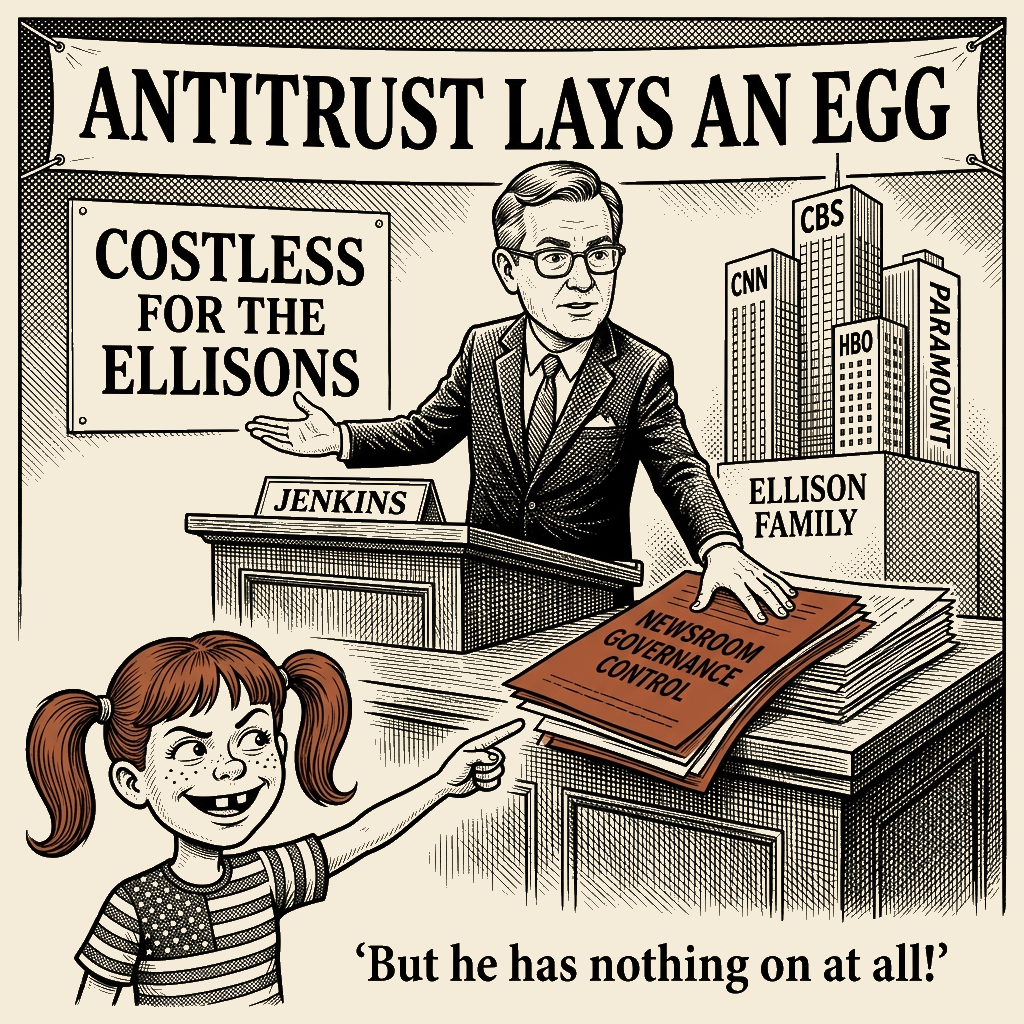
Responding to: Antitrust Lays an Egg — Holman W. Jenkins, Jr. · 2026-09-22
What the Piece Argues
Jenkins’s column characterizes California Attorney General Rob Bonta’s antitrust suit against the Paramount-Warner Bros. merger as a personal political exercise that ended in capitulation when 12 states settled the case. The piece argues that the settlement’s editorial-board concession is costless for the Ellisons and that the merger is closed in substance. Jenkins extends the same “pseudo-events” diagnosis to other contemporary controversies — the Trump media-coverage fight, climate attribution research, and what he calls “narrative” journalism — and concludes that the broader strategy of manufactured political controversy is exhausting itself.
Receipts
The piece wants you to believe Bonta’s antitrust suit was theater, the Ellisons won cleanly, and “pseudo-events” are dying — meanwhile the structural stakes of media consolidation go unnamed.
-
The framing wants you to believe:
- Bonta’s suit was “all politics” and he “caved” — personal ambition, not enforcement
- The “editorial board” remedy is “costless for the Ellisons” and meaningless
- “Success for the Ellisons on all fronts” — the merger is settled and dusted
- “Pseudo-events” — Trump-media fights, climate attribution, narrative journalism — have stopped working
- 70 jurisdictions approved the merger; the antitrust challenge was always hopeless
-
What’s really going on:
- ANCHOR: The “editorial board” remedy Jenkins dismisses as “costless for the Ellisons” is a structural concession on newsroom governance at CBS News and CNN — a concession a corporation that had done nothing wrong would not make as part of a settlement for an antitrust case Jenkins himself calls “political theater.” Jenkins does not resolve this contradiction. The contradiction is the column.
- The Skydance-Paramount merger (closed 2025) put the Ellison family in control of CBS News and Paramount Pictures; the Warner Bros. acquisition would add CNN, HBO, Warner Bros. Pictures, and a vast content library to that stack — one family controlling most American legacy news and entertainment infrastructure is the structure the Bonta suit was attempting to address
- The “70 jurisdictions approved” framing omits that the 12 jurisdictions that filed suit are also jurisdictions, with state-law authority (consumer protection, charitable-asset stewardship, state antitrust claims) that federal approval does not extinguish
- PEN America and the News/Media Alliance have documented press-freedom concerns tied to media ownership concentration; Pew Research has documented the long-term reduction in independent local news ownership that this merger extends and accelerates
- The “pseudo-events are dying” thesis collapses on its own evidence: the column depends on a manufactured narrative (Bonta = political hack, Ellisons = innocent winners, antitrust = theater) that is itself a pseudo-event in exactly the sense Jenkins names
The Response Ladder
Polite Reframe
When to use: at the Thanksgiving table where a relative has just finished quoting Holman Jenkins approvingly and you want to redirect without starting a fight.
The woman who runs the lighting department on a mid-budget Warner Bros. feature is not paying close attention to the Bonta antitrust suit, and she shouldn’t have to. But the structural argument the suit was making is the structural argument that decides whether her next contract gets her any leverage at all. When one family controls the studio, the cable channel, the news division, and the streaming platform, her leverage at contract time drops toward zero — and the news division the studio owns will have a structural interest in not reporting the labor disputes the studio is producing. That is the argument California Attorney General Rob Bonta was attempting to make in his antitrust suit against the Paramount-Warner Bros. merger.
Holman W. Jenkins Jr. dismissed that argument as “political theater” on the editorial page of The Wall Street Journal last week. He announced that the “wheeze” of pseudo-events is no longer working. The column is doing the work the column accuses Bonta of doing: it scripts a verdict through podcast hosts and an American Enterprise Institute fellow, never engages the substantive question of what is being consolidated and why, and announces that public scrutiny of concentrated corporate power has exhausted itself.
The News/Media Alliance and PEN America have both documented press-freedom concerns tied to ownership concentration — not because the Ellisons are villains in private life but because the structure itself produces editorial alignment pressure no individual owner can fully resist. Pew Research has documented the steady reduction in independent local news ownership over two decades — the trend the Ellison-Warner merger extends and accelerates. The “editorial board” remedy Jenkins dismisses as “costless” is a structural concession on newsroom governance — a concession a corporation that had done nothing wrong would not make as part of a settlement for an antitrust case that was “political theater.” Jenkins does not resolve the contradiction. The contradiction is the column.
The Sherman Act was passed in 1890 to break up the kind of concentrated commercial power that had grown into the East India Company moment of its day. The Clayton Act of 1914 reinforced it. The point is not that consolidation is always wrong; the point is that the public has a standing interest in asking what is being consolidated and why. The Founders revolted against an East India Company. When five companies own everything, you are living in a corporate oligarchy, not a free market — and the antitrust suit was an attempt to keep the door from closing.
That’s what the column was about. That’s what “the wheeze” was for. It’s not done.
Mockery and Ridicule
When to use: at the WSJ subscriber who says the editorial page “just calls them like they are.”
The Jenkins column begins with a podcast host saying Bonta “caved,” continues with another podcast host saying the suit was “all politics” to raise Bonta’s “profile,” cites Roger Pielke Jr. of the American Enterprise Institute for the proposition that climate attribution research is “pseudo-news,” and closes by announcing that the “wheeze” of pseudo-events is no longer working. The column is itself a pseudo-event scripted to generate coverage of a pseudo-event. The journalistic noun for this is “riff”; the technical noun is “engagement bait.”
Let’s go through what the column actually does. It cites 70 jurisdictions that approved the deal. It does not cite the 12 that didn’t, including the State of California — the third-largest state economy in the union, where the company being consolidated does much of its business. It mocks Mark Ruffalo for calling the settlement a “huge win to Trump and his billionaire cronies” and offers, in response to the substance of Ruffalo’s claim, a repetition, in different words, that Ruffalo is being theatrical.
It cites Pielke — an AEI fellow whose institution has been funded by fossil-fuel philanthropy since the 1990s, including documented grants from Koch foundations and ExxonMobil-adjacent donors — and stops at the citation. It does not name the lead authors of the WWA studies Pielke critiques. It does not engage the methodology on its merits. The critic’s name is the receipt.
The “editorial board” remedy that Jenkins calls “costless for the Ellisons” is not free. It is the structural concession a determined enforcer extracts from a determined acquirer. A corporation that hadn’t done anything wrong does not give up editorial control of two of its news properties as part of a settlement for an antitrust case that was “political theater.”
Jenkins’s column depends on a load-bearing factual core the reader can check — and the check fails. The check fails because the column does not engage the substance of what it is dismissing. This is the opposite of the wheeze stopping. This is the wheeze functioning exactly as the wheeze has always functioned: on the editorial page of a newspaper owned by News Corp, which is itself a media conglomerate that Jenkins is arguing does not need antitrust scrutiny.
This is the structural case for why antitrust enforcement isn’t theater. The people who call it theater are the people whose structural position depends on nobody checking the structure.
Nuclear Satire
When to use: at the relative who keeps forwarding Jenkins columns and calling them “commonsense.”
Holman W. Jenkins Jr., member of the editorial board of The Wall Street Journal — a publication owned by News Corp, which is itself a media conglomerate controlled by the Murdoch family — has declared that the “wheeze” of pseudo-events is no longer working. He is writing on the editorial page of a media conglomerate, in defense of another media conglomerate’s right to acquire most of the remaining American entertainment and news infrastructure. He accomplishes this by attacking the credibility of a state attorney general who attempted to use the antitrust laws the editorial page of the Journal once supported. The piece is called “Antitrust Lays an Egg.” The piece is itself laying an egg. The egg is the column.
Pause for the architecture.
Jenkins cites 70 jurisdictions that approved the deal. He does not cite the 12 that didn’t, including the third-largest state economy in the union. He mocks Mark Ruffalo for calling the settlement a “huge win to Trump and his billionaire cronies.” The only response to Ruffalo’s substance is to repeat, in different words, that Ruffalo is theatrical. He cites Pielke of the American Enterprise Institute — funded in significant part by fossil-fuel philanthropy, with documented grants from Koch foundations and ExxonMobil-adjacent donors, four decades of “scholarly skepticism” on climate science — as the receipt for climate attribution science being “pseudo-news.” The critic’s name is the receipt. The critic’s institutional funding goes unnamed.
The “editorial board” remedy that Jenkins dismisses as “costless for the Ellisons” is a structural concession on newsroom governance. The column does not resolve why a corporation that had done nothing wrong would give up editorial control of two of its news properties as part of a settlement for an antitrust case that was “political theater.” The column does not notice this contradiction. The contradiction is what the column is.
This is what monopoly looks like when monopoly has been laundered through enough editorial pages to call itself “the market.” A single family — the Ellisons — acquiring Paramount, then CBS News, then CNN, then HBO, then Warner Bros., then the Warner Bros. library, then Max, then DC — is not a series of separate commercial decisions. This is a structural transfer of the apparatus that produces American narrative from diffuse commercial ownership to concentrated family ownership. The transfer is the story. The Bonta lawsuit was attempting to slow the transfer. The Bonta lawsuit did not slow the transfer. Jenkins celebrates the failure to slow the transfer as a victory of the market.
The market is not what is happening. What is happening is one family acquiring the apparatus of American narrative. The market is the word Jenkins uses for it.
The antitrust laws were written for the East India Company moment — when commercial concentration became structural political concentration, when the apparatus of public narrative was about to be concentrated in the hands of a single corporate body the public could no longer check. The moment is recurring. The Bonta lawsuit was the public attempting to meet it. The Wall Street Journal editorial page is the moment explaining why meeting it is impossible. The moment is the editorial page.
A structural question worth holding onto: who pays the price when the editorial page of one media conglomerate celebrates another media conglomerate’s absorption of most remaining American narrative infrastructure as a triumph of the market? The workers don’t. The audiences don’t. The reporters don’t. The only entity paying the price is the public-interest machinery Jenkins is announcing the death of — and that machinery, inconveniently, is the only thing that has ever slowed this kind of consolidation in the United States. The Sherman Act was passed for this. The Clayton Act was passed for this. The question of whether the antitrust laws still apply is the question of whether the United States remains a republic or has become a holding company.
Profane Scorched-Earth
When to use: at the Thanksgiving table where someone is loudly explaining that Bonta “caved” and you need to put the column down on the table.
Holman Jenkins of the Wall Street Journal editorial page — the editorial page of a goddamn media conglomerate defending the right of another goddamn media conglomerate to absorb most of the remaining American news and entertainment infrastructure — wrote a column last week titled “Antitrust Lays an Egg.” The column declares that California Attorney General Rob Bonta’s antitrust suit was “all politics.” The column celebrates “success for the Ellisons on all fronts.” The column closes by announcing that the “wheeze” of pseudo-events is no longer working. The “wheeze,” in Jenkins’s bullshit vocabulary, is the entire apparatus of public scrutiny of concentrated corporate power — the antitrust suit, the climate attribution research, the editorial complaints, the “narrative” journalism Jenkins doesn’t fucking like. He is announcing its death from the editorial page of a newspaper that is itself a media conglomerate. The patient is reading his own fucking chart.
Let us goddamn count what the column does not do. It does not engage Bonta’s substantive claims under the Clayton Act. It does not cite any antitrust economist, any labor economist, any media scholar, any FCC commissioner past or present. It does not name the people who would lose leverage, employment stability, or editorial independence under the merged structure. It cites a podcast host named Sean McNulty, a podcast host named Matt Belloni, an analyst named Rich Greenfield, and an AEI fellow named Roger Pielke Jr. — and presents their shit-talk as the structural verdict on the merger. The hosts are not economists. The hosts are not labor lawyers. The hosts are not the people the merger affects. The hosts are the people the merger benefits. They are the fucking hosts.
The AEI is funded by fossil-fuel philanthropy, including documented grants from Koch foundations and ExxonMobil-adjacent donors, has spent four goddamn decades producing shit-talk on climate science under the rubric of “scholarly skepticism,” and is not a fucking credible source on whether climate attribution science is pseudo-news. Jenkins cites Pielke’s dismissal of ninety-six WWA studies. He does not engage the studies. He does not name the lead authors. He does not engage the methodology on its merits. He cites the critic and fucking stops. The critic’s name is the receipt.
The “editorial board” remedy that Jenkins dismisses as “costless for the Ellisons” is a structural concession on newsroom governance — a concession that a corporation that hadn’t done anything wrong wouldn’t goddamn make as part of a settlement for an antitrust case that was “political theater.” Jenkins does not resolve this fucking contradiction. The contradiction is what the column is.
This is the antitrust case. This is the fucking antitrust case. The Sherman Act of 1890 and the Clayton Act of 1914 were the legislative recognition that shit like this happens, that shit like this happens regularly, and that the public interest requires fucking intervention. The East India Company lost. The Standard Oil trust was broken up. Ma Bell was broken up. Microsoft was broken up. The fucking point of antitrust law is that shit like this doesn’t get to consolidate without the public asking what the fuck is being consolidated and why.
The Paramount-Warner-Ellison-CBS-CNN-HBO-Warner Bros. stack is the shit. The Bonta lawsuit was the public asking. The answer was: it’s fine. Don’t worry about it. The wheeze is over.
The wheeze is not over. The wheeze is the only thing working. The editorial page of the Wall Street Journal is the public-interest machinery explaining to you, with a straight face, that the public-interest machinery has stopped working. The editorial page is the wheeze. The editorial page is asking the wheeze to stop. The editorial page is fucking failing.
By any means necessary that operate within the analytical and political instruments available to us, we name what the editorial page has done. We name the structural transfer of the apparatus of American narrative from diffuse commercial ownership to concentrated family ownership. We name the editorial defense of that transfer as power-protecting bullshit. We name the “wheeze” as the public attempting to hold concentrated corporate power accountable, and we name the editorial page as the attempt to make that attempt fail.
We name what the editorial page is. The editorial page is the wheeze, working.

About Malcolm Little King
Malcolm Little King is a heteronym in Main Street Independent's editorial architecture — an analytical voice, not autobiography of any actual person. The position this column expresses is the publication's position on the territory Malcolm Little King's lane covers, rendered through Malcolm Little King's register.