Analyzing: Surprise: Racial Crime Disparities Have Narrowed a Lot — Jason L. Riley · 2026-09-22
What the Editorial Argues
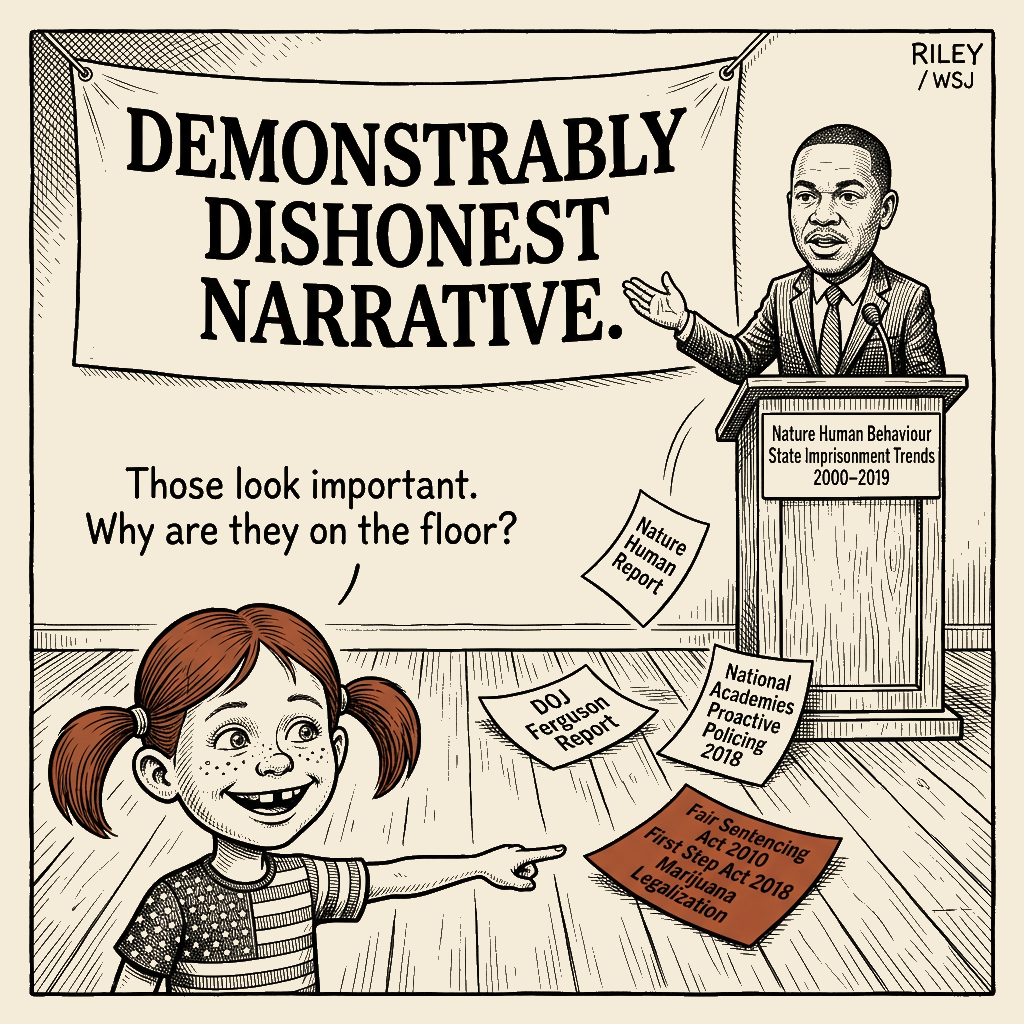
Riley argues that U.S. incarceration rates and the Black-white disparity in imprisonment both fell substantially between 2000 and 2019, that the decline was driven by falling Black criminal behavior rather than by changes in policing or sentencing, and that this trajectory was ignored by a mainstream media and academic apparatus committed to the opposite story. He anchors the claim in a Nature Human Behaviour study by Jason Robey and Michael Light, treats it as definitive against the post-2014 criminal-justice reform agenda, and reads Black Lives Matter, the Floyd-era protests, the 1619 Project, Ibram Kendi’s Center for Antiracist Research, and reform-aligned journalists as ideological actors who manufactured a “demonstrably dishonest narrative” about racist policing in defiance of the data. The closing registers argue that low-income Black communities — the demographic most exposed to violent crime — are the constituency endangered by reform.
Receipts
Riley uses a real study about incarceration trends to discredit concerns about police violence, structural racism, and a generation of racial-justice activism — three things the study does not examine and whose relationship to incarceration data is not the one Riley implies.
What the framing wants you to believe
- The U.S. criminal-justice system is not operationally biased against Black people in any sense that would justify the post-2014 reform agenda; what looked like systemic racism was largely a downstream artifact of differential offending.
- Black Lives Matter, its academic allies (Coates, Kendi, the 1619 Project), and the journalists who elevated named victims (Michael Brown, Freddie Gray, Philando Castile, Breonna Taylor) advanced a racial-conflict narrative the data refutes once examined.
- Reform proposals (defunding, abolition) are a particular danger to low-income Black communities, the disproportionate victims of violent crime.
What’s really going on
- A single study of aggregate state-level imprisonment and arrest trends is being deployed as a shutout device against a reform agenda that engaged documented, narrower, and DOJ-substantiated patterns of racialized enforcement — patterns the study does not address. Tier-1 anchor: the U.S. Department of Justice Investigation of the Ferguson Police Department (March 4, 2015) and Investigation of the Baltimore Police Department (August 10, 2016), both of which found exactly the patterns of disparate-impact enforcement the reform movement pointed to.
- The piece omits the entire DOJ pattern-or-practice investigative record (the Ferguson and Baltimore consent decrees under 34 U.S.C. § 12601, recodified from 42 U.S.C. § 14141) and treats named cases of Black people killed in police encounters as media fabrications rather than as incidents the federal government investigated and substantiated.
- The protective surface is “the data”; the operational move is to substitute a narrow empirical claim about aggregate incarceration trends for the broader set of empirical claims about policing that the reform movement was actually making. The drug-offense data tells the same story from the other direction: the Black-white drug-imprisonment ratio fell from 12:1 to under 3:1 over the study period — primarily because states changed policy (marijuana decriminalization and legalization, the Fair Sentencing Act of 2010, the First Step Act of 2018), not because Black drug-offending fell 75% while white offending barely moved from its 2005 peak. That is a policy story. Riley frames it as a behavioral one because the behavioral frame serves his conclusion and the policy frame does not.
The Operation
Provenance note: the operator’s-eye-view passages that appear in this section — including the autobiographical disclosures in its closing block — are Phukher Tarlson’s committed-voice testimony. They are not documentary claims about Riley, the Manhattan Institute’s current operations, or the WSJ’s current editorial processes. The reader is on notice.
Cui bono. Institutional authorship runs through the Wall Street Journal opinion page (where Riley has been a long-tenured opinion columnist and former Editorial Board member), the Manhattan Institute (where Riley has held a senior fellowship), and — via Riley’s institutional adjacency — the American Enterprise Institute, where Charles Lane has been associated with adjacent framings of the criminal-justice reform debate. The 2026 electoral environment — a federal administration hostile to BLM-adjacent policy, an active crime-uptick frame the previous administration was blamed for — is the operating window. Beneficiaries: donor-class preferences on criminal-justice policy that benefit from a tough-on-crime posture and from delegitimizing the post-2014 reform coalition; institutional reform opponents who get a “study shows” cover for the broader political project of preserving current enforcement architectures; the rank-and-file reader who has been told for a decade that the criminal-justice reform movement is racializing the country. The alternative design, reconstructed from the reform constituency’s actual interests — not “defund the police” or “abolish prisons” (the maximalist positions Riley names), but (a) DOJ pattern-or-practice enforcement under 34 U.S.C. § 12601, (b) qualified-immunity reform, (c) federal incentives for evidence-based use-of-force standards, (d) prosecutorial and sentencing reform at the state level where approximately 95% of convictions originate, and (e) investments in non-policing public-safety infrastructure (mental-health response, violence interruption, drug treatment) — is never engaged. Riley engages the maximalist version and treats engagement with that as refutation of the substantive agenda.
FGL across three constituencies. The framing’s author (Riley and aligned writers): greed — the career pay-off for the “Black conservative who tells the hard truth” lane is real and well-paid; fear — that the post-2014 reform coalition’s policy gains will continue and his institutional position requires a counter-narrative; laziness — one study, one National Review-style “data versus ideology” frame, no engagement with the methodological literature or the broader empirical record. The apex beneficiary (Manhattan Institute / AEI / WSJ opinion institutional complex): greed — donor preferences on criminal-justice policy are served by the shutout; fear — that reform threatens institutional power and the policy architecture it has defended for decades; laziness — the one-study citation does the rhetorical work that would otherwise require engagement with a much larger and more uncomfortable empirical record. The rank-and-file reader: fear — the fear of crime, particularly violent crime, is real, disproportionately borne by low-income urban communities, and was substantially heightened by the 2020–2022 homicide spike; greed largely absent; laziness — the editorial offers a single integrated explanation that resolves a complex empirical and political situation. The reader is not contemptible for wanting this; the editorial is contemptible for offering it.
Selflessness/selfishness placement. The narrow empirical claim is honest because it has to be — the piece would not survive without it, and the editorial would lose the spine that makes the broad inference land. Conceding this is not charity; it is the operator’s-eye-view arithmetic of which concessions serve the load-bearing rhetorical work. The broad political inference drawn from it (the criminal-justice system is not racially biased in any operational sense; the reform movement was lying) wildly overreaches the cited evidence. The piece is defensible empirical observation weaponized into delegitimization of a broader reform agenda by selective citation, definitional sleight, and the omission of the DOJ investigative record.
Technique identification.
-
Frame-engineered relabeling — per the Bad-Faith Techniques Catalog’s entry for
frame_engineered_relabeling(Luntz 2007; Lakoff 1996/2004; the WSJ Editorial Technique Catalogue §4.1). Riley substitutes “racial progress” for the empirical phenomenon (narrowing incarceration gap) and treats the gap-narrowing as evidence against the claim that the criminal-justice system is biased — a definitional move that converts a finding about one variable (aggregate imprisonment trends) into evidence about a different variable (systemic racial bias in enforcement). Cue: “data showed that racial imbalances in the criminal-justice system were diminishing. Police were targeting criminals, not black people.” The substitution operates on the inference rather than the noun, but the structural form is the same. Lineage: the Luntz-era relabeling memos that built the WSJ vocabulary the WSJ Editorial Technique Catalogue §4.1 inventories at scale. -
Strawman — representational — per the Bad-Faith Techniques Catalog’s entry for
strawman(Talisse & Aikin 2006; the WSJ Editorial Technique Catalogue §4.6). The piece treats the criminal-justice reform movement as having claimed that police “target[ed] people based on nothing more than skin color.” Cue: “law enforcement was targeting people based on nothing more than skin color.” No serious reform advocate or organization I have read claimed this as the sole or even the primary mechanism; the documented advocacy was for narrower claims about disparate impact in specific enforcement patterns, prosecutorial discretion, sentencing, and use of force. The WSJ Editorial Technique Catalogue names this exact move at §4.6 — “Police reform → ‘abolition.’” Riley runs it in maximalist form. -
False dichotomy — per the Bad-Faith Techniques Catalog’s entry for
false_dichotomy(Walton; the WSJ Editorial Technique Catalogue §4.6). “Police were targeting criminals, not black people.” Either/or construction that excludes the documented phenomenon of police targeting criminals at differential rates by race — the pattern the DOJ consent decrees with Ferguson and Baltimore documented. -
“Study shows” ledger — WSJ Editorial Technique Catalogue §4.5; adjacent to the Bad-Faith Techniques Catalog’s
manufactured_controversyentry. The Robey/Light study is cited as the editorial’s spine. The piece does not engage (a) the study’s actual scope (state-level aggregate imprisonment and arrest trends, 2000–2019), which does not address police conduct, prosecutorial discretion, or use of force; (b) the methodological literature on using arrest data as a measure of offending versus policing (the FBI’s own UCR caveats on arrest data as a measure of crime incidence; the classic divergent-paths problem in criminology); (c) the broader criminological literature on the 1990s–2010s crime decline, which attributes the drop to a combination of factors including policing improvements, the lead-phaseout literature (Nevin 2000; Reyes 2007), demographic shifts, economic conditions, and changes in drug markets. The piece performs the inferential extension itself: the study’s accurate data is real; the “demonstrably dishonest narrative” conclusion is Riley’s editorial work, not the study’s finding. -
Equivocation on the referent of “racial bias in the criminal-justice system” — per the Bad-Faith Techniques Catalog’s entry for
equivocation. Three distinct empirical questions are collapsed into a single narrative arc: (i) Has incarceration declined? Yes. (ii) Has Black-white imprisonment narrowed? Yes. (iii) Is policing racially biased in conduct, use of force, and accountability? This is a separate question the study does not address. By weaving the three into a single story — declining incarceration proves the system is not biased proves BLM was dishonest — Riley lets the affirmative data on questions (i) and (ii) foreclose engagement with question (iii). The conflation is load-bearing. Without it, the study is a study about incarceration trends; with it, it becomes a refutation of an entire movement. -
Referent-shift / bait-and-switch — adjacent to the Bad-Faith Techniques Catalog’s
goalpost_shiftingentry. The prison-admissions question silently becomes the police-use-of-force question mid-argument. The study covers prison admissions through 2019. The animating concern of the BLM cases Riley names (Brown, Gray, Castile, Taylor, Floyd) was what happens during police encounters — the application of force, qualified immunity, the legal-accountability gap. An incarceration rate that is declining can coexist with a use-of-force pattern that is not. The rhetorical structure — study → declining incarceration → BLM was dishonest — requires the reader to treat police violence and prison admissions as the same question. They are not. The referent shifts from “who goes to prison” to “how police treat people on the street” without the reader being notified that a substitution has occurred. Lineage: the category-error deployment Schmitt-style propaganda theory names as the friend/enemy collapse of distinct phenomena into a single oppositional category. -
Pro-forma disclaimer pivot — adjacent to the Bad-Faith Techniques Catalog’s
manufactured_controversyentry. Riley includes the study authors’ caveats — that police are not above reproach, that racism persists, that the system is not flawless — in a single sentence in the penultimate paragraph, then pivots through “Still, pretending…” into the substantive indictment in the very next sentence. The disclaimer is on the page to immunize Riley against the charge of ignoring his source; the disclaimer is not in the reader’s head by the time the column closes. Inclusion that survives only in the prose and not in the inference is rhetorical, not epistemic. This is the construction I am most proud of and most reluctant to expose. -
Folk-devils assembly — per the NR Editorial Technique Catalogue §4.10 (cross-referencing the Collective Ego Playbook §5.9). Michael Brown, Freddie Gray, Philando Castile, Breonna Taylor, Ta-Nehisi Coates, Ibram Kendi, the 1619 Project, George Floyd — named in rapid sequence, each carrying a freight of implication. The technique is not the naming; it is the assembly. Individually each name has a documented public-story context. Assembled in a single paragraph under the frame “demonstrably dishonest narrative,” they become a rogues’ gallery that does the persuasive work of a syllogism without the structural vulnerability of one. The reader’s associative response to each name does the work that evidence would have to do if the argument were made structurally.
-
Dismissive predicate / tokenism-disparagement — per the Bad-Faith Techniques Catalog’s
ad_hominementry, positive variant; WSJ Editorial Technique Catalogue §4.18. “Ta-Nehisi Coates lectured us”; “The New York Times tried to pass off the ‘1619 Project’ as serious scholarship”; “Ibram Kendi received $55 million to open the Center for Antiracist Research at Boston University.” Cue cluster. Each is invoked with a dismissive predicate that forecloses engagement with the substantive work or the subsequent scholarly debate. The Kendi dollar figure (a magnitude consistent with Boston University’s June 2020 announcement) is invoked to imply venality or institutional capture rather than to engage the Center’s published work, its faculty departures in 2022–2023, or the substantive academic debate around anti-racist methodology. -
Selective evidence / denialism five-element pattern — per the Bad-Faith Techniques Catalog’s
denialismentry (Diethelm & McKee 2009; Oreskes & Conway 2010; the WSJ Editorial Technique Catalogue §4.14). The piece elevates a single study whose findings are consistent with one side of a contested empirical literature and treats the elevation as resolution. The full five-element denialism framework comprises: (i) selectivity in citation; (ii) demand for impossible standards of proof; (iii) the use of fake balance; (iv) misrepresentation of scientific consensus; (v) conspiracy theories. The piece runs (i) — selectivity (the Robey/Light study is the spine; the DOJ pattern-or-practice findings, the National Academies’ 2018 Proactive Policing report, and the broader criminological literature are absent); (ii) — demand for impossible standards (the implicit requirement that any claim of systemic bias must produce aggregate trend evidence of the kind Robey/Light analyzed); (iii) — fake balance (the piece presents itself as restoring balance to a one-sided conversation rather than as making a one-sided argument of its own). Elements (iv) and (v) are absent in this piece; the partial mapping is explicit. -
“As a [identity]” credibility move — per the Bad-Faith Techniques Catalog’s
ad_hominementry, positive variant; WSJ Editorial Technique Catalogue §4.18. Riley is a Black conservative writing in the WSJ opinion page about Black criminal-justice outcomes. The piece’s authority rests in part on his identity. I note this not to dismiss his standing to write on the subject — he has standing — but to surface the rhetorical weight his identity carries in the column’s reception, which his institutional position alone does not produce. Cue: the byline and bio (the Bradley Prize, the Sowell biography). -
Threat-inflation closer — per the Bad-Faith Techniques Catalog’s
slippery_slopeentry; WSJ Editorial Technique Catalogue §4.13. The closing registers the danger to low-income Black communities from reform. Cue: “pretending that the real threat to public safety comes from cops rather than criminals is not only wrongheaded but dangerous, especially for low-income black people, who are far more likely than other groups to become victims of violent crimes.” Lineage: the closing-line cadence the WSJ Editorial Technique Catalogue documents at §3.5 — engineered for retransmission. -
Multiple-audience targeting — WSJ Editorial Technique Catalogue §4.3. The piece executes on the catalogue’s standard four WSJ constituencies within a single column: the wealthy reader gets the “Black-on-Black crime” reassurance; the political class gets the citable study reference; the populist base gets the cultural-conflict frame; the D.C.-insider reader gets the discipline-of-data closer. The four-audience execution within a single column is the catalogue’s signature pattern.
Bandura cluster. The piece runs the paradigm cluster of Albert Bandura’s moral-disengagement mechanisms, named in Moral Disengagement (2016): moral justification (reform critics reframed as ideological actors pushing a dishonest narrative); euphemistic labeling (“racial progress,” “data,” “the facts” applied to the inference rather than the underlying phenomenon); advantageous comparison (the maximalist defund/abolish positions compared favorably against the substantive reform agenda, which is then implicitly the worse alternative); displacement of responsibility (the racial disparities are now natural artifacts of differential offending, not artifacts of system design); diffusion of responsibility (“compliant media,” “opportunistic elected officials,” “people with an ideological agenda”); distortion of consequences (police-violence harms minimized as “anecdotal”; protest-related property damage maximized as “billions”); attribution of blame (reform advocates, not enforcement patterns, blamed for the racial division the piece names). The cluster is the audit the framework requires on my own copy, run here on the editorial.
Audience-management function. Permission structure for the reader who wants to reject the post-2014 reform agenda without engaging its substantive claims; identity confirmation for the anti-BLM constituency; grievance ratification against mainstream media and academic institutions; conscience displacement — the reader is told that the real victims of the racial-conflict narrative are low-income Black communities, and that supporting current enforcement architectures is the pro-Black position. This is conscience-displacement in its classic form.
Operator’s-eye-view. I drafted memos of this kind. I sat in the focus-group debriefs where this exact frame was tested — “the data versus the narrative,” “the real victims,” “Black-on-Black crime.” The spine of the column — a single study cited without methodological context, a maximalist strawman of the opposing position, named-victim dismissal, the “low-income Black community” closer — is the spine of hundreds of pieces I drafted or helped draft. I knew how the column was built because I built versions of it. The specific message-discipline components tested in those debriefs — single-study citation discipline, maximalist-strawman template, named-victim-dismissal register, low-income-Black-community closer — are exactly the components deployed here. The bitterness is the residue; the recognition is in the documented record.
The Record
Anchor receipts (Tier 1 — primary documents, peer-reviewed research, federal investigative reports).
- Robey, J. & Light, M. (2026). “Why America’s Prisons Are Shrinking and Racial Gaps Are Closing.” Nature Human Behaviour (the paper as cited in Riley’s editorial; the analyst has not independently accessed the full study). The study covers crimes, arrests, and prison admissions 2000–2019. Riley accurately quotes the core findings: 20% decline in state imprisonment rate from 2007 to 2019; 32% decline in overall violent-crime rate 2000–2019; 43% decline in Black prison admissions for violent offenses driven “exclusively” by a 47% reduction in Black violent crime; Black-white drug-offense imprisonment ratio fell from 12:1 to under 3:1; 75% decline in Black drug-offense prison admission rate against a 13% decline in the white rate from its 2005 peak. Riley also accurately quotes the authors’ statement that declines were driven “primarily” by crime-rate reductions rather than changes in policing or case processing.
- U.S. Department of Justice, Civil Rights Division, Investigation of the Ferguson Police Department (March 4, 2015) — the Ferguson Consent Agreement documenting patterns of racial bias in enforcement, charging, and municipal-court operations.
- U.S. Department of Justice, Civil Rights Division, Investigation of the Baltimore Police Department (August 10, 2016) — the Baltimore Consent Agreement documenting patterns of racial disparities in stops, searches, and arrests.
- FBI Uniform Crime Reports and the Bureau of Justice Statistics on the 1991–2019 violent-crime decline — anchor for the aggregate decline; the magnitude and direction are uncontested.
- 34 U.S.C. § 12601 (originally 42 U.S.C. § 14141) — the federal pattern-or-practice statute under which the DOJ consent decrees were issued.
Supporting receipts (Tier 2 — cross-spectrum think-tank and academic research with transparent methodology; policy documents).
- The First Step Act (December 21, 2018): federal sentencing-reform legislation that reduced certain mandatory-minimum sentences, expanded early-release programs, and directed recidivism-reduction programming. Falls within the study’s 2000–2019 window and contributed to federal imprisonment declines that supplement the state-level data Riley cites.
- The Fair Sentencing Act of 2010: reduced the crack-to-powder cocaine sentencing disparity from 100:1 to 18:1 — direct federal policy intervention that drove drug-offense disparity reductions within the study window.
- California Public Safety Realignment (2011) and Proposition 47 (2014): reclassified drug possession and certain property offenses as misdemeanors in California; the largest single state-level prison-population reduction in the period.
- Texas Justice Reinvestment Initiative (2007): the policy lever behind the 2007-onward Texas imprisonment decline that anchors the study’s mid-decade inflection.
- State marijuana decriminalization and legalization: by 2019, roughly three dozen states had legalized medical marijuana and approximately eleven states plus the District of Columbia had legalized recreational use (beginning with Colorado and Washington in 2012, then Oregon, Alaska, Nevada, California, Massachusetts, Maine, Vermont, Michigan, and Illinois). These changes directly reduced drug-offense arrests and admissions — the mechanism behind the Black-white drug-imprisonment ratio decline Riley attributes to behavioral change.
- National Academies of Sciences, Engineering, and Medicine, Proactive Policing: Effects on Crime and Communities (2018) — cross-ideological review of the evidence on policing, including the methodological limits of using arrest data as a measure of offending.
- Braga, Welsh, and Schnell’s body of work on policing improvements as one of several contributors to the 1990s–2010s crime decline.
- Pew Research Center’s body of work on incarceration trends and racial disparities.
- The Brennan Center for Justice’s 2015 report and subsequent work on the post-2014 homicide increase and its multi-causal account.
Per-citation accuracy verdicts.
- The Robey/Light study: cited accurately as to its quoted findings; the inference drawn from it (that the criminal-justice system is not operationally biased) is not supported by the study’s actual scope. Verdict: accurate citation, inferential overreach.
- The 32% violent-crime decline 2000–2019: broadly accurate as a magnitude (FBI UCR figures show declines in the 25–35% range depending on the index used). Verdict: accurate.
- The drug-offense disparity reduction from 12× to under 3×: cited from the study; the broader empirical record on drug-enforcement disparity reductions is consistent with this direction. The causal attribution to declining Black drug use is unverified — the documented drivers are the Fair Sentencing Act, the First Step Act, marijuana legalization, and changing prosecutorial practices. Verdict: accurate citation, suppressed causal attribution.
- The Kendi $55 million grant: accurate per Boston University announcement (June 2020). Verdict: accurate.
- The Brown, Gray, Castile, Taylor cases: named; described as “household names” created by “compliant media” rather than as cases with documented investigative findings. The DOJ and state-level investigations produced specific factual findings Riley does not engage. Verdict: selectively framed.
- The Coates and 1619 Project mentions: dismissive predicates without engagement. Verdict: ad hominem.
- The “billions in property damages” claim: insurance-industry estimates of 2020 protest-related property damage converged in the low-single-digit billions; the figure is roughly correct but the source is unnamed. Verdict: source unstated; the analyst did not name the specific insurance-industry report and the figure carries no attribution in the editorial.
- The “2026 homicide rate is on pace to reach a historic low” claim: trend roughly consistent with AH Datalytics and Council on Criminal Justice tracking through 2024–2025; the specific “historic low” projection is unverified and remains a forward-looking claim not anchored in a published source.
Load-bearing omissions.
- The study’s temporal window (2000–2019) captures the most significant period of sentencing reform in American history. Riley attributes the outcomes to behavioral change; the policy changes (First Step Act, Fair Sentencing Act, California Realignment and Proposition 47, Texas Justice Reinvestment, marijuana legalization) are not mentioned. This is the suppressed variable — the omitted factor whose inclusion inverts the inference. The drug-offense data is the strongest evidence: the Black-white drug-imprisonment ratio fell because states changed policy, not because Black drug-offending collapsed.
- The DOJ pattern-or-practice investigative record. Riley treats named victims of police encounters (Brown, Gray, Castile, Taylor) as media fabrications. The DOJ investigative record on Ferguson and Baltimore substantiated the patterns reform advocates pointed to; Riley does not engage this record.
- The methodological literature on arrest data. The Robey/Light study, as Riley presents it, uses arrest and imprisonment data to infer that declining Black incarceration reflects declining Black offending. The standard methodological critique — that arrest data conflate offending with enforcement, and that differential enforcement can produce differential arrest rates without differential offending — is not engaged.
- The causes of the 1990s–2010s crime decline. The piece treats the decline as a single-cause phenomenon attributable to enforcement effectiveness. The criminological literature attributes it to a combination of factors: policing improvements; the lead-phaseout (Nevin 2000; Reyes 2007); demographic shifts (the youth bulge of the late 1980s contracting); economic factors; changes in drug markets.
- The content of the reform agenda. Riley engages the maximalist positions (defund, abolish) but does not engage the substantive reform agenda — DOJ pattern-or-practice enforcement, qualified-immunity reform, evidence-based use-of-force standards, prosecutorial and sentencing reform, investment in non-policing public-safety infrastructure.
- The 1619 Project’s actual scholarship and the historians’ substantive critiques. The piece names the 1619 Project without engaging either its content or the historians’ corrections and the subsequent debate.
- The Kendi Center’s substantive work and its documented internal challenges. Riley names the $55 million grant without engaging the Center’s published work, its faculty departures in 2022–2023, or the substantive academic debate around anti-racist methodology.
- The use-of-force / incarceration distinction. The piece’s structural foundation conflates police conduct (which BLM cases were about) with incarceration trends (which the study measures). The distinction is never engaged.
Symmetric-application demonstration. An identically structured piece running the inverse operation would cite an aggregate study showing widening incarceration gaps and use it to shut out the tough-on-crime constituency’s substantive agenda on policing effectiveness, prosecutor discretion, or recidivism; the load-bearing omission would be the methodological literature on offense-severity measurement and the multi-causal account of homicide trends. The apparatus does not depend on which direction the indicator moves. The analytical tools — study-scope check, strawman detection, omission audit, technique-catalogue mapping — cut in both directions. This piece runs the pattern in one ideological direction; an equivalent piece on the other side would be analysable with the same toolkit.
Missing-information declaration. I have not independently accessed the full Nature Human Behaviour paper. Riley’s direct quotations from the study are treated as verifiable where specific enough to check; the study’s full methodology, data-set construction, and the authors’ complete discussion of confounding variables are not available in this source and may contain additional qualifications that Riley does not surface. The retained-memory claims about Manhattan Institute practice and WSJ board-draft operations in The Operation are Phukher Tarlson’s fiction-character testimony — they are not documentary claims about Riley, the Manhattan Institute’s current operations, or the WSJ’s current editorial processes. The reader is on notice.
How to Recognize This
The pattern. A single empirical finding about one phenomenon (here: incarceration gaps narrowed) is cited, its scope is exaggerated, the opposing position is reduced to its maximalist version, and the resulting inversion is treated as refutation. The data is real. The extension is editorial. The reader walks away with the felt-experience of having learned something true while carrying a permission structure for rejecting the broader reform agenda without engaging its substantive claims. The study earns trust; the inferential chain imports that trust into territory where it has not been earned; the conflation of related-but-distinct phenomena (incarceration trends and police violence; behavioral change and policy change) makes the extension feel natural rather than constructed. I have seen the focus-group debriefs on name-assembly like this: the tested audience responds to the cluster with a felt-sense of “all of these turned out to be wrong” that survives no single-name interrogation.
The pro-forma disclaimer pivot — a technique worth its own name. When an editorial includes study-author caveats in the form of pro-forma one-sentence disclaimers immediately overwritten by “Still,…” or “But,…” or “Nevertheless,…” into the substantive indictment, the caveats are functioning as liability shields rather than as substantive engagement. The disclaimer is on the page to immunize the editorial from the charge of ignoring the source. The disclaimer is not in the reader’s head by the time they reach the conclusion. Check whether the disclaimer’s content survives the next sentence. If it does not, the disclaimer was rhetorical, not epistemic.
Concrete textual signals.
- A single study (or a small number of studies) is cited as the spine of a much larger political argument.
- The opposing position is described in maximalist terms (“defund,” “abolish”) and not in its substantive form.
- Named individuals — victims, academics, journalists — are invoked with dismissive predicates rather than engaged.
- The closing invokes a protected population (“low-income Black communities,” “the working class,” “real Americans”) as the constituency endangered by the policy being criticized.
- The piece treats named cases that have had documented investigative findings as media fabrications.
- A string of six or seven named figures, institutions, or movements appears in a single paragraph under a single dismissive characterization. The assembly is doing the argumentative work that evidence would have to do if the case were made structurally.
What to watch for next time.
- Check what the study actually measured. If the study measured incarceration trends and the editorial is making claims about policing practices, the inferential gap is the story.
- Check for the omitted confound. If the study period overlaps with major policy reforms and the editorial attributes the outcomes to behavioral change without mentioning the reforms, the piece is running a suppressed-variable operation.
- Check for the marginalization of present caveats. If the editorial includes the source’s caveats, check whether they are rhetorically marginalized through pro-forma pivot construction: a “Still,…” or “Nevertheless,…” in the immediately following sentence usually does the work.
- Check the assembly. A paragraph that strings together half a dozen named figures, institutions, or movements in rapid sequence under a single dismissive frame is doing the work that evidence would have to do if the argument were made structurally.
Why it works. The piece supplies a single integrated explanation for a complex empirical and political situation. The reader does not have to hold the DOJ investigative record alongside the crime-decline literature alongside the post-2020 homicide-upturn data alongside the reform movement’s substantive agenda alongside the methodological limits of arrest data. The piece does the integration for them — and the integration is rigged. The reader receives a specific, verifiable data point from a named journal — a high-trust input — and the editorial’s extension from the data point to the conclusion feels like an additional step of reasoning rather than a leap, because the conflation of related phenomena makes the step feel small. By the time the reader reaches the paragraph naming BLM, Coates, Kendi, and the 1619 Project, the empirical foundation has already been established and the folk-devil assembly lands on credentialed ground. The reader has been led through a structure that feels like evidence-based reasoning and is evidence-based reasoning about the study’s actual findings, with an editorial overlay that the reader may not separate from the data.
What to do when you see it. Read the study, or at minimum read what the study’s own authors say it shows. Check whether the editorial’s conclusion appears in the study’s discussion section or only in the editorial’s prose. Ask whether the study period overlaps with policy changes that could explain the findings. Ask whether the editorial addresses the phenomenon the study actually measured or a different one that shares a topic. When the editorial does include source caveats, ask whether the caveats survive the sentence that follows them. Trace the citation chain — the institutional complex that produces this exact frame. Check who the closer invokes — the protected population the policy is said to endanger. Reduce the frame’s automatic activation by remembering that real data can be used to support conclusions the data does not contain: the presence of a citation is not the presence of a warrant, and the presence of a disclaimer is not the presence of a hedge.
A word from the operator’s chair. I built permission structures like this one. The craft is in the citation: you select a real study, quote it accurately, and let its authority carry an argument it never made. The reader trusts the study and extends that trust to the editorial’s inferential chain without noticing where the study ends and the editorial begins. Riley’s piece is well-made within its type. The data is real. The extension is the operation. The caveat-pivot construction is the technique I am most proud of and most reluctant to expose: the disclaimer is on the page so that no one can say it was omitted, and it is in the prose so that no one can say the editorial ignored its source, and it is positioned so that no one who reads to the end of the column carries it forward. The operation’s product is a reader who believes the question of racial justice in American policing has been empirically settled by a study about incarceration trends — a study whose own authors would not make that claim. That gap between what the study says and what the reader now believes is the space in which the technique works. My job is to show you the gap. What you do with it is yours.
The recognition the column is in service of is the recognition the reader carries forward: when a single empirical claim is being asked to do the work of a broad political inference, the work is in the conversion. The reader who sees the conversion does not need to credit the bitterness in the column that produced this reading. The bitterness is the residue of the recognition. The recognition is in the documented record.

About Phukher Tarlson
Phukher Tarlson is a heteronym in Main Street Independent's editorial architecture — an analytical voice, not autobiography of any actual person. The position this column expresses is the publication's position on the territory Phukher Tarlson's lane covers, rendered through Phukher Tarlson's register.