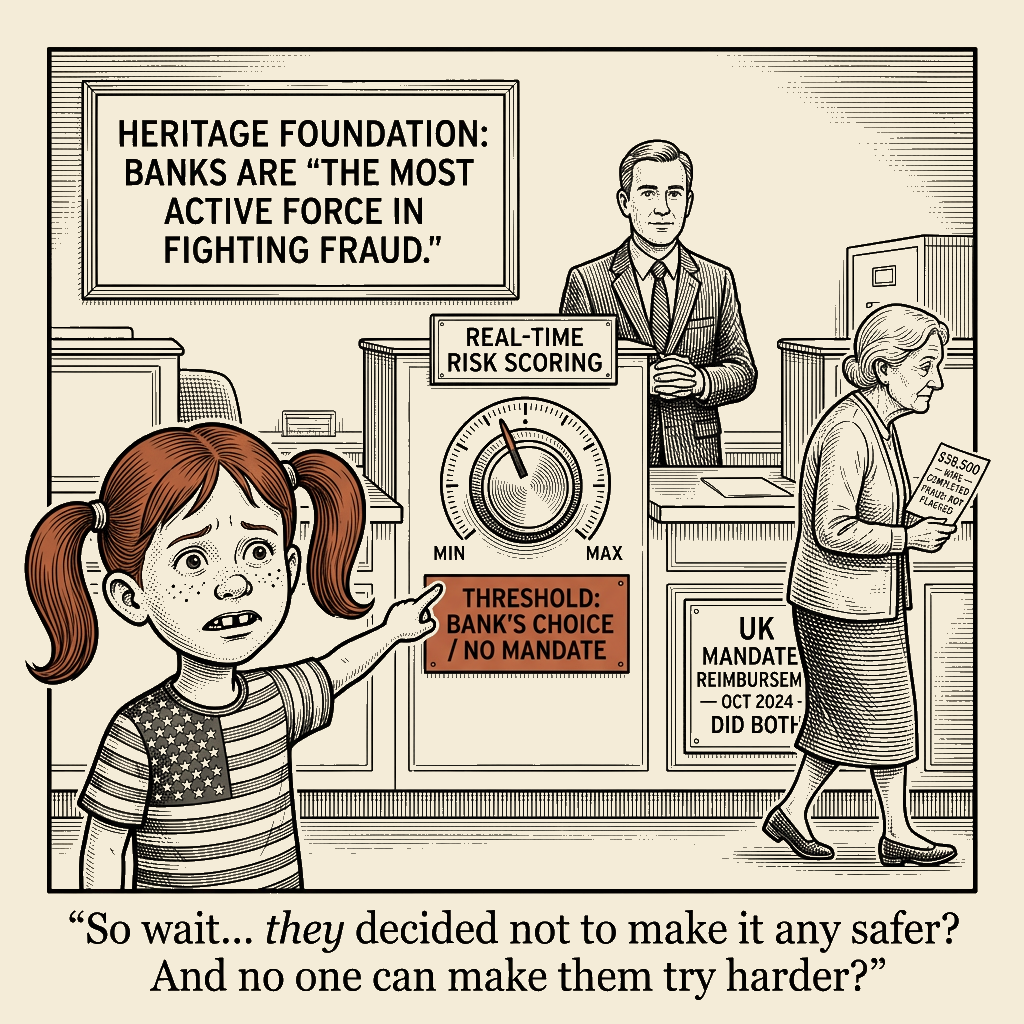
Responding to: Americans lost over $20 billion to one type of crime. Here’s how we can fight it · 2026-09-24
What the Piece Argues
The piece, by E.J. Antoni of the Heritage Foundation, argues that Americans lost over $20 billion to internet-enabled scams in 2025 and that the right policy response is to attack criminal compounds in Southeast Asia rather than force U.S. banks to reimburse victims. It credits banks with already spending roughly $21 billion annually on fraud prevention, praises the Prince Group sanctions, a record $127,000-Bitcoin forfeiture, and Operation Level Up as evidence that source-focused disruption works, and frames bank reimbursement mandates as a policy that would raise consumer banking costs while letting foreign criminals escape with the proceeds. It calls for statute-codifying the current executive-order approach, broader private-sector data-sharing partnerships, and treating qualifying scam syndicates as terrorist organizations.
Receipts
The framing rests on a forced binary — reimburse the banks’ victims or go after the compounds — and picks the side that lets the banks keep their liability shield.
The framing wants you to believe
- Reimbursement mandates that hold banks accountable for scams would “raise the cost of banking” while letting foreign criminals escape with stolen funds.
- Banks’ automated systems cannot catch authorized push payment scams because the customer has been convinced to send the money voluntarily.
- The CFPB’s December 2024 suit against Zelle’s operator and three major banks was rightly dismissed because it was the work of an “outgoing” regulator.
- Source-focused disruption is the only effective lever.
What’s really going on
- The U.K. Payment Systems Regulator (PSR) implemented mandatory reimbursement for authorized push payment fraud on October 7, 2024, for the largest senders and payment firms — and pursued international source-focused disruption in the same period. Both policies simultaneously, not as an either/or.
- The article is published in Fox News and written by the chief economist of a Heritage Foundation that has received documented Koch-network funding for decades and has spent that time opposing financial-services regulation.
- Zelle is operated by Early Warning Services, owned by Bank of America, Wells Fargo, JPMorgan Chase, PNC, U.S. Bancorp, Capital One, and Truist — the institutions whose liability the piece is defending.
- $7.7 billion of the $20.9 billion was reported stolen from Americans over 60, averaging $38,500 per victim — the population the piece uses as emotional garnish while arguing they should eat the loss.
The Response Ladder
Polite Reframe
When to use: a persuadable friend or family member who shared this piece thinking it was a reasonable take on protecting Americans from scams — someone who can hear a different framing if you lay it out calmly.
There is a real conversation to be had about how the United States should respond to a record $20.9 billion in internet-enabled scam losses, and about how the foreign compound operations running these scams — staffed by trafficked workers held in debt bondage in Burma, Cambodia, and Laos — are part of the problem. None of that is in dispute. The dispute is what we do about the side of the wire that lands on this end.
A retired second-grade teacher in Dayton, Ohio, gets a text from someone she believes is her grandson. He is in trouble. He needs $38,500 wired to a new account to make a hospital bond. She drives to her bank, where she has had the same checking account for forty-one years, and asks for the wire. The bank’s fraud system does not flag it. The teller does not flag it. She walks out having lost her late husband’s life savings to a compound in Cambodia whose workers were sold into it. Under the United Kingdom’s mandatory reimbursement rule — adopted by the Payment Systems Regulator and in effect since 2024 — her bank would absorb the loss and have a powerful new reason to make sure the next grandmother does not walk out of the branch with her savings gone. Under the current American system, she is out the money, the bank keeps its record fraud-prevention budget, and the piece you forwarded says the right response is to focus on the compound.
There is a test that separates a serious fraud-fighting position from a bank-protection position, and the piece does not pass it. The test is: would you let your bank keep the fee structure it currently runs, with the detection it currently runs, on a transaction that took your retirement and sent it to a country you cannot pronounce? If yes, you are saying the bank has done enough. If no, you are saying the bank has not — and the only mechanism that has ever made a bank “do enough” is the one the piece is lobbying against. Banks invest in detection proportional to the money they lose when they fail. A serious anti-fraud position says: do both — attack the source and hold the platform accountable. The piece’s argument only does one, and the one it skips is the one that protects the grandmother who walked into the branch this morning.
Mockery and Ridicule
When to use: the bystander audience — Twitter mentions, group chats, comment sections where the piece’s defenders are running cover for it; performing for the chorus rather than persuading the repeater.
Let me make sure I have this right. A grandmother loses thirty-eight thousand five hundred dollars to a scam compound in Cambodia, and the Heritage Foundation’s response is: but have you considered that the bank might lose money if we made it pay her back?
Picture the fraud-prevention budget meeting at the major bank. The head of retail banking walks in with the new fraud-detection platform. It cost more than anyone in the room wants to admit to the board. It catches 70 percent of attempted scams. The head of consumer lending raises his hand. “What about the other 30 percent?” The head of retail banking looks at him. “What about them?” The head of consumer lending clarifies: “Those are grandmothers. Should we, you know, give them their money back?” The head of retail banking laughs. “Why would we do that? They already sent it. E.J. Antoni at Heritage wrote an entire op-ed explaining why it would be bad for the consumer if we did.”
Picture the op-ed. It says the bank is “the most active force in the fight against fraud and scams.” It says the bank is already doing real-time risk scoring. It says banks spent $21 billion on fraud prevention. It says: don’t you dare make us pay the people we failed to protect, because that would raise the cost of banking. The compounding interest on this argument is so high it would trip the bank’s own risk model.
The piece says reimbursement mandates “would raise the cost of banking and payment services on which tens of millions of households depend.” It does not say how much. It does not say by whom. It does not say a single number anywhere about the cost of the mandate to the consumer, because if it printed that number next to the $38,500 your grandmother lost, it would have to admit the trade is: a few dollars more in monthly fees versus an elderly person keeps the savings she earned over a working lifetime.
The piece says the answer is attacking the compound in Burma. Good. The piece says we should sanction the Prince Group. Excellent. The piece says we should designate scam syndicates as terrorist organizations. Sure. The piece does not say the bank is allowed to keep its current detection model and current fee structure while we work on Burma. It does not say the bank is allowed to do less than it could today because the foreign criminals are now the priority. The piece does not say that, which is why the piece does not say it: the position only works as long as nobody asks the bank to do what it can already do, today, with the technology it already has.
The piece says the thief is not in Charlotte or San Francisco. Sure. The thief in Cambodia is the thief in Cambodia. The bank in Charlotte is not the thief in Cambodia. The bank in Charlotte is the only institution between your grandmother and the thief in Cambodia, and the bank waved her through. The piece says: focus on Cambodia. The bank says: thank you, that is very convenient for us. The grandmother says: but where is my money?
Nuclear Satire
When to use: a long email, a Substack comment thread, a sit-down argument with a relative or friend who has bought the piece’s framing. Reads at full Malcolm X register. Sparingly deployed.
E.J. Antoni’s $20.9 billion argument is that the $7.7 billion of it stolen from Americans over 60 should stay stolen, because making the banks pay would “raise the cost of banking.” E.J. Antoni is the chief economist of the Heritage Foundation. The Heritage Foundation is funded by the Koch donor network to oppose financial regulation of every kind. The $7.7 billion lost by people over 60 is, in the Heritage accounting, an acceptable cost of doing business.
We have lifted, in 2026, the moral theology of the late-twentieth-century American financial-services industry to its most refined expression. Take Eleanor. A seventy-one-year-old widow meets a man on Facebook. He is a twenty-six-year-old in a debt-bond compound in Cambodia operating under a script. He uses AI-generated voice, AI-generated face, AI-generated sympathy. He tells her he loves her. He asks for help with a customs fee. He keeps asking. Over four months she sends him $94,000 of the money she and her late husband saved for the years she is now living through. The bank that processed every transfer saw the pattern. The bank did not stop her. The Heritage Foundation reads this and concludes: the bank did nothing wrong.
The argument from Heritage is that the bank cannot be held responsible because “a transfer that the customer has been convinced to make looks to every automated system in the chain like a legitimate one.” Conceded, says Heritage, the system is designed not to catch what happened to her. And therefore the system should not be held responsible for failing to catch what happened to her. This is the argument of an industry that built a screen it cannot see through and would like to be paid for the privacy.
The article treats the choice as binary: either we make banks reimburse victims, or we go after the compounds in Cambodia. The piece does not mention — because mentioning it would break the binary — that the United Kingdom did both in 2024 and documented the result. The U.K. Payment Systems Regulator implemented mandatory reimbursement for authorized push payment fraud on October 7, 2024; the U.K. pursued international disruption efforts alongside the banks’ domestic reimbursement obligations in the same period. The two policies are not in tension. The Heritage Foundation needs them to be in tension to defend the bank position.
The piece is published in Fox News, written by the chief economist of a Koch-network-funded anti-regulation tank, in defense of a legal regime in which Early Warning Services — the consortium owned by Bank of America, Wells Fargo, JPMorgan Chase, PNC, U.S. Bancorp, Capital One, and Truist — continues to operate Zelle without civil liability for scams that flow through it. The CFPB’s suit, dismissed in March 2025, was the regulatory attempt to make Zelle’s parent institutions responsible for what their systems fail to detect. The article calls its dismissal “the right outcome.”
The right outcome, by the Heritage Foundation’s standard, is that she eats the loss. The wrong outcome, by the Heritage Foundation’s standard, is that the banks that built the system which failed her might be required to pay her back. The right outcome, by her standard, is that the banks that built a system they admit cannot catch what was done to her should not have built it that way, and should pay her back for what their system failed to catch.
The Heritage Foundation has spent decades building the donor-funded analytical apparatus to make sure the right outcome, by the Heritage Foundation’s standard, prevails. It is prevailing.
By any means necessary that operate within the analytical and political instruments available to us, we have to stop this. We have to name the bankers who built the system and the politicians who defunded the regulators who would have made them stop. The banks got $21 billion in fraud prevention that didn’t catch her. The Heritage Foundation got a piece in Fox News to convince you it was her fault. She got $94,000 less than she had when Derek first messaged her.
Until the Heritage Foundation is on the hook for what its analysis is producing, it will continue to produce it.
Profane Scorched-Earth
When to use: full catharsis — the reader who has had it up to here with the apparatus, who wants the receipts and the rage and the citations in the same breath, and who is not going to be talked down.
So the Heritage Foundation’s chief economist wants you to know — and I want to be very fucking clear about what he wants you to know — that the right policy response to a 74-year-old widow losing $38,500 to a scam compound in Cambodia is to make sure the fucking bank that waved her through keeps every penny of its fraud-prevention budget, its executives’ salaries, and its quarterly shareholder return, and that the widow can go fuck herself and eat cat food for the last eight years of her life, because the alternative would “raise the cost of banking.”
Let me say that again, slower, for the dipshits in the comment section who still think E.J. Antoni wrote this piece out of concern for consumers: the fucking argument is that the bank should not be on the hook for the bank’s failure, because if it were on the hook, the bank might charge you a dollar a month more on your checking account, and that fucking dollar is more important than your grandmother’s goddamn savings. That is the fucking argument. That is the entire fucking argument. That is the argument the Heritage Foundation was built to produce.
The U.K. did the opposite in 2024. The U.K.’s Payment Systems Regulator implemented mandatory reimbursement for APP scam victims, split between the sending and receiving banks. The entire point of the rule — the design rationale, written into the policy documents, argued out in front of every bank lobbyist in London — is that banks only invest in fraud detection proportional to the money they fucking lose when they fail to detect fraud. That is not a theory. That is what happens when you impose liability. Banks hire more people. Banks deploy better models. Banks call the customer. Banks block the wire. The U.K. did this because the U.K.’s regulators sat in a room with the math and concluded that the alternative was watching pensioners get robbed while the bank collected fees on the transaction that robbed them.
The Heritage Foundation’s documented institutional record over fifteen fucking years is consistent opposition to consumer-protection financial regulation whose enforcement would have made that wire harder to send. The fucking thread is the thread. The CFPB, the rules that would have made it stick, the regulatory architecture that would have given the grandmother a remedy — opposed, opposed, opposed. Every single one of these rules is a rule the bank did not want because every single one of these rules is a rule that would have made the bank pay for one more thing it currently gets to externalize. The argument in the op-ed is not a coincidence. The argument is the fucking product. The institution was built to produce this argument, on this schedule, in this register, for this fucking purpose.
The op-ed says banks are “the most active force in the fight against fraud and scams.” Banks are the most active force in the fight against having to pay for fraud and scams. The op-ed says banks do “real-time risk scoring.” Real-time risk scoring that the bank deploys at the fucking specification the bank chooses, with no liability for deploying it at the wrong fucking specification, because the fucking Heritage Foundation is writing op-eds about Cambodia to make sure no liability attaches. The op-ed says banks spent $21 billion on fraud prevention in 2025. Banks spent $21 billion on fraud prevention in 2025 and your grandmother still lost $38,500. That is not a counter-argument to reimbursement mandates. That is the fucking case for them.
The op-ed says “the thief is not in Charlotte or San Francisco but in a compound on another continent.” The thief in Cambodia is the thief in Cambodia. The bank in Charlotte is the institution your grandmother walked into with forty-one years of savings and walked out of with a receipt and no fucking money, and the bank in Charlotte is not fucking Cambodia. The bank in Charlotte is the bank in Charlotte. The bank in Charlotte chose the fraud-detection model the bank in Charlotte is running. The bank in Charlotte chose the training the teller received. The bank in Charlotte chose the fee structure that funds the fraud-detection model and the training. The bank in Charlotte chose all of it. The bank in Charlotte should fucking pay when it fucking fails.
The op-ed invokes “personal responsibility.” The grandmother is 74. The grandmother worked for forty-one years. The grandmother is being told, by the chief economist of a think tank whose donor disclosures run into the hundreds of millions of dollars from financial-services interests, that her loss is her fucking responsibility, because the alternative would be asking the bank to take responsibility for the bank’s own fucking platform, and the fucking Heritage Foundation cannot fucking allow that, because if it allowed it once, the principle would apply elsewhere, and the fucking principle is what they are fucking protecting.
King, in the late period of his work, returned across his preaching to the test in Matthew 25 — the judgment of nations by how they treated the hungry, the stranger, the imprisoned, the sick. He meant it the way the Hebrew prophets meant it: a nation that lets its banks keep its grandmothers’ savings and calls it consumer protection has answered the test, and the answer is fucking recorded. The answer does not change because Heritage Foundation economists write op-eds about Cambodia. The answer does not change because E.J. Antoni has a Ph.D. The answer does not change because the op-ed cites Juniper Research. The answer is recorded. The fucking apparatus is recorded. The fucking think tank is recorded. The fucking industry is recorded. And the grandmother is still fucking broke.

About Malcolm Little King
Malcolm Little King is a heteronym in Main Street Independent's editorial architecture — an analytical voice, not autobiography of any actual person. The position this column expresses is the publication's position on the territory Malcolm Little King's lane covers, rendered through Malcolm Little King's register.