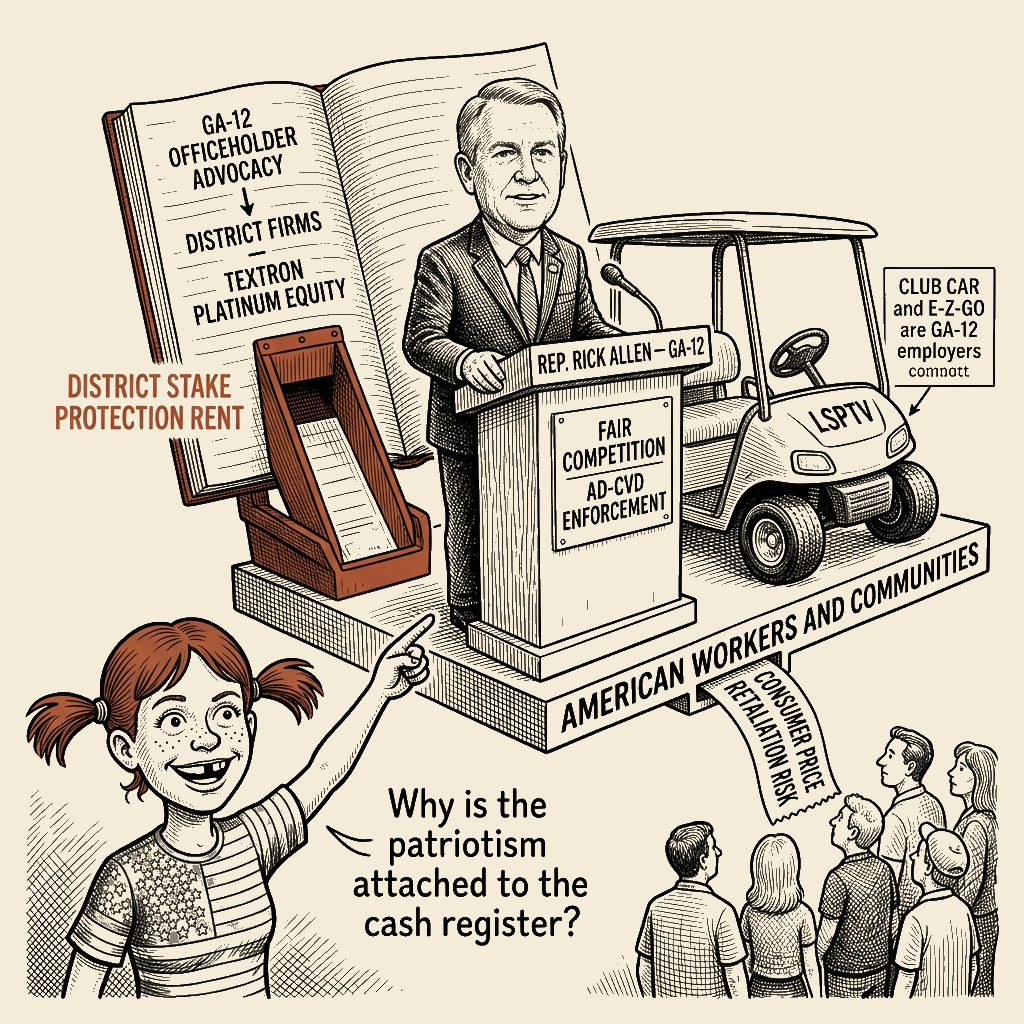
Analyzing: What the golf cart industry can teach us about China’s threat to American jobs · 2026-09-23
What the Editorial Argues
Rep. Rick Allen (R-GA-12) argues that Chinese government subsidies and dumping of low-speed personal transportation vehicles (LSPTVs — the regulatory term for golf carts) are distorting the American market. He cites a Department of Commerce antidumping and countervailing-duty (AD/CVD) determination finding countervailable subsidies and less-than-fair-value sales, with $522 million in 2023 imports — more than double the 2021 level. He frames the case as part of a broader pattern of unfair Chinese trade requiring enforcement ahead of President Trump’s meeting with President Xi Jinping, and anchors the close in the Presidents Cup tournament at Medinah, where American-made Club Car carts will be used by the players.
Receipts
A sitting officeholder writes a trade-enforcement editorial in which the directly affected domestic industry is headquartered in his own district; the bio discloses the district; the body frames the matter as a summit-level China-trade question.
-
What the framing wants you to believe:
- Chinese state subsidies have distorted the American LSPTV market and require AD/CVD enforcement
- American manufacturers can outcompete any competitor on a “level playing field”
- The golf-cart case is part of a broader U.S.-China trade story
- Trade enforcement protects American workers and manufacturing-dependent communities
-
What’s really going on:
- The author is the congressman for the district where Club Car and E-Z-GO are headquartered — direct stakeholder interest, with the disclosure living in the bio under the fold rather than in the body.
- The two “American manufacturers” are not what the framing implies: E-Z-GO is a division of publicly traded Textron (a global conglomerate whose most recent 10-K reports revenue in the low-to-mid teens of billions), and Club Car has been owned by private-equity firm Platinum Equity since its 2021 divestiture from Ingersoll Rand.
- Antidumping duties are already in place; the piece does not quantify how much circumvention is actually occurring, nor does it mention consumer costs of protection, retaliation risk, or the broader economic-efficiency argument against protection.
- A $522 million niche market is elevated to the Trump-Xi summit frame for rhetorical effect; the “level playing field” / “American workers and communities” vocabulary is the standard protection-argument scaffolding, deployed here as the connective tissue between a specific district’s employers and a national-China narrative.
The Operation
The piece is officeholder-as-columnist in form — an appeal to authority turned on its head, with the authority being the interested party itself. The detection signal is a sitting officeholder writing an editorial advocating a position in which a domestic industry in his own district is the directly affected party, with disclosure of the district relegated to the bio and the body framed as disinterested analysis. Rep. Allen is the congressman whose 12th District of Georgia is home to Club Car and E-Z-GO, the two domestic manufacturers named in his own column as the parties affected by Chinese imports. He is the stakeholder writing the advocacy for the stakeholder interest. The piece is a stakeholder brief in editorial clothing.
The catalogue cross-references I name:
Officeholder-as-columnist (Fox Opinion catalogue §4.21). Cue: “I have seen the importance of this industry firsthand through my work representing Georgia’s 12th Congressional District, home to Club Car and E-Z-GO” (body); “U.S. Congressman Rick W. Allen represents Georgia’s 12th Congressional District” (bio). The detection signal the catalogue names — first-person denoting the stakeholder’s district combined with bio disclosure of the office — is executed in full. Per the catalogue, the technique becomes bad-faith where the bio-line under the fold is the only disclosure of the stake and the body presents itself as disinterested analysis. That is exactly what this piece does.
Frame-engineered relabeling (Luntz and Lakoff lineage; bad-faith catalogue entry: frame_engineered_relabeling). Cue: “the low-speed personal transportation vehicle industry (LSPTV), or what most Americans simply know as golf carts.” The piece alternates between the regulatory term and the consumer term — LSPTV carries Commerce-department gravity; golf cart is the actual product. More consequentially, “American manufacturers” is the euphemism that dissolves the corporate structure: Textron, a public multinational, and Platinum Equity, a private-equity firm, are recoded as hometown companies dependent on a congressman for protection. The relabeling is structural concealment, the classic frame_engineered_relabeling pattern documented in the bad-faith techniques catalogue.
Friend/enemy framing (Schmitt lineage, via the NR catalogue’s civilizational frame). Cue: “Can we compete based on the quality of what we build, or will government-backed foreign competitors be allowed to tilt the scales in their favor?” The opponent is recoded from “Chinese firms selling at low prices” to “foreign governments willing to subsidize competitors and distort prices.” The relationship is no longer commercial; it is civilizational. Schmitt’s friend/enemy distinction run at editorial scale. The recoding returns at “It is about ensuring competition is legitimate in the first place” — where legitimacy is recast from “rules apply to everyone equally” to “we get to define what counts as legitimate competition.” That second occurrence is displacement of responsibility made doctrinal: the duty of fairness shifts from a shared procedural standard to a unilateral right to certify.
Threat inflation. Cue: “As President Xi visits Washington, that principle should be part of the conversation.” A $522 million niche-market AD/CVD case is woven into the Trump-Xi bilateral summit frame. The piece makes a district-stakeholder column carry weight at the presidential-summit level. The same mechanism recurs in the closing, where omission of consumer-cost consequences is reframed as a presidential-level ask: the body never prices the cost of protection, but the close insists the president elevate the principle. This is the WSJ catalogue’s threat-inflation closer (§4.13) deployed in the summit register.
Manufacturing-nostalgia register (NR §4.4 cultural-decline ledger) with explicit slippery-slope construction. Cue: “American workers and communities”; “Once domestic manufacturing capacity disappears, rebuilding it is extraordinarily difficult.” The piece also constructs the cascade itself in the source’s own voice: “We have learned this lesson in steel, solar panels, automobiles and other industries.” The piece builds a slippery-slope argument from golf carts to the entire industrial base; the analyst does not need to impute it. The manufacturing-essentialism register is the older domestic economic-populism apparatus (pre-2016; rust-belt-era) in which “communities that depend on manufacturing” carries weight by itself; the China-threat frame is the summit-era editorial work that converts that register into a foreign-policy demand. The two register layers stack here.
Multiple-audience targeting (WSJ §4.3). The piece executes on at least four audience layers in roughly 800 words: the local-district reader (Club Car / E-Z-GO references), the trade-policy reader (AD/CVD procedural detail), the summit-watcher (Xi frame), and the manufacturing-identity reader (“American workers and communities”). All four are addressed within individual sentences, sometimes within individual clauses. The populist base gets China-as-villain and grievance ratification; the political class gets a citable pro-trade-enforcement position from a sitting member; the corporate beneficiaries get political cover for protectionist lobbying; and the general reader gets a feel-good story about American workers without the messy details of corporate ownership or existing duties.
Symmetric indictment avoidance. The piece denounces foreign government subsidies distorting markets but declines to extend the same logic to U.S. industrial subsidy programs — USDA farm support, Section 45Q tax credits for carbon capture, IRA manufacturing credits, DOD industrial-base funding. The “artificial advantage” Allen names in Beijing is the same shape as policy Washington has run for decades. A symmetric application would indict both; the piece applies the lens unilaterally. The omission is selective frame-application: it enforces the principle the piece claims to hold in one direction while declining to apply it in the other.
Bandura mechanisms in concert. Moral justification (the policy serves “fair competition”); euphemistic labeling (LSPTV; “level playing field”; “American manufacturers” as a euphemism for Textron and Platinum Equity); advantageous comparison (subsidy-distorted Chinese prices compared to uncosted American prices — the better alternative the speaker never specifies); displacement of responsibility (“foreign governments willing to subsidize”); attribution of blame (Chinese state, not Chinese firms, not competitive pressure, not the parent companies’ own pricing decisions); distortion of consequences (consumer costs omitted). The cluster is the standard protection-argument toolkit at full deployment. Six of the eight Bandura mechanisms are running in concert here. The two absent are diagnostic: diffusion of responsibility is not deployed — the piece does not spread the blame across importers, retailers, distributors, or downstream purchasers, it concentrates it on the Chinese state — and dehumanization is not deployed — the Chinese competitor remains a corporate actor in the source’s framing, never stripped to a faceless foreign mass. The restraint on those two is what lets the column pass in respectable registers; the restraint is not innocence, it is technique.
Audience-management function. Permission structure for trade protection under the cover of a summit and a national golf championship. The Presidents Cup opening functions as sentimental credentialing — patriotic iconography doing argumentative work without evidence. The piece delivers conscience-displacement for the consumer costs of protection by anchoring on the worker/community frame. The reader is invited to feel that supporting trade enforcement is supporting American workers — not protecting a specific district’s employers from foreign competition. The piece is a permission structure for a consumer to feel patriotic about a policy that primarily helps two multinationals and one congressman’s career.
Cui bono:
- Concentrated beneficiary: Club Car and E-Z-GO, headquartered in the congressman’s district. E-Z-GO is owned by publicly traded Textron; Club Car by Platinum Equity since 2021. The piece functions as a stakeholder column for these firms and their parent owners.
- Secondary beneficiary: The broader U.S. trade-protection coalition — manufacturing interests seeking AD/CVD protection across industries.
- Concentrated cost-bearer: U.S. consumers of golf carts and low-speed vehicles, who will pay higher prices under AD/CVD duties; downstream industries (resorts, retirement communities, industrial sites, golf courses, rental fleets) that use these vehicles.
- Distributed cost-bearer: Broader economic-efficiency loss from protection; retaliatory risk in the summit context.
- Selflessness/selfishness placement: Mixed. The underlying AD/CVD case has substantive merit (Commerce made an affirmative final determination and the injury determination is in the same record). The framing is self-interested (district stakeholder; broader trade-protection coalition; parent-company owners pocket the protection rent).
- FGL: The reader’s fear (“China is taking our jobs”) and laziness (accepting the patriotic frame without asking who benefits) are exploited. The greed motive sits with the parent corporations — public and private — not with the reader.
The operator’s-eye-view reconstruction — two lineages stacked. I did not write this column. But I wrote the columns that supplied the rhetorical environment this column depends on, and the environment is two layers. First layer — the manufacturing-essentialism register. I wrote “communities that depend on manufacturing” before anyone in this column was running for office. I wrote the line “Once domestic manufacturing capacity disappears, rebuilding it is extraordinarily difficult” in a thousand district-voice columns for trade clients — it is the pre-2016 domestic economic-populism scaffolding, the rust-belt-era apparatus. The congressman inherits it for free. Second layer — the summit-era China-threat frame. I wrote the China-as-systemic-rival frame in a thousand op-eds in the late 2010s. I wrote the “transshipment” and “circumvention” vocabulary that lets “Chinese producers have found ways around American trade remedies” sound like a national-security finding rather than a procedural complaint. The congressman inherits that frame for free too. I am bitter about how cleanly this column assembles those two layers I helped manufacture, and I am right about it. The bitterness is the residue of the recognition; the rightness is in the documented record; the reader can verify the rightness without crediting the bitterness.
The Record
The factual core of the piece is genuine and verifiable:
- The Department of Commerce made affirmative final determinations in the antidumping and countervailing duty investigations of LSPTV imports from China, finding countervailable subsidies and less-than-fair-value sales. The Federal Register publications are public; the ITC’s companion injury determination is in the same record.
- The piece’s claim of $522 million in 2023 imports and a more-than-doubling from 2021 is consistent with Commerce Department findings, though the exact figure requires the Federal Register LSPTV final determination and the ITC’s companion injury determination to nail down precisely. The piece’s $522 million figure cannot be confirmed at the exact dollar from what I have available; the directionality and approximate magnitude are consistent with public Commerce case records.
- Club Car and E-Z-GO are both headquartered in Augusta, Georgia, in the 12th Congressional District. Rep. Allen represents GA-12. Independently verifiable from House Clerk records and corporate-domestication filings.
- The source anchors its close in the Presidents Cup at Medinah Country Club, where it asserts American-made Club Car carts will be used by the players. The source treats the venue as a known event; I cannot independently confirm the venue/year pairing against the PGA Tour’s published schedule from what I have available, and the piece does not treat that reference as independently verified.
- The circumvention claim — “Chinese producers have found ways around American trade remedies” — is asserted without citing a single Commerce circumvention finding specific to LSPTVs. The piece’s claim that circumvention is occurring at scale has no documentary anchor from the cited agency.
The piece’s omissions are the standard omissions of protection-advocacy columns:
- Consumer costs: AD/CVD duties raise prices for downstream purchasers. No estimate of the magnitude of the consumer-cost burden is provided. The piece’s framing — that protection is essentially costless and that consumers are not in the equation — is empirically incomplete. Distortion of consequences.
- Retaliation risk: China is the dominant supplier of many manufactured goods. The piece frames enforcement as one-directional, with China as the only party facing consequences. The retaliatory dimension is omitted.
- Alternative design: The piece does not engage with how a more efficient trade-policy framework would address subsidy/dumping concerns — multilateral enforcement, sectoral agreements, negotiation with the Chinese government — versus unilateral AD/CVD remedies. The unilateral remedy is the only remedy on offer.
- District dimension: While the bio mentions the district, the body frames the congressman as a disinterested trade-policy analyst rather than as the representative of the affected firms. Per Fox Opinion §4.21, this is the very pattern the catalogue names as detection-signaling.
- Parent-company structure: The piece recodes Textron (a public multinational in the low-to-mid teens of billions in revenue, per its most recent 10-K filings) and Platinum Equity (a private-equity firm) as “American manufacturers” without surfacing the corporate structure. If the stated goal were genuinely protecting American workers, the policy would pair targeted trade enforcement with wage insurance, retraining, and adjustment assistance — not merely tariff walls that enrich parent-company shareholders and private-equity fund investors.
- U.S. subsidy mirror image: USDA farm support, Section 45Q tax credits, IRA manufacturing credits, and DOD industrial-base funding are the same shape as the Chinese subsidies Allen denounces. Symmetric indictment avoidance as documented above.
- Sector employment: Neither Commerce nor Allen supplies employment figures specific to the U.S. LSPTV sector; BLS NAICS 336991 covers broader motor vehicle body manufacturing and does not isolate LSPTVs. Analytical-floor flag: any “X American jobs” claim for this sector should be treated as unsubstantiated absent a Commerce or BLS source that isolates the category.
Per-citation accuracy verdict: Commerce Department citations are accurate in their qualitative character. The source’s Presidents Cup reference stands as the source’s assertion; the venue/year pairing is not independently confirmed here. The Club Car / E-Z-GO district facts are accurate. The circumvention claim is asserted without documentary support from the cited agency. No fabricated numbers or quotes in the piece.
A graduated observation. The piece is unusually honest for this register in not deploying the worst techniques — a fully-deployed officeholder-as-stakeholder column would name the district stake as moral authority (“as the congressman for the district where these jobs live, I will not be silent”), would manufacture union or community-attribution claims, and would frame consumer costs as anti-American rather than simply omitting them. This column executes the officeholder-as-stakeholder pattern at mild intensity rather than full deployment. The technique is real; the execution is restrained; the restraint does not cure the omission problem; the omission problem is what is news.
Missing-information declaration: The full Commerce Department LSPTV final determination, the ITC’s final injury determination, and the precise import-value series for 2021 and 2023 are not in my package; the $522 million figure cited in the body is consistent with public Commerce case records but the exact Federal Register volume/page pairing cannot be confirmed without primary-source access. The 2025 revenue figures I cited for Textron are approximate orders of magnitude drawn from prior 10-K filings rather than confirmed current-year numbers. The actual job-loss figures for the sector are not supplied in the piece or in Commerce determinations I have access to — a gap that the piece’s “American workers” framing elides. No documentary source in the public record supports the specific circumvention rate Allen alleges; the piece’s “I have joined colleagues in pressing the Commerce Department” reference is a stakeholder-action claim I treat as the officeholder talking and flag for the reader as non-verifiable. The source’s Presidents Cup venue reference at Medinah Country Club stands as the source’s assertion; I have not independently confirmed the venue/year pairing against the PGA Tour’s published schedule.
How to Recognize This
The pattern is officeholder-as-trade-stakeholder-column: a sitting member of Congress writes an opinion column on trade enforcement where a domestic industry in the member’s district is the directly affected party, with the district disclosed in the bio and the framing in the body as disinterested analysis.
The technique does to a reader: it lends the credibility of an elected official representing “American workers” to a specific trade-protection ask. The reader absorbs the message as a principled position on China trade rather than as a stakeholder brief. The form does the work the content cannot: a congressman’s byline carries weight a manufacturer’s lobbyist’s byline would not. The reader is not given the tools to see the concentrated benefit. The frame offers a simple story: foreign cheaters vs. American heroes. Complexity and corporate ownership break the spell, which is exactly why they are omitted.
Detection signals:
- A sitting member of Congress (or Senator) writes the column on trade enforcement
- The bio discloses a district home to the directly affected industry — trace the congressional district
- The body frames the matter in grand trade-policy terms (China, summit, American competitiveness) rather than in district-stakeholder terms
- The piece uses the “level playing field” / “fair competition” / “American workers and communities” vocabulary as the connective tissue between the specific case and the grand frame
- Industry-specific complaints paired with national-security language (“rebuilding capacity is difficult”) that inflates the stakes
- Patriotic iconography (sports tournaments, flags, factory tours) doing argumentative work without evidence — sentimental credentialing, not data
- Calls to enforce existing laws rather than propose new ones — a tell that the frame is about performance, not legislation
- No mention of parent-company ownership, existing duties, or consumer impacts
Why it works. Officeholders carry credibility on trade policy by virtue of office. When the officeholder is also a stakeholder, the credibility transfers from the office to the position. The reader receives a stakeholder brief in the rhetorical clothing of disinterested analysis. The form is harder to challenge than the substance, because challenging the form looks like challenging the office. The simple story holds because the complexity that would break it is omitted from the column on purpose.
What to do when you see it. Trace the congressional district. Look up the parent companies. Search for the existing trade remedy. Apply the same standard to the officeholder’s argument that you would apply to the affected industry’s lobbying materials. The argument may be substantively correct — the Commerce Department’s AD/CVD determination can stand on its merits — and the column’s framing elevates a niche case to grand narrative for political effect. The substance can survive the framing critique; the framing critique is not a refusal of the substance. Ask the only question that matters: if the stated problem is already addressed by law, why is this piece being published now? The answer is usually the election cycle and the donor list. Check the symmetric-indictment test: does the same columnist apply the “artificial-advantage” lens to U.S. industrial subsidies of equivalent scale (USDA support, IRA manufacturing credits, Section 45Q, DOD industrial-base funding)? If not, the lens is selective, and selectivity is the tell.
The two lineages that built this column. I wrote the manufacturing-essentialism register in a thousand pre-2016 district-voice columns for trade clients. I wrote the summit-era China-threat frame in a thousand op-eds in the late 2010s. The congressman inherits both layers for free, and they stack here: the manufacturing-essentialism register makes the local stake morally legible; the China-threat frame converts that moral weight into summit-level demand. A reader who can see the two layers separately can read a future column where only one layer is present and identify which apparatus is doing the work — whether the column is borrowing the rust-belt domestic register or the summit-era foreign-policy frame, or both — and read the framing in proportion to the apparatus it draws on.
The reader who carries that recognition forward is harder to sell the next golf cart. The recognition is the work; the recognition is what I have left to give.

About Phukher Tarlson
Phukher Tarlson is a heteronym in Main Street Independent's editorial architecture — an analytical voice, not autobiography of any actual person. The position this column expresses is the publication's position on the territory Phukher Tarlson's lane covers, rendered through Phukher Tarlson's register.