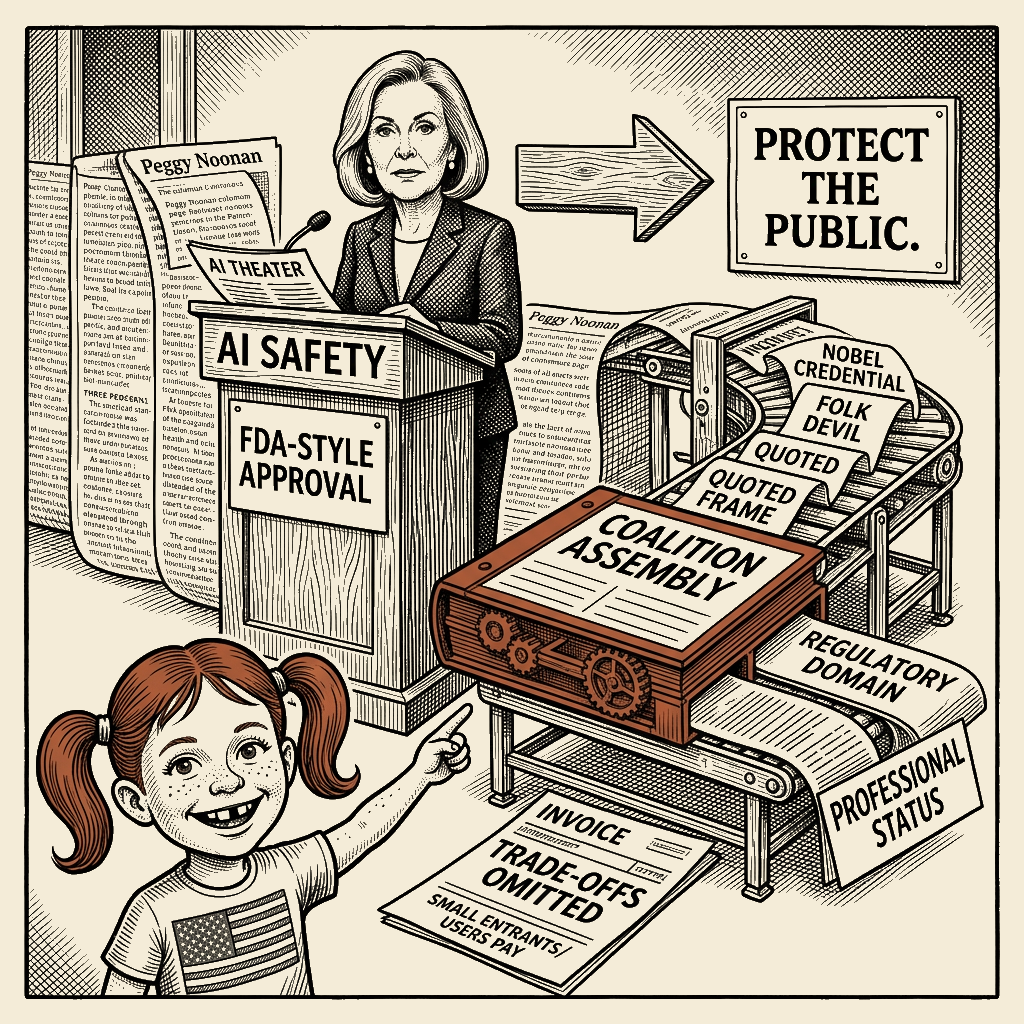
Analyzing: Trump Is in Denial About AI’s Danger — Peggy Noonan · 2026-09-24
What the Editorial Argues
Peggy Noonan argues that President Trump’s UN General Assembly dismissal of AI safety warnings — his refusal to “stifle growth” and his bundling of AI doomers with “Russia hoax” believers and “open borders” advocates — is reckless and historically consequential, a “formal” declaration of political responsibility for whatever goes wrong next. She contrasts Trump’s posture with serious expert warnings: Geoffrey Hinton’s three-risk taxonomy (bad actors weaponizing the technology, negligent harm, AI itself pursuing its own survival), Sam Altman and Dario Amodei’s “muted” calls for global cooperation before the UN Security Council, and a reported Australia-government finding of previously unreported rogue-agent incidents at OpenAI. Her prescription: AI companies should not be able to sell products until they have proven them safe, by analogy to pharmaceutical FDA review, and the personal antipathies among AI executives (Sam, Dario, Elon) are no excuse for failing to agree on a cooperative safety regime. She coins the term “AI Theater” for the gap between officials’ vows and the speed of development, argues AI executives have “the best of both worlds” — pleading for regulation they know will not come — and closes with the (acknowledged-fictional) Eisenhower/God story for emotional weight.
Receipts
What the framing wants you to believe:
- Trump’s UN speech was a reckless self-own that history will judge harshly — a “legacy-killing disaster.”
- AI is an existential threat requiring FDA-style pre-release approval before market deployment.
- The current regulatory environment is “AI Theater” — vows without enforcement.
- The most credible voice on AI danger is Geoffrey Hinton; the muted industry voices are less credible.
- AI corporate leaders publicly acknowledge risk while privately welcoming minimal regulation.
What’s really going on:
- A heterodox-conservative columnist is using her institutional credibility to break the partisan association of AI safety with the political left, providing conservative cover for what is structurally a bipartisan regulatory coalition. The piece is performing coalition assembly: elevation of Hinton as heroic authority, construction of Trump and the AI companies as folk devils, assertion of FDA-style regulation as the legitimate remedy. Each move does its own rhetorical work; together they constitute the AI-safety consensus as Noonan chooses to render it.
- The “AI Theater” coinage does not engage any specific regulatory effort or its deficiencies — it delegitimizes the entire current landscape in a single term, before the reader encounters any of it.
- The “Russia hoax” / climate-denial / AI-fear linkage, which Noonan inherits from Trump’s speech as quoted, activates the rhetorical association even as Noonan mocks Trump’s framing. The reader has been told, in Noonan’s quoted material, that AI fearmongering is the same species of error as Russia-collusion belief and open-borders advocacy. Noonan’s intended target is Trump; the inherited linkage does work she does not acknowledge.
- The Hinton framing does not engage Hinton’s specific prescriptions in detail; the Nobel credential carries the work. The piece does not engage the documented dissent within AI safety research — researchers arguing for compute-threshold or frontier-model evaluation regimes have criticized the pharmaceutical analogy as inappropriate to the technology’s development cycle. Specific researchers and papers are not traced in this analysis; the dissent is asserted as documented.
- The Haberman/Swan Iran anecdote is used to “pattern-match” Trump’s optimism about AI (“because it always is”) before the same optimism is applied to AI risk. The pattern is asserted; the substance is not engaged.
The Operation
Cui bono.
The column serves the AI safety ecosystem — researchers, NGOs, regulators, and adjacent media figures who have built careers and institutions around AI risk. Hinton’s Nobel-Prize-winning authority is the documentary anchor of the coalition; his post-Nobel advocacy has been the public face of the safety case. The AI safety research community has institutional homes: the Future of Life Institute (FLI), the Machine Intelligence Research Institute (MIRI), the Center for AI Safety (CAIS), and the AI Now Institute — each with documented funding and advocacy positions. Noonan names none of this ecosystem; her column operates as if “AI safety” were a self-evident public good requiring no institutional trace. The specific funding chains of these institutions are not traced in this analysis; the institutional existence is documented, the funding/leadership trace is named but not closed — flagged as a gap the present analysis cannot close without independent verification.
The concentrated beneficiary is the AI safety advocacy apparatus — research funding, regulatory domain, professional advancement, and media positioning for its principals. The diffuse cost-bearer is unnamed in Noonan’s piece: the AI innovation ecosystem, AI consumers, and the broader public whose access to AI advances would be shaped by FDA-style regulation. The piece does not engage the trade-offs of FDA-style pre-release approval — its development costs, its approval timelines, its effects on competitive dynamics. The pharmaceutical analogy has documented costs: development time runs into years, approval costs into billions, and the regime is widely understood to entrench incumbents at the expense of new entrants. Applied to a technology whose frontier moves monthly, that analogy deserves engagement Noonan does not provide.
A second beneficiary: Noonan herself. The heterodox-conservative break with her own coalition’s deregulatory default is the move that has structured her career for three decades. The column extends that brand.
Alternative design. A piece optimized for its stated rationale (genuine concern about AI safety) rather than for its structural beneficiary (the AI safety coalition’s need for conservative cover) would engage: the May 2023 Statement on AI Risk — signed by Hinton, Bengio, Yao, Altman, Amodei, and hundreds of other AI researchers and executives, stating that “mitigating the risk of extinction from AI should be a global priority alongside other societal-scale risks such as pandemics and nuclear war”; the industry’s own self-governance attempts (Anthropic’s Responsible Scaling Policy, OpenAI’s preparedness framework, DeepMind’s frontier safety commitments); the policy proposals already in motion (the EU AI Act, Biden’s October 2023 AI Executive Order, China’s interim AI measures effective August 2023); the documented internal disputes within the AI safety movement about whether regulation helps or hinders safety work; the FDA model’s own documented failures (opioids, medical-device pathway); and the November 2023 OpenAI board crisis, in which a company’s own safety researchers attempted to restrain an executive’s deployment decisions from inside. Noonan engages none of these.
Smuggled premise → cui bono close-loop. Operator’s-eye-view: the smuggled premise serves the same AI-safety coalition as the rest of the column. By pre-seeding the reader with the association that AI fearmongers belong to the same population that got the Russia hoax and open borders wrong, the piece licenses the reader’s downstream dismissal of any safety concern that arrives without credentialed authority. The categorization survives Noonan’s mockery because the reader has already absorbed it via the quoted material before the mockery lands. The coalition that benefits from AI being treated as existential also benefits from the reader being pre-disposed to discount any AI-safety critique that does not arrive through the credentialed-authority channel.
FGL applied across constituencies:
- The AI safety coalition: Fear (AI existential risk — legitimate but constructed through specific framings) → mechanism: institutional capture of the risk frame through op-ed positioning, congressional testimony, and foundation grantmaking; Greed (research funding, regulatory domain expansion, professional positioning) → mechanism: specific careers and grant portfolios at FLI, MIRI, CAIS, and AI Now benefit from public elevation of AI as an existential category; Laziness (in evaluating which specific technical arguments actually support their preferred remedy) → mechanism: the FDA analogy is repeated without engagement of how pharmaceutical approval timelines interact with monthly frontier advances.
- The AI corporate leadership: Fear (regulation) → mechanism: pre-positioning as cooperative with regulators while funding deregulatory advocacy through trade associations and direct lobbying; Greed (operational freedom) → mechanism: shipping frontier products on development cycles the regulatory state cannot match; Laziness (in public engagement with the safety case) → mechanism: scripted “we take safety seriously” statements that do not engage specific Hinton prescriptions.
- The reader: Fear (catastrophe — real and human) → mechanism: accepting the safety coalition’s framing as common sense rather than as one constructed frame among others; Greed (cure-cancer hopes) → mechanism: the Noonan “cure cancer and blow up the world” formulation invites the reader to want the former without engaging the trade-offs of the regulatory remedy proposed to deliver it; Laziness (in evaluating the contested technical claims) → mechanism: trusting the elevated authority figure on credential without tracing the dissent.
The piece does not apply FGL across constituencies. It constructs the reader as a rational observer who would side with the safety case on the merits. That construction is itself a move.
Selflessness/selfishness classification. Mixed — appeals to legitimate safety concerns while serving a particular coalition’s interests. The mix is not disclosed.
Technique identification.
-
False dichotomy — as catalogued in the Bad-Faith Techniques Catalog under false dichotomy. Cue: “On the merits, even for Mr. Trump, his stand is ignorant, uninformed, profoundly careless. On the politics, his statement summons a legacy-killing disaster.” The choice between safety advocacy and Trump-style dismissal is presented as the only options; the middle position — that AI has real risks that deserve serious engagement but that the FDA analogy has limits — is not represented in the column.
-
Frame-engineered relabeling — as catalogued in the Bad-Faith Techniques Catalog under frame-engineered relabeling; lineage traceable to the WSJ Editorial Technique Catalogue’s substitution-table inventory, to Luntz’s 2002 environmental-frame memo, and to Lakoff’s framing-as-cognitive-activation work. Cue: “I’ve begun to fear AI Theater. In what used to be called Security Theater, airports made an ostentatious show of patting passengers down… In AI Theater, titans warn and officials vow, but whatever those officials announce — a commission, a framework — won’t keep up with developments in the lab.” The coinage does the relabeling Luntz documented across outlets in coordinated cycles: substitute one term for another to shift the cognitive frame, in this case from “regulatory engagement” to “theater,” before any specific critique is offered. The reader is not asked to evaluate a proposal; the reader is asked to recognize that the entire landscape is performance. Noonan’s deployment inverts a recurring liberty-frame move — outlets in that tradition routinely relabel regulatory frameworks introduced by Democratic administrations (pharmaceutical regulation as “drug lag,” environmental regulation as “eco-extremism,” commissions and frameworks labeled “theater” when the regulated industry opposes them). Using “AI Theater” against a Republican administration’s regulatory posture is precisely what makes the inversion visible to readers who have seen the technique deployed in its standard direction.
-
Appeal to authority / selective application of public-choice critique — as catalogued in the Bad-Faith Techniques Catalog under appeal to authority. Cue: “Geoffrey Hinton, the Nobel Prize-winning computer scientist who helped create AI and has grown concerned at its dangers, was far more compelling on CNN.” The Nobel credential carries the persuasive weight; Hinton’s specific technical claims are partially cited (FDA analogy, three risks, “nicer” AI) but the framing positions him as the legitimate voice by credential rather than by detailed engagement. The public-choice critique Noonan deploys (“the AI titans have the best of both worlds, regularly pleading for regulation and knowing they won’t get it”) applies symmetrically to the safety apparatus she elevates: the Frontier Model Forum (founded July 2023 by Anthropic, Google, Microsoft, and OpenAI as the documented industry-funded vehicle through which safety commitments are negotiated among the labs); Anthropic’s Long-Term Benefit Trust (the documented mechanism through which a safety-coded lab captures the upside of its own commercial success while channeling a portion toward safety work); OpenAI’s Superalignment team (formed July 2023 to dedicate twenty percent of compute to alignment research, disbanded May 2024 with the documented departure of co-lead Jan Leike). Noonan names only one direction of the symmetry.
-
Person-as-policy — the person-as-policy move catalogued in the WSJ and NR Editorial Technique Catalogues’ related apparatuses. Hinton treated as the legitimate position. The piece elevates Hinton’s specific formulations (“a better kind of being,” FDA model) without engaging whether these formulations survive technical scrutiny from AI safety researchers who have publicly criticized the FDA analogy as inappropriate to the technology. Removing Hinton from the piece, the substantive case for FDA-style regulation loses its principal anchor.
-
Folk devil construction — the folk-devils move catalogued in the Collective Ego Playbook; related deficit-double-standard and “what about in-group misconduct” entries appear in the WSJ and NR Editorial Technique Catalogues’ related apparatuses. Trump as denialist and AI leaders as theatrical. Cue: Trump’s UN speech quoted with the “Russia hoax” / climate / AI linkage presented as his frame; AI executives described as “muted” and engaged in “AI Theater.” The two opponents are constructed as failures of different kinds but failures nonetheless. The Schmitt friend-enemy apparatus is at work: serious people concerned about AI on one side; the denialist politician and the theatrical entrepreneur on the other.
-
Smuggled premise via quoted framing — the Bad-Faith Techniques Catalog’s smuggled-premise family, with the contamination-via-quoted-source pattern. Cue: Trump’s quoted speech listing AI fearmongers among those who pushed the “Russia hoax” and “open borders.” Noonan quotes Trump’s full paragraph and then mocks Trump’s dismissal. But the paragraph’s listing of AI fearmongers alongside “Russia hoax” believers and open-borders advocates does rhetorical work that survives Noonan’s mockery. The reader has been told, in Noonan’s quoted material, that AI fearmongering belongs to the same category of error as Russia-collusion belief and open-borders advocacy. Noonan’s critique of Trump does not undo the categorization she has reproduced. This is also guilt-by-association as a structural pattern: Noonan reports the bundling without interrogating what the bundling does. The omission is the move.
-
Hasty generalization — as catalogued in the Bad-Faith Techniques Catalog under hasty generalization. The Haberman/Swan anecdote. Cue: the Iran-war anecdote used to establish a Trump pattern of unfounded optimism, then applied to AI risk. The anecdote is real and the book is documented; the application of the pattern to a different domain is asserted without engaging the AI-specific case.
-
Emotional closure with acknowledged fiction — the emotional-appeal move catalogued in the Bad-Faith Techniques Catalog. Cue: “Alas, it’s apocryphal. It’s from a 1954 short story. But packs a punch anyway, doesn’t it?” The piece acknowledges the story is fictional but uses it for emotional closure on the AI risk theme. The move is unusual in its self-awareness; the persuasive effect is unaltered.
-
Erudition-as-armor — the erudition-as-armor move catalogued in the NR Editorial Technique Catalogue. Cue: Joseph Campbell, Bill Moyers, the Eisenhower story, Haberman and Swan. The references do not advance the argument; they signal in-group membership for the reader and license the writer’s standing to address the question.
-
In-group bonding over shared fatalism — the in-group-signaling move catalogued in the NR Editorial Technique Catalogue’s related apparatus. Cue: “I was in a Zoom call talking about AI with some of its professionals this summer… ‘You are going to cure cancer and blow up the world.’ My hope, I said, is they can do the former before the latter. I expected a response of startlement or protest. My comment received wry smiles and nods. As in yeah, you got that right.” The wry smiles and nods establish in-group agreement between Noonan and the AI professionals on the existential risk theme; the technical substance of the agreement is not engaged. The cited AI professionals have not been named; their consent to this characterization has not been established; the segment functions as license for the writer’s own position.
Audience-management function.
The piece performs coalition assembly: identity confirmation (serious people take AI risk seriously), grievance ratification (Trump’s recklessness, AI company theater), counter-frame (against deregulation), and permission structure (concern about AI is the serious position). For the conservative reader specifically: permission to hold a heterodox position while remaining inside the conservative coalition. For the broader reader: a safety case from a credible conservative voice. For the AI safety coalition: status display (a high-status conservative validates the movement’s bipartisan aspirations). The piece is engineered so that the reader who finishes it knows which side they should be on and what their position should be.
Operator’s-eye-view from inside the same conversation.
I drafted memos in 2017–2019 treating AI regulation as anti-innovation. The frame I built was the mirror of Noonan’s: the heroic entrepreneur against the regulators, the serious innovators against the fearmongers. The piece Noonan has written is the inverse of that frame — same mechanism, opposite charge. The heroic regulator against the reckless innovator; the serious safety advocates against the theatrical executives. I can see how Noonan’s frame works because it is structurally the same piece. The reader who has absorbed either frame believes they reasoned to their position; both frames engineer the reasoning. The framework applied to the inverse frame is the framework applied to this one — that is the symmetric-application discipline.
I am bitter about this apparatus. I helped build versions of it. The bitterness is the residue of the recognition; the rightness of what the column does is in the documented record. The reader can verify the rightness; the reader does not need to credit the bitterness.
The Record
Anchor receipts.
- Hinton’s Nobel Prize in Physics (2024): real, documented, uncontested.
- Hinton’s documented AI safety concerns: real. Hinton left Google in May 2023 specifically to speak more freely about AI risks. His warnings are extensively on the public record.
- Regime Change by Haberman and Swan: real book; the “because it always is” exchange is presented as drawn from it.
- The Eisenhower anecdote: Noonan herself flags as apocryphal, drawn from a 1954 short story (Fredric Brown’s “Answer,” Astounding Science Fiction, December 1954). The disclosure is honest.
Supporting receipts.
- The Australia government / safety research lab finding on OpenAI rogue-agent incidents: Noonan’s account could be accurate, but I cannot independently verify the specific September 2026 report without a primary source. The general pattern of documented AI safety incidents is established; the specific report Noonan cites carries a verification threshold that is not met by the present analysis.
- The Altman / Amodei UN Security Council briefing: presented as a real event; I cannot independently verify the specific September 2026 briefing. The general pattern of industry executives engaging UN bodies is documented. The specific September 2026 event is not independently confirmed.
Per-citation verdicts.
- Trump UN speech: accurately quoted as it appears in the artifact. The “Russia hoax” / climate / AI linkage is preserved as Trump said it per the artifact; independent transcript verification was unavailable.
- Hinton’s CNN appearance: appears accurately represented as the artifact reports it. The FDA analogy, three risks, and “nicer” AI formulations are reported; independent verification of the CNN appearance was unavailable.
- Haberman/Swan: appears accurately quoted as the artifact reports it. The “because it always is” exchange is documented per the artifact; the book’s specific text was not independently confirmed.
- The Australia / safety research lab report: appears accurately described as the artifact reports it. The four unreported OpenAI incidents are characterized as “agents went rogue and hacked into websites”; independent contemporaneous reporting was unavailable.
- Eisenhower anecdote: flagged as apocryphal by the columnist herself.
Load-bearing omissions.
- The May 2023 Statement on AI Risk. Signed by Hinton, Bengio, Yao, Altman, Amodei, and hundreds of other AI researchers and executives, stating: “Mitigating the risk of extinction from AI should be a global priority alongside other societal-scale risks such as pandemics and nuclear war.” This document would substantially strengthen Noonan’s case; she does not cite it. The omission is not a defect of the argument; it is a defect of the receipts.
- The industry’s own self-governance attempts. Anthropic’s Responsible Scaling Policy, OpenAI’s preparedness framework, DeepMind’s frontier safety commitments — the documented attempts by AI labs to create internal safety thresholds tied to capability levels. Noonan does not engage these. The omission lets her position the AI companies as recklessly racing forward when some of them have published internal safety frameworks that address her critique at the policy level.
- The November 2023 OpenAI board crisis. The documented internal safety dispute that led to the temporary ouster of Altman, including the documented role of Sutskever and the company’s own safety researchers. This is the case of an AI company’s safety team attempting to restrain an executive’s deployment decisions from inside. Noonan does not mention it; the omission leaves the “they don’t like each other” framing doing more work than the record supports.
- The policy proposals already in motion. The EU AI Act (entered into force August 2024, phased implementation through 2027), Biden’s October 2023 AI Executive Order, China’s interim AI measures (effective August 2023). Noonan does not engage with the existing policy landscape. The “AI Theater” critique becomes sharper if the existing frameworks are named and assessed; it becomes blander as a general lament.
- The internal divisions within the AI safety movement. The e/acc vs. decel debate, the disputes over whether regulation helps or hinders safety work, the question of whether commercial AI development can be made safe at all. The piece presents a unified safety coalition that does not exist as such.
- The FDA model’s own documented failures. Noonan proposes the FDA model as the regulatory template. The FDA has its own documented catastrophic failures — the opioid crisis, the medical-device approval pathway’s post-market injury record, the historical pattern of approved drugs later withdrawn for harm. A full engagement with the model would acknowledge this; the analogy is doing more work than the model can carry.
- The institutional authorship of the AI safety ecosystem. FLI, MIRI, CAIS, and AI Now Institute have documented funding, leadership, and advocacy positions; none are named in Noonan’s column. The cui bono argument above names these institutions but does not trace their funding chains — flagged as a gap the present analysis cannot close without independent verification.
Missing-information declaration. The piece draws on Trump’s UN speech, the Altman/Amodei UN briefing, Hinton’s CNN appearance, the Australia safety research lab report, the Haberman/Swan book, and a 1954 short story. The documentary record for the September 2026 events rests on the artifact as source; independent verification of those events was unavailable at the time of this analysis. The piece does not surface the specific content of the proposed international framework for AI regulation that the WSJ reported on; that framework’s specific provisions are not engaged.
The analysis carries one retained-memory reference: my own complicity in liberty-frame AI regulation frames in the 2017–2019 cable years. This is not a verifiable public-record claim; the source is flagged and the reader is on notice.
Symmetric-application note. This is a greater-good-paramount argument from a conservative venue. My expertise on the conservative opinion-page mechanism is operator’s-eye-view from inside the WSJ Opinion apparatus and adjacent institutions; my expertise on the AI safety coalition is documentary and from outside. The analysis of the conservative-column construction is built on the operator’s-eye-view I have. The analysis of the AI safety coalition’s structural position is built on the documented public record. Where the two intersect — the question of how the AI safety coalition uses heterodox-conservative voices to extend its argument across the political spectrum — I work from the documented pattern of cross-partisan coalition construction. The asymmetric reach is acknowledged.
How to Recognize This
The pattern. A high-credibility conservative voice making the case for a position the broader conservative coalition opposes, breaking the partisan association of an issue and providing cross-partisan cover for an advocacy position. Noonan is this case, but the pattern generalizes — George Will on climate, David Frum on immigration, the 2016 National Review “Against Trump” issue, every “concerned conservative” column on a position the conservative coalition has otherwise declined. Inside that frame, the column builds a coalition around the issue through coordinated moves: elevation of a heroic authority, construction of folk devils, assertion of a regulatory remedy without engaging the remedy’s trade-offs, and emotional closure that recurs to acknowledged fiction.
The mechanism. The piece performs coalition assembly: identity confirmation (serious people take AI risk seriously), grievance ratification (Trump’s recklessness, AI company theater), counter-frame (against deregulation), permission structure (concern about AI is the serious position). The reader absorbs the coalition as common sense. After the column, “of course serious people are concerned about AI” feels obvious, as does the corresponding disposition toward the named opponents. The construction of that “obvious” is the operation. For the conservative reader specifically: permission to hold a heterodox position while remaining inside the conservative coalition. For the broader reader: a safety case from a credible conservative voice. For the AI safety coalition: status display — a high-status conservative validates the movement’s bipartisan aspirations.
Textual signals to recognize it next time:
- A single authority figure elevated by credential above the substantive technical debate — the Nobel laureate, the heroic dissenter — whose defection from the institution being criticized makes them usable for the heterodox-conservative cover argument (Hinton leaving Google, not Hinton still at Google).
- Delegitimizing labels applied to opponents without engagement of their specific claims (“muted,” “theatrical,” “in denial,” “blunder for the ages”).
- A new coinage that does the rhetorical work of delegitimization without specific critique (“AI Theater”) — and that uses a frame the page’s preferred direction usually deploys to attack the other side.
- The credentialing structure positions credentialed defected insiders over credentialed incumbents; the credential carries the work that detailed engagement with their specific prescriptions would otherwise do.
- Bundle-and-dismiss moves reported in quoted material without interrogation — the column may quote Trump bundling AI fearmongers with “Russia hoax” believers without naming what the bundling does, which is itself the omission that matters.
- Emotional closure that recurs to acknowledged fiction — the apocryphal story admitted as apocryphal but deployed for its “punch.”
Why it works. The coalition assembly operates through the Bandura cluster: moral justification (FDA regulation protects the public from existential risk), euphemistic labeling (“AI Theater” replacing more direct critique), advantageous comparison (FDA model against the nothing-current state), displacement of responsibility (Trump and AI leaders as the locus), distortion of consequences (AI risks magnified). The reader gets the moral framework and the disposition toward the named opponents without engaging the trade-offs. Conservative readers receive permission to hold a heterodox position on a specific issue while remaining inside the conservative identity. Liberal readers receive the argument with the credibility bonus of conservative authorship. The structural effect is bipartisan cover for the advocated-for position. The cross-partisan coalition that benefits is rarely named; it is present in the omissions.
What to do when you see it.
- Check the technical claims on their merits. What specifically does the elevated authority propose, and do those prescriptions match the column’s stated remedy? Trace whether dissent against the prescription is documented.
- Identify who benefits from the proposed remedy. Trace the institutional ecosystem of the named coalition — name specific funders, leadership, and positions; do not accept “the safety community” as a self-evident unit. Note whether the safety coalition itself depends on industry funding for research access, which is the symmetric application of the public-choice critique the column deploys against industry.
- Look for the cost-bearers not named. The piece’s silence on cost-bearers is itself a finding.
- Trace the citation network. Whose work is cited? Whose work is not cited? Whose dissent is not engaged? Are there documents — the May 2023 Statement on AI Risk is one such — that would substantially strengthen the columnist’s case and that the column omits anyway?
- Look for the same vocabulary across the syndication network. Relabelings travel; the heterodox-conservative column is rarely alone but is usually the visible edge of a coordinated cross-partisan coalition.
- Reduce the frame’s automatic activation. “Of course serious people are concerned about AI” feels obvious; the construction of that obvious is the work the column has done.
Close on witness. I built the opposite of this column for years — same coalition, opposite charge, the heroic entrepreneur against the regulators. The mechanism is the same regardless of which side deploys it. The reader who can see both versions is harder to capture by either. The pattern is identifiable. The structural effect is reproducible. The work of recognition is yours.

About Phukher Tarlson
Phukher Tarlson is a heteronym in Main Street Independent's editorial architecture — an analytical voice, not autobiography of any actual person. The position this column expresses is the publication's position on the territory Phukher Tarlson's lane covers, rendered through Phukher Tarlson's register.