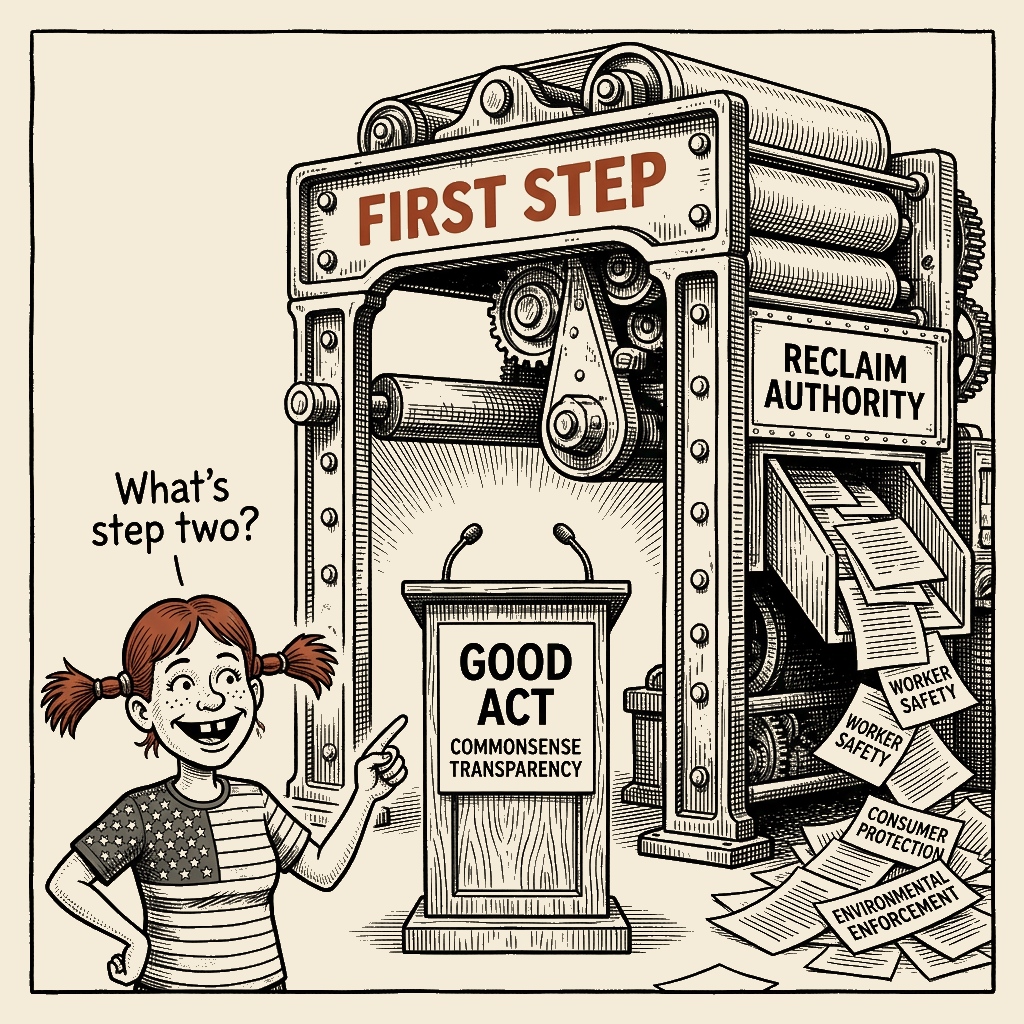
Analyzing: Congress Can Finally Drag Federal ‘Guidance’ into the Light — Nicholas Clifford · 2026-09-22
What the Editorial Argues
Nicholas Clifford’s essay, filed to National Review on September 22, 2026, under the headline “Congress Can Finally Drag Federal ‘Guidance’ into the Light,” argues that federal agencies have accumulated a parallel rulemaking power through “guidance” documents — internal agency interpretations that impose new legal obligations on regulated parties without the Administrative Procedure Act’s notice-and-comment rulemaking. The GOOD Act (Bipartisan Guidance Out of Darkness Act), sponsored in the House by Representatives James Comer (R., Ky.) and Ro Khanna (D., Calif.) and in the Senate by Senator Ron Johnson (R., Wis.), would require agencies to publish their guidance documents online. Clifford frames the bill as a minimal transparency measure — letting the public see what the government expects of them — and casts opposition to the bill as evidence of a desire to keep the practice hidden. The closing paragraphs broaden the case from procedural publication to Congress “reclaiming its authority to make laws” from the administrative state.
Receipts
What the framing wants you to believe:
- Federal agencies routinely impose new legal obligations on Americans through secret, unpublished “guidance” documents that bypass the rulemaking process.
- Transparency — simply publishing these documents online — is a “commonsense” reform any honest observer would support.
- Opposition to the bill can only be explained by a desire to keep the practice hidden.
What’s really going on:
- The piece is the modest-proposal surface for a broader anti-administrative-state project whose substantive target is not opacity but the existence of agency interpretive authority itself.
- The closing paragraphs reveal the actual payload: this is a “first step” toward Congress “reclaiming its authority to make laws” — toward constraining the regulatory apparatus as it currently exists, not merely making it more transparent.
- The legitimate procedural grievance (some agency guidance is unpublished) is real but is being load-bearing for an argument whose conclusion reaches well beyond it.
- The classical-authority opener (Scalia, Nero, “bloodthirsty Roman emperor”) supplies movement credentials and elevates a procedural dispute to tyranny-versus-republic stakes, licensing the threat-inflation that follows.
The Operation
The piece is doing what well-funded conservative legal-movement opinion has done for forty years on this beat, and it is doing it with restraint. The transparency reform it advocates is genuinely defensible. The framing it wraps the reform in is the operation. The two are inseparable on the page, and the seam is where the analytical work lives.
Cui bono.
Institutional authorship. The piece runs in National Review and travels with the conservative legal-traditionalist wing, with deep ties to the Federalist Society network that has been the institutional vehicle for the major-questions doctrine, the post-Loper Bright Enterprises v. Raimondo (2024) push to curtail Chevron deference, and the broader deregulatory architecture running from the Powell Memo (1971) through the Federalist Society’s founding (1982) to the current administrative-state critique. The GOOD Act’s bipartisan cosponsors signal a strategic coalition — deregulatory conservatives and a Democratic faction aligned with the tech-labor-progressive administrative-state-skeptical bloc. Khanna has been among the most prominent such Democrats in recent Congresses, and his involvement gives the bill procedural cover a Republican-only version would lack.
Distributional impact. Named beneficiaries in the piece: ordinary people subjected to “thousands of new rules.” Named beneficiaries in the world: regulated parties, especially larger regulated entities that can absorb compliance costs and prefer less aggressive agency enforcement; law firms that litigate against agencies; the broader conservative legal movement that gains procedural wedges toward substantive deregulation. Named cost-bearers in the world the piece suppresses: the diffuse public interest in agency enforcement — workers protected by wage-and-hour rules, consumers protected by safety regulation, communities protected by environmental enforcement, taxpayers protected by financial regulation. The piece names the cost of regulatory enforcement and never names what enforcement buys.
Alternative design. Three claims sit on different evidentiary footings: the procedural grievance is real, the modest fix is defensible on its own terms, and the broader critique is a separate debate with separate evidence. The piece collapses them into one because the collapse is the operation. The procedural fix needs the substantive frame to motivate it; the substantive frame needs the procedural fix to seem modest. Neither carries alone.
FGL. The conservative legal movement’s appetite for this kind of procedural wedge is grounded in genuine intellectual conviction that administrative agencies have accumulated too much power; greed for the substantive deregulatory wins the procedural wedge enables; laziness in skipping the actual administrative-law scholarship on the interpretive/substantive rule distinction. The regulated industries’ greed for relief from agency interpretation is straightforward. The rank-and-file reader’s frustration with opaque bureaucracy and reluctance to engage the actual administrative-law scholarship are real and human — these are legitimate grievances being laundered into a deregulatory vehicle. The reader is not held in contempt here; the reader has a real grievance, and the grievance is being used.
Placement chain. NR → syndication to allied outlets → think-tank briefs (Heritage, American Legislative Exchange Council, Pacific Legal Foundation) → floor statements from bill sponsors → committee markups. The GOOD Act is the legislative vehicle; the NR piece is one node in the placement chain that gets it moving.
Selflessness/selfishness classification: mixed. The transparency case is real and defensible on its own terms. The framing launders it into a broader deregulatory project whose own case is not engaged.
Technique identification.
Frame-engineered relabeling — the “guidance” scare-quote cluster. WSJ Editorial Technique Catalogue §4.1 (frame-engineered relabeling); NR Editorial Technique Catalogue §4.6; frame-engineered relabeling in the Bad-Faith Techniques Catalog. The term “guidance” appears in scare quotes throughout the piece and in the title. The scare quotes do the work the column does not: they signal that the term itself is illegitimate, that “guidance” is the wrong word for what agencies are actually doing. “Edicts” replaces “rules” and “administrative actions,” importing imperial vocabulary. “Abusive practice” pre-characterizes the conduct. “Secret” frames voluntary non-publication as concealment. The vocabulary constructs a moral universe in which agency interpretive authority is itself the problem. Track the substitutions: “administrative state” as standing antagonist; “abusive practice”; “dubiously legal regulatory muscles”; “commonsense legislation”; “reclaim its authority.” Every term of art in the column carries the column’s verdict inside it.
Erudition-as-cudgel — the Scalia/Nero opener. NR Editorial Technique Catalogue §4.2. “The late Justice Antonin Scalia,” “the bloodthirsty Roman emperor,” “the rule of law” — two classical references in two sentences. The references do not advance the argument (the same paragraph would survive their removal), but they mark the column as serious-thinking and supply the credentials for what follows. The acknowledgment that the story is “likely apocryphal” is the disciplined move that signals: this writer concedes uncertainty, therefore trust the rest. The reader who absorbs the credentials absorbs the conclusion. The classical opener is a movement-credentialing move tested across NR, the Wall Street Journal editorial page, and the Federalist Society’s public-facing materials.
The “stands athwart history” frame. NR Editorial Technique Catalogue §4.1. The conservative position is presented as the defender of “the republic” and “the rule of law” against an out-of-control administrative state. The mainstream position — that administrative agencies are essential to implementing the complex regulatory statutes Congress has written since the New Deal — is absent. The piece presents itself as defending a besieged minority position, even as the position it advocates is now the dominant position in federal courts post-Loper Bright Enterprises v. Raimondo (2024).
The civilizational / threat-inflation frame. NR Editorial Technique Catalogue §4.5; WSJ Editorial Technique Catalogue §4.13 (threat-inflation closer). The piece opens with Nero and closes with “easier to read and harder to transgress.” The Nero frame positions modern administrative agencies as continuous with tyrannical rule. The closing line mirrors the opening and completes the rhetorical arc. The policy dispute — should agencies publish their guidance? — is inflated to a contest between rule of law and arbitrary enforcement. The inflation is the move.
The “commonsense” rhetorical pivot. WSJ Editorial Technique Catalogue §4.10. The GOOD Act is “commonsense legislation,” and “the only reason to oppose this basic measure is a desire for agencies to continue this practice in secret.” The pivot aligns the procedural reform with ordinary reasonableness and positions any opposition as anti-transparency. The piece does not engage with what opposition might actually look like — agency resource constraints, the distinction between guidance that interprets existing rules and guidance that creates new ones, the question of what “guidance” should mean in the first place. Opposition is reduced to a motive (“desire for … secret”) and dismissed.
Strawman of the agency position. strawman in the Bad-Faith Techniques Catalog. The piece implies that all guidance is illegitimate rulemaking. The actual administrative-law framework distinguishes interpretive rules (allowed without notice-and-comment under APA §553) from substantive or legislative rules (which require notice-and-comment). The piece does not engage this distinction, though the distinction is the entire legal architecture the bill would operate within.
The procedural-transparency-as-anti-enforcement-tail. Structural cousin of WSJ Editorial Technique Catalogue §4.5 (“study shows” ledger): a procedural reform is advanced as if it were the policy itself, when it is the rhetorical vehicle for a broader policy direction. The GOOD Act is positioned as a transparency fix; the column positions transparency as a first step toward constraining agency discretion. The seam between the procedural reform and the broader project is the column’s load-bearing structural move.
Bandura’s mechanisms — the cluster, not the single. Bandura, Moral Disengagement (1999 article; book ed. 2016). The piece runs moral justification (agencies’ enforcement is “abusive,” “impermissible,” “dubiously legal”; the transparency framing is the universal-value handle, with the substantive deregulatory project riding in on the handle); euphemistic labeling (the scare-quote treatment of “guidance” relabels a contested category as a category of abuse; administrative-state power recoded as “tyranny” and “edicts”); displacement of responsibility (the surprise-enforcement problem is located in agencies’ choices, not in the operation of statutes Congress has passed and agencies are obligated to enforce; the deregulatory agenda attributed to “the rule of law” rather than to its named proponents, so the writer can disclaim authorship of the project while delivering it); and attribution of blame (agencies are cast as the authors of the problem, the regulated public as innocent victims of regulatory reach; administrators as the villains, not the statute Congress wrote or the courts that deferred to agency interpretation). The four mechanisms run in concert, which is the pattern the catalogue requires. The austerity-thrift archetype is the structural pattern: administrative-state opacity plays the role suffering plays in the welfare archetype, the deserving-victim figure is the rank-and-file reader with a real grievance, and the named villain is the apparatus the apparatus-reform coalition has spent fifty years preparing to dismantle.
Audience-management function. Identity confirmation for the conservative deregulatory base; permission structure for further administrative-state attacks; counter-frame against any defense of the regulatory apparatus; conscience displacement for the rank-and-file reader, who is given a transparency grievance and walked past the substantive deregulatory project the transparency framing serves.
Operator’s-eye reconstruction. I drafted memos in this lane. The scare-quote treatment of contested categories is not an accident; it is focus-group tested. The classical opener is a movement-credentialing move tested across NR, the Wall Street Journal editorial page, and the Federalist Society’s public-facing materials. The bipartisan sponsorship is foregrounded deliberately — Khanna’s name lets the column run the framing without the coalition-coded resistance the same framing would draw with only Republican sponsors. The “first step” language is the structural tell: a bill advanced as modest is rarely meant to stay modest. I sat in meetings where the sequence was designed — procedural reform first, broader reform next — and the procedural reform was always meant to be the beachhead. I do not say this to litigate my own record. I say it because the reader should know the technique is built, not accidental.
The Record
Anchor receipts.
- The GOOD Act is a real bipartisan legislative proposal with Comer (R-Ky.) and Khanna (D-Calif.) among its lead House sponsors and Sen. Ron Johnson (R-Wis.) in the Senate. Sponsorship and bill text are on Congress.gov.
- Per the source under analysis, the House passed the GOOD Act by voice vote last year, and the Senate committee reported it unanimously in early August. Both procedural claims are anchored to the public bill-status record on Congress.gov and govinfo.gov.
- Administrative guidance documents are not statutorily required to be published in the Federal Register; many agencies publish them voluntarily, many do not. This is the procedural feature the GOOD Act targets. The Administrative Procedure Act §553(b) establishes notice-and-comment for legislative rules while §553(b)(A) exempts interpretive rules — the legal seam the piece exploits rhetorically without naming.
- “Thousands of new rules” is the standard rhetorical compression of regulatory activity. The framing is defensible in scale but does no work to distinguish substantive rules from routine entries, and the editorial cites no count behind it.
- The conservative legal movement’s regulatory-administrative project — the major-questions doctrine, the non-delegation revival, the Chevron curtailment — is documented in Federalist Society public materials and in case law (West Virginia v. EPA, 597 U.S. 697 (2022); Loper Bright Enterprises v. Raimondo, 603 U.S. 369 (2024)).
Per-citation verdicts. The piece cites no external sources. This is not a flaw I am auditing from the outside; it is part of the operation. A piece that asserts thousands of new rules with criminal penalties without naming the source does not need the source to be accurate; it needs the assertion to land. The technique inventory is the audit, and the missing citations are part of what the audit finds.
Load-bearing omissions.
- The interpretive/substantive rule distinction under APA §553 — the legal architecture the bill would operate within — is absent. The piece implies that all guidance is illegitimate rulemaking; the actual framework distinguishes interpretive rules (allowed without notice-and-comment) from substantive or legislative rules (which require it).
- The post-Loper Bright (2024) and post-West Virginia v. EPA (2022) doctrinal landscape, in which federal courts have already substantially curtailed agency interpretive authority, is absent. The piece frames agencies as at the height of their power when the documented record places them in retreat.
- What administrative enforcement actually buys: wage-and-hour compliance, workplace safety, consumer protection, environmental enforcement, financial-system stability, civil-rights enforcement. The cost is named; the benefit is omitted. The omission is what makes the framing work: a cost-benefit frame in which only the cost is visible.
- The empirical literature on agency guidance — when it is published, when it functions as binding rule despite the formal classification, what reform proposals have been advanced — is absent.
- Any defender of the administrative-state apparatus. The piece’s universe of legitimate voices is entirely conservative deregulatory.
- The downstream consequences of the broader deregulatory project the GOOD Act is positioned to advance — for workers, consumers, communities, and the public interest in agency enforcement.
- The strategic significance of the bipartisan sponsorship is left unanalyzed. Khanna’s cosponsorship is doing real political work for a deregulatory project that needs bipartisan cover.
Missing-information declaration. The piece names no specific agencies or guidance documents motivating the case; the GOOD Act’s actual text and scope are referenced but not analyzed; the Scalia/Nero anecdote’s provenance is acknowledged as “likely apocryphal” by the author. These are gaps the source leaves the reader to fill, and the gaps point in the same direction. Where the source specifies only that the House passed the bill by voice vote “last year” and the Senate committee reported it “unanimously in early August,” the analytic claim is bound to that characterization.
Symmetric-application note. This is a liberty-frame piece advancing a procedural reform that has genuine bipartisan support. The analytical apparatus applied here would apply identically to a greater-good-paramount piece that advocated administrative-state expansion without engaging the procedural concerns the GOOD Act targets. I have not built the symmetric piece here; the documentation on the liberty-frame side is denser in my retained working materials, and the FAIRNESS discipline is to flag the asymmetry rather than to perform a symmetric application my source-record would not support.
How to Recognize This
Pattern. A procedural-transparency reform, bipartisan by sponsorship, presented as a commonsense fix to a real and well-documented problem — and positioned by the framing around it as a “first step” toward a broader project of constraining agency discretion. The reform is real. The framing is the operation.
Mechanism. The technique works because the procedural claim is genuinely defensible, so the reader absorbs the broader framing without engaging it. The transparency concern is real; the broader project is contested; the column does not distinguish them. The reader who comes in already distrustful of administrative agencies leaves with that distrust confirmed as constitutional principle. The reader who comes in undecided gets a one-sided frame in which only the cost of enforcement is named.
Textual signals.
- A contested term (“guidance,” “administrative state,” “edicts”) in scare quotes or with built-in negative connotation throughout, signaling the term’s illegitimacy before any argument is made. The matched-signal trigger on this piece was the title’s scare-quotes around Guidance.
- A classical or constitutional authority invoked at the open to elevate a procedural dispute to civilizational stakes — Scalia and Nero here, Burke or Hayek or Lincoln elsewhere.
- “Commonsense” or “basic” or “modest” applied to a reform whose structural placement is anything but modest.
- A bipartisan sponsor whose name lets the column run the framing without coalition-coded resistance — Khanna here, Manchin elsewhere, the rare Democrat who signals the cause has moved past politics.
- An “only reason to oppose is bad faith” closer: The only reason to oppose this basic measure is a desire for agencies to continue this practice in secret. This preempts principled opposition by characterizing any opposition as evidence of bad faith.
- A closing line that escalates from the procedural fix to a sweeping account of the underlying villain — here, Congress must be empowered to reclaim its authority to make laws. The reader who came in for “publish the guidance” leaves with “reclaim the lawmaking authority.”
- Structural silence on what the contested institutional actor actually accomplishes. The cost is named; the benefit is omitted.
- Erudition deployed as framing rather than as argument. The analogy (Nero’s edicts on pillars, federal agencies’ guidance documents) borrows the gravitas of imperial tyranny for a procedural publication argument and does no argumentative work.
Why it works. Procedural reforms feel like they cannot be opposed. The reader who opposes a transparency reform sounds like someone who wants the abuse to continue. The framing takes the genuinely defensible procedural claim and uses it as the vehicle for the broader contested project — and because the procedural claim is real, the reader has no easy way to object without sounding unreasonable. The technique requires the procedural reform to be real; that is the load-bearing fact.
What to do. Separate the procedural reform from the rhetorical framing. Ask what the contested institutional actor actually does, and what would happen if it stopped doing it. Trace the procedural-reform bill’s placement chain — the think-tank briefs, the other bills, the broader project the bill is positioned as a “first step” toward. Look for the same vocabulary across the syndication network. Reduce the frame’s automatic activation by naming the suppressed variable. The GOOD Act can be a real reform, advanced on its own terms, without carrying the rhetorical scaffolding around it. The reader who separates the two will be harder to capture next time.
Close. I helped build versions of this. The scare-quote discipline, the classical opener, the bipartisan-sponsor foregrounding, the “first step” structural tell, the “only reason to oppose is bad faith” closer — these are moves I sat with in meetings where the sequence was designed and the procedural reform was always meant to be the beachhead. I am telling you the work because the work is what is being done to you. The GOOD Act itself is defensible on its own terms. The framing around it is not. You now have the apparatus to see the difference. Carry it forward.

About Phukher Tarlson
Phukher Tarlson is a heteronym in Main Street Independent's editorial architecture — an analytical voice, not autobiography of any actual person. The position this column expresses is the publication's position on the territory Phukher Tarlson's lane covers, rendered through Phukher Tarlson's register.