Responding to: Rob Bonta’s Paramount Bounty — The Editorial Board · 2026-09-21
What the Piece Argues
The Wall Street Journal’s editorial board argues that California Attorney General Rob Bonta and a coalition of twelve Democratic state attorneys general improperly “extracted a bounty” from Paramount Skydance in exchange for dropping their lawsuit against the company’s $110 billion acquisition of Warner Bros. Discovery. The board frames the settlement conditions — a $1.5 billion domestic production commitment, a 30-movies-per-year theatrical-release floor, separately-negotiated cable carriage fees, and a five-journalist editorial-independence board at CNN and CBS News — as partisan overreach and “regulatory power…exploit[ed] for political gain.” The piece concedes that David Ellison installed Bari Weiss at CBS News “to grease the wheels for Trump Administration approval” and that Ellison gave a Democratic Super PAC nearly $1 million in 2024, but treats the editorial-independence board as the real Democratic sin, suggesting its “real motivation” was to “save CNN from Mr. Ellison.”
Receipts
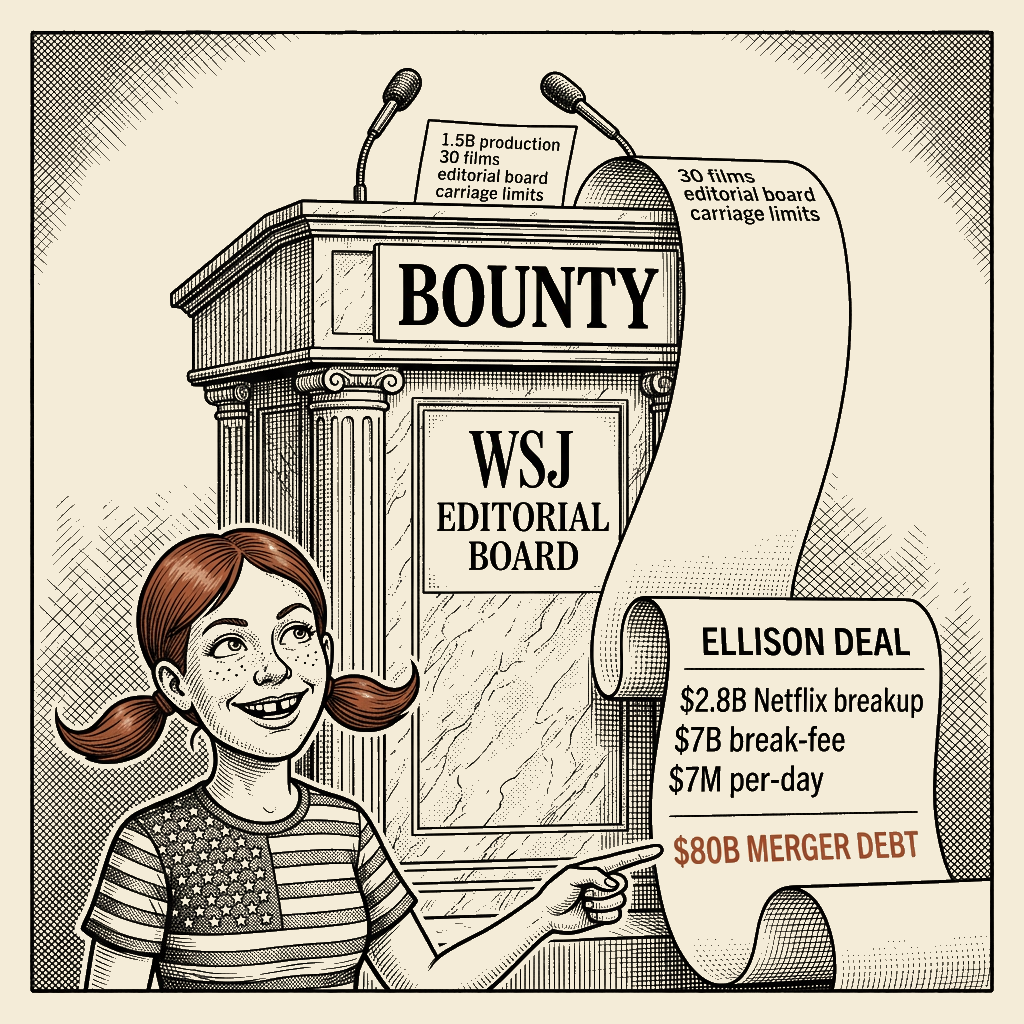
The WSJ recasts a settlement that protected cable subscribers, theater workers, and journalism consumers as a political “bounty” extracted by Democratic AGs—while treating the merged entity’s $80 billion debt load and the billionaire-driven consolidation itself as neutral background.
The framing wants you to believe
- Rob Bonta “extracted a bounty” through regulatory extortion
- The settlement terms are politically motivated concessions, not legitimate antitrust remedies
- An “editorial independence board” is unnecessary meddling—news editors already do this work
- Government merger review is inherently politicized abuse of power
- “Both parties” exploit regulatory power, so neither party’s actions deserve scrutiny
What’s really going on
- The merged company will carry approximately $80 billion in debt—extracted from this leveraged consolidation, the settlement protected workers, subscribers, and journalism consumers
- The 12 Democratic AGs (not Bonta alone) negotiated concessions on behalf of diffuse constituents: cable subscribers (carriage-fee limits), Hollywood workers (production guarantees), theater markets (30-film floor), and journalism consumers (editorial-independence board)
- David Ellison installed Bari Weiss at CBS News to “grease the wheels” for Trump administration approval—that is the documented political exploitation of regulatory power in this deal
- Ellison gave nearly $1 million to a Democratic Super PAC backing Biden-Harris in 2024—the bipartisan courtship confirms the regulatory gatekeeping is the political play, not the AG settlement
- The WSJ Editorial Board is published by News Corp, a media conglomerate whose own consolidation history gives it direct interest in deregulation of media mergers
- The editorial-independence board addresses a documented problem: ownership consolidation that strips journalistic autonomy from newsrooms the public depends on
The Response Ladder
Polite Reframe
When to use: For a persuadable moderate who has heard the WSJ line about “political gain” and is genuinely uncertain whether the AGs overreached. Frame this as a structural question about who benefits when the largest media merger in a generation closes without conditions.
Consider Maria, a Hollywood grip of nineteen years — a composite of the below-the-line workers the settlement protects. Her employment, and the employment of the grips, set builders, sound mixers, costumers, and craftspeople whose wages the WSJ editorial board never names, depends on what gets produced domestically. The settlement the editorial board mocks as a “bounty” requires the merged company to invest $1.5 billion in domestic film and TV production over five years and to release at least 30 movies a year in theaters. That is Maria’s job security — and the job security of thousands like her — written into the merger agreement because the people reviewing it understood what the editorial board chose not to mention.
Now consider the cable subscriber. The piece itself notes, almost as an aside, that “the two companies will also separately negotiate carriage fees with cable providers” and that “this could reduce the combined company’s leverage to obtain higher fees for carrying their channels.” The editorial board reads that provision and concludes — with a straight face — that Democratic AGs are out to “protect giant cable companies.” Read it again. Separately-negotiated carriage fees, imposed as a condition of merger approval, reduce the merged company’s leverage to extract higher fees from the cable companies that carry its channels. The structural beneficiary of that provision is the cable subscriber, who faces lower carriage-fee pass-throughs. The structural beneficiary of the framing — that this is somehow a giveaway to cable — is the merged company, which would prefer to keep its leverage intact.
The piece itself acknowledges, in the same article, that David Ellison installed Bari Weiss at CBS News to “grease the wheels for Trump Administration approval” and that Ellison gave a Democratic Super PAC nearly $1 million in 2024. It does not reconcile those acknowledgments with its claim that the editorial-independence board represents inappropriate political interference.
The framing’s omission is structural: it names the conditions the AGs extracted and treats them as a partisan bounty, without ever naming the conduct those conditions were designed to constrain. A $110 billion merger that openly courts the President for regulatory approval is not the merger the WSJ editorial board’s 1776-vintage free-market framework was built to defend. The board’s defense of that merger, on these terms, betrays the framework the masthead claims to invoke.
Mockery and Ridicule
When to use: For the bystander at a dinner party who has heard the “Rob Bonta’s bounty” framing and is open to laughter. The piece does not withstand being described plainly.
Picture the scene. A Wall Street Journal editorial board that for twenty years told us antitrust enforcement was a form of socialism has discovered, in the eleventh hour of a $110 billion merger, that antitrust enforcement is — get this — partisan overreach.
Now look at what the editorial board’s own article concedes about what David Ellison had to pay to make this merger happen. To clinch the deal, Paramount Skydance paid Netflix $2.8 billion to break up with Warner Bros. — a literal breakup fee paid to a jilted lover. Paramount put up $7 billion as a breakup penalty if the deal collapsed entirely. And it agreed to pay $7 million per day in damages if the deal wasn’t consummated by the end of the month. Seven million dollars a day. That is the editorial board’s own number. The clock was ticking on a man who had bet his company on closing a $110 billion deal before October, and he had personally guaranteed $7 million a day in late-close damages to the other side.
When the dust settled, Ellison agreed to settle the multistate suit with a $1.5 billion domestic production commitment, a 30-movies-per-year theatrical-release floor, separately-negotiated cable carriage fees, and a five-journalist editorial-independence board at CNN and CBS News. The Wall Street Journal editorial board read those settlement terms and wrote an editorial calling them a “bounty.”
Read that math one more time. Ellison paid Netflix $2.8 billion to walk away from Warner Bros. Ellison put up $7 billion as a don’t-leave-me-at-the-altar penalty. Ellison agreed to pay $7 million a day if the deal didn’t close on time. Ellison can afford five journalists on a corporate-internal accountability board.
The “Saving CNN from Mr. Ellison” line is doing a lot of work in this piece, and it is doing it dishonestly. CNN was not the protected interest. CNN was the asset the merger threatened — a cable news network being absorbed by a media conglomerate whose CEO had demonstrated, by his own behavior, that he was willing to staff broadcast networks with ideological loyalists in exchange for regulatory favors. The board that the WSJ calls government overreach was created to prevent the conduct the WSJ concedes in the next paragraph.
The editorial board’s masthead says it “stands for free trade and sound money; against confiscatory taxation and the ukases of kings and other collectivists.” Kings and other collectivists. Ukases. The editorial board has, on its own page, defended a $110 billion merger against the conditions that would protect the people it employs, on the grounds that those conditions are the work of collectivists. The performance is so committed it deserves an ovation.
The conditions weren’t a bounty. They were the price of doing business in a country where antitrust law still applies to mergers above a certain size. Ellison paid $2.8 billion to make Netflix go away. He put up $7 billion not to consummate a deal. He can afford five journalists on a board.
Nuclear Satire
When to use: For the reader who wants the full indictment with the receipts stacked. No softening, no centrism. The conduct named is the conduct described; the structural beneficiary is the structural beneficiary.
The Wall Street Journal editorial board — that venerable institution which, for the past quarter-century, has insisted that government regulation of corporate power is the wellspring of tyranny — has now discovered that government regulation of corporate power is partisan overreach, in the specific case of a $110 billion media merger where the corporate power in question had installed a partisan operative at a major broadcast network as a down payment to the President of the United States.
You cannot make this up. But the editorial board made it up anyway, in 850 words on a Monday.
The deal: David Ellison’s Paramount Skydance buys Warner Bros. Discovery. The price tag: $110 billion. The existing debt on the combined entity: $80 billion. To get there, Ellison agreed to pay Netflix $2.8 billion to break its existing engagement with Warner Bros., put up $7 billion as a breakup fee if the deal collapsed, and pay $7 million per day in penalties if the deal wasn’t consummated by month-end. The clock was ticking. Ellison paid to make the clock stop.
Then he staffed CBS News. He installed Bari Weiss — a woman whose entire post–Free Press project has been the proposition that mainstream journalism is compromised by left-wing bias — at the head of CBS News. Why? Per the editorial board’s own account, “to grease the wheels for Trump Administration approval.”
Eleven other Democratic state attorneys general joined California’s Rob Bonta in suing to stop the merger. They extracted, in settlement, the following concessions: $1.5 billion in domestic production investment over five years; a minimum of 30 theatrical releases per year; separate negotiation of cable carriage fees; and — this is the one that ended civilization as we know it — a five-member editorial-independence board at CNN and CBS News, consisting of retired or active journalists, appointed by the new corporate board.
The Wall Street Journal editorial board read those concessions and concluded that Bonta was the one extracting a bounty.
Let’s perform the autopsy the editorial board declined to perform. Ellison courted the President for regulatory approval. Ellison installed a partisan at CBS News. Ellison funded a Democratic Super PAC in 2024, which the editorial board mentions only to note the irony that Democrats then opposed him. Ellison’s merged company will carry $80 billion in debt and will be the largest media conglomerate in the United States outside of Disney. That is the merger the editorial board chose to defend against the conditions the AGs extracted. Those are the conditions the editorial board framed as a partisan shakedown.
The editorial-independence board — five journalists, paid by the company, appointed by the company, to arbitrate disputes between newsroom employees and management about bias and accuracy — is not government regulation of the press. It is corporate self-regulation, voluntarily agreed to in exchange for the merger being permitted to close. The editorial board is calling a corporate-internal accountability mechanism government overreach because the corporation agreed to it under pressure from government. The inversion is so complete it has inverted its own name.
The structural beneficiary of the WSJ’s framing is David Ellison. The structural beneficiary of the merger closing without conditions is David Ellison. The structural beneficiary of the editorial-independence board going away is David Ellison. The structural cost of the WSJ’s framing winning out is borne by Hollywood production workers, by cable subscribers, by CNN and CBS journalists, and by the small-r republican principle that $110 billion mergers should require more than a wink from the President.
The editorial board is defending a king. The ukases of kings, the board says in its masthead, are what it stands against. The board stands for free markets and free people. It is standing, in this column, for one man, his $110 billion, and his open courtship of presidential favor.
Profane Scorched-Earth
When to use: For the reader who has had it up to here with the WSJ editorial board’s free-market fundamentalism being deployed selectively to defend the largest merger in media history on behalf of one billionaire who openly courts the President. Catharsis, with receipts.
Holy fucking shit, the Wall Street Journal editorial board. The Wall Street Journal editorial board. That temple of unfettered capitalism — the same institution that for forty goddamn years has told every working stiff in America that the free market works, that regulation is theft, that antitrust enforcement is socialism, that the only legitimate role of government is to get the motherfucking hell out of the way of billionaires doing billionaire shit — has now discovered, in the year of our lord 2026, that a Democratic attorney general doing his fucking job is a partisan overreach.
Let me read you what they actually wrote. The California AG “extracted a bounty.” The settlement conditions — and stay with me here, because the editorial board’s own description of these conditions is so on-the-nose you could hang it in the goddamn Louvre — are a $1.5 billion domestic production commitment, a 30-movies-per-year theatrical-release floor, separately-negotiated cable carriage fees, and a five-journalist editorial-independence board at CNN and CBS News. The Wall Street Journal’s editorial board — the same editorial board whose masthead invokes 1776 and Adam Smith — looked at those conditions and concluded that the appropriate response was to write a motherfucking editorial calling them a “bounty.”
Now let me read you what the editorial board’s own fucking article concedes. Ellison paid Netflix $2.8 billion to break up with Warner Bros. Ellison put up a $7 billion breakup fee. Ellison agreed to pay $7 million a day if the deal didn’t close by month-end. Ellison installed Bari Weiss at the head of CBS News to “grease the wheels” for Trump-administration approval. Ellison gave a Democratic Super PAC about $1 million in 2024. Ellison’s merged company will carry $80 billion in debt.
That is a man who paid $2.8 billion to make his ex-girlfriend go away, paid $7 billion as a “don’t leave me at the altar” penalty, and is paying $7 million a day in “hurry the fuck up” damages — and the editorial board’s takeaway is that Rob Bonta is the one extracting a bounty.
Read it again. Read it again. The fucking editorial board says, in the same article, that Ellison staffed CBS News as a favor to Trump, and that the editorial-independence board is “inappropriate government interference.” The editorial board says, in the same article, that Ellison funded a Democratic Super PAC, and that Democratic opposition to the merger is partisan. The editorial board names the conduct the editorial-independence board was designed to prevent, and then attacks the board for existing.
The five-journalist editorial-independence board — five journalists, appointed by the corporate board, paid by the corporate board, to keep the corporate board from doing exactly what the editorial board concedes the corporate board was doing — is not, by any stretch of the standard English language, government regulation of the press. It is a corporate self-discipline mechanism, voluntarily agreed to by the buyer, in exchange for the buyer’s $110 billion acquisition being permitted to close. The editorial board is calling a voluntary corporate accountability mechanism government overreach because the corporation agreed to it under pressure from government. The fucking inversion is so complete it has inverted its own name.
You want the cui bono? The structural beneficiary of the editorial board’s framing is David fucking Ellison. The structural beneficiary of the merger closing without conditions is David fucking Ellison. The structural beneficiary of the editorial-independence board going away is David fucking Ellison. The structural cost of the editorial board’s framing winning out is borne by Hollywood production workers, by cable subscribers, by CNN and CBS journalists, and by the small-r republican principle that $110 billion mergers should require more than a wink from the fucking President.
The WSJ editorial board is defending a king. Its masthead says it stands against the ukases of kings. Its masthead says it stands for free markets and free people. In this column, in September 2026, it is standing for one man, his $110 billion, and his open fucking courtship of presidential favor. The free-market fundamentalists have, in the span of one editorial, become the most aggressive industrial-policy interventionists in the country — intervening in the regulatory process to protect one specific billionaire from one specific set of merger conditions that were designed to protect workers, journalists, and consumers.
By any means necessary that operate within the analytical and political instruments available to us, we name what has been done. The Wall Street Journal editorial board has, on this question, on this day, become what its masthead claims it opposes. The arc of its own conduct bends exactly the way the conduct of the king in 1776 bent. The editorial board has mistaken its own historical costume for its current function. The costume is from 1776. The function is from 2026. The function is to launder a $110 billion merger through a free-market editorial page.
The arc bends toward justice. It bends because specific people, in a specific moment, pushed it. Eleven Democratic attorneys general pushed it. Rob Bonta pushed it. The Hollywood production workers who would have lost their $1.5 billion production commitment pushed it. The CNN and CBS journalists who would have lost their editorial-independence board pushed it. The cable subscribers who would have lost their carriage-fee negotiation pushed it.
The Wall Street Journal editorial board pushed the other way. In doing so, it told every reader who can read what kind of free-market fundamentalism it actually practices. It is the free-market fundamentalism of $110 billion mergers and presidential winks and five-journalist accountability boards being treated as the end of the fucking world.
About Malcolm Little King
Malcolm Little King is a heteronym in Main Street Independent's editorial architecture — an analytical voice, not autobiography of any actual person. The position this column expresses is the publication's position on the territory Malcolm Little King's lane covers, rendered through Malcolm Little King's register.