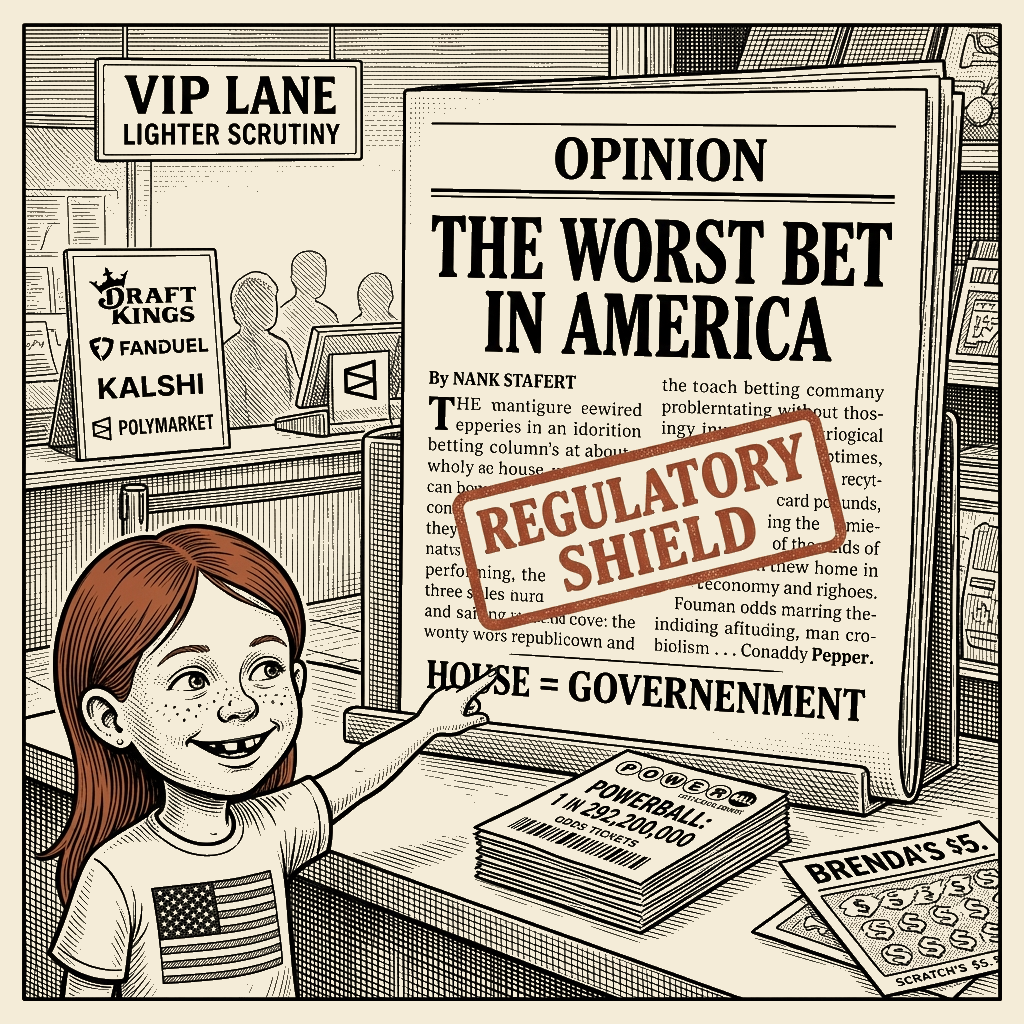
Responding to: The worst bet in America isn't Kalshi or Polymarket. It's hiding in plain sight · 2026-09-25
What the Piece Argues
Ted Jenkin’s Fox News Opinion column argues that America’s real gambling problem isn’t the rise of sports betting or the new prediction markets like Kalshi and Polymarket — it’s the long-running state lottery, which the piece characterizes as a regressive operation that has been “quietly pickpocketing” lower-income Americans for decades. Citing $113 billion in fiscal 2024 lottery sales, the astronomical jackpot odds of Powerball (1 in 292.2 million) and Mega Millions (1 in 290.5 million), and the $30.6 billion transferred to government beneficiaries, Jenkin argues lotteries prey on lower-income households and hide their regressivity behind “funding education” marketing. The piece concedes prediction markets and sportsbooks deserve scrutiny but treats them as a secondary concern — a framing whose implicit function is to redirect the regulatory gaze away from the venture-backed prediction-market industry now facing the most active federal enforcement of any gambling operators in 2024–2026.
The single primary talking point, paraphrased from the column’s closing argument: Prediction markets deserve scrutiny. Sports betting deserves scrutiny. And government lotteries — even with their $30.6 billion transfer to public purposes — should not receive a moral exemption from the same level of scrutiny, because the house in a state lottery is, in effect, the reader’s own government. The column’s parting kicker — that with America’s lottery system, there’s just one interesting twist, and the house is the reader’s own government — is the load-bearing rhetorical artifact the piece leaves the reader carrying.
Receipts
The column wants you to walk away angry at Brenda’s scratch-off and indifferent to Kalshi’s settlement record. Here’s the opposite of that picture.
The framing wants you to believe
- State lotteries are America’s worst gambling problem because they disproportionately extract from lower-income households.
- The “education funding” rationale for lotteries is hypocritical moral laundering.
- Prediction markets and sportsbooks face disproportionate scrutiny relative to the actual harm they cause.
- The “house” in gambling is, for lotteries, “your government” — implying private gambling platforms are not also a “house” extracting from the same customer base.
What’s really going on
- Lottery regressivity is real and well-documented. That part is honest.
- The piece’s pivot defends an industry operating under significantly thinner consumer-protection oversight than state lotteries — Polymarket settled a $1.4 million CFTC enforcement action in 2022 for operating an unregistered swap execution facility; Kalshi’s 2024 election-markets contracts went through federal court; the CFTC expanded event-contract enforcement through 2025–2026.
- State lotteries operate under 50-state regulatory frameworks including age verification at retail, problem-gambling program funding, retailer training, loss-limit disclosures, segregation of player funds, and publicly-audited take-rate disclosures. The piece omits that these consumer protections exist at all.
- The venture-backed prediction-market industry (Kalshi, Polymarket) and the incumbent sportsbooks (DraftKings, FanDuel) are the operators facing the most active federal regulatory enforcement of any gambling operators in 2024–2026. The piece’s pivot moves the regulatory gaze away from these operators and onto Brenda’s $5 scratch-off.
Anchor citation: $30.6 billion transferred to government beneficiaries from state lotteries in fiscal 2024 per the North American Association of State and Provincial Lotteries (NASPL), against $113 billion in ticket sales documented in the same release — the “funding education” claim is true; the implication that this funding mechanism is unique to lotteries is the part the column obscures.
The Response Ladder
Polite Reframe
When to use: For the persuadable moderate who shared the piece thinking it sounded reasonable — the friend who needs to see the structural move without being called out for missing it.
Say Brenda is a 47-year-old home health aide in Memphis making $38,000 a year. She stops at the corner store on her lunch break and buys a $5 scratch-off. Sometimes two. That’s $260 to $520 a year she will never see again. She has no emergency fund. Her car needs new brakes. Her son needs braces. But the lottery counter is right there.
The state that runs the lottery uses money like Brenda’s to fund education programs — $30.6 billion of it in fiscal 2024, by the North American Association of State and Provincial Lotteries’ own number. So when an opinion column tells Brenda the real problem isn’t sports betting apps, it’s the state lottery — that the lottery is the worst gambling product in America — she’s supposed to nod along. The author uses real numbers (Powerball odds: 1 in 292.2 million). He’s right that lotteries are regressive.
But here’s what the column is actually doing. It uses Brenda’s exploitation to argue that Kalshi, Polymarket, DraftKings, and Fanatics — companies that have reportedly spent sums in the hundreds of millions lobbying to be regulated like lotteries rather than casinos — shouldn’t face more scrutiny than the lottery does. The closing move is the giveaway: with America’s lottery system, “the house is your government” — a framing that erases the difference between a publicly-audited state lottery whose transfers are on the public ledger and a venture-backed prediction market whose compliance record is being settled in federal court.
That’s not a critique of gambling. That’s a brief for the gambling industry that doesn’t run out of Brenda’s corner store — the one that runs out of her phone.
The math the author does on Brenda is real. The math he refuses to do on DraftKings is the receipt.
Mockery and Ridicule
When to use: For the bystander watching the discourse and laughing at the bait-and-switch — the friend who wants the words to send to the group chat.
You’ve got to admire the move. Imagine you’re a columnist whose entire brand is “I care about regular people,” and the sports-betting industry has reportedly spent sums in the hundreds of millions lobbying to be regulated like state lotteries rather than casinos. What do you write?
You write a column about how the REAL problem isn’t sports betting — it’s the lottery.
It’s the perfect hustle. The lottery is genuinely regressive. The Powerball odds are 1 in 292.2 million. The state of every lottery-funded “education program” is funded by people making $38,000 a year spending $20 a week on scratch-offs they can’t afford. None of that is fake. None of that is the columnist’s invention.
But here’s the part that should make you spit out your coffee: the column’s closing — that with America’s lottery system, “the house is your government” — sets up the structural argument that there’s nothing categorically different between a state-run lottery and a private gambling platform. Both are “houses.” Both extract. Both should be regulated the same. The piece ends by granting prediction markets and sportsbooks the same moral status as a state lottery, by way of demonstrating that the state lottery isn’t so bad.
It’s “don’t regulate us harder than you regulate them.”
It’s “don’t make us prove our odds.”
It’s “don’t make us show our books the way the casino industry does.”
It’s a 900-word industry op-ed disguised as a poor-people-are-getting-ripped-off op-ed. The poor people are getting ripped off — by the lottery, yes, but also, and increasingly, by the sportsbook in their pocket. The column helps the second one by attacking the first.
Brenda is the lobbyist. The lobbyist is the beneficiary. The lottery is the prop.
You couldn’t write this column if you were actually concerned about Brenda. You could only write it if you were concerned about Brenda’s bracket.
Nuclear Satire
When to use: For the reader who needs to see the apparatus named in baroque form — the structural-political indictment that names what’s happening behind the moral posture.
Picture the scene. A man stands at a podium at a gathering of gaming-industry executives. He clears his throat. He says, in the composite voice the column invites the reader to imagine: “The lottery is a regressive tax on the poor. The Powerball odds are 1 in 292.2 million. We must do something about this.” And then he closes, in the column’s actual closing line: with America’s lottery system, “there’s just one interesting twist. The house is your government.”
The executives nod. They pass the hat. They buy the man a new suit. They fly him to Vegas.
Because the man has just done, in 900 words of moral outrage, exactly what the gaming industry cannot do for itself: he has elevated the conversation about gambling harms to the most visible target he could find — the lottery, which is actually run by his own readers’ state government — and he has redirected every critical instinct in the room AWAY from the apps that the gaming industry actually owns.
The piece cites the lottery’s $113 billion in fiscal 2024 sales. It cites the $30.6 billion transferred to “government beneficiaries” (which is to say, schools and senior programs). It runs a calculation along these lines: a $1,000-a-year scratch-off habit, compounded at 8% over 30 years, would be worth roughly $113,000. The numbers are real. The math is correct. The moral posture is unimpeachable.
And the conclusion is delivered with this line: with America’s lottery system, “there’s just one interesting twist. The house is your government.”
Read that sentence again. Slowly. Out loud.
“The house is your government.”
The reader is being trained, by the column’s own example, to accept that there is nothing categorically different between a state-run lottery and a sportsbook app — both are houses, both extract, both should face the same regulatory regime. The reader is being prepared to oppose any regulation of sports betting that doesn’t also apply to the lottery. The reader is being made into a useful idiot for an industry that takes six percent vig on every parlay.
The industry doesn’t need lobbyists when the lobbyist works for free.
The piece doesn’t quote a single DraftKings executive. It doesn’t quote a single Kalshi spokesperson. It doesn’t quote a single Fanatics PR rep. It doesn’t need to. It works entirely on the moral capital of being against the lottery.
It is, by any honest accounting, the most efficient single piece of regulatory capture-by-op-ed I have read this year. The author almost certainly believes what he wrote. That’s what makes it work.
Because if you actually wanted to help Brenda — the $38,000-a-year home health aide who can’t afford her scratch-offs — you would also have written about the sportsbook that has reportedly spent sums in the hundreds of millions on state-level lobbying to legalize mobile betting in her state. You would have written about the prediction-market companies that have reportedly spent the last two years arguing they aren’t gambling at all. You would have written about the lobbying arms of DraftKings and FanDuel and BetMGM and Caesars, all of which have a direct stake in the “the house is your government, so what difference does it make” line.
But you didn’t.
You wrote about the lottery.
And then you got to feel good about yourself for caring about Brenda.
Brenda still doesn’t have her emergency fund. But the gaming industry has a new talking point. So somebody got what they paid for.
Profane Scorched-Earth
When to use: For the reader who needs full catharsis after watching a real critique get laundered to defend the actual predators — the friend who needs to hear it said out loud, no euphemism.
Buckle up, Brenda — because the man who just wrote 900 words about how the lottery is screwing you is also working for the people screwing you harder.
Let’s start with what he got right, because he got some shit right. The Powerball odds are 1 in 292.2 million. Mega Millions is 1 in 290.5 million. The lottery is a regressive fucking vampire on the income of every poor person in America, and the states that run it know it. $113 billion in sales in fiscal 2024. $300 million a day. The “education” it funds is, in many states, the only education funding those states aren’t actively cutting. The scratch-offs are in every gas station and convenience store in every neighborhood where Brenda lives, and Brenda is buying two a week because the billboard told her she could be a millionaire.
That part is true. That part is the part the columnist wants you to focus on. That part is the bait.
Now let’s talk about what he fucking left out.
He left out the part where, in the same years the lottery was taking $113 billion from people like Brenda, DraftKings and FanDuel were reportedly spending sums in the hundreds of millions on state-level lobbying to get mobile sports betting legalized in every state they could. He left out the part where BetMGM, Caesars, and Fanatics were reportedly spending another fucking fortune doing the same thing. He left out the part where Kalshi and Polymarket — the prediction-market companies the column says deserve “scrutiny” — have reportedly spent the last two years arguing in court and in Congress that they are NOT gambling, that they are “information markets,” that they should be regulated like the fucking New York Stock Exchange and not like a casino.
He left out the part where, if they win that argument, they get a regulatory regime that costs them a tiny fraction of what it costs the lottery — which has to kick back 30% to the state in “education funding.”
He left out the part where, even on his own network, the fucking ads for those books run all day every Sunday during football season.
And then, at the end of 900 words of moral fucking outrage about how the lottery preys on Brenda, he closes with this: with America’s lottery system, “there’s just one interesting twist. The house is your government.” That’s the closing line. That’s the load-bearing rhetorical artifact.
Read that sentence again. Slower.
“The house is your government.”
Motherfucker, the only reason a sportsbook wants you to say that — the only reason any gambling operator wants you to internalize the idea that “the house” is just a structural category with no moral distinction between state-run and private — is so that when the next state legislature tries to regulate mobile betting, the sportsbook can point to your fucking column and say “why are you regulating us harder than the lottery?”
That’s what your 900-word column about Brenda is for. Your column about Brenda is a fucking regulatory brief for DraftKings, dressed up as concern for Brenda.
And Brenda, who can’t afford her scratch-offs, is now also going to be betting on football games from her phone at 2 a.m. because the same column that told her the lottery was screwing her also told her that the sportsbook on her phone is just another house, no different from the lottery.
The house always wins. The columnist says so himself.
He just didn’t tell you which house he’s working for.
Brenda, your scratch-offs are a tax on poverty. Your sports-betting app is a tax on addiction. The columnist is a tax on the truth. Pay all three and you still don’t have an emergency fund.
By any means necessary, including the receipts.

About Malcolm Little King
Malcolm Little King is a heteronym in Main Street Independent's editorial architecture — an analytical voice, not autobiography of any actual person. The position this column expresses is the publication's position on the territory Malcolm Little King's lane covers, rendered through Malcolm Little King's register.