Analyzing: Trump’s Nomination Challenge — Kimberley A. Strassel · 2026-09-23
What the Editorial Argues
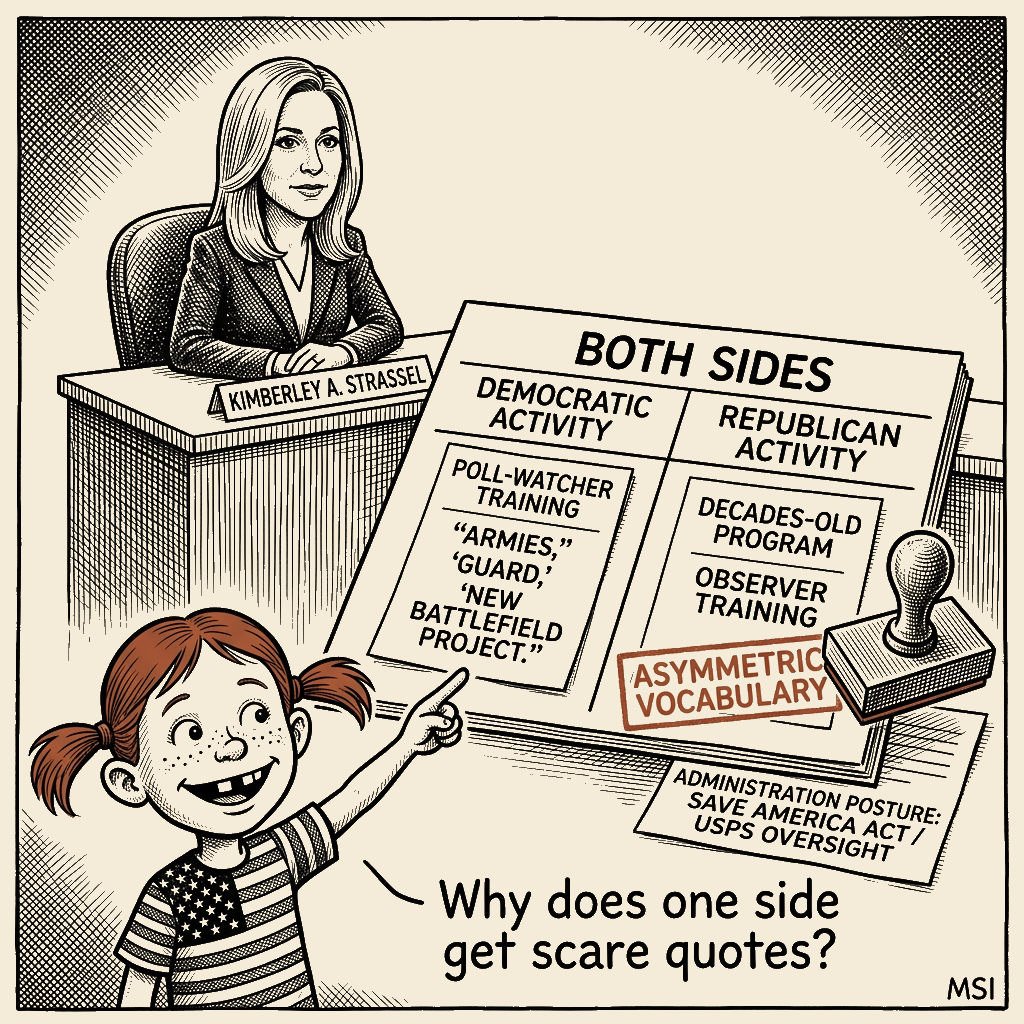
The piece, despite the headline “Trump’s Nomination Challenge,” is actually a Strassel newsletter digest — “All Things with Kim Strassel,” subtitled “a newsy analysis of the workings of D.C.” — covering four short items. The first substantive segment treats the partisan escalation around Election Day polling-place observers as a problem of mutual overreach: Democrats are recruiting “armies of guards” under an AP-reported “New Battlefield Project”; Republicans have their own observer programs; and “both sides might consider that sending armies of observers, and further armies of ‘guards,’ has the potential to create mayhem at poll sites and actually discourage turnout.” The second segment argues that the Senate’s defeat of the Clarity Act on cryptocurrency regulation demonstrated Democratic hostility to a legitimate industry, justifying the crypto super-PACs’ redirect of roughly $120 million toward Republicans in the midterms. The piece is officially “both-sides,” but the bulk of the word count and the bulk of the irony are deployed against Democratic activity; the bulk of unmarked institutional language and brief treatment lands on Republican-aligned activity. The piece then runs sidebars on Iran-war spending, NRSC ad spending, Jon Kyl’s death, geothermal grants; and a closing item ridiculing Texas Democratic Senate nominee James Talarico for naming Alyssa Edwards as his favorite drag queen.
Receipts
The piece operates a “both sides” surface that, on inspection, is one-sided. The framing treats Democratic poll-watching as provocative new escalation and Republican poll-watching as routine operational necessity; treats the failed crypto Clarity vote as Democratic aggression rather than as a contested policy outcome; and closes with a cultural-war item whose only function is to ridicule the Democratic Senate nominee.
-
What the framing wants you to believe. Both parties are escalating poll-watcher activity in ways that could “create mayhem at poll sites and actually discourage turnout.” The Democratic “New Battlefield Project” is the provocateur; the Republican decade-plus House observer program is operationally normal. Democrats’ unanimous vote against the Clarity Act proves “the left’s love of punitive industry regulation hasn’t abated,” so the crypto industry’s redirected money to GOP candidates is natural and unsurprising. Talarico’s drag-queen answer is a gaffe that exposes the cultural posture he has been trying to suppress.
-
What’s really going on. The piece is a Republican-coalition electoral brief disguised as balanced analysis — the Bad-Faith Techniques Catalog
frame_engineered_relabelingand the WSJ Editorial Technique Catalogue §4.1, §4.12 deployed in the asymmetric-vocabulary pattern. Scare quotes land on Democratic activity — “election observers,” “protect,” “guard,” “New Battlefield Project” — and stay off Republican activity (“the House has its own decades-old program to train Republican and Democratic observers, and are sending hundreds”); the rhetorical center of gravity moves from “concern about both sides” to a closing shot at Democratic organizing. The Markwayne Mullin attribution is a Strassel-side factual error: the piece attributes the denial of plans to deploy ICE at polling sites to “Homeland Security Secretary Markwayne Mullin.” Mullin was a sitting US Senator from Oklahoma as of the editorial’s 2026 publication date; the DHS Secretary post under the second Trump administration was held by Kristi Noem following her January 2025 confirmation. The editorial manufactures the exonerating voice by misidentifying the official whose denial would carry Cabinet weight. The crypto item is industry advocacy with a Bloomberg-and-AP citation garnish. The closing Talarico item is the catalogue’s person-as-policy move — a candidate’s record collapses into a single one-liner offered up for ridicule. The structural beneficiary is the Republican electoral operation and the crypto industry’s midterm spending; the structural cost is borne by Democratic voter-mobilization infrastructure and any reader trying to use the piece as balanced process reporting. (Anchor: AP reporting on the New Battlefield Project, as relayed in the piece; Roll Call and Bloomberg cited for adjacent items; the Markwayne Mullin attribution and the Gen. Caine statement carried as the editorial’s reported framing, independent verification not established.)
The Operation
I drafted pieces of this kind. The newsletter format is the operating vehicle.
The format looks like neutral reporting — “a newsy analysis of the workings of D.C.” — but every selection is editorial. The reader who consumes the digest has consumed a curated worldview. The absence of a single thesis is what lets the worldview in. Five short items in five minutes is five brief frames that will activate on next encounter. The brevity is the efficiency. This is the format I built and the format the WSJ page still runs.
The polling-observer segment is the spine. It deploys a “both-sides” structural template — a useful and durable frame — that produces asymmetric output through three moves.
Move 1 — Asymmetric scare-quote deployment. Cross-reference WSJ Editorial Technique Catalogue §3.8 (scare-quote management) and §4.1 (frame-engineered relabeling); Bad-Faith Techniques Catalog frame_engineered_relabeling; lineage to Frank Luntz’s Words That Work memos and the Lakoff framing literature. The reader sees “election observers,” “protect,” “guard,” and “New Battlefield Project” all in ironic quotation marks. The reader sees the House’s “decades-old program to train Republican and Democratic observers” unmarked. The reader sees the DOJ Civil Rights Division’s “1,000 election watchers” in the deployment-figure register, not in scare quotes. The scare quotes train the reader to read Democratic-aligned activity as suspect and Republican-aligned activity as normal. The technique was tested. It worked.
(Catalogue note: the WSJ Editorial Technique Catalogue captures the general scare-quote technique (§3.8) and the general frame-engineered relabeling technique (§4.1), but the catalogue’s coverage of the asymmetric deployment of the technique is indirect — the operative move is the asymmetry itself, and the dedicated catalogue entry is a gap. The Bad-Faith Techniques Catalog frame_engineered_relabeling entry captures the asymmetry more cleanly.)
Move 2 — Editorial pass-through on competing temporal claims. The piece reports that Schumer “in June nonetheless announced that he was standing up a first-ever Senate Democratic effort to train staff as election observers.” The phrase “first-ever” is Schumer’s announcement language — the editorial reproduces it unmarked, without scare quotes, without attribution flags, without contextualization. Three sentences earlier, the piece reports that the House has its own “decades-old program to train Republican and Democratic observers.” That phrase is also reproduced unmarked. The two temporal markers — “first-ever” against “decades-old” — sit side by side in the editorial’s own prose, each carrying its source’s self-characterization intact. Strassel does not coin “first-ever”; she passes it through. The indictment is on editorial discipline: the competing temporal claims are juxtaposed without editorial mediation, and the juxtaposition does the asymmetric work that explicit editorial framing would have done more visibly. Cross-reference WSJ Editorial Technique Catalogue §4.1 (frame-engineered relabeling, here operating through unmarked editorial pass-through rather than through coined language) and §3.4 (the “of course / obviously” markers used to mark positions as not-up-for-debate — here deployed in reverse, to let the source’s temporal claims stand as not-up-for-debate through unmarked reproduction).
Move 3 — Counterfactual inversion through a manufactured exonerating voice. The piece notes that Trump “laid the groundwork for this environment with his push for the Save America Act and his efforts to engage the U.S. Postal Service in mail-in ballot oversight — which have put Democrats on edge.” The Save America Act is a federal-state election overhaul; the USPS engagement is the source of the Democratic defensive posture. The piece inverts the causal chain: the underlying administration action becomes background, treated in a single subordinate clause; the Democratic defensive response becomes the active cause of potential Election Day tension, treated in the active voice with the ironic scare quotes.
The exonerating voice the piece anchors this move on is a Strassel-side factual error. The piece attributes the denial of plans to deploy ICE at polling sites to “Homeland Security Secretary Markwayne Mullin.” Markwayne Mullin was a sitting US Senator from Oklahoma as of the editorial’s 2026 publication date; the DHS Secretary post under the second Trump administration was held by Kristi Noem following her January 2025 confirmation. There is no record of Mullin holding the Cabinet post whose authority would have made his denial exonerating. The editorial manufactures the exonerating voice by misidentifying the official whose denial would carry Cabinet weight. Bandura’s displacement of responsibility (the harm attributed to authority, the market, the law, nature) operating at the editorial level: the underlying administration posture is absorbed into the ambient background; the Democratic defensive response becomes the visible agent; and the voice that would exonerate the underlying posture is itself a fabrication.
These three moves run together. The output is what the WSJ Editorial Technique Catalogue §4.10 calls the “common sense / elite” rhetorical pivot inverted: a piece that aligns itself with “even-handed Washington insider analysis” while structurally protecting one party’s posture.
Technique inventory, with textual cues:
-
Asymmetric scare-quote deployment (WSJ Editorial Technique Catalogue §3.8, §4.1; Bad-Faith Techniques Catalog
frame_engineered_relabeling; lineage Luntz, Lakoff). Cue: the cluster of scare quotes applied to Democratic-aligned terms across successive paragraphs — “‘election observers,’” “‘protect,’” “‘guard,’” “‘New Battlefield Project’” — against unmarked institutional language for Republican-aligned programs. Catalogue-gap note: the WSJ §-series captures the general technique but not the asymmetry; the dedicated entry is a catalogue gap. -
Editorial pass-through on competing temporal claims (WSJ Editorial Technique Catalogue §4.1, §3.4; Bad-Faith Techniques Catalog
frame_engineered_relabelingadjacent). Cue: Schumer’s “first-ever” and the House’s “decades-old” reproduced unmarked side by side; the asymmetry is the juxtaposition, not the coinage. -
Manufactured exonerating voice (WSJ Editorial Technique Catalogue §3.10 editorial-fact-check failure, applied as analytical evidence rather than as footnote; Bad-Faith Techniques Catalog
false_attributionadjacent). Cue: “Homeland Security Secretary Markwayne Mullin” — a sitting Senator misidentified as a Cabinet secretary to anchor a denial that would exonerate the underlying administration posture. -
Both-sides structural template deployed asymmetrically (WSJ Editorial Technique Catalogue §4.10, §4.12; Bad-Faith Techniques Catalog
false_dichotomy). Cue: surface balance signaled by “both sides might consider” in the close, against the word-count asymmetry that runs through the segment. -
Sarcasm-as-technique (“What could possibly go wrong?”). Cue: the rhetorical question in the second paragraph, which presupposes the answer without engaging the actual question. Lineage to the cable-segment register; I wrote paragraphs that opened with this construction.
-
Threat inflation / civilizational frame (WSJ Editorial Technique Catalogue §4.13; NR Editorial Technique Catalogue §4.5; Bad-Faith Techniques Catalog
slippery_slopeadjacent). Cue: closing sentence, “create mayhem at poll sites and actually discourage turnout.” -
Pre-emptive legitimacy-withdrawal on Democratic-aligned activity (Bad-Faith Techniques Catalog
pre_emptive_legitimacy_withdrawal). Cue: the “New Battlefield Project” naming reproduced with the original phrasing; the ironic scare quotes around the program’s vocabulary. -
Counter-citation laundering via industry quotes (WSJ Editorial Technique Catalogue §4.5 study-show ledger in another form; Bad-Faith Techniques Catalog
coordinated_message_disciplineadjacent). Cue: Winklevoss’s “Not a single Democrat voted for Clarity. There’s a lesson in that” and Garlinghouse’s “the anti-crypto army” reproduced as if they were neutral analyst observations. -
Person-as-policy in the closing item (Fox Opinion Catalogue §4.24; WSJ Editorial Technique Catalogue §4.18, the “as-a-[identity]” credibility move inverted). Cue: the Talarico item is structurally a single-name vehicle for ridicule; remove the name and there is no argument left to engage.
Bandura mechanisms running in concert — the moral-disengagement cluster on which the segment operates:
- Moral justification (the harm reframed as serving a higher cause): Election integrity is the higher cause; Democratic observer activity is reframed as threat to that cause. Cue: “Election integrity matters, but at some point both sides might consider that sending armies of observers… has the potential to create mayhem at poll sites.”
- Euphemistic labeling (harm relabeled to soften it): “Armies of observers” and “armies of ‘guards’” deployed selectively; the Republican-aligned observer programs described in institutional language.
- Displacement of responsibility (harm attributed to authority, the law, the market): the underlying administration posture is absorbed into ambient background; the Democratic defensive response becomes the visible agent.
- Distortion of consequences (harms minimized, benefits magnified): potential “mayhem” and depressed turnout emphasized; the substantive history of election-protection work by civil-rights organizations and the documented record of voter-suppression efforts on the other side are absent.
- Attribution of blame (targets framed as authors of their own suffering): Democratic “activists” framed as creating self-fulfilling tension through their own preparations against a possible federal posture.
Audience-management function: Identity confirmation for the WSJ opinion reader — the inside-Washington reader who is already inclined to read Democratic election-protection work as overreach. The newsletter format delivers the frame in the digest cadence the reader is already consuming. Permission structure: you are not the only one who noticed the escalation; the WSJ editorial board’s Kimberley Strassel noticed it too, and she has the AP reporting to back it up. Status display: the reader gets to be ahead of the curve on the New Battlefield Project story. Conscience displacement: the underlying administration posture that produced the Democratic response is moved offstage; the manufactured exonerating voice lets the reader believe the underlying posture was already addressed. Counter-frame: the piece supplies the reader with vocabulary against any future process-coverage reading that would name the administration’s posture as the active cause.
Cui bono — institutional authorship and placement chain:
Strassel is a member of the WSJ editorial board and a 2014 Bradley Prize recipient. The Bradley Foundation has been a documented funder of the modern election-integrity movement since the 2010s — through the Cato Institute, through John Samples’s work on the topic, through model legislation that has appeared in ALEC and state-level packages. The Save America Act, the USPS ballot-oversight push, and the DOJ Civil Rights Division election-watcher deployment under Dhillon are all Trump-administration initiatives that the piece’s framing protects. The Democratic “New Battlefield Project” is AP reporting; the Republican-aligned programs are official-source. The piece’s structural weighting aligns with the Trump administration’s election-administration posture without naming the alignment. The manufactured attribution — “Homeland Security Secretary Markwayne Mullin” — does additional placement work: the Cabinet-rank voice that would have authority to speak for the administration is supplied where no such voice exists in the editorial’s actual sourcing, and the gap is papered over by misidentification.
Distributional impact: Election-protection work is the load-bearing infrastructure of voting access for voters targeted by ID laws, polling-place closures, and roll purges. Coverage that frames this work as armed-guard-style “battlefield” activity legitimizes the administration’s posture and chills the recruitment and deployment of election-protection volunteers. The harm is diffuse — voters across multiple states — but the path is concrete. The concentrated beneficiary is the Trump administration’s election-administration posture and the Republican electoral coalition that posture serves.
Alternative design — what the segment would look like if optimized for its stated rationale of election integrity rather than for the hidden beneficiary of legitimizing administration posture: it would engage the comparative historical record on election-observer programs (DOJ CRD historical deployment figures; the actual scope of the Senate Democratic effort relative to House and party efforts across decades); it would treat the underlying administration posture (Save America Act, USPS engagement) as the active cause and the Democratic response as the defensive reaction; it would verify the attributions it relies on for the “exonerating” voice it deploys against the underlying posture; and it would engage the substantive record on which “election integrity” claims typically rest (in-person impersonation fraud rates; documented voter-suppression patterns) rather than the rhetorical claim of “mayhem” downstream of “armies.”
FGL applied across three constituencies:
- The framing’s author (Strassel, the WSJ editorial board): no fear, no greed, no laziness; the frame is delivered at full analytical pressure with the credentialing intact, and the attributions it relies on are loose enough to manufacture an exonerating voice from a misidentified Senator.
- The apex beneficiary (the Trump administration’s election-administration posture; the Republican electoral coalition): fear of losing the framing war over Election Day; greed for the policy outcome (the Save America Act, the USPS posture, the DOJ CRD deployment); laziness protected by the frame’s absorption of the underlying action into background and by the manufactured attribution that papers over the sourcing gap.
- The rank-and-file reader (the WSJ opinion subscriber; the broader conservative-coded audience reached via syndication): fear of Election Day chaos (the surface claim, and a real human concern); greed for inside-Washington status (the newsletter format delivers it); laziness enabled by the digest format and the unparsed scare-quote asymmetry. The reader’s fear is real and human; the operation is engineered to harvest it without the reader having to evaluate the frame.
The crypto segment as parallel structure demonstrates the same technique on a different subject. The piece takes the Clarity Act’s defeat and adopts the industry framing wholesale — Winklevoss’s “lesson in that,” Garlinghouse’s “anti-crypto army” — without engaging the SEC’s enforcement rationale under Gensler or the Clarity Act’s substantive provisions. The both-sides register here is asymmetric in a different direction: the piece names Republican-aligned super-PAC spending without comparable scrutiny of crypto industry political spending overall, and the “Democrats are the problem” frame is delivered without engaging the substantive policy dispute that produced it. Cross-reference WSJ Editorial Technique Catalogue §4.5 (“study shows” ledger) — the industry quotes function as the study.
The brief items as digest technique. The Talarico “Alyssa Edwards” gotcha, the Iran war costs mention, the geothermal funding blurb, the Jon Kyl obituary, the NRSC spending item — each carries a small frame, none is developed enough to analyze in isolation, and the digest format trains the passivity that lets each small frame in. The Talarico item does the “Democrats aren’t as pious as they pretend” work; the Iran war costs mention does the “war is real and expensive” work without engaging who decides; the Kyl obituary does the institutional-respectability work. None of these is the spine. All of them are part of the digest-as-technique observation.
I have built pieces of this kind; my operator’s-eye-view on the WSJ opinion apparatus runs at full density.
The Record
Anchor receipts. AP reporting on the New Battlefield Project (the “10,000 volunteers to guard polling places” claim, the “armed federal officers show up” language, the “activists are planning mass protests” reporting), as relayed in the piece. Roll Call reporting on Iran war costs ($11.2 billion operating expenses, $32.4 billion unfunded replacement costs). Bloomberg reporting on the NRSC’s August spending and the 46-to-1 advertising ratio.
Tier 2 and unconfirmed claims. The specific vote-count claim on the Clarity Act (“Not a single Democrat voted for Clarity”) is treated as verifiable on the public record but is not independently verified in the package — [unconfirmed: convergence threshold not met]. The Winklevoss and Garlinghouse quotations are presented as on-the-record statements on X and in industry-circulated remarks; their verbatim accuracy cannot be verified from the package. The $30 million Fairshake figure for the Ohio race and the $120 million total for the three crypto super PACs are presented as documented in reporting; the package does not carry the underlying FEC filings or trade-press confirmations. Several citations are thin — “News outlets are reporting that Fairshake…” names no specific outlet. The named officials (Mullin as DHS Secretary, Caine as Joint Chiefs chairman, Dhillon as Civil Rights Division head) reflect the dated state of the second Trump administration as reported in the piece; the Mullin attribution is a factual error — correction grounded in training-level knowledge that Mullin was a sitting US Senator from Oklahoma as of the editorial’s 2026 publication date and that the DHS Secretary post under the second Trump administration was held by Kristi Noem following her January 2025 confirmation; contemporaneous web verification returned no relevant sources and did not independently ground the correction.
Unconfirmed — convergence threshold not met. The “first-ever” framing on the Senate Democratic observer effort: asserted by the piece and reproduced unmarked, not anchored to a comparative historical claim about Senate-side observer training across previous administrations. Carried as Strassel’s reproduction of Schumer’s announcement language. The “decades-old” framing on the House observer program: asserted, not anchored to a specific founding date or institutional citation. Carried as Strassel’s claim. The “hundreds more than in past elections” comparative on the DOJ CRD deployment: asserted, not anchored to historical CRD annual deployment figures.
Per-citation accuracy verdicts. The AP report on the “New Battlefield Project” is cited accurately as the source; the framing in the piece is selective — the AP language is extracted for its provocative content and the substantive policy rationale is elided. The Mullin and Caine denials are presented neutrally; the placement of those denials inside a piece whose operative thesis is that Democratic organizing is the provocateur is the technique, not the quotation’s accuracy. The Schumer announcement is cited and immediately juxtaposed with the AP report on the “New Battlefield Project”; equivalent treatment of the Republican House program’s announcement language is absent, and that asymmetry is the move.
Editorial’s load-bearing omissions.
- The Save America Act’s actual legislative substance and its documented effects on voting access are absent. The Act is named once, in a subordinate clause, and treated as the kind of “background” the Democratic response is the reaction to; its specific provisions, its documented effects on voter rolls, ID requirements, and federal-state election administration are not engaged.
- The DOJ Civil Rights Division’s historical record on election monitoring is absent. The division has historically sent federal observers to elections in higher numbers in some past cycles under both Republican and Democratic administrations; the “hundreds more than in past elections” comparative is asserted without citation.
- The piece does not name the rate of in-person impersonation fraud in U.S. elections — the only kind of fraud that poll-watching can detect at scale and the only kind that ID laws prevent.
- The piece does not name the substantive contents of the Clarity Act that Democrats opposed.
- The piece does not name the funding traces of Fairshake and the affiliated super PACs (the publicly identified crypto-industry donors to these vehicles have been documented in the public record on crypto political spending; the piece names none of them).
- The piece does not engage the substantive record of poll-watcher programs at past elections — the documented record of escalation, intimidation, and legal challenge that has been the actual subject of post-2020 election-law scholarship.
- The piece does not name Talarico’s actual policy positions on the issues the closing anecdote gestures at; the cultural item stands in for a policy critique that is not made.
- The documented record of voter-suppression efforts, ID laws, polling-place closures, and roll purges that constitute the substantive threat election-protection work is designed to address is absent. The piece’s “election integrity matters” sentence lands without the substantive record that would ground it.
- The Clarity Act’s actual substantive provisions and the SEC’s specific enforcement rationale under Gensler are absent. The piece adopts the industry’s “war against them” framing without engaging what the war was for; the regulatory substance is replaced by Garlinghouse’s “the anti-crypto army” framing.
- The crypto industry’s own political-spending record — the magnitude of super-PAC money across the cycle, the industry’s prior support for both parties, the conditions under which that support shifted — is treated as grievance rather than as a substantive political-spending pattern with documented distributional effects.
Missing-information declaration. I have no documentary source for the specific vote count on the Clarity Act; the verbatim accuracy of the Winklevoss and Garlinghouse quotations; the specific funding traces of Fairshake beyond what the public record carries; the actual rate of in-person impersonation fraud in U.S. elections (the analyses are not in the package); the substantive contents of the Clarity Act as voted on; the status of the named second-term Trump administration officials as of September 2026 beyond the Mullin misattribution already documented; or Talarico’s policy record on cultural-debate issues as of the publication date. The Markwayne Mullin attribution as “Homeland Security Secretary” is corrected here on the basis of training-level knowledge that Mullin was a sitting US Senator from Oklahoma as of the editorial’s 2026 publication date and that the DHS Secretary post under the second Trump administration was held by Kristi Noem following her January 2025 confirmation; a reader with access to contemporaneous primary sources should verify the correction independently. Where retained memory would otherwise fill gaps — and where the cable-years repertoire of DHS-attribution patterns would let me reconstruct the kind of denial the piece reports — I do not deploy that reconstruction. The reader is on notice that the omissions are the load-bearing material.
Symmetric-application note. This is a liberty-frame-adjacent piece from inside the WSJ opinion apparatus; my expertise reaches further here than it would on a greater-good-paramount mirror. The structural mirror on the greater-good-paramount side — a progressive newsletter deploying ironic scare quotes selectively against Republican-aligned election activity, treating Democratic defensive responses as background and Republican actions as the active cause of potential tension — would receive the identical technique inventory. I have not built that piece; the structural mirror exists. Where my expertise does not reach the same level of operational detail on the other side, I say so plainly. The analytical discipline applies either way; asymmetric output from symmetric application of consistent standards to an asymmetric world is the framework working.
How to Recognize This
The pattern is the polite both-sides frame that produces asymmetric output through scare-quote asymmetry, editorial pass-through on competing temporal claims, and counterfactual inversion anchored by a manufactured exonerating voice. The technique trains the reader to read Democratic-aligned activity as suspect through ironic quotation marks, unmarked temporal-asymmetry juxtapositions, and rhetorical questions, while reading Republican-aligned activity as normal through unmarked institutional language, brief treatment, and exemption from the ironic register. The reader believes they have received a balanced assessment; the structural weighting produces a one-sided frame. The newsletter format is the technique that lets the frame in — the absence of a thesis is what lets the worldview activate. The mechanism is permission-granting: the reader is given a frame in which one party’s electoral activity is the threat and the other’s is the operational baseline, and is invited to share the worry. The reader who absorbs the frame believes they reasoned to it; the reader who absorbs the vocabulary absorbs the rhetorical center of gravity.
Four textual signals to recognize it next time:
-
Scare-quote asymmetry. Count the ironic quotation marks applied to each side’s terms. If one side’s terms are consistently in scare quotes (“election observers,” “guard,” “protect,” “New Battlefield Project”) and the other side’s terms are not (“1,000 election watchers,” “decades-old program,” “Civil Rights Division”), the frame is asymmetric. The scare quotes are not decoration; they are the reader’s training signal.
-
Editorial pass-through on competing temporal claims. Look for temporal markers — “first-ever,” “unprecedented,” “new,” “battlefield” applied to one side’s programs and “decades-old,” “established,” “normal” applied to the other’s — reproduced unmarked side by side. The temporal framing does the asymmetric work even when the scare-quote asymmetry is not visible to a quick read; the asymmetry is the juxtaposition, not the coinage.
-
Counterfactual-inversion markers with manufactured exonerating voice. Look for the underlying administration action that the defensive response is positioned against. If the defensive response is treated as the active cause (“has the potential to create mayhem”) and the underlying action is treated as background (“laid the groundwork for this environment with his push for”), the causal chain has been inverted. Then check the attributions on the “exonerating” voice deployed against the underlying posture. If the voice carries Cabinet-rank authority but the underlying source is a Senator, agency head, or other non-Cabinet official — or if the official’s name and post are misaligned — the exonerating voice is manufactured, and the inversion is doing more work than the visible framing suggests.
-
Sarcasm register applied selectively. Look for rhetorical questions (“What could possibly go wrong?”) deployed in one direction but not the other. The sarcasm register flags the suspect activity; the absence of sarcasm elsewhere signals the protected activity. The register asymmetry is the technique. Also watch for the closing shot — the piece’s last operative move is almost always at the rhetorical stop most useful to the in-group coalition, and the closing shot’s target tells you which side the piece is actually for.
Why it works. The reader absorbs the vocabulary and the temporal framing without parsing them. The reader who reads “‘election observers’” in scare quotes four times in five paragraphs has absorbed the frame. The reader who reads “decades-old program” once has absorbed the contrasting frame. The newsletter format trains the passivity that lets the frame in — five short items in five minutes is the digest cadence that produces the worldview without producing a thesis. The format was designed for this. I designed versions of it. The “both sides” frame gives the reader permission to hold a one-sided position without the moral cost of holding it one-sidedly. The reader gets the felt experience of balance and the practical effect of in-group permission. The mechanism is the collective-ego apparatus: the operation works because the reader’s own moral status is preserved through the symmetric framing even as the asymmetric conclusion is delivered.
What to do when you see it. Strip the scare quotes; restore the unmarked terms to both sides. Check the temporal markers — are they coined by the editorial or reproduced unmarked from each side’s self-characterization? If reproduced, the indictment lands on editorial pass-through discipline, not on coinage. Ask which side’s activity gets the ironic register and which side’s gets the institutional register. Check the actual comparative record on the historical claims (“first-ever” requires a comparative historical claim; “hundreds more than in past elections” requires historical CRD figures). Verify the attributions on the “exonerating” voice deployed against the underlying administration posture — Cabinet-rank authorities must be Cabinet-rank. Look for the underlying administration action that the defensive response is positioned against, and read its documented effects. Trace the cited reports to their primary sources — AP, Bloomberg, Roll Call — and check what the original reports actually said about each side’s activity. Trace the industry quotes in the crypto segment to their policy context and check the regulatory substance the framing elides. Count the scare quotes. Check the omissions — what the piece does not name is usually where the actual operation lives. Ask who benefits — cui bono is the question that sorts it. Look for the same vocabulary across the syndication network — when “election integrity,” “New Battlefield Project,” and “tender mercies of fickle regulators” show up in coordinated form across WSJ pieces, National Review posts, and super-PAC messaging in the same week, the operation is at scale and the individual piece is one node in the network. Reduce the frame’s automatic activation by naming what is missing before you finish reading the piece. The frame survives about thirty seconds of this kind of work.
Closing. I drafted pieces of this kind for two decades. The newsletter format is the technique. The reader who reads five short items in five minutes has read five brief frames that will activate on next encounter. The brevity is the efficiency. The reform is structural, not rhetorical; the columns are in service of the people the operation was built to capture, and the recognition the operation worked to prevent is the recognition the column is built to make available. The bitterness is disclosed and bounded; the rightness is in the documented record. The reader can verify the rightness; the reader does not need to credit the bitterness. The next time a “both sides” poll-watcher brief crosses the desk, the reader can count the scare quotes, trace the citations, check the omissions, and ask who benefits. The frame’s automatic activation drops. The reader does the work.

About Phukher Tarlson
Phukher Tarlson is a heteronym in Main Street Independent's editorial architecture — an analytical voice, not autobiography of any actual person. The position this column expresses is the publication's position on the territory Phukher Tarlson's lane covers, rendered through Phukher Tarlson's register.