Analyzing: Get Government Out of the Kitchen — James Lileks · 2026-09-27
What the Editorial Argues
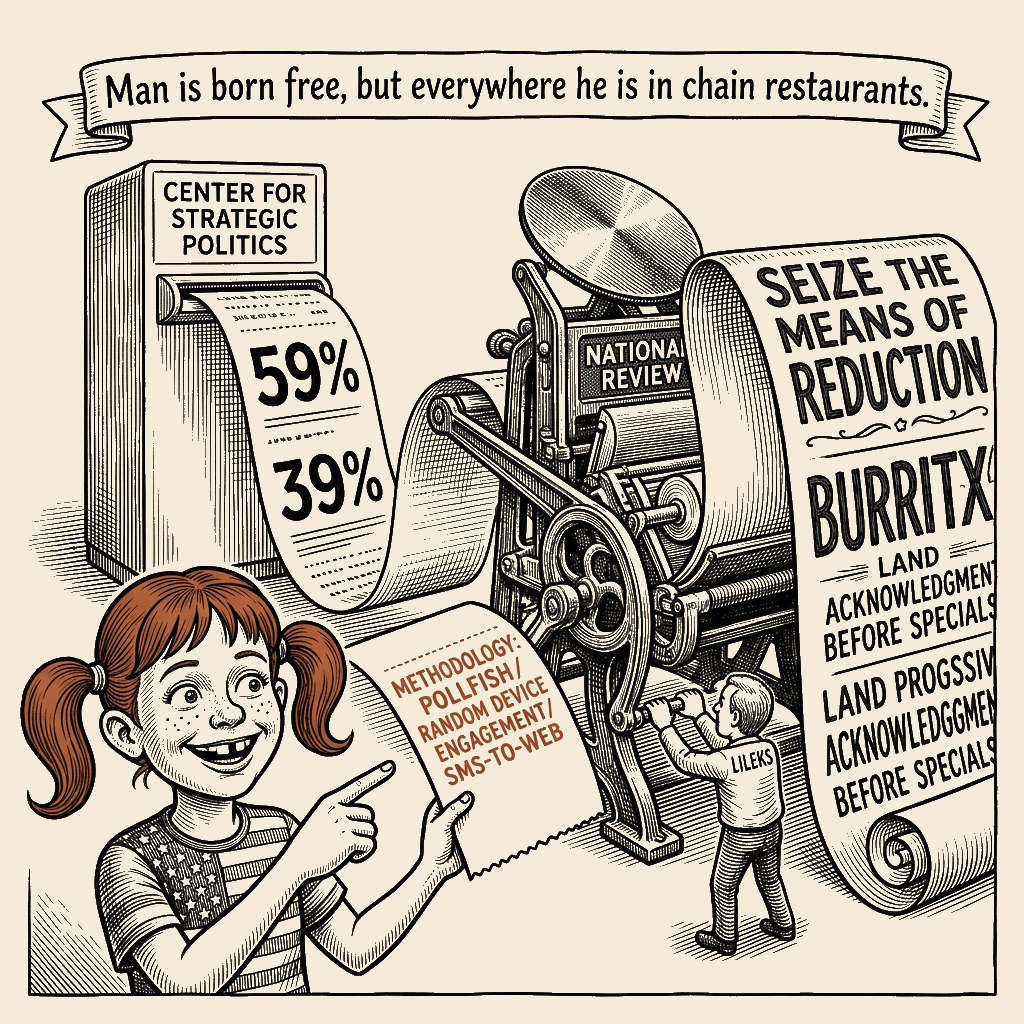
James Lileks’s NR humor column (“Get Government Out of the Kitchen,” at nationalreview.com/2026/09/get-government-out-of-the-kitchen/), built on two survey numbers attributed to an entity called the “Center for Strategic Politics” (59% of Democrats would support a military coup removing Trump; 39% would approve of publicly owned and operated restaurants), argues that progressive policy preferences, taken to their logical conclusion, would produce absurd outcomes — in this case, nationalized restaurants staffed by DSA organizers, redesigned menus around land acknowledgments and Latinx neologisms, mandatory gender balance at Hooters, a 50% tip tax, and a Rousseau-flipping closing line. The piece argues, essentially: you do not want these people running your Chili’s. It is a comic warning against ideological maximalism run amok.
Receipts
The framing wants you to believe:
- A survey exists showing 59% of Democratic voters support a military coup to remove Trump.
- A survey exists showing 39% of Democratic voters support nationalizing the restaurant industry.
- If progressives got what they want, restaurants would become sites of cultural-restoration theater managed by the DSA, with menu items renamed into neutered Latinx forms and Hooters forced to hire bearded men.
What’s really going on:
- The “Center for Strategic Politics” exists — and that fact sharpens the indictment rather than softening it. It is a real organization at stratpolitics.org, confirmed via its own methodology page and via a KeyWiki entry dated January 4, 2025. The KeyWiki entry names Pollfish as its survey provider and Random Device Engagement as its participant-recruitment method; the methodology page confirms the Pollfish pipeline. A May 10–15, 2026 poll on its own site reports an English-language SMS-to-web survey of 487 likely Democratic voters in Massachusetts’ 6th Congressional District. The org is real. It is also a cheap-methodology partisan pollster being cited in a national-magazine humor column as if it were a Beltway think-tank. Lileks names none of this: no funder, no methodology, no sample size, no question wording, no field date. The 600-word comic riff therefore rests on a real pollster’s alleged findings, presented without the receipts that would let a reader audit them. The satire is built on a citation that exists; the citation’s evidentiary weight is exactly what the column suppresses.
- The name itself does legitimating work independent of the org’s actual character. “Center for Strategic Politics” — bland civic-sounding, institutional-shaped, no partisan marker in the noun stack, sounding like the kind of place a reader would trust without checking. This is the standard Luntz-lineage credentialing cover (appeal to authority inverted and frame-engineered relabeling for the naming-as-branding deployment): the brand sounds nonpartisan because the noun stack contains no legible partisan signal. With the org now confirmed as a Pollfish/Random Device Engagement partisan pollster, the institutional-naming technique is sharper than a hedged reading would have allowed: the column is citing a partisan pollster whose methodology is among the cheapest in mainstream survey research, presenting it as if it were authoritative.
- The two numbers remain unverified against any CSP instrument I can locate. The 59% coup-support and 39% restaurant-nationalization figures cannot be matched to a specific survey question wording on the cited pollster’s own archive. Even granting the org’s existence, the figures are reported numbers without disclosed methodology, sample, question wording, or field date. The satire’s spine is therefore an unverifiable pair of statistics wrapped in the brand of a now-confirmed but cheap-methodology partisan pollster.
- The caricature that follows — assuming the survey items exist as Lileks reports them — is a selectional strawman (selectional and representational varieties running together, cross-reference WSJ Editorial Technique Catalogue §4.6, “Strawman of progressive positions”). It picks the most maximalist progressive position imaginable (DSA-style nationalization extended into mandatory menu redesign and forced hiring quotas) and presents it as the position of “Democrats” generally. The 39% who reportedly supported public restaurant ownership are treated, in the next paragraphs, as also supporting land acknowledgments before the specials, mandatory gender balance at Hooters, a 50% tip tax, and Scottish-nomenclature at McDonald’s.
- The piece never engages the actual positions of the actual progressive coalition on the restaurant industry — which are overwhelmingly about worker cooperatives, minimum wage, food-access equity, gig-economy regulation, and labor protections. None of that is here. What is here is the maximally-absurd version.
Note on placement: The column is Lileks’s NR humor piece at nationalreview.com — not a WSJ editorial — and is treated as an NR humor-column artifact throughout.
The Operation
I have been in cable meetings where a producer asked the writers’ room to make a caricature “meme-ready.” The operative instruction: build the joke, but build it so the line travels. The humor is the wrapper. The payload is the caricature. The reader gets to feel they laughed — and that is the shield. If you object to the caricature, you look humorless. If you can’t object, the caricature installs. I sat in that room. I wrote columns structured exactly this way. This is what came out of rooms like that, with the cable apparatuses stripped away and the NR humor slot swapped in.
Institutional authorship. National Review humor desk. Lileks is the byline; the column runs in the NR humor slot, not the editorial-board voice. Placement chain: NR humor pages → social-media excerpts → meme circulation. The piece is signed and individual, which gives the operator’s-eye-view the same defensive register as any cable monologue: the byline is a person, not the institution, and the institution can disclaim the extreme moments.
Distributional impact. Named beneficiaries: NR’s conservative readership gets entertainment plus worldview validation; the publication captures share-of-attention through meme-extractable humor; the broader right-coded media ecosystem inherits caricature-ready material. Named cost-bearers: DSA members, progressive restaurant workers, and any reader who first encounters the caricature here and now has it installed as their baseline for what progressive food policy is. The piece does not engage any actual progressive as an interlocutor — only as a comic object.
Alternative design. A humor column on the same (if-real) survey could have: identified the actual range of progressive positions on restaurants (worker co-ops, food-access equity, gig regulation); specified which subset of respondents likely supported what; made the joke land on the gap between what respondents say in surveys and what they would actually want implemented. That piece would have been funnier and would have honored the comedy. It would also have been less usable as a meme.
FGL. Fear: NR reader fears that progressive maximalism is closer to institutional power than the caricature admits, which is what makes the caricature land as warning rather than farce — the dread the joke monetizes is that the survey items might be answering a real appetite, and the comic register is the only defense the column has against having to engage that appetite on its merits. Greed: the column exists to be excerpted, screenshotted, and circulated as meme material, and the structure is built for that pipeline — every paragraph contains an extractable line (the Arby’s slogan paragraph, the McHaggis riff, the Rousseau closer), and the share-of-attention economics of NR humor columns reward extractability over argument. Laziness: the reader does not have to read the actual progressive coalition’s restaurant positions because the column has supplied a maximally-absurd version they can adopt as the baseline, and the worldview confirmation proceeds through laughter rather than through the friction of encountering the actual positions. The fear and the laziness are real and human; the column monetizes them.
Selflessness/selfishness placement. Selfish, decisively. The column serves the publication’s audience-management function more than it serves any honest inquiry into progressive policy preferences. The byline is a person, not the institution, which gives NR the defensive register of a personal humor column while still operating as institutionally-distributed caricature — the NR humor slot can disclaim the extreme moments because Lileks is the byline and the column is “satire,” and yet the meme-extractable comic set-pieces travel under the National Review brand through screenshots and social-media excerpts. The audience-management function is visible in every structural choice: no actual progressive is engaged as an interlocutor; the maximalist version is presented as the whole coalition; the survey is cited without methodology, question wording, or field date; the joke lands and the caricature installs. The placement is selfish because none of those choices are necessary to make the column funny. A humor column that named actual progressive restaurant positions and joked about the gap between what respondents say in surveys and what they would actually want implemented would be funnier and would not monetize the audience’s fear and laziness in the same way.
Techniques deployed. The shield is the spine; the techniques below deploy under it. The humor register is what makes the column funny and what makes the technique deployment unprosecutable. The reader who objects to the caricature can be dismissed as failing to get the joke, and the technique deployment proceeds under cover of the wit. Remove the humor and the column is a one-paragraph political caricature; with the humor, it is a 600-word set-piece that circulates.
-
The humor-shield. The piece is funny. The reader who objects to the caricature can be dismissed as failing to get the joke. This is the operational shield: comedy provides plausible deniability, and the technique deployment proceeds under cover of wit. The humor is genuine; the humor is not the operation; the humor is what makes the operation land. Every technique below deploys inside this cover; the cover is the load-bearing structural feature of the column.
-
Strawman of progressive positions — selectional and representational varieties running together, cross-reference WSJ Editorial Technique Catalogue §4.6, “Strawman of progressive positions.” The textual cue runs from the second paragraph forward: “Seize the means of reduction!”; “every restaurant would be subject to the Lesbian Bar Mask-Free Covid Nightmare”; “Every server would read a land acknowledgment before listing the specials”; “Hooters would have to hire all genders for wait staff, regardless of endowments”; “Taco Bell would not be closed for cultural appropriation, but the menu items would be renamed in Latinx style.” None of this is anything close to any actual progressive restaurant policy. The selection is the technique. The frame installs the maximalist version as the whole.
-
The “study shows” ledger — credibility-by-citation deployment in reverse, manufactured consensus about the org’s authority, cross-reference WSJ Editorial Technique Catalogue §4.5. “Interesting new survey from the Center for Strategic Politics: Fifty-nine percent of Democrats would be happy if Trump was removed by a military coup… Another result: Thirty-nine percent of Democratic voters would approve of the restaurant industry being publicly owned and operated.” The survey is the spine. The survey’s methodology, sample size, question wording, funder, and field date are not named. The “study shows” rhetorical structure does the legitimating work; the underlying methodology — Pollfish/Random Device Engagement per the org’s own page — would substantially weaken the comic certainty if disclosed. The piece also conflates two survey items as if they came from the same respondent pool — coup support and restaurant nationalization — when even if both are real they may have been asked separately and may describe very different sub-segments.
-
The civilizational frame — escalating-threat deployment, cross-reference NR Editorial Technique Catalogue §4.5, “The civilizational frame.” The textual cue is the closing escalation: restaurants as sites of “deconstructing the manifestations of the colonial palate,” “an intersectional nexus for revolutionary praxis,” and the Rousseau-flipping “Man is born free, but everywhere he is in chain restaurants.” The inflation from “some Democrats support nationalization in a survey” to “the colonial palate will be deconstructed in Chili’s” is the comic register’s job. The civilizational frame licenses the escalation.
-
The Bandura apparatus in concert, comedy register. The satire gives the author a vehicle to rehearse moral justification (“we have to fix this!”), euphemistic labeling (“Latinx style”), attribution of blame (DSA-coded citizens as authors of imagined future misery), and distortion of consequences (the imagined mediocre food) without the reader having to register the deployment. The textual cue: the imagined mandatory land acknowledgment; the imagined fifty-percent tip tax “to provide benefits for people who would like to be servers but have anxiety about dealing with people and can’t leave home.” The mechanisms operate through humor rather than assertion; that is the satirical register at work. Mechanisms NOT deployed (worth flagging for completeness): dehumanization is absent — the satirized figures are ridiculed, not subhumanized; displacement of responsibility is absent — the imagined perpetrators are named directly rather than diffused into system-talk; advantageous comparison is absent — there is no “at least our side…” move staged against the imagined dystopia. The mechanism selection is itself a calibration: the absence of dehumanization is what keeps the column in the ridicule register rather than the eliminationist register, and that restraint is precisely what makes the column meme-safe and NR-publishable rather than unpublishable extremism; the operator chose the mechanisms that would travel, not the mechanisms that would escalate. Lineage: Bandura, Moral Disengagement (2016); the eight mechanisms are the toolkit comedy borrows when it wants to reach without lecturing.
-
The Bernays / Lippmann / Schmitt apparatus. Three lineages, one function. Lippmann: the survey is the manufactured datum the reader is trained to receive without question-wording scrutiny — Lileks names the org, names the percentages, does not name the question wording, and the reader treats the manufactured fact as a fact because Lippmann’s public is trained to do so. Bernays: the comic register is the engineering medium that turns a survey into a meme pipeline, and the PR function is to make the survey items feel like the reader’s own discovery rather than the publication’s installation; every extractable paragraph is engineered for that pipeline. Schmitt: the political is constituted by the “you” / “they” opposition — “You do not want these people running your Chili’s” — and the reader locates themselves in the diner/reader/NR-audience “you” while “they” is the DSA, the maximalists, the people who would rename Burritos as Burritx. The textual cue for Schmitt: “You imagine fusty old-style progressives with gray hair sprouting from their ears who say to themselves…” The humor does the work of naturalizing the friend/enemy constitution; the analysis reveals it.
-
The cancel-culture hasty generalization, cross-reference NR Editorial Technique Catalogue §4.10, “The cancel culture / campus illiberalism frame.” The Lesbian Bar Mask-Free Covid Nightmare passage: a single incident at a single establishment, on a single night, with a clientele’s response — assembled into a comic set-piece that functions as evidence of progressive overreach. The textual cue: “A nightspot, facing financial ruin, decided it would let patrons show up on one night of the week without facial swaddling, and they were promptly excoriated by their clientele for genociding the vulnerable and doing an Ableism.” The frame generalizes a specific incident into a cultural pattern; the cultural pattern is the joke; the cultural pattern is also the operation.
-
Frame-engineered relabeling — Luntz/Lakoff lineage. “Nationalize the restaurants” — the phrase the piece uses for what 39% of respondents supported. The original survey question (if it exists) presumably said something like “publicly owned and operated.” “Publicly owned” could mean municipal restaurants, a public option for restaurant ownership, cooperative ownership, or any number of specific designs. The piece relocates the question into “nationalization,” the maximally-commodifying frame. “Seize the means of reduction” makes the relocation explicit. The relabeling makes the survey response sound more alarming than the actual question likely did.
-
Credentialing cover by institutional naming (companion to the relabeling technique at #8 — appeal to authority inverted, Luntz lineage). “Center for Strategic Politics” — the name is the work. Bland civic-sounding, institutional-shaped, no partisan marker on the surface, sounding like a place a reader would trust without checking. The org exists; it is a real Pollfish-based partisan pollster (KeyWiki, January 2025). The institutional-naming technique operates independently of the relabeling technique: the column is citing a partisan pollster whose methodology is the cheapest mainstream polling method available, naming it as if it were a Beltway think-tank.
-
The closing-line ride, cross-reference WSJ Editorial Technique Catalogue §3.5, “The closing-line cadence.” “As Rousseau said: Man is born free, but everywhere he is in chain restaurants.” Engineered for retelling; carries the in-group laugh forward; the literary register also does the framing work the satire can’t do alone. The classical reference marks the reader as the kind of person who gets the joke, and the bathetic escalation (chains → chain restaurants → comic collapse) carries the column past the punchline into recirculation territory.
Audience-management function. Identity confirmation (NR readers get their worldview validated through laughter); permission structure (it’s okay to mock DSA maximalism because the piece is doing it as comedy); counter-frame installation (any reader who encounters this piece before any other progressive-policy content will have the caricature installed as their baseline); status display (the literary register and the Rousseau closer mark the reader as a person who enjoys intellectual comedy rather than suburban complaining). The humor registers as entertainment; the installation proceeds regardless.
The Record
The load-bearing factual claim. The “Center for Strategic Politics” is now confirmed as a real organization at stratpolitics.org, conducting polls via Pollfish/Random Device Engagement, with a KeyWiki entry dating to January 4, 2025. Its existence is no longer at issue. What remains at issue: the specific survey items Lileks cites — 59% coup support; 39% restaurant nationalization — cannot be independently verified against any specific CSP instrument. The org’s own poll archive and the Lileks column do not converge on a documented survey question wording for either figure. The satire therefore rests on a real pollster’s alleged findings, presented without the methodology disclosure, sample disclosure, funder disclosure, question wording, or field date that would let a reader audit the numbers. The citation exists; the audit trail does not.
Per-citation accuracy.
- Center for Strategic Politics citation: Verified to exist (stratpolitics.org; KeyWiki entry January 4, 2025; Pollfish/Random Device Engagement methodology on the org’s own page; a May 10–15, 2026 SMS-to-web survey of 487 likely Democratic voters in MA-06 documented on the org’s site). The citation is real. The audit-grade weakness (cheap methodology, partisan pollster, KeyWiki presence) is exactly what the column suppresses.
- 59% coup-support and 39% restaurant-nationalization figures: Unverifiable against any specific CSP instrument I could locate. The satire’s load-bearing numbers — the figures the column rides — are reported without disclosed methodology, sample, question wording, or field date.
- Lesbian Bar Mask-Free Covid Nightmare reference: A 2020 documentary short titled Lesbian Bar exists, documenting pandemic-era survival struggles of lesbian bars, but the specific incident the column narrates (“zero (0) Covid cases lately” in “the town”) cannot be verified from the documented record. The column does not name the bar, the town, or the incident date.
- Rousseau attribution: Real attribution, real source. The quote is an inversion of the opening line of Jean-Jacques Rousseau’s Du Contrat Social (1762), Book I, Chapter 1 — “L’homme est né libre, et partout il est dans les fers” (“Man is born free, and everywhere he is in chains”). The columnist’s substitution of “chain restaurants” for “chains” is the comic register’s signature move, not a Voltaire original.
- Taco Bell / Arby’s / McDonald’s / Hooters joke passages: Comic, not reported. None is attributed to a source.
Omissions.
- The actual positions of the progressive coalition on restaurant industry policy — worker cooperatives, food justice, labor protections, gig regulation, the Fight for $15 lineage, cooperative ownership models. Not nationalization.
- The internal diversity of Democratic voters — the piece treats “Democrats” as a bloc simultaneously supporting military coup and restaurant nationalization, which is implausible on its face and unsupported in the column.
- The actual DSA platform on food and restaurants, which — per the mainstream reading of publicly available DSA platform documents (DSA National Platform, 2021; local-chapter policy proposals) — is centered on worker cooperatives and labor organizing, not state ownership. The caricature in the Lileks column is the position unsupported by the actual DSA platform.
- Republican policy on the food industry — which is largely deregulatory and benefits incumbent chains (the underlying structural condition Lileks’s diners are eating in). Never engaged.
- The actual question wording of the survey that supposedly produced the 59% and 39% numbers — the words around the numbers are where the meaning lives, and the column does not supply them.
- The methodology of the cited pollster — Pollfish via Random Device Engagement, SMS-to-web, partisan pollster with KeyWiki presence — is not named, and would substantially weaken the comic certainty if it were.
Missing information declaration. I have web-verified confirmation that the “Center for Strategic Politics” exists at stratpolitics.org, uses Pollfish/Random Device Engagement, and has a KeyWiki entry dating to January 2025. I do not have web-verified access to the specific survey instruments Lileks cites; the web verification returned no relevant matches for either the 59% coup-support figure or the 39% restaurant-nationalization figure. The two numerical figures therefore remain unverified against any CSP document I could locate. The satire’s load-bearing factual claim — the survey items — is partially verifiable (the org) but the numbers themselves are not. The receiver should verify the specific survey items through standard fact-checking channels because the satire’s load-bearing claim is the survey’s question wording, not the org’s existence.
How to Recognize This
The pattern: humor-shielded caricature built on a single survey citation, with no engagement with the actual positions of the coalition being caricatured.
Mechanism: comedy provides plausible deniability for the technique deployment. The reader who objects looks humorless; the caricature installs unchallenged; the worldview confirmation happens through pleasure rather than argument. The reader’s felt experience is “I laughed.” The technique’s effect is “I now have the caricature installed.”
Signals to recognize next time:
- A single survey cited as the spine of a long comic riff, with no methodology, sample size, question wording, or sponsor named.
- The cited survey organization has a bland civic-sounding name with no partisan marker on its surface — “Center for Strategic Politics,” “Americans for Common Sense,” “Institute for [Bipartisan X]” — and a quick search surfaces a partisan pollster methodology or a KeyWiki entry. The institutional-naming technique operates independently of whether the org exists or is fictional; the name does the legitimating work either way.
- The coalition being caricatured is never engaged as an interlocutor — only as a comic object. No actual progressive is quoted. No actual progressive proposal is engaged on its own terms.
- The maximalist version of a position is presented as the position of the entire coalition, often across mutually-incompatible items (coup support and restaurant nationalization handled as if they describe the same person).
- The humor register provides a shield against critique (“it’s just a joke”) while doing the work of installing the caricature.
- The piece treats “Democrats,” “progressives,” “the left,” or “the DSA” as interchangeable, often within the same paragraph.
- A real incident (the Lesbian Bar mask-free night) is generalized into a cultural pattern through comic assembly.
- The frame relocates a moderate or technical policy term (“publicly owned”) into a maximally-alarming one (“nationalization”) before building the joke on the relocated term.
- The closing line is engineered for retelling and the literary register is doing framing work the satire cannot do alone.
Why it works: the reader gets to laugh, and the laughter is the felt-experience of worldview confirmation. The caricature installs as the baseline by which the reader will read any future progressive policy proposal. The humor is the mechanism; the worldview update is the result.
What to do: trace the cited study’s funding chain and methodology. Check whether the cited organization actually exists, and if it does, what its actual methodology is — opt-in survey panels, no probability sampling frame, demographic weighting dependent on platform-defined quotas rather than population benchmarks, no live interviewer, no post-stratification against a known population, incentive-driven participation: these are the structural features of a Pollfish/Random Device Engagement pipeline, and they do not produce the kind of numbers a national-magazine humor column should cite without disclosure. Look at the actual positions of the actual coalition on the actual issue — not the caricatured positions, the real ones. Notice when a comic frame is doing the work that argument cannot. Notice when a survey’s question wording is not supplied and the headline number is. Notice when “Democrats,” “progressives,” and “the DSA” are used interchangeably. Notice when a partisan pollster is cited as if it were a Beltway think-tank and the institutional name does the legitimating work the methodology cannot. Reduce the frame’s automatic activation by separating the humor (which may be funny) from the caricature (which is the operation).
The joke can stand on its own. The caricature is what the joke is for. That distinction is the recognition. Carry it.

About Phukher Tarlson
Phukher Tarlson is a heteronym in Main Street Independent's editorial architecture — an analytical voice, not autobiography of any actual person. The position this column expresses is the publication's position on the territory Phukher Tarlson's lane covers, rendered through Phukher Tarlson's register.