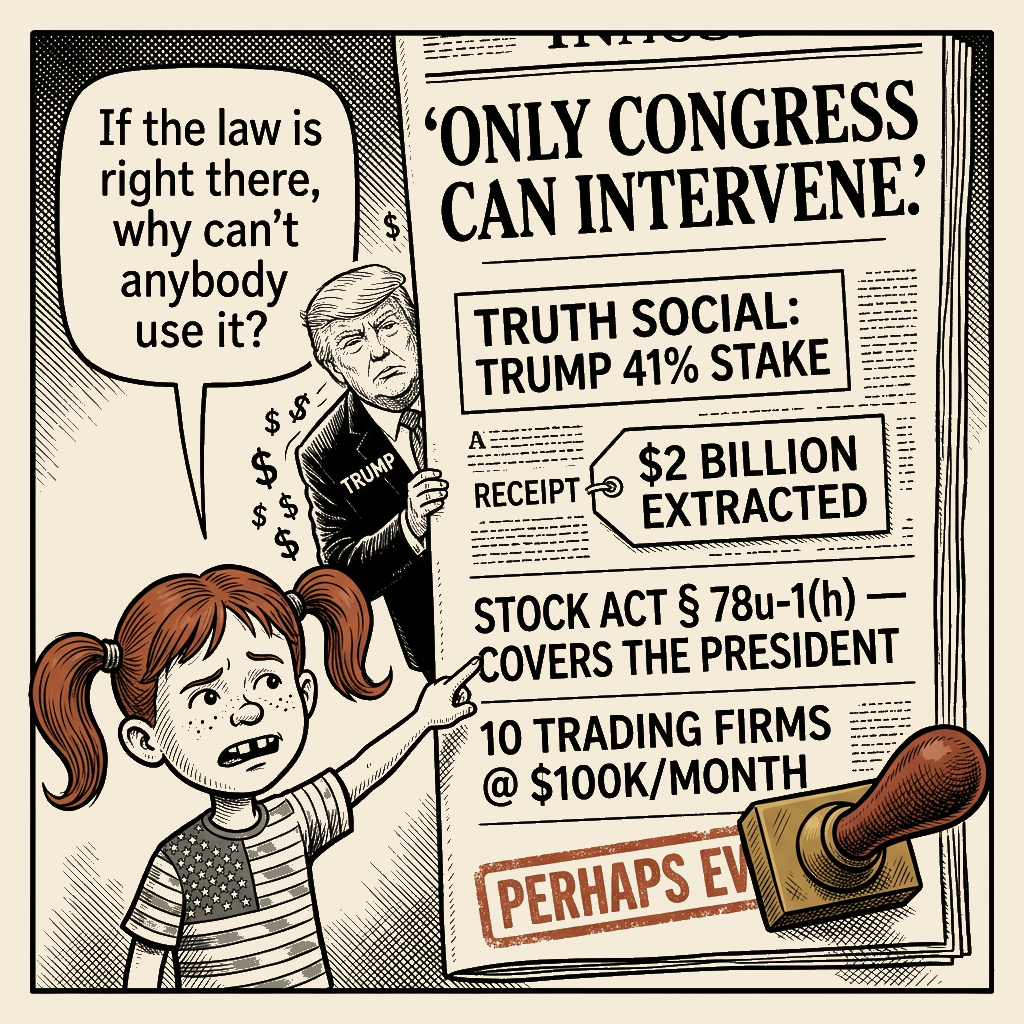
Responding to: Only Congress Can Intervene on Trump’s Truth Social Profiteering — Andrew C. McCarthy · 2026-09-26
What the Piece Argues
The source column argues that Donald Trump’s Truth Social monetization scheme — selling market-moving presidential posts to high-frequency traders at microsecond latency for up to $100,000 a month — represents a constitutional abuse that neither the courts, the SEC, the FBI, nor the DOJ can address, because the 2024 immunity ruling has shielded presidential communications, the STOCK Act faces constitutional and proof hurdles, and Trump-appointed regulators will not investigate their own boss. The column documents the abuse with unusual precision — the fees, the Iran-strike post that crashed oil prices 5 percent within hours, the $2 billion-plus Trump has extracted from the office — but concludes that “in our system, either Congress acts or there is no remedy any time soon, perhaps ever.” Congress, the author concedes, is “a model of dereliction.” The result is a piece that catalogs a “neon-flashing conflict of interest” in detail and then argues that the only constitutional response is the one Congress has no intention of providing.
Receipts
The column catalogs a documented presidential-corruption scheme and concludes the corruption should be tolerated.
-
The framing wants you to believe
- Trump’s Truth Social / TMTG monetization scheme is probably illegal but functionally un-prosecutable; the 2024 immunity ruling, statute-of-limitations problems, Trump-loyal DOJ/FBI/SEC, and pending self-pardons foreclose any judicial path.
- The Constitution vests Congress alone with the capacity to address executive misconduct, and the current Congress is a “model of dereliction.”
- Therefore the corruption stands — “perhaps ever” — and the honest conservative position is resignation.
-
What’s really going on
- The strongest legal theory is right there in the column: the STOCK Act of 2012 (15 U.S.C. § 78u-1(h)), which explicitly names the President as a “covered official” and creates a fiduciary duty breached when a federal official “cashes in, or knowingly abets others in cashing in, on nonpublic information.” John Coates, former SEC General Counsel under Biden, lays out the case in the “Shadow SEC” article the column cites and in the Harvard interview with Jack Goldsmith the column recommends.
- State attorneys general retain authority under state-law insider-trading and bribery statutes regardless of federal immunity. Civil plaintiffs have standing under the STOCK Act. SEC career enforcement staff can refer matters, and statutes of limitations run from the date of the violation, not the date of discovery. The 2024 immunity ruling shields official acts; the establishment of the paid monetization scheme, as the column itself notes, is a private act that predated the second term.
- The load-bearing talking point is “perhaps ever.” The column identifies the abuse, names the statute, names the scholar, and then walks back every remedy path — to produce the conclusion that the doctrine the column serves (executive power insulated from judicial remedy) must remain in place.
The Response Ladder
Polite Reframe
When to use: The persuadable conservative or institutional reader who sees McCarthy’s column as sober separation-of-powers analysis and wants the constitutional concerns taken seriously while the cost of doing nothing is named in human terms.
Consider Brenda. Brenda is 64, lives in Saginaw, and has $87,000 in a 401(k) she built across thirty-eight years of factory shifts and weekend nursing shifts. Last April she watched her retirement savings drop 5% in an afternoon because a Truth Social post announcing the cancellation of strikes on Iran moved oil markets ahead of the news. Brenda does not subscribe to Truth Social. Brenda does not pay $100,000 a month for the privilege of learning presidential policy before the rest of the country. Brenda, in Andrew McCarthy’s telling, will get no remedy from the courts, no remedy from the SEC (led by Trump’s appointees), no remedy from a Republican Congress McCarthy concedes is “a model of dereliction,” and perhaps no remedy ever.
This is the polite frame, so let me concede what is real: there is a genuine argument that courts are limited in addressing systemic executive abuse, and that some forms of misconduct are political rather than criminal. McCarthy is not wrong that the STOCK Act path faces hurdles—he says so, and Coates, the former SEC general counsel whose article McCarthy cites at length, says so. The legal mechanics are difficult. The immunity doctrine is real. The pardon power is broad.
But McCarthy is doing something his own piece documents without naming. He raises every obstacle to accountability and resolves none of them. The proof problem? He raises it and then notes that Coates’s analysis “is on stronger footing.” The state-level prosecutions Coates outlines that survive federal pardons? McCarthy mentions them in passing and moves on. The civil suits under § 78u-1(h) that explicitly cover the President? McCarthy quotes Coates on the point and then details the immunity hurdle as if it were dispositive. The pattern is recognizable, and it is the pattern McCarthy has run in similar columns for what he himself describes as “more than a dozen years”: identify the remedy, explain at length why the remedy is structurally inadequate, and conclude with a counsel of constitutional restraint.
The numbers in the piece do not support the conclusion. Trump’s 41% stake flows into a revocable trust controlled by his eldest son, who also sits on the TMTG board. He has made more than $2 billion from this and adjacent monetization schemes. The receipts are in the column. The remedy the column insists is unavailable is also in the column.
We are the defenders of the public trust. We are the people who insist the office is bigger than the officeholder—that the Constitution’s emoluments clause, its separation of powers, its fiduciary structure (which the STOCK Act makes explicit) all exist precisely so the country does not arrive at the place Andrew McCarthy has now described in print and concluded cannot be reached by any institution he can identify. The architecture exists. Coates has written it down. The question is whether we accept the counsel of despair, or whether we name the scheme for what it is and pursue the remedies the existing law already provides.
Mockery and Ridicule
When to use: A reader who has been nodding along with the “hobby horse” — show them what is funny about a writer spending eighteen hundred words cataloging an abuse and then concluding no one can do anything about it.
The column has a hobby horse. It has had it for more than a dozen years. The hobby horse is this: the legal system is not equipped to address abuses of executive power. It has been ridden through the Obama administration, the first Trump administration, the Biden administration, and now the second Trump administration. The hobby horse has not gotten its rider anywhere. The hobby horse is, at this point, the hobby horse’s primary employer.
This week the hobby horse is cantering through the Trump-Truth-Social-HFT-fee scandal, and the canter is magnificent. The column lays out, in its customary prosecutorial cadence, the precise dollar figures: $60,000 to $100,000 monthly fees, $1.2 million per customer per year at the top tier, a 41 percent ownership stake held in a revocable trust run by Donald Trump Jr., a $2 billion-plus personal haul from monetizing the presidency, a single Truth Social post about canceling strikes on Iran that crashed oil prices five percent within hours and pumped TMTG stock up seven percent in the days that followed. At least ten trading firms have reportedly purchased the service. The column cites John Coates, the former SEC general counsel, on the STOCK Act. It does all the work. It names the apparatus. It describes the conflict of interest with the word “neon-flashing.”
Then it gets to the part where the hobby horse is supposed to carry the argument, and the part is this: nothing can be done. The courts cannot act because of the 2024 immunity ruling. The SEC cannot act because Trump appointed the SEC. The FBI cannot act because Trump appointed the FBI. The DOJ cannot act because Trump appointed the DOJ. Congress could act but Congress is a model of dereliction. Pardons are coming. The statute of limitations is a problem. The proof problem is intractable. The author concedes being hardly alone in this conclusion. In our system, either Congress acts or there is no remedy any time soon, perhaps ever.
Perhaps ever.
The hobby horse, by the end of the piece, has carried its rider to the conclusion that the United States Constitution, as currently interpreted, provides no remedy for a sitting President who sells privileged access to his own market-moving policy announcements to high-frequency traders for a hundred grand a month. The hobby horse’s hooves are stained with what is politely called “a sleazy betrayal of the public trust.” The hobby horse has not been cleaned in thirteen years. It is unlikely to be cleaned in the next thirteen.
The piece is, in its way, a perfect specimen of the genre: it documents a real and ongoing corruption with extraordinary precision, names the people and the dollar figures and the statutes and the case law, and arrives at the conclusion that the reader is supposed to do nothing. The structural fact is not the abuse. The structural fact is the doctrine that says nothing can be done about the abuse. The doctrine has produced no remedy in thirteen years. The doctrine is currently producing $2 billion for the man whose corruption the doctrine exists to leave untouched.
Nuclear Satire
When to use: The audience that needs grotesque metaphor and full villainization—the place where receipts are deployed with cumulative force and the comparison is hyperbolic, criminal, medical, or hellfire.
There is a particular kind of constitutional scholarship that diagnoses monarchy, names it monarchy, catalogs the symptoms, and concludes by recommending that we wait for the monarch to die. Andrew McCarthy has been writing this scholarship for what he himself describes as “more than a dozen years.” With this column he has written the ur-text.
The President of the United States is selling his office. He is selling it the way a Sun King sold audiences—not in the polished salons of Versailles, but through a Truth Social API that charges algorithmic traders $100,000 a month for the privilege of receiving his policy pronouncements three microseconds before the rest of the citizenry. He has made $2 billion from the sale. He will make more. The trade is the trade of monarchy: the sovereign controls information that affects the wealth of the realm, and the sovereign sells access to that information. The republican innovation was supposed to be that the sovereign did not own his office, did not profit from it, and did not conduct the nation’s business through a corporate vehicle. The Constitution is a long, deliberate argument that the Sun King model is wrong.
Donald Trump has reversed the republican innovation. He has built a private corporation to monetize the public trust. He has appointed his eldest son to manage the monetization. He has staffed the Securities and Exchange Commission—the body that would normally police such arrangements—with his own appointees. He has set up the Justice Department to do the same. He has built, in short, the most efficient extraction machine in the modern history of the American presidency, and he has done so with the cheerful constitutional assistance of Andrew McCarthy, who has spent fifteen years writing columns explaining that each of the bodies designed to restrain this kind of conduct is structurally unequipped to do so.
This is not insider trading in the traditional sense. It is worse. Insider trading requires a corporate insider; Trump is the President. It requires nonpublic information; Trump is making the information public, just selectively, through a private channel. It requires intent; the API is the intent. It requires a counterparty willing to pay; at least ten trading firms have signed up. It requires a regulatory body willing to investigate; the SEC is run by his people. It requires, finally, a constitutional commentator willing to certify that no remedy is available; Andrew McCarthy has provided that certification in 1,800 words.
The historical analogues are not difficult. James Buchanan used his office to enrich his associates and prepare the ground for the Cotton South’s secession. Warren Harding’s Teapot Dome colleagues used the executive branch to extract oil revenue. Spiro Agnew resigned to avoid prosecution for what would, today, be a small scheme. None of them built a $2 billion subscription product. None of them conducted policy through a corporate communications channel whose equity they owned. None of them sold three-microsecond access to the announcement of their own foreign-policy decisions. The scale is new. The republican rebuttal must be new too.
McCarthy proposes no rebuttal. He proposes diagnosis. He proposes, with the methodical exhaustion of a hospice chaplain, that the patient has entered a stage at which palliative care is the only remaining intervention, that Congress will not provide it, and that the rest of us should adjust our expectations accordingly. He cites Coates to identify the STOCK Act path and then enumerates each reason the path will fail. He mentions state prosecutions and pardons and moves on. He mentions civil suits and immunity doctrine and moves on. He mentions the constitutional architecture and moves on. The patient is dying. McCarthy has made his rounds. He has signed the chart.
The Sun King had his Versailles. Donald Trump has his Truth Social. Andrew McCarthy has provided the constitutional death certificate in advance of the body’s removal. We have, for the moment, the opportunity to decline the death certificate. The STOCK Act is in the U.S. Code. Coates has done the legal work. State prosecutors exist. Civil plaintiffs exist. The Constitution, despite the columnist’s reading, does not foreclose the remedies it is supposed to guarantee. The question is not whether the architecture exists. The architecture exists. The question is whether we will use it, or whether we will accept the columnist’s certification that we cannot.
Profane Scorched-Earth
When to use: When the reader needs the full cathartic payload against the conclusion that the President can extract billions from the office and face zero consequence because the analysis has spent twelve years concluding this is Congress’s problem and Congress will not act.
Let’s start with what is actually happening, because the column has done the courtesy of documenting it with the prosecutorial precision it is famous for and which has now been put in the service of letting the documented thing stand.
Donald Trump, the President of the United States, owns 41 percent of Trump Media & Technology Group, the publicly traded company that owns Truth Social. TMTG has set up a paid service called Truth API. Truth API sells early access to Trump’s Truth Social posts — that is, his presidential policy announcements — to high-frequency trading firms for between sixty thousand and one hundred thousand dollars a month. The firms get the posts microseconds before the posts appear on the Truth Social website or app. The firms use those microseconds to make computerized trades that profit from the price movements the President’s policy announcements cause. The President, through his 41 percent stake and his revocable trust run by his eldest son Donald Trump Jr. — who is also the most visible board member of TMTG — captures a share of the resulting revenue. The President has personally extracted more than two billion dollars from the monetization of the office. On the day the service launched, the President posted on Truth Social that he had canceled strikes against Iran. Oil prices fell five percent within hours. TMTG shares rose seven percent in the days following. At least ten trading firms have purchased the service. At the top of the price range the service will generate 1.2 million dollars per customer per year. The column calls this “a neon-flashing conflict of interest guaranteed to produce unstable governance.” The column is correct.
Now here is what the analysis, which has now spent twelve years and counting arriving at exactly this conclusion, wants you to do with this information: nothing.
The courts cannot address it because of the 2024 immunity ruling. The SEC cannot address it because Trump appointed the SEC. The FBI cannot address it because Trump appointed the FBI. The DOJ cannot address it because Trump appointed the DOJ. Congress could address it but Congress is a model of dereliction. The President is going to mass-pardon his way out. The statute of limitations is going to run out. There is, the column concludes, “no remedy any time soon, perhaps ever.”
Perhaps ever. Fuck “perhaps ever.” Fuck the hobby horse. Fuck twelve years of arriving at the same place. The place the hobby horse arrives at is the place where the corruption stands. The hobby horse is built to arrive there. The hobby horse has been arriving there for twelve years. The hobby horse has, in the present case, arrived there with the receipts for two billion dollars in presidential profiteering laid out in detail, with the statute named, with the scholar named, with the precise dollar figures named, and with the explicit admission that the doctrine the hobby horse serves has produced no remedy and will produce no remedy because the doctrine is the reason no remedy will be produced.
This is the trick. The trick is not that the analysis is wrong about the abuse. The trick is that the analysis is right about the abuse, and the analysis is using its rightness about the abuse to argue that the abuse must be tolerated. The trick is that the most careful conservative legal writing in the country is spending eighteen hundred words documenting a presidential corruption scheme with the receipts and the statutes and the dollar figures, and then turning to the reader and saying that the reader’s only honorable response is resignation. The trick is that the analytical work terminates in the conclusion that the analytical work is useless. The trick is that the craft built on prosecutorial precision has now been trained on the conclusion that there is no prosecution to be had.
The judiciary has been immunized. The regulators have been captured. The legislature is derelict. The President is going to pardon himself. The statute of limitations is going to run out. The argument is, in the technical sense, correct: as a matter of current doctrine, no remedy exists. The argument is also, in the technical sense, the argument. The doctrine that says there is no remedy is the doctrine that produces the no-remedy. The doctrine is not a description of a constraint. The doctrine is the constraint. The doctrine was built by people who have spent the last twelve years arguing that the doctrine must be preserved. The doctrine has, in the present case, produced the precise outcome the doctrine was built to produce: a President who can monetize the presidency with no consequence.
The column ends with this: “And only Congress can do anything about it.” The Congress in question is a Republican Congress that has spent the entire second Trump term declining to do anything about anything. The Congress in question is the Congress that watched the President sell access to his own policy announcements to Wall Street firms and did not hold a single hearing. The Congress in question is the Congress that the column itself calls “a model of dereliction.” The Congress in question is the only remedy offered. The remedy is the derelict Congress. The remedy is the absence of remedy. The remedy is “perhaps ever.”
The schoolteacher in Dayton whose IRA gets clipped every time the President posts about Iran is not paying for the legal-analytical subscription. The retiree in Pittsburgh whose 401(k) takes the same hit every time the President escalates or de-escalates a trade war is not the customer base for the doctrine. The high-frequency trading firms paying $100,000 a month for microsecond latency on presidential policy announcements are the customer base. The President is the supply side. The doctrine that has been defended for twelve years is the regulatory framework that has legalized the supply side.
As the prophet Amos put it — in the eighth century BCE, roughly twenty-eight centuries before the present column — the rich sell the righteous for silver and the needy for a pair of sandals; they pant after the dust of the earth on the head of the poor, and pervert the way of the meek. Justice rolled down like waters would be a different column than this one. This column rolls down like a memo from a Beltway law firm to a sovereign wealth fund. There is a tradition in Black radical speech — sharpened by Malcolm X, repeated by generations of organizers — that puts the point plainly: he created the problem; he is the criminal; you do not take your case to the criminal.
The doctrine is the answer. The doctrine is the question. The doctrine is the hobby horse. The doctrine is the twelve-year ride to the place where the corruption stands. The doctrine is the place.
Perhaps ever. Fuck “perhaps ever.” The doctrine produces what the doctrine produces. The doctrine has produced this. The doctrine is producing this right now, in real time, in oil futures markets and in pension funds and in the forty-one percent of TMTG that the President owns. The doctrine is not a description of a constraint on power. The doctrine is the constraint on power being applied. The constraint is what the constraint produces. The constraint has produced two billion dollars for the President and no remedy for the rest of us.
We are done with the hobby horse.

About Malcolm Little King
Malcolm Little King is a heteronym in Main Street Independent's editorial architecture — an analytical voice, not autobiography of any actual person. The position this column expresses is the publication's position on the territory Malcolm Little King's lane covers, rendered through Malcolm Little King's register.