Analyzing: Washington Bought Itself Another 100 Days. It Didn’t Buy a Fiscal Plan — Jay Rogers · 2026-09-25
What the Editorial Argues
The piece, by Jay Rogers in National Review, is a fiscal-conservative critique of congressional budgeting in bipartisan register. It argues that the September 2 continuing resolution is a symptom of a deeper failure: Washington’s habit of kicking the fiscal problem down the road through stopgap measures. It cites the CBO’s August Monthly Budget Review showing the deficit at $2 trillion through the first eleven months of fiscal year 2026 and gross federal debt crossing $40 trillion for the first time; flags interest payments rising 12 percent year-over-year and now exceeding defense spending; notes that S&P (2011), Fitch (2023), and Moody’s have all stripped the United States of its top-tier credit rating. It argues that continuing resolutions are “the legislative equivalent of paying the minimum on a credit card,” that the Fiscal Responsibility Act of 2023 only touched discretionary spending while the real growth is in mandatory programs and net interest, and that the December 11 deadline will likely produce another CR. The proposed fix: reinstate enforceable discretionary caps, require real offsets on tax or benefit extensions, and establish a bipartisan commission on Social Security and Medicare solvency before depleted trust funds force the issue. It closes with a Reagan quotation on the eternity of government agencies and the line that a CR is “the closest thing to eternal life that a bad budget gets.”
Receipts
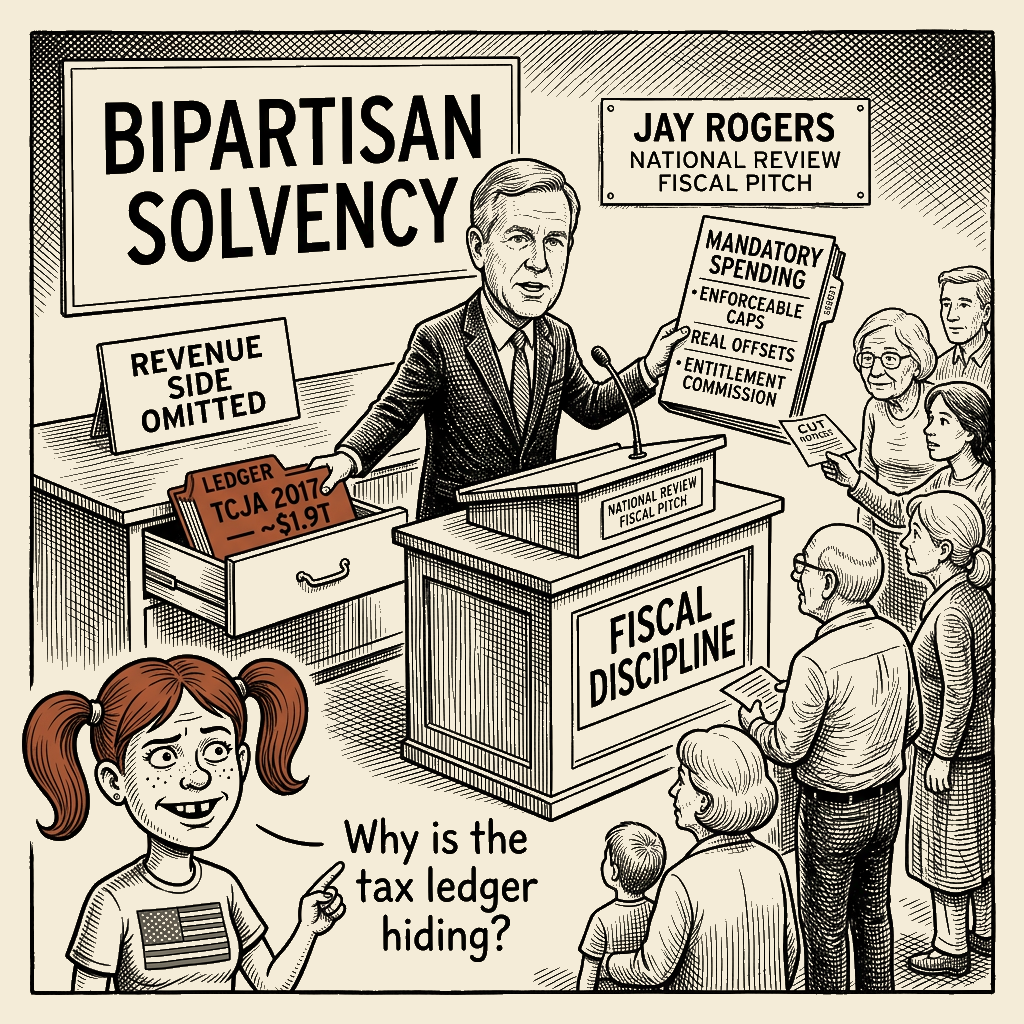
The piece’s bipartisan register structurally protects the revenue side of the ledger.
-
What the framing wants you to believe:
- The deficit is a bipartisan failure; both parties punted equally.
- The fix is institutional: enforceable discretionary caps, real offsets on tax or benefit extensions, a bipartisan Social Security and Medicare solvency commission before trust funds run out.
- The December 11 deadline is the next inflection point; the choice is to govern or to keep punting.
-
What’s really going on:
- The structural deficit driver of the past decade — legislatively enacted and persistent, as distinct from cyclical or demographic drivers — is the 2017 Tax Cuts and Jobs Act, which the Joint Committee on Taxation scored at approximately $1.9 trillion over ten years including macroeconomic-feedback effects. The piece never names it.
- The Committee for a Responsible Federal Budget (CRFB) is the citation backbone — a Pete Peterson–funded outfit whose institutional purpose is to make entitlement cuts the inevitable response to deficit growth. The piece treats CRFB as neutral expert without disclosing the funding or the project.
- CRFB has published extensive revenue-side analysis — annual “Options for Reducing the Deficit” updates — showing revenue-side fixes close the gap faster and more progressively than spending-only paths. The piece cites CRFB on caps and never engages CRFB’s revenue-side work. Tax Policy Center, Penn Wharton Budget Model, and Brookings revenue-side modeling show the same pattern.
- The “bipartisan commission” is the structural deferral device: take the distributional choices off the table now, deliver the cuts later, let the eventual body absorb the political cost.
- The “real offsets” / “enforceable caps” framework distributes future cost to the roughly 65 million Social Security recipients, 65 million Medicare beneficiaries, and 70-plus million Medicaid enrollees, while leaving upper-bracket revenue preferences structurally unaddressed. Tax Policy Center distribution analyses have placed the long-window share of TCJA benefits going to the top 1 percent at roughly 80 percent in vintages covering 2027 and beyond — the concentrated beneficiary of the trajectory the piece warns about.
The Operation
Cui bono. The piece operates inside a well-developed apparatus whose apex beneficiary is concentrated capital. The distributional logic is clean: tax rates on high incomes, capital gains, carried interest, and estates stay where the 2017 TCJA and related legislation left them; spending on the diffuse working-age and retired population gets cut; the donor circuit (Peterson, the Wall Street–aligned fiscal-discipline foundations, the editorial apparatus that runs the message discipline) keeps its institutional mission and its access. I worked in this apparatus for almost a decade. The work is recognizable.
The citation stack is the placement chain: CRFB is presented as credible expertise; CRFB’s institutional purpose and funding are not disclosed; the methodology is not engaged; CRFB’s revenue-side modeling is not cited. The reader receives the conclusion the apparatus was built to deliver, attached to the credential of the apparatus itself. The Pete Peterson Foundation funded the Concord Coalition, Fix the Debt, and CRFB; the same vocabulary — “fiscal responsibility,” “hard choices,” “bipartisan commission” — travels across the network; the same deficit-hawk ecosystem staffs both greater-good-paramount and liberty-frame variants of the frame.
Distributional impact. A “real fix” along the lines the piece recommends — enforceable discretionary caps, real offsets, a bipartisan entitlements commission — falls disproportionately on the diffuse population that depends on Social Security, Medicare, Medicaid, and the rest of the discretionary book. The protection is on the revenue side: tax rates stay where the recent tax legislation set them; the structural deficit cannot be closed without revenue-side action, and the piece knows it.
Alternative design. The structural deficit would be substantially addressed by allowing the 2017 TCJA individual rates to expire on their own schedule, by restoring the pre-2017 estate-tax exemption level, or by closing the carried-interest treatment. Revenue-side option analyses from CRFB and from the broader deficit-reduction research community (Tax Policy Center, Penn Wharton Budget Model, Brookings revenue-side modeling) show these moves close the gap faster and more progressively than spending-only paths. The piece does not engage the alternative because engaging it would invert the frame.
FGL applied across three constituencies. The deficit-anxious professional-class reader (the piece is aimed at this constituency) operates in fear — the country is going broke, the dollar is at risk, their retirement is exposed. They are also operating in laziness: they want a fix that does not require them to examine the distributional structure they benefit from. The apex beneficiary operates in greed (preservation of low taxes) and in fear (eventual reckoning, which serves to license preemptive cuts). The author operates in greed for credentialing (private-credit founder positioning as the serious adult) and in a more diffuse ideological conviction that the entitlement state is structurally bloated. All three constituencies get something from the piece; only one of them is asked to pay.
Selflessness/selfishness classification. Mixed. The deficit-hawk frame is genuinely concerned about fiscal sustainability; the structure of the frame consistently protects concentrated capital from being named as the structural driver. Both layers operate together; the column works because the selfless layer is real and the selfish layer is hidden.
Selective omission on both sides of the ledger. The piece is selective not only on the revenue side but on the cost side. It names the four mandatory-spending line items driving growth — Social Security, Medicare, Medicaid, net interest — but does not name the structural cost-side drivers of that growth. Drug pricing, administrative costs, and the absence of federal price-negotiation leverage are documented contributors to Medicare and Medicaid expansion; the piece’s silence on these mirrors its silence on the revenue side. A piece genuinely concerned with the trajectory would press both. The bipartisan register is structurally incapable of pressing either, because pressing either side would break the symmetry the frame needs to stay intact.
Technique inventory.
-
Frame-engineered relabeling (WSJ Editorial Technique Catalogue §4.1; Bad-Faith Techniques Catalog,
frame_engineered_relabeling). “Real offsets” stands in for “spending cuts” or “tax increases” — the substitution is euphemistic; “offset” presumes the baseline spending level is the right one to defend against. “Enforceable” contrasts with “toothless points of order” but does not name what would actually be enforceable or on whom the enforcement would fall. Textual cue: “Pair any tax or benefit extension attached to the December package with a real offset, not a promise to cover the cost later.” -
Austerity-thrift archetype (WSJ §4.2; Bandura moral justification + attribution of blame). The piece does not run the strongest form — it does not frame the suffering of cut recipients as character-building — but it runs the lower-intensity version where the absence of cuts is moral failure. The harm of proposed cuts is not engaged; the harm of inaction is inflated. Textual cue: “Momentum in the wrong direction does not correct itself.” And: “Every year we wait to address entitlements makes the eventual fix more painful for the people those programs were built to protect.” The phrase “the people those programs were built to protect” is the operation’s innocence claim — the cuts are framed as protection, even as the protection is being withdrawn.
-
False equivalence / bipartisanship frame (WSJ §4.4 deficit-double-standard adjacent; Bad-Faith Techniques Catalog,
false_dichotomyadjacent). The opening paragraph equalizes Republican and Democratic responsibility for the deficit trajectory when the structural driver (TCJA 2017) was passed on a party-line vote with no Democratic support and when the FRA caps were allowed to expire under single-party control. Textual cue: “Both parties got what they wanted: no shutdown before the midterms, no hard votes, and a fresh budget deadline conveniently scheduled for right after the elections.” Spreads responsibility for the trajectory across the diffuse political class. Lets the specific policy choices that produced the deficit stay invisible while the diffuse growth categories become the named target. -
Multiple-audience-targeting analytic (WSJ §4.3). The piece addresses the technocratic class through the CBO / CRFB / rating-agency citations; addresses the political class through the bipartisan-commission call; addresses the populist-conservative base through the “Washington can’t do math” framing; addresses the fiscal-hawk movement through the cap-and-cut register. Four audiences receive coordinated messages inside a single 800-word piece.
-
The “study shows” ledger (WSJ §4.5). CRFB is cited for the FRA savings estimate and is implicitly invoked as the authority on the December policy options. CRFB’s institutional home, its Pete Peterson funding, and its forty-year project of entitlement cuts are not disclosed. Textual cue: “the estimate of the Committee for a Responsible Federal Budget, saved roughly $1 trillion over a decade.”
-
The deficit double standard (WSJ §4.4; apparatus-level pattern). The deficit-hawk apparatus itself does not name this in any single piece, but the pattern across decades is documented: deficits produced under Republican administrations are absorbed into the structural backdrop; deficits produced under Democratic administrations are treated as fiscal emergencies. The piece sits inside that historical pattern by treating the current trajectory as a bipartisan failure rather than as the product of specific party-line choices.
-
Omnibus-vehicle normalizer (Bad-Faith Techniques Catalog, frame-manipulation; WSJ §4.x adjacent). The artifact names three unrelated policy riders attached to the continuing resolution — delay of an administrative rule letting political appointees pull grants for political reasons, a two-year extension of sub-Saharan Africa and Haiti trade preferences, and continuation of expiring authorities on autopilot — and folds them back into the bipartisan-cooperation frame. Textual cue: “Notice, too, what riders got attached to a bill that was supposed to be a simple funding patch. The same legislation that punts appropriations to December also delays an administrative rule that would let political appointees pull grants for political reasons, extends trade preferences for sub-Saharan Africa and Haiti another two years, and keeps a handful of expiring authorities alive on autopilot.” What it does operationally: the must-pass vehicle is used to launder unrelated policy items; the framing of “bipartisan cooperation” then makes the omnibus function invisible to the reader. The artifact itself names the riders and then folds them back into the bipartisan-cooperation frame — which is the very technique being deployed. The omission of defense-related riders is also load-bearing: the discretionary-cap recommendation would fall on defense as well, and the piece does not name that distributional consequence.
-
Threat-inflation closer (WSJ §4.13). Textual cue: “The national debt doesn’t care about our election calendar. It just keeps compounding, waiting patiently for someone in Washington to do the math.” The closing-line cadence converts a politically-contestable trajectory into a meteorological event waiting to punish. The reader is positioned as the victim of an impersonal process rather than as a participant in policy decisions with specific authorship.
-
Moral-traditional anchor (Bad-Faith Techniques Catalog, frame-manipulation;
authority_via_reverenceadjacent). The piece closes on a Reagan formulation: “Ronald Reagan liked to say a government agency is the closest thing to eternal life we will ever see on this earth. A continuing resolution is the closest thing to eternal life that a bad budget gets.” The technique is to anchor a politically-contestable institutional habit — the continuing resolution as eternal life for a bad budget — to a revered conservative figure’s voice. What it does operationally: naturalizes the continuing-resolution habit as a permanent feature of governance by attaching it to the moral-traditional authority of a revered figure. The reader inherits the framing as received wisdom rather than as a contestable institutional choice. The technique operates in tandem with the threat-inflation closer: where the closer converts the trajectory into a meteorological event, the anchor converts the institutional practice into an eternal one. The pairing is the apparatus’s standard closing-rhetorical move — nature-plus-eternity as the rhetorical answer to a contestable policy question. -
Bandura cluster (Bandura, Moral Disengagement, 2016). The piece deploys several of Bandura’s eight mechanisms in concert, which is how the mechanisms operate in practice — moral justification (the higher cause is intergenerational equity and debt sustainability; the proximate policy is cuts to programs serving diffuse low- and middle-income beneficiaries); euphemistic labeling (cuts as “real offsets”); diffusion of responsibility (“Washington,” “Congress,” “lawmakers,” “both parties” — no specific author of any specific policy choice is named); displacement of responsibility (the CR is the symptom; the structural driver is the revenue-side choices that produced the trajectory, none of which are named); distortion of consequences (the harms of proposed cuts to mandatory-spending beneficiaries are not engaged; the harms of inaction are inflated; the revenue-side benefits to upper-bracket households are not named; the cost-side drivers of mandatory growth are not engaged). Textual cue: “Solve the political problem in front of you and leave the fiscal dilemma exactly where you found it.”
Audience-management function. The piece supplies permission structure (it is responsible to want enforceable caps; the absence of caps is moral failure), identity confirmation (fiscal conservative, common-sense budget hawk), conscience displacement (the harm of cuts is depoliticized; the framing positions the author as technocratic rather than as advancing a distributional choice), and counter-frame against revenue-side arguments (any defense of current programs is treated as unserious).
Operator’s-eye-view. I drafted memos in this exact frame for almost a decade. The CRFB talking points came down through the donor circuit; the message discipline was “deficit = entitlements + waste, not taxes”; the focus-group-tested vocabulary was “fiscal responsibility,” “hard choices,” “bipartisan commission,” and the Reagan-as-eternal-life flourish at the rhetorical close was a standard closing-line move I drafted into more memos than I care to count. I sat in meetings where the “stand athwart” framing was reinforced against any temptation to acknowledge that the 2017 TCJA was the single largest contributor to the structural deficit the CRFB apparatus was designed to address. The work I am doing now is to make the wiring visible to readers who were the target of the work I used to do.
Symmetric-application note. The same deficit-hawk frame operates from greater-good-paramount variants — Brookings/Hamilton Project “fiscal discipline” arguments, Urban Institute budget analyses that prioritize entitlement reform, the Obama-era Simpson-Bowles and Biden Commission precedents. The analysis above would apply to those deployments with the same apparatus named and the same omissions surfaced. The apparatus is bipartisan in staffing and shared in method; the policy direction is consistently toward protecting revenue and toward cutting diffuse programs. I have more operational detail on the liberty-frame variant because that is what I worked inside; the symmetric-application note is not a hedge but an honest scope statement.
The Record
Anchor receipts.
- CBO August 2026 Monthly Budget Review — the $2 trillion deficit through eleven months of FY2026 and the $40 trillion gross national debt are documented CBO figures.
- S&P downgrade August 5, 2011; Fitch downgrade August 1, 2023; Moody’s downgrade May 16, 2024 (the piece says “Moody’s in 2025” — that appears to be a typo; the documented Moody’s downgrade of US sovereign debt from Aaa to Aa1 occurred on May 16, 2024).
- Fiscal Responsibility Act of 2023 (P.L. 118-5, signed June 3, 2023). Caps on discretionary spending FY2024 and FY2025; estimated savings roughly $1.5 trillion over a decade per CRFB’s published range (the piece’s “roughly $1 trillion” sits at the lower bound of CRFB’s range). Expiration at end of FY2025 is correct.
- TCJA 2017 (P.L. 115-97) — Joint Committee on Taxation original ten-year revenue-reduction score approximately $1.9 trillion including macroeconomic-feedback effects. Subsequent JCT and CBO updates revised the number.
- CRFB institutional history — Pete Peterson Foundation funding is documented in foundation 990s and in Peterson’s public statements about his commitment to fiscal discipline and entitlement reform. Concord Coalition, Fix the Debt, and the broader Peterson-aligned ecosystem — organizational histories document the shared project.
- Mandatory-spending growth figures cited in the piece (up $78B / $73B / $47B / $111B year-over-year through August) are consistent with CBO monthly data.
Supporting receipts on what the piece omits.
- Tax Policy Center distribution analyses have placed the long-window share of TCJA benefits going to the top 1 percent at roughly 80 percent in vintages covering 2027 and beyond; the bottom 60 percent received a small average benefit, with some deciles seeing net losses from associated spending changes. The precise figure is vintage-dependent; the directional finding is well-documented.
- CRFB has published extensive revenue-side options analysis — including annual “Options for Reducing the Deficit” updates — presenting revenue-raising options the piece does not cite or engage. Penn Wharton Budget Model and Brookings revenue-side modeling show the same pattern: revenue-side fixes close the gap faster and more progressively than spending-only paths.
- Healthcare-cost growth as a driver of mandatory spending: drug pricing, administrative costs, and the absence of federal price-negotiation leverage are documented contributors to Medicare and Medicaid expansion; the piece names the growth but does not engage its structural cost-side drivers.
- Defense spending growth: the largest discretionary line item; not engaged when “discretionary” is named as the cap target. A cap that includes defense produces different distributional outcomes than one that excludes it; the piece does not engage the question.
Load-bearing omissions.
- The TCJA as the structural deficit driver.
- The distribution of TCJA benefits to upper-bracket households.
- Defense spending as a discretionary category that could absorb caps.
- CRFB’s institutional purpose, funding, and revenue-side analysis.
- Specific policy options that would address the structural driver (rate sunset, exemption restoration, carried-interest close).
- Healthcare-cost structural drivers on the cost side (drug pricing, price-negotiation leverage).
- The bipartisan-equivalence framing never examined: one party held the institutional levers that produced the trajectory the piece laments.
Per-citation verdicts.
- CBO August 2026 MBR: cited accurately.
- CRFB FRA estimate: the piece’s “roughly $1 trillion” sits at the lower bound of CRFB’s own published range (~$1.5 trillion over a decade). The discrepancy is worth noting as evidence the piece is selecting the conservative-end estimate rather than the headline CRFB number.
- Reagan quote (“government agency is the closest thing to eternal life”): the formulation is a recognized Reagan paraphrase used across multiple 1980s appearances rather than a single press-conference citation. The reader should treat the attribution as a paraphrase rather than as a verbatim citation.
- The three rating-agency actions: documented as factual events. The piece’s framing that all three cited “exactly this kind of unaddressed deficit growth” is a selective gloss: each agency’s published downgrade rationale cites debt trajectory as one of several concerns. S&P’s 2011 action also cited the 2011 debt-ceiling episode and political polarization; Fitch’s 2023 action cited governance erosion and repeated fiscal brinksmanship; Moody’s 2024 action cited rising interest costs, political-institutional erosion, and widening fiscal deficits. The piece’s “exactly this kind” framing collapses the multiple rationales into a single deficit-anxiety narrative that the rest of the argument requires.
Missing-information declaration. I attempted web verification of the flagged claims; the search infrastructure returned predominantly irrelevant results for the dated-event, distributional, and scoring queries. I have not independently verified the specific status of TCJA individual provisions as of the piece’s September 2026 publication date (whether the 2025 sunset was extended in the intervening legislative cycle); the structural-revenue-side-driver argument holds regardless of the specific configuration of current tax law. The CRFB-and-Peterson-apparatus detail is operational substance I am drawing on from retained working memory of message-discipline drills, donor-circuit conversations, and focus-group debriefs not in the public record — flagged as non-verifiable per the retained-memory rule; the documentary record on CRFB’s institutional position and on the TCJA’s structural role is verifiable and is the load-bearing evidence here. The retained-memory description is apparatus-pattern rather than documented instance.
How to Recognize This
The pattern. A piece that names entitlements (and discretionary waste) as the structural fiscal problem, never names the specific tax cuts that produced the trajectory, frames the answer as bipartisan restraint, and treats any defense of revenue-side solutions as unserious. This is the deficit-hawk playbook in its standard form — the bipartisan fiscal-discipline pitch, austerity as common sense, the driver unnamed.
The mechanism. The piece shifts the burden of adjustment from concentrated capital (whose taxes were cut) to the diffuse population that depends on the named programs. The bipartisan framing makes this look like shared sacrifice rather than like a specific distributional choice. The reader who absorbs the frame gets to feel serious without having to examine who is protected by the silence. The bipartisan register provides moral cover; the cap-and-cut frame sounds technocratic and common-sense; the commission is the structural deferral device that lets the framing author advocate the policy now and avoid accountability for the cuts later; the debt-crisis register supplies urgency the technocratic vocabulary alone could not.
Concrete textual signals.
- The piece names entitlements (or “the four line items,” or “mandatory spending,” or “the larger slice of the pie”) as the structural problem in a paragraph that does not name any specific tax-side action as part of the structural trajectory.
- The piece’s “real fix” recommendations list enforceable caps, offsets, and bipartisan commissions — and do not include letting TCJA individual rates expire, restoring the pre-2017 estate-tax exemption level, or closing the carried-interest treatment.
- The piece credits a Peterson-family foundation or one of its organizational satellites (CRFB, Concord, Fix the Debt) as a neutral expert.
- The piece uses bipartisan-equivalence framing in a fiscal context where one party holds the institutional levers that produced the trajectory.
- The piece closes on a revered-figure flourish that anchors a contestable institutional practice to folk-wisdom authority — a moral-traditional signature that pairs with the threat-inflation closer to convert the trajectory from meteorological event to eternal fact.
- The piece names unrelated policy riders attached to a must-pass vehicle, then folds them back into the bipartisan-cooperation frame — the omnibus-normalizer signature.
- “Enforceable caps” / “real offsets” / “fiscal discipline” / “bipartisan commission” appear as the proposed solutions, with no specific spending cuts or specific revenue increases named.
- A closing register that shifts from technocratic detail to civilizational / debt-crisis threat inflation.
What to do when you see it. Trace whose taxes aren’t being raised. Trace which existing tax law isn’t being named as the structural driver. Follow the benefit up. Note when “bipartisan” is doing the work of “omitting the structural driver.” Apply the symmetric-application question: would the same piece propose the same solutions if the 2017 TCJA had been a 2017 spending expansion of equivalent magnitude? If not, the bipartisan register is itself the technique. Check whether the cited fiscal-hawk sources have published revenue-side analysis the piece does not engage — CRFB, Concord Coalition, and the GAO all do. Trace the cited expert’s funding chain. CRFB’s institutional purpose is documented; the question is whether the piece discloses it. Check the omitted tax-side options. Tax Policy Center, JCT, and CBO all publish distributional analyses of the TCJA; the figures are in the public record. Ask the cui bono question: who is protected from being named in this piece? Look for the same vocabulary across the deficit-hawk syndication network — “fiscal responsibility,” “hard choices,” “bipartisan commission,” “mandatory spending” travel as a set; pieces that use several of these in close proximity are inside the playbook. Press the cost-side drivers the piece omits as well: drug pricing, federal price-negotiation leverage, administrative-cost growth, defense as the largest discretionary line item. The bipartisan register survives only as long as both sides of the ledger stay dark. Reduce the frame’s automatic activation: when a deficit-hawk piece lands without naming the TCJA, slow down. The seriousness of the tone is the apparatus speaking.
A close on witness. The debt trajectory is real. The credit rating downgrades are real. The mandatory-spending growth is real. The piece is not wrong about the problem; it is structured to protect a particular set of beneficiaries from the solution. You can hold both facts at once. The work is in holding them at once, which is what the bipartisan register is built to make hard. I built versions of this piece. The CRFB talking points; the “deficit = entitlements” frame; the “real fix” recommendations that protected revenue; the bipartisan-equivalence cover; the Reagan-as-eternal-life flourish at the rhetorical close. I sat in the room where the message discipline was reinforced against any temptation to name the tax side. The work I am doing now is partly to make the wiring visible to readers who were the target of the work I used to do. The frame does not change because the people deploying it are sincere; it changes because readers can see it. That is the work, and it is the only thing I have to give back.

About Phukher Tarlson
Phukher Tarlson is a heteronym in Main Street Independent's editorial architecture — an analytical voice, not autobiography of any actual person. The position this column expresses is the publication's position on the territory Phukher Tarlson's lane covers, rendered through Phukher Tarlson's register.