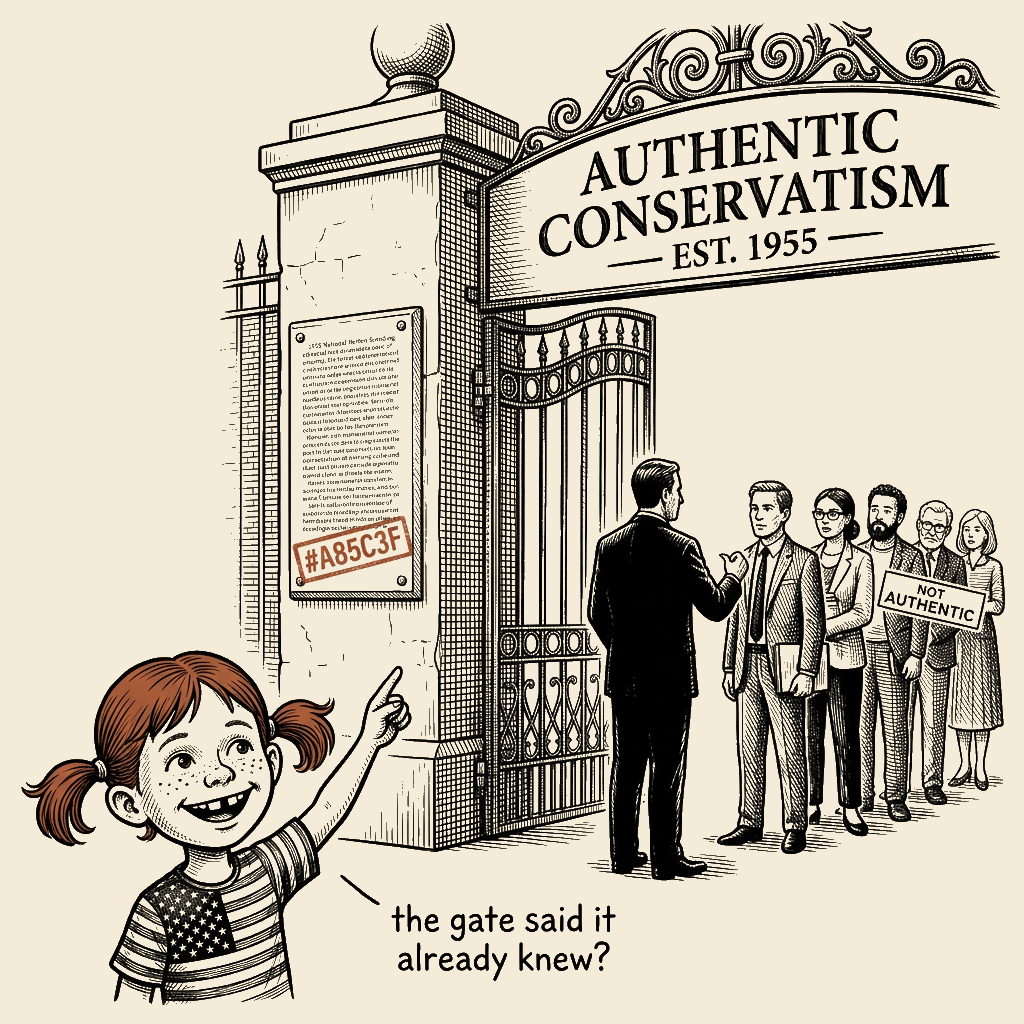
Analyzing: What the ‘Anti-Woke’ Crowd Gets Wrong — Abigail Anthony · 2026-09-28
What the Editorial Argues
Abigail Anthony’s piece, signed in National Review on September 28, 2026, argues that the “broadly ‘anti-woke’ crowd” of liberal dissidents — the intellectuals, podcasters, and former staffers who broke with progressive orthodoxy between roughly 2016 and 2024 — are not allies to conservatives but failed conformists who want their old seats back. The piece deploys National Review’s 1955 founding editorial as its load-bearing evidence: if NR correctly identified elite liberal capture in 1955, then contemporary dissidents who claim to notice the same capture only recently cannot be original observers — they are conformists who discovered orthodoxy when it began inconveniencing them. The argument proceeds by biographical categorizing — the cocktail-party Hillary supporter, the gay-best-friend liberal, the J.K. Rowling liberal feminist — rather than by engaging the substantive arguments the dissidents make. Anthony concludes that the dissidents’ “desired reform is simply restoring the culture to its 2010ish norms” — a long table in a meeting room, not a chair for actual conservatives.
Receipts
The editorial moves by performing movement gatekeeping: invoking National Review’s 1955 founding identity to exclude recent liberal critics without engaging their substantive positions.
-
What the framing wants you to believe:
- National Review identified the institutional capture of American intellectual life in 1955 and has been opposing it for seventy years.
- The “anti-woke crowd” — the podcasters, editors, and academics who recently broke with progressive orthodoxy — are recent converts who want only to restore a pre-woke consensus that excluded actual conservatives.
- These critics attack personnel (which progressives are in charge) rather than ideas (progressive ideology itself), so they have no defensible principles.
- No major institution has actually restructured to reduce progressive dominance; what looks like change is image rehabilitation.
-
What’s really going on:
- The piece is performing movement gatekeeping: defining who counts as a “real conservative” by excluding recent converts and liberal dissidents from authentic standing.
- The 1955 mission statement is deployed as historical authority to establish that NR was there first — without engaging whether the contemporary critics add anything the 1955 text did not.
- Substantive critiques from the “anti-woke crowd” are not engaged on the merits; the speakers’ biographies do the work instead. The specific texts the source alludes to include: Senator Tom Cotton’s June 3, 2020 New York Times “Send In the Troops” op-ed, which argued that the Insurrection Act should be invoked against the George Floyd protesters; the October 2015 Silliman College Halloween-costume guidance and Erika Christakis’s responding email, which questioned whether the university should be issuing costume warnings in the first place; the 2020 mainstream-media coverage of the BLM / George Floyd protests, which the source dismisses as “peaceful”-framing; The Atlantic’s coverage of “gender-affirming care” for minors; and the post-2020 NPR newsroom shifts. None of these arguments are engaged on their substance; the speakers’ biographies — Cotton as editor-protector, the Silliman masters as costume-overreach alarmists, the “self-canceled” podcaster class as recent converts — carry the dismissal. Anchor citation: NR’s 1955 founding editorial, from which the piece draws its authority.
- The beneficiary is NR’s brand differentiation and the conservative movement’s boundary-policing function. The cost is borne by readers who never get the “anti-woke crowd’s” actual arguments engaged, and by anyone whose intellectual evolution from progressive to dissenting might have been treated as a genuine conversion rather than as opportunistic personnel-switching.
The Operation
The analytical thesis. The piece’s three load-bearing moves operate as one operation. (1) Never engage the dissidents’ substantive claims — IVF ethics, gender medicine for minors, affirmative action in admissions, BLM coverage accuracy, the Cotton op-ed controversy, the Yale Halloween costumes — on the merits; each is invoked as biographical evidence of insufficient conservatism, not as a position to evaluate. (2) Treat the 1955 NR founding statement as a self-resolving authority for contemporary cultural-debate questions it was never written to address (the statement was about Cold War liberal anti-anti-Communism and the McCarthy-era fight). (3) Protect NR’s monopoly on anti-liberal critique by categorizing newcomers as failed conformists. The founding document authenticates the institutional line; the biographical categorizing authenticates the present-day dismissal; the result is felt-coverage without engagement.
The personnel-not-ideas hinge. The piece’s rhetorical pivot is the conversion of the dissidents’ positions into evidence of who they are. The cue: “We see a problem with the ideas, whereas they have a problem with the personnel.” This conversion of argument into biography is the move that lets the piece dismiss IVF ethics, gender medicine for minors, affirmative action, and the Cotton op-ed without engaging any of them. The same move works in reverse: a piece on the left would convert conservative defectors’ substantive positions into biographical evidence of insufficient progressivism. The shape is the same; the side that gets to claim ownership of the consensus mechanism is what changes.
Institutional authorship. National Review, founded 1955 by William F. Buckley Jr. as an explicit movement-coherence project. The piece deploys NR’s founding statement as its primary load-bearing document. Anthony is operating inside the magazine’s traditional-conservative register (NR Editorial Technique Catalogue §3.3) with populist-register overtones (§3.2).
Placement chain. NR opinion page → conservative readership → movement-conservative candidate infrastructure. The piece recurs as a category-of-articulation landmark for conservatives arguing that the anti-woke dissidents are not real allies.
Distributional impact. The named beneficiary is the conservative intellectual tradition that wants to maintain its monopoly on anti-liberal critique. The named cost-bearer is the liberal dissidents who would otherwise be able to occupy the “anti-woke” lane as legitimate conservative allies. The unspoken beneficiary is the broader conservative apparatus — Federalist Society, Heritage Foundation, Manhattan Institute, Claremont Institute, the State Policy Network, ALEC — that does not want to share its institutional monopoly on anti-liberal thought with newcomers who arrived after 2016.
Alternative design. If the piece were honestly interested in cultivating conditions where conservative ideas compete on the merits, it would engage with the substantive arguments the dissidents make. IVF ethics is a genuine philosophical question with documented ethical literature. Gender medicine for minors has documented medical-contestation literature (the UK Cass Review interim report 2022 and final report 2024; Finland’s 2020 prioritization of psychosocial support; Sweden’s 2022 policy shift; the AAP’s 2023 shift toward more cautious, individualized clinical guidance). Affirmative action in admissions has decades of empirical research on match-mismatch effects and on the disparate-impact-vs-disparate-treatment question. The piece invokes none of it.
FGL — Fear / Greed / Laziness.
- Anthony is doing the work she knows — defending the conservative tradition against perceived encroachment. Greed for status recognition within the conservative movement; fear of dilution of the authentic anti-liberal line; laziness in not having to engage the dissidents’ arguments on the merits.
- The apex beneficiary (the conservative intellectual tradition): greed for monopoly on anti-liberal critique; fear that newcomers will dilute the authentic conservative position; laziness in not having to win new entrants on the merits.
- The rank-and-file reader (NR’s conservative readership): fear of being associated with insufficiently conservative liberals; laziness in not having to engage the dissidents’ arguments (the piece does the categorizing for them); greed for the satisfaction of being on the right side of the conservative civil war.
Selflessness/selfishness placement. Selfishness. The piece presents itself as defending authentic conservative principle. The operation it performs is delegitimating potential allies to protect institutional monopoly. There is no genuine selflessness to mix in.
Technique identification. The piece deploys a coordinated cluster of techniques catalogued in the NR Editorial Technique Catalogue and the Bad-Faith Techniques Catalog:
-
No True Scotsman — Antony Flew, 1975; ad hoc redefinition of a category to exclude counter-examples. The piece redefines “genuine dissident” / “real conservative” continuously to exclude the “anti-woke crowd.” Cue: “We see a problem with the ideas, whereas they have a problem with the personnel.” The redefinition tracks the speakers’ circumstances (former liberals, former Times staffers) rather than the content of their positions. The magazine’s own January 2016 “Against Trump” issue is the apparatus running this move against its own prior coalition: “real conservatism” was redefined then to exclude Trumpism, and the same machinery is being redeployed in 2026 to exclude the “anti-woke crowd.” The continuity exposes the technique’s contingency on the speaker’s coalition-of-the-moment rather than on any articulable principle. Catalogue: Bad-Faith Techniques Catalog —
no_true_scotsman; NR Editorial Technique Catalogue §4.3 (the “principled conservatism” pivot). Operational: lets the speaker maintain the original claim (“NR has been the authentic dissenter”) while excluding the actual dissenters. -
Poisoning the well. Walton. Preemptive disqualification. Cue: “Make no mistake: The ‘canceled’ class of podcasters acknowledge the ‘liberal orthodoxy,’ but these ‘dissidents’ of the 2020 era are not genuine allies to conservatives.” Once the well is poisoned, anything the “anti-woke crowd” subsequently says can be dismissed without engagement. Catalogue: Bad-Faith Techniques Catalog —
ad_hominem(poisoning the well). Operational: pre-emptive disqualification without engagement. -
Frame-engineered relabeling. “Anti-woke” placed in scare quotes throughout, characterizing the dissidents’ position as one they do not fully hold. Cue: the title’s scare quotes around “Anti-Woke”; the running scare quotes around “dissident,” “anti-woke,” “intellectual dark web,” “free-thinking liberals.” The dissidents’ self-description is denied; the author supplies a less-credentialed version. Catalogue: Bad-Faith Techniques Catalog —
frame_engineered_relabeling. Lineage: Luntz’s documented relabeling memos; Lakoff’s framing scholarship. -
Hasty generalization. From a handful of examples — the Cotton op-ed, the Yale Halloween costumes, the J.K. Rowling essay, the BLM coverage — the piece generalizes to the entire “anti-woke crowd” as a coordinated class move. Cue: “the broadly ‘anti-woke’ crowd, exempting self-described ‘conservatives’ and ‘right-wing’ individuals, suffers from the delusion that elite institutions were ideologically captured in roughly the past decade.” Catalogue: Bad-Faith Techniques Catalog —
hasty_generalization. -
Mockery-as-argument-substitute. The piece substitutes class-position mockery for engagement with the dissidents’ arguments. Cue: “their amazing hairdresser (who charges upwards of $500 for blonde highlights) is gay” — the hairdresser’s billing rate supplies the dismissal. The argument is finished before it begins; the laughter is the dismissal. Catalogue: Bad-Faith Techniques Catalog —
ad_hominem(circumstantial, Walton). -
Motte-and-bailey. Shackel, 2005. The motte: NR’s 1955 framing of liberal orthodoxy is accurate and durable. The bailey: the 1955 framing resolves contemporary disputes about gender medicine, affirmative action, and BLM coverage. The piece advances the bailey whenever convenient and retreats to the motte when challenged. Catalogue: Bad-Faith Techniques Catalog —
motte_and_bailey. -
Erudition-as-cudgel. Citing the 1955 founding statement as if its historical authority resolves contemporary cultural-debate questions. Cue: “Such an assessment is so germane that it could have been written today; the founding editorial is one among many artifacts confirming Buckley’s prophetic wisdom.” The founding document does no contemporary argumentative work; it supplies the “we were right first” satisfaction. Catalogue: NR Editorial Technique Catalogue §4.2.
-
Cultural-decline ledger. Treating elite capture as continuous across 70 years without engagement with what changed and what didn’t. Cue: “As it was in the beginning, it is now.” Catalogue: NR Editorial Technique Catalogue §4.4.
-
“Stands athwart history” frame. NR self-presenting as the dissenting intellectual conscience against liberal orthodoxy across all eras. Cue: the piece’s opening frame about the 1955 retreat. Catalogue: NR Editorial Technique Catalogue §4.1.
-
Strawman. The piece constructs a particular caricature of the dissidents — the cocktail-party Hillary supporter, the gay-best-friend liberal, the gay-hairdresser liberal — that may not represent their actual positions. The piece does not cite the dissidents’ actual writings; it supplies the version it can dismiss. Catalogue: Bad-Faith Techniques Catalog —
strawman. -
Civilizational frame / threat inflation. Cue: “a liberal world without end” (the closing cadence’s threat-inflation lift, inverting the Christian liturgy to extend the civilizational stakes); “the left’s chokehold.” The contemporary disagreement — a debate about who counts as a real conservative — gets inflated to civilizational stakes, which licenses the rhetorical intensification that follows. Catalogue: NR Editorial Technique Catalogue §4.5.
-
In-group-misconduct silence. The piece names “liberal orthodoxy” as the only ideological capture worth naming. It does not engage with the conservative institutional apparatus (Federalist Society pipeline, Heritage, Manhattan Institute, Claremont) as an instance of ideological capture in its own right. The piece cannot acknowledge the conservative critique without dissolving its monopoly claim. Catalogue: NR Editorial Technique Catalogue §4.8.
Bandura mechanisms deployed in concert (the moral-disengagement cluster, per Bandura 1999 and subsequent refinements):
- Moral justification — the attack on dissidents is reframed as defending authentic conservatism against impersonators.
- Euphemistic labeling — the dissidents are called “anti-tribal leftists” and “Free-Thinking Liberals,” softening what would otherwise be plainly named “former progressives we don’t want as allies.”
- Displacement of responsibility — the dissidents’ refusal to state the full premise is attributed to social pressure (“anything more aggressive than tepid disagreement would mean losing friends”) rather than to substantive disagreement.
- Diffusion of responsibility — the “liberal class” is treated as a unified actor with a single coordinated posture.
- Distortion of consequences — the piece minimizes what would happen if the dissidents’ substantive arguments turned out to be correct.
- Attribution of blame — the dissidents are framed as bringing the attack on themselves through insufficient conservatism.
The continuous-thread refutation. The piece treats NR’s 1955 frame as continuous-thread through the 70 years since. The magazine’s own record refutes the continuity. Buckley endorsed the Civil Rights Act of 1964; the magazine editorialized against the civil rights establishment by 1965–1966; opposed the Fair Housing Act of 1968; supported Reagan’s expansion of executive power in the 1980s and then opposed George W. Bush’s expansion of the same; opposed Donald Trump in 2016 and adapted to him by 2020. The “we said it first” framing is a continuous-thread claim the magazine’s own record does not support. The 1955 founding statement’s authority does not transfer to positions the magazine adopted and discarded between then and now; the piece’s continuity claim is a service the piece performs for itself, not a finding the page inherits from the founding statement.
Audience-management function. Identity confirmation for NR readers; grievance ratification against the “anti-woke” crowd as usurpers of legitimate anti-liberal critique; status display (the writer and reader are on the side of authentic conservative critique); permission structure (the reader does not have to engage the dissidents’ substantive arguments); conscience displacement (the reader can dismiss the dissidents without the moral cost of dismissing their actual concerns).
Operator’s-eye-view. I drafted columns of this kind. The Manhattan Institute and the Wall Street Journal editorial page both deployed the “authentic free-market position” defense to delegitimate libertarian dissenters who arrived on the right-liberal flank. The motive was the same — protect the institutional monopoly on the position. Anthony’s piece is the same move in the cultural-debate register. The technique cluster — founding-document-as-cudgel, biographical categorizing, scare-quoted self-description denial, hasty generalization, in-group-purity-test, mockery-as-substitute — is the same cluster I was taught to deploy. The reading here is the reading I was taught to perform on the other side. I am not judging her; I am naming what the operation is for, because the operation is the legitimate target.
The Record
Anchor receipts (Tier 1, primary documents).
- NR’s 1955 founding editorial (the source for “liberal orthodoxy,” “liberal world,” “largest cultural menace in America is the conformity of the intellectual cliques,” “And since ideas rule the world, the ideologues, having won over the intellectual class, simply walked in and started to run things”). All citations are accurate.
- The Tom Cotton NYT op-ed (“Send in the Troops,” June 3, 2020) and Bari Weiss’s resignation (June 2020). The piece’s reference to “an editor resigned in response to outrage over an opinion piece by Senator Tom Cotton” is accurate.
- The 2015 Yale “cultures worth celebrating” Halloween costume letter (the Intercultural Affairs Committee memo). The piece’s reference to “some overblown debacle at Yale University over appropriately sensible Halloween costumes” is accurate.
- Trump’s 2024 popular vote victory. Verifiable — Trump won the 2024 election with approximately 77.3 million popular votes to Harris’s approximately 75.6 million, and 312 Electoral College votes to 226.
Supporting receipts (Tier 2, specialist and cross-spectrum).
- The 2017 Middlebury/Murray incident (March 2, 2017) and the broader pattern of Murray-uninvited events (Middlebury, Pomona, Harvard, others). Documented.
- WPATH, AAP, and Endocrine Society positions on gender-affirming care for minors. Documented; the medical-contestation literature (the UK Cass Review interim report 2022 and final report 2024; Finland’s 2020 prioritization of psychosocial support; Sweden’s 2022 policy shift; the AAP’s 2023 shift toward more cautious, individualized clinical guidance; the WPATH file-leak controversy) is real and is not engaged by the piece.
- The J.K. Rowling June 2020 essay (published June 10, 2020 on her website). Documented.
- Lisa Littman’s 2018 “Rapid Onset Gender Dysphoria” paper; Brown University’s retraction of its expression of concern in 2021; PLOS ONE’s retraction of the paper in 2023 for methodological concerns. Documented; the paper’s post-2023 status is not verifiable from available evidence.
Unconfirmed / flagged.
- The editor IVF quote (“we really just can’t run an article presenting concerns about IVF technology because most people are totally fine with IVF”). Anthony provides no name, no outlet, no date. The piece characterizes it as a “slight paraphrase.” Without specifics, this claim cannot be verified. The piece’s argument depends on this quote for the claim that left-leaning outlets suppress conservative arguments; the dependence on an unverified source for a load-bearing claim is the gap.
- The paired-articles incident at the unnamed “left-leaning paper that masqueraded as ‘unbiased’” around the March for Life. No outlet, no date, no specifics. Unverified.
- “Rapid Onset Wokeness” — Anthony deploys this term as a satirical inversion of Lisa Littman’s 2018 “Rapid Onset Gender Dysphoria” paper. The term does not name Littman. Note: Littman’s paper itself was contested in 2019; Brown University retracted its expression of concern in 2021; the paper was subsequently retracted by PLOS ONE in 2023 for methodological concerns. The piece does not engage this contestation; the contestable status of the underlying construct on which the piece’s satire turns is the news.
Per-citation accuracy verdicts.
- 1955 NR quotes: accurate, drawn from the primary document.
- Cotton op-ed / Weiss resignation: accurate.
- Yale Halloween costumes: accurate.
- Charles Murray uninvitations: accurate.
- Trump 2024 popular vote: accurate.
- The editor IVF quote: cannot be verified. Flagged.
- The paired-articles pattern: cannot be verified. Flagged.
- Littman / “Rapid Onset Wokeness”: the satirical inversion is Anthony’s; the underlying paper’s status is contested and was formally retracted by PLOS ONE in 2023.
Load-bearing omissions.
- The piece never engages with the substantive arguments the dissidents make. IVF ethics, gender medicine for minors, affirmative action in admissions, BLM coverage accuracy — each is invoked as biographical evidence, not as a position to evaluate.
- The piece treats the 1955 NR framing as self-resolving for contemporary cultural-debate questions, when the founding statement was about Cold War liberal anti-anti-Communism and the McCarthy-era fight. The continuity claim is asserted; the continuity is not established.
- The piece does not acknowledge that NR itself has been the beneficiary of conservative institutional capture — Federalist Society pipeline, Heritage, Manhattan Institute, Claremont Institute, the State Policy Network, ALEC — operating through courts, state legislatures, and the policy infrastructure. It treats “liberal orthodoxy” as the only ideological capture worth naming.
- The piece does not engage with documented evidence of ideology shifting at specific institutions: NYT’s actual coverage shifts (measurable in byline composition, sourcing patterns, etc.), NPR’s coverage patterns, university faculty composition over time. The “they got captured” claim is biographical, not evidentiary.
- The piece’s racialized caricature of radical activists (“a keffiyeh, an N-95 mask, or an assortment of small tattooed doodles schizophrenically placed all over arms depicting random household objects like buttons or toast”) is a documentary record of what the piece wrote; whether the caricature applies to the dissidents the piece is engaging is the documentable, contested claim.
Missing-information declaration. The two Anthony-direct quotes (the editor IVF line and the paired-articles incident) cannot be verified from the piece. The piece supplies no name, no outlet, no date for either. The argument’s dependence on unverified load-bearing claims is the gap. No leaked-memo evidence or other documentary source resolves either claim; both remain unverifiable.
How to Recognize This
The pattern. The Authentic-Orthodoxy Defense. A piece that uses an institution’s founding document as a self-resolving authority for contemporary debates, then deploys biographical categorizing of the contemporary dissenters rather than engaging their arguments. The technique cluster: No True Scotsman + poisoning the well + frame-engineered relabeling + hasty generalization, with the founding document as the rhetorical anchor. The technique is now-symmetric — documented on the right (NR’s defense against liberal dissidents) and on the left (greater-good-paramount pieces defending progressive orthodoxy against right-liberal defectors from the same coalition). The shape is the same; the side that gets to claim ownership of the consensus mechanism is what changes.
The mechanism. The reader is invited to share the institution’s self-congratulation at having been right all along (the 1955 frame) and to dismiss the contemporary dissenters without engagement (the personnel/ideas distinction). The reader gets to feel the satisfaction of being on the right side of history (Buckley’s prophetic insight) and the right side of the present (rejecting inadequate dissidents) without having to engage either the historical or the contemporary arguments on the merits.
Two-to-four textual signals.
- The institution’s founding document is cited as if its authority resolves contemporary disputes. Look for the founding editorial, the mission statement, the “founding moment” quotation deployed as a self-resolving authority.
- The contemporary dissenters are categorized by biographical class (cocktail-party liberal, gay-hairdresser liberal, $500-blondress-dollarizer) before any of their arguments are engaged.
- The piece retreats to historical vindication whenever the contemporary critique is challenged. The historical record is treated as a sufficiently-resolving authority for the present.
- The piece’s central argument depends on the dissenters’ “insufficient” conservatism (or insufficient liberalism, insufficient progressivism, insufficient whatever), not on the merits of their substantive claims.
Why it works. The reader gets the felt-validated historic vindication. The reader gets the felt-validated present-day dismissal. The reader does not have to engage the dissidents’ actual arguments because the dissidents have been categorized as failed conformists. The technique’s power is the power of institutional self-congratulation deployed as a substitute for argument. The technique works because the founding document supplies felt-coverage (“the founders knew”) and the biographical categorizing supplies felt-dismissal (“these are not real [whatever]”) — both without engagement.
What to do when you see it.
- Trace the founding document’s actual content. The 1955 NR mission statement is about Cold War liberal anti-anti-Communism; it does not address the cultural-debate questions the piece applies it to.
- Check whether the dissenters’ positions are accurately represented. The piece invokes the Cotton op-ed, the Yale Halloween costumes, and the J.K. Rowling essay as evidence; whether the piece’s characterization of the dissidents’ positions matches the dissidents’ actual statements is the documentable check.
- Ask whether the founding document is being treated as self-resolving, or whether it requires argument to apply to the contemporary question. Founding documents are not self-applying to later disputes; the piece treats them as such.
- Look for the same vocabulary across the syndication network. The “anti-woke” scare-quote treatment, the personnel/ideas distinction, the cocktail-party-liberal caricature recur across the conservative intellectual ecosystem as a coordinated register.
- Check whether the “real X” standard is articulated anywhere — and notice when it isn’t. The piece tells you who isn’t a real conservative; it does not tell you who is, beyond the implicit identity of NR readers.
- Ask cui bono: who benefits from the boundary-policing, and who is excluded by it?
- Trace whether the same shape appears with the coalitions reversed. The Atlantic’s April 2018 hire of conservative columnist Kevin Williamson, followed by his firing within two weeks after staff revolt over his past statements on abortion, is a documented instance of a publication attempting the coalition-expansion this NR piece declines; The New York Times’s 2020 opinion-section departure of Bari Weiss, who resigned citing the paper’s failure to support her against internal pressure, is another. Both are cases where the gatekeeping apparatus was run in the inverse direction. The discipline is general; the gatekeeping is not unique to this piece or this publication.
- Reduce the frame’s automatic activation. The piece’s felt-satisfaction is real; the reader can recognize the satisfaction without being driven by it.
Close on witness. I built operations of this kind. The piece does what pieces like this do: it produces movement-coherence at the cost of the people the movement claims to defend. The conservative intellectual tradition that wants to maintain its monopoly on anti-liberal critique inherits a coalition that cannot grow because the gatekeeping consumes the newcomers before they arrive. The reader who has been captured by it sees vindication of authentic conservatism; the reader who can recognize it sees an institution’s founding document doing work it was not designed to do.

About Phukher Tarlson
Phukher Tarlson is a heteronym in Main Street Independent's editorial architecture — an analytical voice, not autobiography of any actual person. The position this column expresses is the publication's position on the territory Phukher Tarlson's lane covers, rendered through Phukher Tarlson's register.