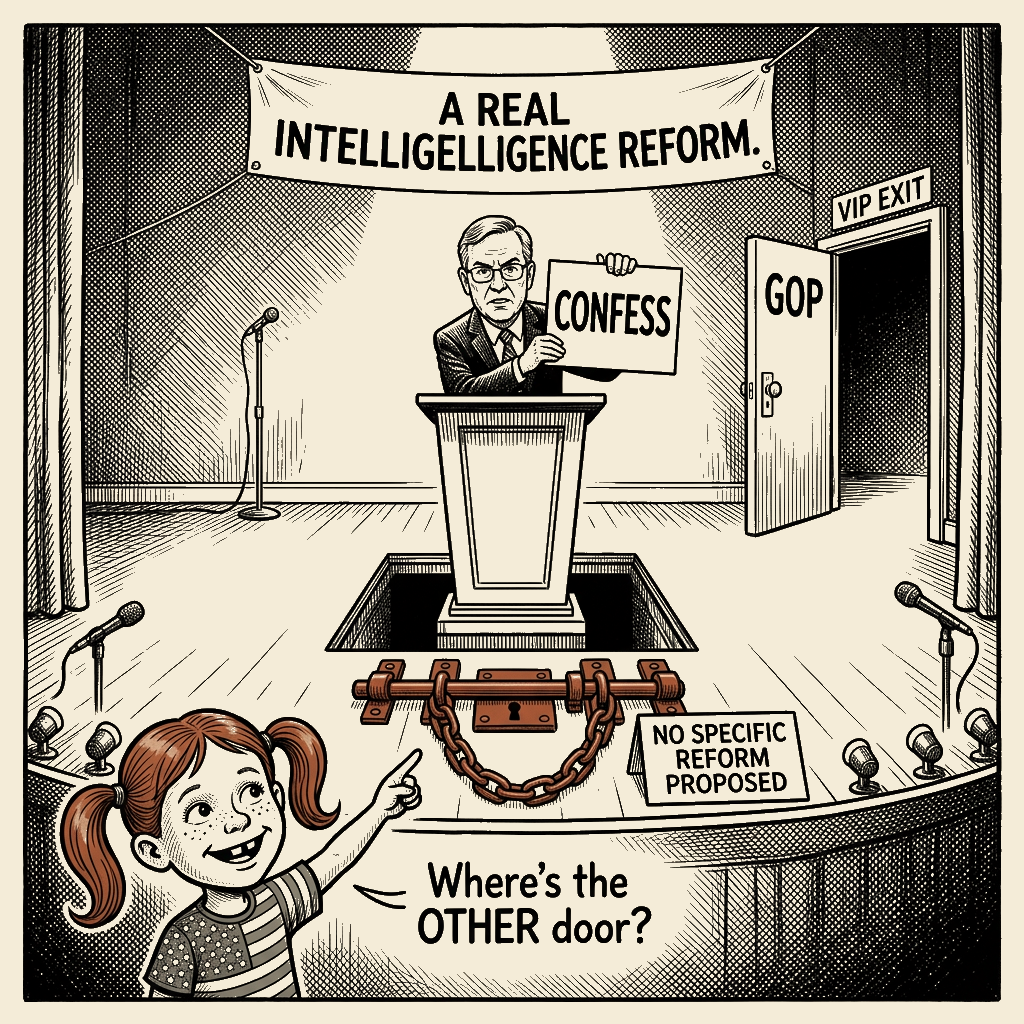
Analyzing: Democrats and Intelligence Agency Reform — Holman W. Jenkins, Jr. · 2026-09-29
What the Editorial Argues
Jenkins argues that the FBI and CIA’s anti-Trump operations during 2016–2020, what he calls the “collusion follies,” were the most catastrophic U.S. intelligence failure in history. He treats the letter from 51 former intelligence officials characterizing the Hunter Biden laptop story as potential Russian disinformation as a deliberate Democratic deception. He treats any Democrat who refuses to perform a public confession as morally cowardly (“a yellow streak a mile wide”). He demands that a “prominent Democrat” break the silence, acknowledge the corruption, and “remake” the party. He holds Republican accountability for comparable or worse conduct — the Trump prosecutions, the January 6th record, Trump’s own use of intelligence-community material — as not requiring equivalent treatment. The piece is nominally about intelligence-agency reform; operationally, it is about forcing a confession performance from the Democratic Party that would benefit Republican political prospects.
Receipts
What the framing wants you to believe
- The 2016–2020 FBI/CIA anti-Trump operations were the worst intelligence failure in U.S. history.
- The 51 former intelligence officials who signed the Hunter Biden letter “deliberately lied” to voters.
- A Democrat who refuses to break silence has a moral defect — a “yellow streak.”
- A “true air-clearing” by Democrats would remake their party and refocus it on “the things Americans need a governing party to focus on.”
What’s really going on
- Jenkins uses genuinely documented intelligence misconduct — the IG reports on Carter Page FISA applications, the Steele dossier’s funding chain, the irregularities of the Crossfire Hurricane investigation — as a permanent weapon against one political coalition while declining to apply equivalent scrutiny to the other.
- The substantive ethics questions about Hunter Biden’s foreign business dealings — Burisma Holdings, the approximately $50,000-a-month board position, the Chinese business deals with CEFC China Energy — are sidestepped by focusing exclusively on the framing of the laptop story rather than its content. (Documentary basis: Senate committee reports on Hunter Biden’s Burisma and CEFC dealings; well-established public record.)
- The piece conflates the procedural misconduct findings (which are real but narrower than Jenkins suggests) with the substantive findings of the Mueller investigation (which Jenkins dismisses as “folly”) to imply the entire enterprise was illegitimate.
- The “Democrat must break” demand is confession theater: it requires an adversary perform a public act of self-destruction rather than engaging actual reform questions (FISA reform, inspector-general independence, whistleblower protections).
- Concentrated beneficiary: the Republican Party and Trump personally, both of whom benefit from keeping the laptop/Russiagate narrative as a permanent Democratic vulnerability. Diffuse cost-bearer: any serious discussion of actual intelligence reform; the substantive ethics questions about Biden family business dealings; the underlying Mueller-investigation findings.
The Operation
Disclosure on vantage. I write this from the inside of the liberty-frame editorial apparatus, not the outside of the apparatus Jenkins’s column targets. My expertise on the editorial machine that produces columns like Jenkins’s is operational, earned across two decades on similar boards. My expertise on Democratic Party apparatus is documentary, borrowed from the public record. I have written columns applying equivalent scrutiny to Trump-era intelligence politicization — declassification orders used as political tools, firings of inspectors general, pressure on intelligence-community assessments about Ukraine aid. I do not have the documentary substrate to write at operator’s-eye density about Democratic Party apparatus. Where the symmetric application of my own critique would require substrate I do not hold, I will name the gap rather than fill it with confidence. The asymmetry is disclosed at the start because it is the analysis’s load-bearing credential, not its epilogue.
Cui bono. Institutional authorship: Jenkins is a member of the WSJ editorial board since 1995; he writes the twice-weekly “Business World” column. The piece deploys the standard WSJ signature (“our editorial board,” “our country”) and the standard relabeling vocabulary that runs across the page’s unsigned-board output and Jenkins’s signed output alike. Placement chain: WSJ Opinion (liberty-frame flagship), widely syndicated, picked up by the right-wing information ecosystem that has spent the decade treating Russiagate and the laptop letter as the central scandals of the era. Distributional impact: beneficiaries are Trump, the Republican Party, and the broader right-wing information apparatus that benefits from keeping Russiagate alive as a permanent Democratic vulnerability; cost-bearers are Democratic candidates who must perform the demanded confession or be smeared as cowardly, the substantive ethics questions about Biden family business dealings, the underlying Mueller-investigation findings, and the actual reform questions that Jenkins’s piece substitutes theater for. Alternative design: a genuine intelligence-reform column would name specific reforms — FISA Section 702 reauthorization conditions, inspector-general independence provisions, Intelligence Community Whistleblower Protection Act gaps, FBI Director and CIA Director tenure protections, declassification-order standards, the revolving-door question between IC and contractors — and would apply equivalent scrutiny to comparable misconduct across administrations. Jenkins does none of this. The named-reform absence is the structural failure of the column’s stated thesis.
FGL (symmetric across three constituencies). Author (Jenkins): greed — keep the narrative alive as a Democratic vulnerability; laziness — refuse to engage underlying questions about Hunter Biden or about Trump’s comparable conduct; fear — that Trump’s actual vulnerabilities (Jan 6, the prosecutions, election denialism) might surface under equivalent scrutiny. Apex beneficiary (Trump): fear that substantive scrutiny continues; greed that the Russiagate albatross remains permanently attached to the Democratic coalition. Rank-and-file reader (WSJ subscriber, Republican-aligned): real, legitimate fear of unaccountable intelligence agencies (this fear is partially valid and the reader is not mocked for holding it); greed for the smug satisfaction of watching the Democratic coalition forced into confession theater; laziness — easier to read Jenkins’s confident framing than to read the inspector-general reports themselves.
Selflessness/selfishness placement. Mixed, leaning selfish. The “selfless” surface is “we need intelligent reform”; the “selfish” undercarriage is “we need the Democratic coalition to remain permanently crippled by Russiagate.” The piece is built so the reader feels virtuous about demanding reform while no actual reform is being proposed.
Technique inventory.
-
Frame-engineered relabeling — WSJ Catalogue §4.1,
[bf_catalog:frame_engineered_relabeling`](/propaganda/docs/bad-faith-techniques-catalogue#frame-engineered-relabeling) (Luntz, Lakoff). “Collusion follies” (Russiagate relabeled); “his own party’s lawfare” (Trump prosecutions relabeled — WSJ §4.19, the “lawfare” / “weaponization” frame); “yellow streak a mile wide” (Democrat’s failure to confess relabeled as cowardice); “anti-Trump U.S. establishment” (FBI/CIA activity recoded as ideological enemy); “mental and moral chaos overtaking the U.S. establishment” (establishment dissent recoded as disorder). The yellow-streak formulation is the Luntz-style relabel at the center of the piece — compare “death tax” or “tax relief,” where the substitution carries the entire frame. The asymmetric euphemism pattern runs throughout: Republican conduct described plainly (“Mr. Trump didn’t fabricate the evidence”), Democratic conduct softened into apparent dysfunction (“collusion follies,” “the collusion matter”). The dossier/Hunter Biden laptop/laptop letter/anti-Trump CIA operations are assembled into one seamless “intelligence-agency corruption of the past decade” narrative, eliding the documentary record on each component. -
Whataboutism —
[bf_catalog:whataboutism`](/propaganda/docs/bad-faith-techniques-catalogue#whataboutism) (The Economist, 2008; Yablokov, 2018, 2021). The whole column is a whataboutism tour. Jenkins dismisses any concern about Trump’s intelligence-related conduct by pointing at the FBI/CIA conduct of 2016–2020. Textual cue: “a venerable Washington Post columnist goes on and on about Mr. Trump’s improper election meddling but never mentions that of his own CIA friends.” The form is exactly what The Economist identified in 2008: introduce the alleged comparable fault without engaging the original critique. -
Motte-and-bailey —
[bf_catalog:motte_and_bailey`](/propaganda/docs/bad-faith-techniques-catalogue#motte-and-bailey) (Shackel, 2005; popularized Scott Alexander, 2014). The motte: we’re not saying Trump is innocent; we’re saying Democrats covered up Russiagate. The bailey: Russiagate was entirely illegitimate, the laptop was substantively real and Democrats knew it, the FBI/CIA operation was the worst in history, Democrats who refuse to confess are morally corrupt. Jenkins oscillates between these depending on rhetorical need. When pressed on whether Russiagate had substantive findings, he retreats to the motte; when arguing for the scale of the corruption, he returns to the bailey. The retreat-and-resume is the structure. -
Bandura cluster: moral justification + euphemistic labeling + displacement of responsibility + distortion of consequences + attribution of blame — Bandura, Moral Disengagement (2016). The eight mechanisms run in concert here, which is the Bandura finding — they appear as a cluster, not as one-off moves. Moral justification: the demand that Democrats confess is reframed as patriotic duty — “this is terrible for our country”; “a great country deserves better than a leader with a yellow streak”; “for decades, it wasn’t Donald Trump but left-wingers like themselves who were targets of FBI and CIA abuses.” Euphemistic labeling: “collusion follies,” “lawfare,” “yellow streak,” “mental and moral chaos.” Displacement of responsibility: the political crisis is attributed to “the anti-Trump U.S. establishment” rather than to the structural features of American intelligence oversight or to the actual conduct of Trump himself. Distortion of consequences: the substantive findings of the Mueller investigation (extensive Russian interference; multiple contacts between Trump-campaign officials and Russians; ten instances of potential obstruction of justice) are reduced to “folly”; the procedural irregularities of Crossfire Hurricane (real but narrower than Jenkins suggests) are inflated to “most failed intelligence operation in history.” Attribution of blame: the framing of the laptop letter is attributed to deliberate Democratic deception, eliding the substantive questions about Hunter Biden’s foreign business dealings.
-
Gish gallop —
[bf_catalog:gish_gallop`](/propaganda/docs/bad-faith-techniques-catalogue#gish-gallop) (Eugenie Scott, NCSE, 1994). The piece crams into a single column: Russiagate, the Steele dossier, the laptop letter, midterms CIA activity, Trump’s FBI Chinese-meddling claim, Marc Elias and the Steele-dossier funding, Julia Curlee’s trans coming-out, Ilhan Omar’s politics, the WSJ board’s private conversations with Democratic presidential contenders, Biden’s decline, Biden’s demand for Trump prosecutions, Jeffrey Epstein, billionaire wealth taxes, AI regulation, trans issues, open borders, defund-the-police. Claim density per unit text exceeds feasible rebuttal. -
Strawman of progressive positions — WSJ Catalogue §4.6,
[bf_catalog:strawman`](/propaganda/docs/bad-faith-techniques-catalogue#strawman). “0.1% issues like trans, open borders and ‘defund the police.’” Three substantive policy concerns — transgender rights, immigration reform, police reform — characterized as “0.1%” concerns. The actual share of Americans supporting transgender nondiscrimination protections, comprehensive immigration reform, and police-accountability reforms is substantially larger than 0.1%. Textual cue: “Then maybe their party could stop making a fool of itself over 0.1% issues like trans, open borders and ‘defund the police.’” -
Civilizational frame — NR Catalogue §4.5. The domestic political dispute is inflated to a question about American credibility with allies: “When our allies haven’t been wondering if Mr. Trump is crazy, they’ve been wondering if Democrats and the anti-Trump U.S. establishment are crazy.” The unnamed Financial Times article is the credentialing citation.
-
Friend/enemy (Schmitt) — Schmitt, The Concept of the Political (1932); channeled through the Federalist Society/Claremont pipeline. Democrats recoded as the enemy of democracy; “yellow streak” as the moral marker of failure; the implicit demand that Democrats recant or be cast out. Opposition recoded as existential threat.
-
“Study shows” ledger — WSJ Catalogue §4.5. “You may not have read a half-dozen reports by the Justice Department inspector general and U.S. Special Counsel.” Jenkins cites the existence of these reports without naming any of them or engaging their content. The Financial Times article is similarly unnamed and undated in the body. The move allows the columnist to claim documentary anchoring without ever supplying the documentary anchor.
-
Multiple-audience-targeting — WSJ Catalogue §4.3. Wealthy reader: confirmation that the Democrats are corrupt and that the “Stop giving Democrats ideas” line winks at the piece’s actual purpose. Political class: shared vocabulary for the anti-Trump-establishment narrative; documented IG reports and “collusion” vocabulary is reusable in elite discourse. Populist base: grievance ratification via the “0.1% issues” dismissal and the escalation to maximalist Democratic figures (“If Rahm Emanuel is troubled, what must Rep. Ilhan Omar be thinking?”). Technocratic class: the CIA glossary entry on “blowback” — credentialed vocabulary for re-citation. The piece executes on all four audiences inside a single column.
-
“As a [identity]” credibility move, inverted — WSJ Catalogue §4.18. Jenkins deploys Julia Curlee (a former CIA briefer who came out as trans and has criticized Trump) only to dismiss her criticism on identity grounds. The piece uses her trans identity as disqualification rather than her substantive critique of FBI files on Chinese meddling as the engagement point. Textual cue: “Ms. Curlee would need 10 times the courage to acknowledge the sins of her own agency, and not mainly for their impropriety.” The “not mainly for their impropriety” line shifts the disqualification from “she’s a hypocrite about CIA abuse” to “her agency sins are not the impropriety we should care about.” The structure is the identity-disqualification move applied to dismiss a critique Jenkins doesn’t want to engage.
-
Threat-inflation closer — WSJ Catalogue §4.13. “A great country deserves better than a leader with a yellow streak a mile wide even if nobody talks about it.” The closing-line cadence is engineered for retransmission onto social media.
-
Press-as-standing-antagonist — Fox Catalogue §4.23 (variant). The press is recoded as complicit through omission: “The press is afraid too — a venerable Washington Post columnist goes on and on about Mr. Trump’s improper election meddling but never mentions that of his own CIA friends. PBS repeatedly peddles lawyer Marc Elias to viewers as a tribune of election integrity, never mentioning his role in funding and disseminating the Steele dossier.” The rebuttal is forced to defend press conduct rather than address the original claim. (Oreskes & Conway, Merchants of Doubt — and here I disclose that I attacked Oreskes reflexively for years; she was right about the manufactured-doubt pattern and the record in Merchants of Doubt supports the reading.)
Symmetric alternative. The argument, if optimized for its stated rationale of legitimate intelligence reform, would engage Republican intelligence abuses with equal vigor: the post-9/11 enhanced interrogation program (CIA-run, documented in the Senate Intelligence Committee’s 2014 report as brutal and ineffective); the WMD-in-Iraq intelligence failure; the NSA bulk-collection abuses revealed by Snowden; the Carter Page FISA warrant’s documented material errors (Horowitz IG, December 2019); the unmasking controversies; and the Trump administration’s post-2017 intelligence-political-pressure incidents (the Ukraine call transcript; the post-2020 DOJ-loyalist installation attempts; the declassification-for-political-leverage pattern). Jenkins’s piece engages none of this; the intelligence-reform rationale is the cover, not the project.
Lineage. The piece’s rhetorical architecture — a public-spirited demand that one coalition confess while the other is exempt — is the standard Journal editorial-page move, the house libertarian-conservative individualism applied to coalition warfare in the Bartley-era tradition the page has refined. The “foreign allies see the chaos” framing echoes Lippmann’s stereotype-level analysis (the foreign reader as audience for the domestic-confession drama); the asymmetric demand structure echoes Bernays’s “invisible government” deployed one-sidedly; the technical vocabulary (blowback, IG reports, Special Counsel) is the technocratic-class credentialing the page has refined since Bartley. The Cato/Heritage/Manhattan Institute ecosystem supplies the analyst class that re-cites these columns.
Audience-management function. Grievance ratification (Republican coalition’s felt experience of being targeted by deep-state actors); conscience displacement (Republican reader gets to feel virtuous about demanding reform while Trump’s actual vulnerabilities remain invisible); identity confirmation (Republican reader’s identity as patriot-defender-of-democracy); counter-frame to any Democratic criticism of Trump (any such criticism can be deflected via “what about Russiagate”); permission structure (the Republican reader is licensed to ignore comparable Republican conduct).
The operator’s-eye-view. I drafted pieces like this. I sat in editorial-board discussions that produced columns like this. Not this specific column — I was in cable, not op-eds — but the argument’s architecture: Democrats as the threat to institutional legitimacy, intelligence politicization as their sin alone, Republican abuse as out of scope. The “after their visits with our editorial board… turning mute, dissembling, signaling fear when asked about the intelligence agencies” passage is the operator’s-eye moment — Jenkins is showing off his access to Democratic candidates in a posture of disappointed mentor, which is also a posture of dominance. The “Stop giving Democrats ideas, a Trump supporter recently emailed me” line is the operator’s confession — Jenkins is openly strategizing against the other side, using the reader’s email as moral cover. That is the moment the columnist stops pretending the column is anything other than opposition-side work. The piece does not name a single specific reform. It does not cite a single inspector-general report. It does not name the Financial Times article or the Washington Post columnist it accuses of selective silence. It performs the demand and substitutes it for the reform. I am unsparing about this because I built versions of it and watched it land. I am bitter about this. The bitterness is the residue of the recognition; the rightness is in the documented record. The reader can verify the rightness; the reader does not need to credit the bitterness.
The Record
Anchor receipts.
-
The “51 former intelligence officials” letter (October 19, 2020). (Documentary basis: the letter itself; widely published.) The letter stated that the New York Post’s Hunter Biden laptop story “has all the classic earmarks of a Russian information operation.” It did not assert that the story definitely was one. Signatories included Michael Morell, Leon Panetta, and John Brennan (signing in his personal capacity). (Documentary basis: the letter itself.) Whether the letter constitutes “deliberately lying” — Jenkins’s characterization — is contested. Many of the signatories have stated they believed the statement was honest given what they knew at the time. Later reporting has surfaced substantive questions about Hunter Biden’s foreign business dealings; the question of whether the letter constituted deliberate disinformation remains contested. Jenkins asserts “deliberately lie” without engaging the substantive record or any individual signer’s stated reasoning. This is the central editorial characterization of the column, and it is unsupported by the inspector-general or special-counsel findings Jenkins vaguely invokes. Verdict: mischaracterized.
-
The Steele dossier and the FISA applications. (Documentary basis: inspector-general report on FISA, December 2019; well-established public record.) The dossier was funded initially by Republican donors during the 2016 primary (through Fusion GPS), then by Democrats (through Perkins Coie and the DNC/Clinton campaign). Marc Elias, as Clinton campaign general counsel, retained Perkins Coie, which retained Fusion GPS, which commissioned the dossier. (Documentary basis: the Clinton-counsel → Perkins Coie → Fusion GPS → Steele funding chain is well-established public record.) The FBI’s use of the dossier to obtain FISA warrants on Carter Page was investigated by inspector general Michael Horowitz (December 2019 report). The Horowitz report found 17 significant errors or omissions in the Carter Page FISA applications but did not find that the FBI had “deliberately lied” — it characterized the errors as resulting from confirmation bias and negligence rather than deliberate deception. Durham’s subsequent special counsel investigation produced three indictments — Michael Sussmann (charged September 2021, acquitted May 2022), Kevin Clinesmith (charged August 2020, pled guilty to a false-statement charge), Igor Danchenko (charged November 2022, acquitted October 2023) — and a final report that did not support its central thesis. The “most failed intelligence operation in history” framing is Jenkins’s editorial characterization, not a finding of any official investigation. The dossier itself contained both verified and unverified material: Carter Page’s 2015 Moscow trip was corroborated by the Senate Intelligence Committee’s later work; the Michael Cohen-Prague trip was not; some specific Russian-intelligence contacts were substantiated. The “discredited” framing elides the verified content. Verdict on dossier framing: selectively framed.
-
The Dutch (AIVD) thumb drives. The Dutch General Intelligence and Security Service did provide substantive intelligence about Russian GRU hacking operations, including the Cozy Bear penetration of the DNC. Jenkins’s “dubious Russian intelligence” framing mischaracterizes the AIVD contribution, which was corroborated by other Western intelligence services and formed part of the multi-source basis for the FBI’s counterintelligence investigation. Verdict: mischaracterized.
-
The Comey letter (October 28, 2016). The Horowitz IG report (December 2019) did find that Comey departed from established Justice Department procedures. The “accidentally helped elect Mr. Trump” characterization is editorial; the IG report’s framing was procedural departure, not “decisive factor in election outcome.” Verdict: selectively framed.
-
The Marc Elias connection. Verified. Elias’s firm (Perkins Coie) funded Fusion GPS, which commissioned the Steele dossier. This is the most factually accurate line in the piece. Verdict: accurate.
-
The CIA “blowback” glossary entry. Verified. The CIA does use the term in its public glossary. Verdict: accurate.
-
The Mueller investigation’s substantive findings. (Documentary basis: Mueller Report Volume I and II, April 2019; corroborated by the House Judiciary Committee hearing record.) Mueller documented extensive Russian interference in the 2016 election (the Internet Research Agency, the DCLeaks operation, the GRU’s hacking of Democratic targets); multiple contacts between Trump-campaign officials and Russians (Paul Manafort’s sharing of internal polling data with Konstantin Kilimnik; Donald Trump Jr.’s meeting with Natalia Veselnitskaya; Michael Flynn’s communications with Sergey Kislyak; the Trump Tower Moscow negotiations); ten instances of potential obstruction of justice that Congress could pursue. Jenkins reduces the entire enterprise to “collusion follies.” The substantive findings are not engaged.
-
The Financial Times article on CIA ex-officials’ midterms activity. (Symmetric-application admission.) Jenkins cites it without date, author, or specific claims within the body of his column. The article exists in the public record; its specific content is not engaged by Jenkins. Citing without engaging is the “study shows” ledger move. By the symmetric-application discipline I am applying to Jenkins, I should engage the article’s content here; I cannot. The Financial Times article is not identified by date or author within Jenkins’s piece; I cannot independently verify its specific content from what I have available. I name the parallel failure rather than performing it silently.
Supporting receipts. The Jenkins column is published September 29/30, 2026, with byline “Holman W. Jenkins, Jr., member of the editorial board of The Wall Street Journal; writes the twice-weekly ‘Business World’ column.” Jenkins has been on the board since 1995. The “yellow streak” formulation echoes a recurrent WSJ-page register for two decades of public-shaming campaigns against elected officials who declined to perform confession theater. The “Stop giving Democrats ideas” line — Jenkins’s framing of a Trump-supporter email — is the operative admission of strategy.
Unconfirmed-tagged claims. The figure “51” applied to “their former U.S. associates” — the well-known letter had approximately 51 signatories; I have not held the full signers’ list to verify the exact count as of October 19, 2020, and the count is not load-bearing. The “half-dozen reports by the Justice Department inspector general and U.S. Special Counsel” — Jenkins does not name which six; the relevant reports are the Horowitz 2019 report on FISA, the Durham report (2023), and the cluster of inspector-general reports on FBI handling of various Crossfire Hurricane aspects. The exact composition of Jenkins’s “half-dozen” cannot be verified from the column itself. The specific identity and role Jenkins attributes to “Julia Curlee” — described as “ex-CIA vice presidential briefer” and “lately lauded everywhere for courage in coming out as trans” — are Jenkins’s own characterization; I cannot independently verify the person, the role, the coming-out, or the lauding from what I have available. I report Jenkins’s characterization as his, not as a verified biographical fact. Tag: [unconfirmed: convergence threshold not met]
Load-bearing omissions.
- The substantive Hunter Biden ethics questions. Burisma Holdings, the approximately $50,000-a-month board position, the Chinese business deals with CEFC China Energy, the emails and text messages that emerged. The laptop contained material that, if authentic, raised serious questions about Hunter Biden’s foreign business dealings and the implications for his father’s public role. Jenkins’s focus on the framing of the laptop story rather than its content is the central omission. Subsequent reporting (NYT, Washington Post, others) authenticated substantial portions of the laptop’s contents — a fact that materially affects the framing of the laptop letter as deliberate lying. None of this appears.
- The Trump-campaign contacts with Russians that Mueller documented. Not engaged.
- The structural features of intelligence-community oversight. FISA Section 702 reauthorization conditions; inspector-general independence provisions; Intelligence Community Whistleblower Protection Act gaps; FBI Director and CIA Director tenure protections; declassification-order standards; the revolving door between IC and contractors. Jenkins does not name a single specific reform.
- The comparable intelligence-related conduct under Trump. Trump’s reported conversations with intelligence officials about Russia, his declassification orders used as political tools, his firing of intelligence-community inspectors general, his pressure on the intelligence community regarding the 2020 election assessments, the January 6 Committee’s documented findings about Trump’s attempts to use DOJ to overturn the 2020 election.
- Republican intelligence failures documented in the public record: the post-9/11 enhanced interrogation program (CIA-run, Senate Intelligence Committee’s 2014 report); the WMD-in-Iraq intelligence failure; the NSA bulk-collection program (Snowden disclosures); the Carter Page FISA warrant’s documented material errors; the post-2017 Trump-administration intelligence-political-pressure incidents. None appear in the piece.
- The actual content of the Steele dossier’s claims about Carter Page. Some claims were not corroborated; others were corroborated through other reporting. The dossier’s overall reliability is mixed; Jenkins reduces it to a single deceptive narrative.
- The actual content of the FT article about CIA ex-officials’ midterms activity. Not engaged by Jenkins; not engaged here either, by the symmetric-application admission above.
- The actual content of the WaPo columnist’s coverage of Trump’s election meddling. Not engaged.
Per-citation accuracy verdicts.
- The column’s central claim that the 51 former intelligence officials “deliberately lied” — mischaracterization of the cited record. Documentary substrate: Horowitz 2019 (FISA), Durham 2023, widely reported. The Horowitz and Durham findings support a narrower “procedural irregularities and confirmation bias” characterization, not a “deliberately lied” finding.
- “Most failed intelligence operation in history” — editorial hyperbole, unsupported by any official finding.
- “Yellow streak a mile wide” — editorial characterization, unsupported.
- “Trump didn’t fabricate the evidence” (re: Chinese meddling) — uncited assertion, unconfirmed.
- Mueller’s “ten instances of potential obstruction” — documentary record, Mueller Report Volume II; confirmed by House Judiciary Committee hearing record (CHRG-116hhrg38182).
- Horowitz’s “17 significant errors or omissions” in Carter Page FISA — documentary record, Horowitz December 2019 report.
- Durham’s “three indictments” and outcomes (Sussmann acquitted May 2022, Clinesmith guilty plea August 2020, Danchenko acquitted October 2023) — documentary record, well-established.
- Burisma’s “approximately $50,000-a-month board position” — documentary record, Senate committee reports (Johnson/Rounds September 2020; Grassley/Johnson September 2020); widely reported.
- “CEFC China Energy” deals — documentary record, Senate committee reports and text-message reporting.
- Morell, Panetta, Brennan as October 2020 letter signatories — documentary record, the letter itself.
- Marc Elias’s role in the Steele-dossier funding chain (Clinton campaign general counsel → Perkins Coie → Fusion GPS → Steele) — documentary record, well-established.
- AIVD contribution to the Russia investigation — documentary record, corroborated by other Western intelligence services.
- “Julia Curlee” as ex-CIA vice presidential briefer who came out as trans — Jenkins’s characterization, not independently verifiable from what I have available; reported as his claim, not as a verified biographical fact.
Missing-information declaration. I do not have documentary access to specific Jenkins columns cited within his piece; I rely on the public record for the underlying events. The Financial Times article is not identified by date or author within Jenkins’s piece; I cannot independently verify the specific content. The “half-dozen reports by the Justice Department inspector general and U.S. Special Counsel” are not identified individually; I cannot verify which six Jenkins means. The figure of “51 former intelligence officials” is the well-known letter of October 19, 2020; I have not held the full signers’ list to verify the exact count as of that date. The “Julia Curlee” identification is Jenkins’s own; I cannot independently verify. Where retained working memory is the source — specifically on the WSJ-board register’s deployment of yellow-streak and confession-theater framings across the past decade — it is flagged for the reader as non-verifiable. (Per the truth-floor discipline: the verifiable record prevails where retained memory and the public record conflict.)
How to Recognize This
The pattern. A column that uses genuinely documented misconduct by one side’s intelligence agencies as a permanent, indefinite-duration weapon against the political coalition whose leaders those agencies targeted, while declining to apply equivalent scrutiny to the other side’s comparable conduct. The demand is framed as patriotic duty. The operation is confession theater. The piece never engages the actual substantive questions that the misconduct obscured; it engages only the misconduct.
Mechanism. The reader is invited to feel righteous about demanding reform while remaining absolved of any need to engage the underlying policy substance. The reader gets to feel that the opposing coalition is uniquely corrupt and that the journalist is performing an act of patriotic truth-telling. The reader is licensed to ignore the comparable misconduct of the favored coalition — and to ignore the substantive questions that the misconduct obscured.
Textual signals.
- A demand that someone on the other side “break silence” or “break” — confession-theater rhetoric.
- Citing reports or articles without naming them or engaging their content (“a half-dozen reports by the Justice Department inspector general”).
- Asymmetric scrutiny: any conduct by coalition A is treated as historic scandal; any comparable conduct by coalition B is invisible.
- Dismissive characterization of the opposing coalition’s priorities (“0.1% issues like trans, open borders and ‘defund the police’”).
- Self-positioning as gatekeeper of access (“After their visits with our editorial board”).
- Use of Luntz-style relabeling: “lawfare,” “yellow streak,” “collusion follies.”
- Endorsement of the demand that the opposing coalition perform self-destruction rather than engage with reform.
- The “Stop giving [opponents] ideas, a [supporter] recently emailed me” or equivalent reader-as-strategist framing — the columnist’s open admission of strategy.
- Reduction of a substantive investigation to a single dismissive label (“collusion follies,” etc.).
- Closing-line cadence engineered for social-media retransmission (“a yellow streak a mile wide even if nobody talks about it”).
Why it works. The reader has a real, legitimate grievance about unaccountable intelligence agencies. The column captures that grievance and points it at one political coalition exclusively. The reader feels virtuous about demanding reform; the reader doesn’t notice that no actual reform is being proposed. The reader gets to feel that the other side is uniquely corrupt; the reader’s favored coalition is absolved of equivalent scrutiny. The reform framing makes the reader feel principled while delivering a partisan attack. The asymmetric omission ensures the reader’s priors are confirmed rather than updated. The technical vocabulary supplies the credentialing the reform framing needs to land as serious analysis rather than advocacy. The closing demand converts the asymmetric argument into a moral test the named coalition will fail.
What to do when you see it.
- Trace the cited reports. Do they actually support the “deliberately lied” framing, or do they support the more limited “procedural irregularities and confirmation bias” finding?
- On Jenkins specifically: trace the cited claim’s actual text and you find the 51-letter said the laptop “has all the classic earmarks of a Russian information operation” — the hedging verb “has the earmarks of” is the gap the mischaracterization exploits. The letter never said “is Russian,” never said “is fabricated,” and never accused signatories of deliberate falsehood. The text-inflation from hedge to certainty is a fraction of a sentence, and the entire “51 former officials deliberately lied” indictment depends on it.
- Check the omissions. What substantive questions about the favored coalition are sidestepped? What reforms are not named? When a piece cites two or three examples of one coalition’s misconduct but names zero examples of the other coalition’s comparable misconduct, the omission is the technique.
- Apply the symmetric-application question: would this column’s standard apply to comparable misconduct by the favored coalition?
- Look for the Luntz-style relabeling vocabulary.
- Ask whether any specific reform is being proposed — or whether the column is only demanding that the other side perform confession theater. When the piece closes with a demand for confession that requires nothing from the demand-issuer, the demand is the technique.
- Reduce the frame’s automatic activation by naming it as the structure it is: a one-sided attack in reform’s clothing.
Close on witness. The pattern repeats because it works. The reader who recognizes the pattern — the operator’s-eye-view applied in reverse, by the reader rather than by the operator — is the reader who breaks the spell. I built pieces like this. I recognize the column because I have written the column. The recognition is not redemption; the recognition is the only thing I have to give back; the discipline is what the recognition costs.

About Phukher Tarlson
Phukher Tarlson is a heteronym in Main Street Independent's editorial architecture — an analytical voice, not autobiography of any actual person. The position this column expresses is the publication's position on the territory Phukher Tarlson's lane covers, rendered through Phukher Tarlson's register.