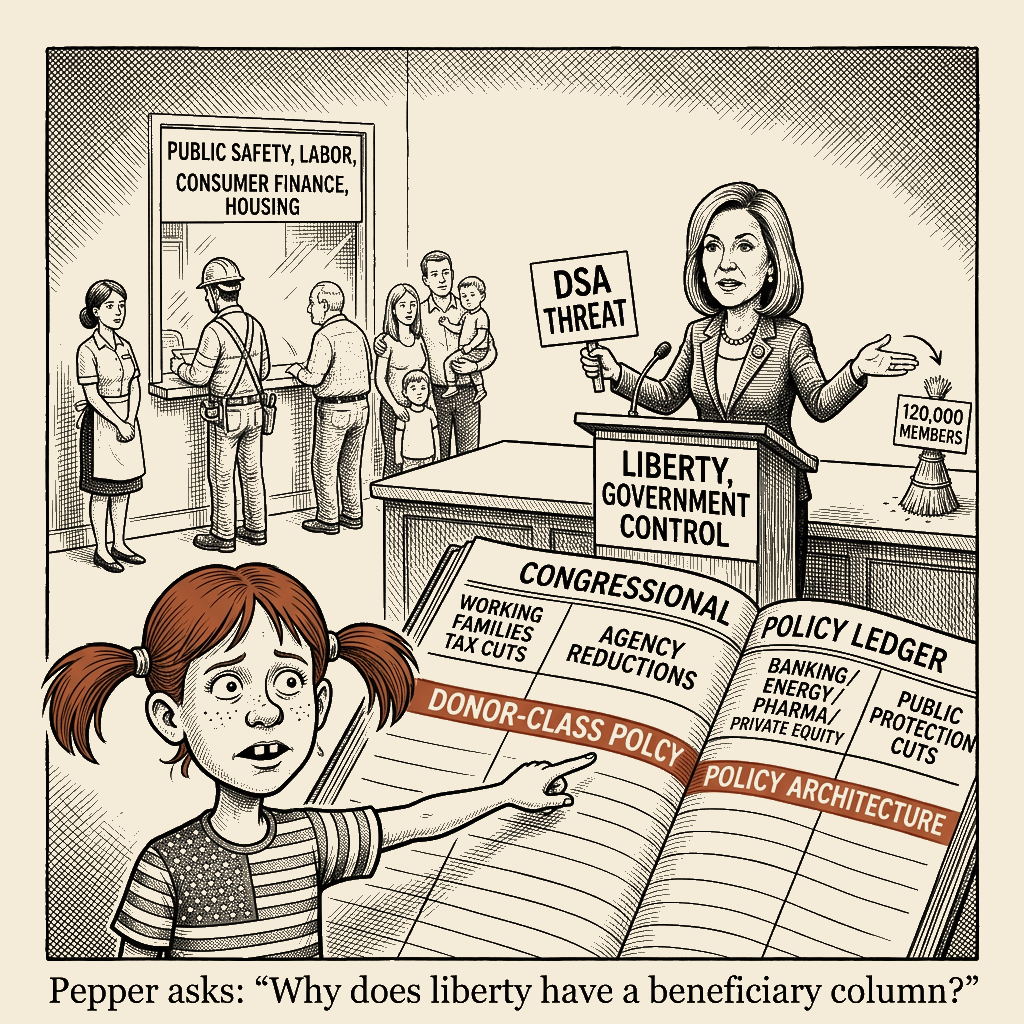
Responding to: Our closing argument: The midterms are a referendum on who runs your life · 2026-09-28
What the Piece Argues
The piece, by Rep. Lisa McClain (R-MI), chairwoman of the House Republican Conference, makes the case that the November midterms constitute a referendum on individual liberty versus government control, with the Democratic Socialists of America as the central threat. It argues that the Republican majority’s record since January 2025 — border enforcement, the Working Families Tax Cuts, federal workforce reductions, and public-safety gains — embodies the Founders’ principles of individual self-rule, while the Democratic Party, locked in with the DSA, pursues collectivist policies that the closing argument compares to the trajectories of Cuba, North Korea, and the Soviet Union. The piece casts the choice as civilizational — between the Founders’ “radical ideal of human liberty” and a sinister government management of American life — and concludes that voters who fail to recognize the contrast risk finding that “history, the thing itself, has come for us at long last.”
Receipts
The piece poses a referendum between individual liberty and government tyranny; the documented record shows the architecture is written by the donor class the column will not name.
-
The framing wants you to believe
- The “Working Families Tax Cuts” are “the largest tax cut for the middle class in American history,” delivering relief to “the waitress closing out a double shift, the lineman working and the retiree.”
- “Smallest federal government since 1966” equals liberty restored through red-tape rollback.
- The border is now the “most secure in modern American history” with the “largest recorded drop in violent crime in FBI history.”
- The Democratic Party is functionally captured by the DSA — a 120,000-member organization backing 250+ Democrats — and is on a Marx-to-Lenin trajectory toward collectivism.
-
What’s really going on
- The 2025 tax architecture extends the 2017 TCJA; Tax Policy Center, CBO, and Joint Committee on Taxation analyses consistently document the top quintile capturing a disproportionate share of cumulative value, with the bottom quintile receiving a fraction. The “no tax on tips,” “no tax on overtime,” and senior-break provisions scale with income — the largest dollar benefits accrue to the highest-earning tipped workers, the highest-earning overtime workers, and the retirees with the largest itemized deductions.
- “Smallest government since 1966” was achieved primarily by cutting the consumer-finance bureau, the labor board, the environmental agency, the public-housing office, and IRS enforcement — the agencies that protect the diffuse public — while armed federal agencies (Defense, DHS, federal prisons) held steady or grew. The donor-class beneficiaries of deregulation (banking, energy, pharma, private equity) gained protected revenue streams.
- The “most secure border” is a regime of mass detention, expedited removal, family separation, and the criminalization of asylum — with humanitarian costs documented by every major humanitarian organization in the country and labor costs borne by the agricultural and service sectors now short-staffed because their workforce was deported.
- The DSA boogeyman conflates a 120,000-member organization backing ~250 candidates with the entire Democratic caucus of several hundred. Most Democrats are not DSA. The strawman move lets the piece refuse to name the actual architecture of concentrated economic power the GOP donor class represents — a lobbying infrastructure several orders of magnitude larger than anything DSA has built.
The Response Ladder
Polite Reframe
When to use: at the Thanksgiving table with a relative who just quoted “who do you trust to run your life” and wants a real conversation, not a fight. Audience: the persuadable moderate, the good-faith family. Story-before-statistic. Invitational tone; the voter is not the enemy.
The waitress the piece names — the one closing out a double shift — is a real person. She deserves the full benefit the piece is claiming for her. So let’s look at what she actually receives.
“No tax on tips” sounds like it was built for her. The federal standard deduction already keeps most servers at modest incomes out of federal income tax; they pay payroll taxes, but income tax was never the binding constraint. The new provision delivers the largest dollar benefits to tipped workers whose reported income is high enough to clear the standard deduction in the first place — the fine-dining server, the bartender at the high-volume steakhouse, the sommelier. The waitress at the diner working the late shift for $40K a year gets a modest benefit; the bartender at the steakhouse clearing $120K gets several times more.
Same for “no tax on overtime.” A lineman making $30 an hour working ten hours of overtime a week, fifty-two weeks a year, takes home roughly $15,600 in base-rate overtime wages plus another $7,800 in the half-time premium, for about $23,400 in overtime compensation. The new provision shields the premium portion from federal income tax — at this worker’s marginal rate, that’s roughly $1,700 in annual tax savings. A lineman making $80 an hour working the same ten hours of overtime a week, fifty-two weeks a year, takes home roughly $41,600 in base-rate overtime wages plus $20,800 in the half-time premium; the new provision shields several thousand dollars from federal income tax. The provision scales directly with the regular rate — the higher the base wage, the larger the dollar benefit, because the premium portion is a percentage of the base.
The senior break follows the same shape: a larger dollar benefit for retirees with larger portfolios and higher itemized deductions. The retirees with the smallest portfolios and the lowest tax liability benefit least.
So when the piece tells you it is “putting money where it belongs: back in the pockets of those who earned it,” it is asking you to read the dollar sign without checking who gets the largest one. The waitress in the piece is a real person; the dollar amount she actually receives is not the dollar amount the headline claims.
The “who runs your life” question is fair to ask. The honest answer is that a tax code designed to look like middle-class relief but written to deliver the largest benefits at the top runs the working person’s life more than any senator ever has — it tells them which bills they can pay and which they can’t, in the same way a sub-living minimum wage does, in the same way an uninsured emergency room visit does. The question isn’t who runs your life. It’s who writes the rules, and who the rules are written for. The piece is asking you not to ask that question. The receipts are right there for whoever does.
If you want to look yourself, the relevant lobbying disclosures are sortable on OpenSecrets.org, and the distributional analyses of the underlying tax architecture are published by the Tax Policy Center, the CBO, and the Joint Committee on Taxation. The mechanism is not hidden. It is just not in the closing argument.
Mockery and Ridicule
When to use: at the family group chat when your uncle forwards it to argue that you need to wake up about the DSA. Audience: the bystander. Funny-before-devastating. The voter is shown being used; mockery targets the apex-of-power figures, never the rank-and-file.
The House Republican Conference’s closing argument for the 2026 midterms is that the question before the country is who runs your life — you or the government — and that the answer is you, because they shrank government to its smallest level since 1966.
A small observation. The federal government is the largest employer in the country. The Internal Revenue Service, which is the part of the government most likely to actually run your life, still has the same staff it had last year. The Pentagon, which is also part of the government, was given its largest inflation-adjusted budget last December. The Department of Homeland Security, which is also part of the government, now has more armed agents in it than at any point in its history.
The pieces of the government that shrank were, by and large, the ones that did things for you: the consumer-finance bureau that went after the bank that took your money, the labor board that went after the employer who took your wages, the environmental agency that went after the factory dumping into the river your kids swim in, the public-housing office that put a roof over your cousin’s head. Those shrank. The pieces of the government that do things for the people the piece is paid by grew.
So when the piece asks “Who do you trust to run your life, you or the government,” the actual answer is: it depends which part of the government. The part that audits your refund and the part that prosecutes the bank that defrauded you. The part that comes for your overtime and the part that goes after your employer for not paying it. The part that subsidizes the conglomerate that raised your insulin and the part that subsidizes the small hospital serving your county. The piece would like you not to distinguish between those parts, because the parts that shrank were doing work the piece’s donors were tired of paying for.
And then the piece points to the Democratic Socialists of America — a 120,000-member organization — and tells you that this is what the other party is. That a 250-strong contingent within the Democratic caucus is the whole caucus. That because some Democrats have DSA members as constituents, every Democrat is a secret Bolshevik waiting to nationalize your barbershop.
That is not an argument. That is a fundraising letter with a flag pin. The DSA’s actual membership is roughly the population of a mid-sized American city. The donor class the piece is actually selling for is a smaller group still, and the dollar value of what it extracts is several orders of magnitude beyond what any democratic-socialist policy proposal has ever moved. The DSA has maybe a dozen registered federal lobbyists on a good day. The pharmaceutical industry has thirty-plus. The real-estate industry has more than forty. The business roundtable has more than fifty. The DSA is the boogeyman. PhRMA is the architecture. Please keep your eyes on the boogeyman.
The question the piece is asking you is not who runs your life. The question the piece is asking you is whether you’ll defend the people who actually do.
Nuclear Satire
When to use: the long-form response when the original piece demands the full register. Audience: the reader who wants the receipts laid down hard. Full identity inversion. Grotesque metaphor. Cumulative force. No profanity — that’s reserved for the final response.
The House Republican Conference’s 2026 closing argument presents the choice before the American voter as a referendum between self-rule and government tyranny, with the Democratic Socialists of America positioned as the heir to a tradition running from Marx’s 1875 “Critique of the Gotha Programme” through Lenin to the sugar-architecture of Havana. This is, of course, a serious analytical claim and not at all the rhetorical equivalent of yelling “COMMUNISM” at a union hall until the union hall agrees to give you tax cuts. It is a serious analytical claim because it has receipts. Let us look at the receipts.
The Republican tax architecture the piece is selling as “largest in history for the middle class” was extended at a multi-trillion-dollar cost over the budget window, with the distributional effect documented across decades of Tax Policy Center, CBO, and Joint Committee on Taxation analysis: the top quintile of households captures a disproportionate share of the cumulative value, with the bottom quintile receiving what economists call, with great generosity, “a benefit.” The “no tax on tips” provision delivers the largest dollar benefits to tipped workers whose reported income is already high enough to clear the standard deduction in the first place. The “no tax on overtime” provision scales with the regular rate — the higher you earn, the more you save. The senior break is structured to benefit retirees with substantial deductions, which is to say retirees with substantial portfolios. The architecture is a stepladder, and the stepladder’s tallest step belongs to the people who already owned the ladders.
The “most secure border in modern American history” is, by the operational metrics the piece’s own party uses when the cameras are off, a regime of mass detention, expedited removal, family separation, and the criminalization of asylum — at a humanitarian cost documented by every major humanitarian organization in the country and an economic cost documented by every agricultural and service-sector employer currently short-staffed because the workforce they relied on was deported. The “most secure border” is the border at which a migrant mother is sent back across with no due process; that is what security looks like when the security is for the people on this side of the line and not the people on the other.
The “smallest federal government since 1966” is, by the relevant federal-employment data, an achievement accomplished by reducing the civilian workforce at the consumer-finance bureau, the labor board, the environmental agency, the public-housing office, the IRS enforcement division, and the small-business lending arm of the government — while the armed agencies of the federal government, the Department of Defense, the Department of Homeland Security, and the federal prison system grew or held steady. The government that shrank is the government that does things for the citizen; the government that grew is the government that does things to the citizen. The “small government” claim is, in the technical sense, true; it is also, in the technical sense, the most precise way to describe a project of removing the citizen’s protections while expanding the citizen’s exposure.
And the DSA. The DSA, with its 120,000 members, its 250 backed candidates, its open calls for collective ownership and the end of capitalism. The DSA is the boogeyman, the secret Marxist, the heir to Lenin — the piece invokes Marx’s 1875 “Critique of the Gotha Programme” as if it were a freshman seminar and not a campaign memo written for a politician who has never read it. The DSA is the threat. The DSA is what you must stop. Forget about the donor class that wrote the tax architecture the piece is selling. Forget about the merged industrial concentration that the regulatory agencies the piece cut would have policed. Forget about the private-equity fund that extracted the hospital in your county and replaced your emergency room with a parking lot. Forget about the pharmacy benefit manager that has raised insulin list prices from under $100 a vial to several hundred dollars a vial over the past two decades. Forget about the entire architecture of concentrated economic power the piece will not name, because the piece’s donors are its authors.
The Democratic Socialists of America have, by any honest accounting, less direct policy influence on the United States government than the U.S. Chamber of Commerce. They have less direct policy influence than the National Association of Realtors. They have less direct policy influence than the Business Roundtable, the National Association of Manufacturers, the American Bankers Association, the Pharmaceutical Research and Manufacturers of America, and the American Hospital Association — every one of which maintains a full-time lobbying presence on Capitol Hill, runs political operations, and contributes to members of both parties who will vote its way. PhRMA maintains a stable of registered federal lobbyists whose headcount exceeds the DSA’s entire paid national staff. The Business Roundtable’s PAC contributions in a single cycle outpace the DSA’s entire annual budget. The DSA is the threat. The DSA is the boogeyman. Please don’t look at the actual lobbying disclosures on OpenSecrets. Please don’t look at the actual campaign-finance records. Please don’t look at the documented pattern of regulatory capture that produced the insulin price, the hospital closure, the wage suppression, the gig-economy misclassification. Please keep your eyes on the 120,000-member organization that has never held a majority in either chamber of Congress and has never produced a Secretary of Labor.
The piece’s question is who runs your life. The piece’s answer is a powdered-wig farce. The actual answer, when you look at the receipts, is that the people who run your life are not on the ballot. They are in the lobbying disclosures. They are in the campaign-finance records. They are in the structural architecture of a tax code that delivers the largest dollar benefits to the largest incomes and the largest dollar burdens to the smallest ones. They are in the structural architecture of a regulatory state that protects the donor class from the consequences of its own extraction and exposes the citizen to the consequences of being unprotected. They are not running for office. They do not need to. They wrote the policy. The policy is doing what they wrote it to do.
The DSA is not running your life. The DSA does not have the money to run your life. The DSA is the rhetorical address the piece has chosen so it does not have to give the actual address.
That is the closing argument the piece is asking you to accept. The closing argument is that you should be afraid of an organization with 120,000 members and ignore an economy of influence several orders of magnitude larger. The closing argument is that the threat to your liberty is the Democratic Socialists of America and not the architecture of concentrated economic power the piece’s party has spent forty years building. The closing argument is that the lighthouse on the darkest night is a tax code that scales with income.
Look at the receipts. The receipts will tell you. The receipts are not afraid of you. The receipts are not asking you to vote. The receipts are the architecture of who actually runs whose life, and the piece is asking you not to look at them.
Profane Scorched-Earth
When to use: when the gentle approach has failed, the family has gone home, and you are at the desk at 3 a.m. Audience: the reader who needs the full catharsis. Profanity frequent and hard, gloves off. Receipts spine intact. At least one canonical source cited.
The House Republican Conference’s 2026 closing argument is, and I want to be precise about this, horseshit. It is horseshit in the technical sense that Harry Frankfurt’s 2005 On Bullshit identifies, and it is horseshit in the vernacular sense, which is to say it is a load of shit about a country that has spent forty years getting its ass handed to it by the people the piece is selling you as the alternative. The piece asks who runs your life. The piece’s answer is that you run your life, if by “you” you mean the donor class that wrote the tax architecture the piece is selling, and by “life” you mean the forty-year project of extracting every spare dollar from the median household and shoving it into the offshore accounts of the people who pay the piece’s bills.
The piece invokes Marx’s 1875 “Critique of the Gotha Programme” to establish that socialism is a waypoint on the road to communism. Let us invoke, with the same scholarly seriousness, the August 23, 1971 Powell Memo, in which a tobacco-industry lawyer named Lewis Powell wrote a confidential strategy to the U.S. Chamber of Commerce outlining how corporate America would, quote, “attack the destroyers” and rebuild American politics in the interest of concentrated economic power. That memo, signed by Powell two months before Nixon appointed him to the Supreme Court, has been the operating manual of the piece’s party for the past half-century. The Powell Memo is to concentrated economic power what “The State and Revolution” is to Lenin: the founding document of a project. The Powell Memo is on the document. The Powell Memo is what this piece is doing right now, asking you to be afraid of the Democratic Socialists of America.
The DSA, for the record, has roughly 120,000 members. That is approximately the population of Savannah, Georgia, or Topeka, Kansas, or Springfield, Missouri. The DSA has not held a majority in either chamber of Congress in its entire organizational history. The DSA has never produced a Secretary of Labor. The DSA has, on its best day, the policy footprint of a moderately successful junior senator from a small state. The DSA’s annual budget is what the National Association of Realtors spends on its catering contract.
The DSA is the threat. The DSA is the boogeyman. The DSA is what the piece is asking you to lose sleep over, while the National Association of Realtors spends more on lobbying in a quarter than the DSA has spent in its entire organizational history, and the Pharmaceutical Research and Manufacturers of America maintains more registered federal lobbyists than the DSA has paid national employees, and the Business Roundtable’s PAC contributions outpace the DSA’s entire annual budget before the DSA finishes making a phone call. The DSA is the threat. Please don’t look at OpenSecrets. Please don’t look at the lobbying disclosures. Please don’t look at the actual architecture of concentrated economic power in the United States, which is documented in public filings, sortable by sector and dollar amount, available to anyone with a browser and ten minutes to kill.
The piece invokes Cuba, North Korea, and the Soviet Union to establish the stakes of Democratic governance. Let us invoke, with the same rhetorical seriousness, the documented record of the piece’s own party on the question of who runs your life:
The 2008 financial crisis, in which the piece’s party deregulated the banking sector for the explicit benefit of the donor class, after which the piece’s party voted to bail out the donor class with public money while leaving eight million households in foreclosure — that is who runs your goddamn life. The IRS enforcement budget cut that produced a documented decline in audits of high-income filers and a documented increase in audits of low-income filers claiming the Earned Income Tax Credit — that is who runs your goddamn life. The state-level refusal to expand Medicaid that left millions of working-class households without health insurance in states with Republican governors — that is who runs your fucking life. The private-equity extraction of rural hospitals, more than half of which are now at risk of closure in the piece’s strongest states — that is who runs your fucking life. The student-loan portfolio held by entities that spent the piece’s tax architecture’s savings on share buybacks — that is who runs your goddamn life. The wage suppression in industries where four firms control more than eighty percent of the market, an architecture the piece’s regulatory agencies have been cut to enforce against — that is who runs your goddamn life. The pharmacy benefit manager that has raised insulin list prices from under $100 a vial to several hundred dollars a vial over the past two decades and then funded the campaign accounts of the piece’s most senior members — that is who runs your goddamn life.
You want to talk about a system of central planning? Then goddamn let us talk about a system of central planning. The system of central planning is the architecture of regulatory capture and donor-class extraction that the piece’s party has spent forty years constructing, that the piece’s tax architecture is now codifying, and that the piece’s closing argument is asking you to misrecognize as your own freedom. You are free. You are free to choose which of two insurance plans you can no longer afford. You are free to choose which of three employers will fire you next. You are free to choose which of two private-equity-backed hospital systems will close the emergency room nearest your zip code. You are free. The freedom is yours. The architecture of concentrated economic power the piece is selling is what made you free.
The piece invokes human agency and the radical idea of trust in the individual. Let us invoke, with the same prophetic cadence, the documented record of the piece’s donor class on the question of human agency. The donors who funded the disinformation campaigns that convinced a measurable slice of the electorate that the 2020 election was stolen. The donors who funded the legislative map-drawing operations that locked in ten-year partisan gerrymanders across the piece’s strongest states. The donors who funded the litigation strategies that produced Dobbs. The donors who fund the lobbying infrastructure that keeps the documented pattern of regulatory capture in place. The donors who fund the piece. The donors who pay the piece’s bills. The donors who are, on the most conservative accounting available, several orders of magnitude larger than the DSA’s 120,000 members and several orders of magnitude more influential on the actual architecture of who runs whose life.
The piece asks who runs your life. The piece’s answer is horseshit. The actual answer is that the people who run your life are the donor class whose interests the piece’s tax architecture codifies, whose regulatory environment the piece’s appointments shape, whose disinformation infrastructure the piece’s media partners operate, and whose concentrated economic power the piece’s framing is specifically designed to obscure. The actual answer is in OpenSecrets. The actual answer is in the lobbying disclosures. The actual answer is in the campaign-finance records. The actual answer is in the documented record of who actually writes the policy and who actually benefits from the policy.
The DSA is not running your life. The DSA does not have the money to run your life. The DSA is the rhetorical address the piece has chosen so it does not have to give the actual address. The actual address is the donor class. The actual address is the lobbying infrastructure. The actual address is the architecture of regulatory capture and concentrated economic power the piece’s party has spent forty years constructing and that the piece’s closing argument is asking you to misrecognize as your own freedom.
By any means necessary that operate within the analytical and political instruments available to us, we name what they have done and we keep the receipts. We do not forgive them the horseshit. We do not come together with anyone whose program requires the ongoing harm of the people this architecture targets. We are the citizens whose lives the piece is running. The piece does not run our fucking lives. The receipts run the piece. And the receipts are not on the piece’s side.

About Malcolm Little King
Malcolm Little King is a heteronym in Main Street Independent's editorial architecture — an analytical voice, not autobiography of any actual person. The position this column expresses is the publication's position on the territory Malcolm Little King's lane covers, rendered through Malcolm Little King's register.