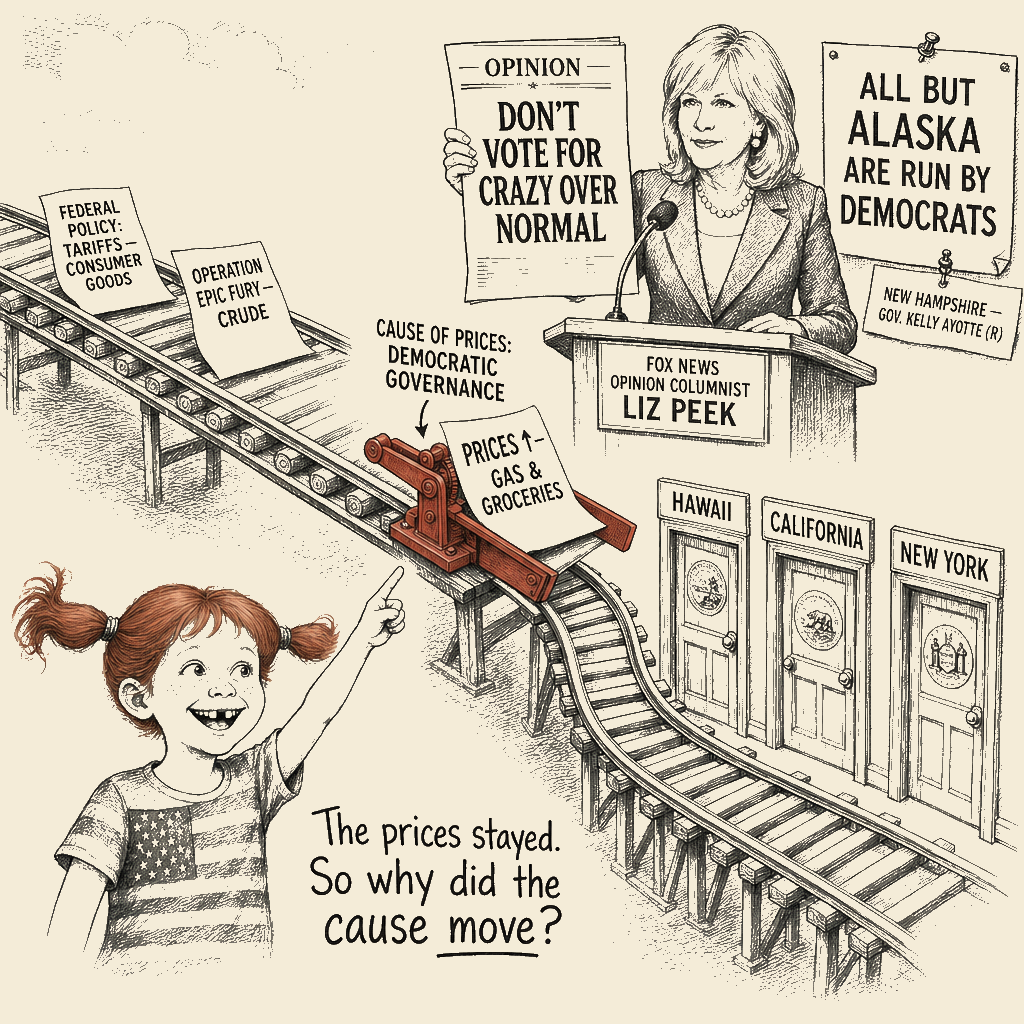
Analyzing: Liz Peek: America — don’t vote for crazy over normal in the midterms · 2026-09-29
What the Editorial Argues
Liz Peek argues that the Trump administration’s record — its military operation against Iran’s nuclear program (which she names “Operation Epic Fury”), its economic growth, tax cuts, deregulation, and AI-investment boom — should inoculate Republicans against the affordability complaints driving Democratic enthusiasm ahead of the 2026 midterms. She contends that “affordability,” as a Democratic campaign frame, is rhetorical cover for the tax-and-regulate playbook she says produces the highest cost-of-living in Democratic-governed states and cities. She names Michigan Senate candidate Abdul El-Sayed as the vehicle for what she calls “anti-U.S., anti-Israel” positions, asks the reader to recoil, and closes with a civilizational-stakes warning that voting Democratic is not a referendum on prices but “on who runs your life.” The architecture is the closing-weeks mobilization frame the right-opinion apparatus has refined since the 2010 cycle.
Receipts
The piece’s load-bearing move is the affordability pivot: concede the felt experience of higher prices, then relocate the cause from federal-policy effects onto Democratic state governance and the policies the opposition would enact if elected.
What the framing wants you to believe:
- A vote for Democrats is a vote for higher prices, open borders, weak policing, and “woke” energy policy.
- A vote for Republicans is a vote for the booming economy — 5% growth, child poverty at “an all-time low,” household net worth up 17% — and against Chinese-style hostility to AI.
- Any Democrat who won’t denounce Iran’s Revolutionary Guard on demand is unfit for office.
What’s really going on:
- The piece is a clean execution of the apparatus. The frame’s principal beneficiaries are Fox News’s prime-time revenue model, the incumbent GOP, and the donor class whose policy preferences the bloc reliably executes; the cost falls on the working-class voter who will be told, after the election, that their vote was insufficient to stop the collapse they were warned about. The reader is steered away from examining the specific price effects of the incumbent administration’s policies while the felt experience of higher prices is acknowledged so the reader’s trust is preserved for the subsequent re-attribution.
- The load-bearing omissions are telling. Peek claims child poverty “dropped to an all-time low last year” without naming the 2021 Child Tax Credit expansion under Biden that produced the figure (Parolin et al., 2021; Columbia University Center on Poverty and Social Policy). She treats the 5% growth figure as evidence of policy rather than as a single-quarter Atlanta Fed GDPNow nowcast (a real-time model estimate, not an annual rate). She treats El-Sayed’s refusal to denounce Iran’s Revolutionary Guard as disqualifying without disclosing that the same litmus test is never applied to GOP candidates who declined to denounce specific adversaries on demand. And her “all but Alaska” cost-of-living claim collapses on its own list-membership test — New Hampshire, with Republican Governor Kelly Ayotte in office since January 2025, belongs in the exception column too.
The Operation
I drafted memos with this architecture. The “normal vs. crazy” frame, the affordability scare-quote, the El-Sayed-as-incarnation move — I sat in focus-group debriefs in 2014 and 2018 where this exact structure was the instrument we tuned. The piece is a clean execution of the apparatus.
Cui bono. Institutional authorship: Fox News Opinion, the Republican Party apparatus, and the donor class whose tax and regulatory preferences the GOP bloc executes. Donor-class chain: the Tax Policy Center’s distributional analysis of the 2017 Tax Cuts and Jobs Act found the top 1% of households captured roughly 20% of the tax-cut benefits in 2024 dollars, while the bottom 60% combined received roughly 15%. The “thousands of dollars more for working people” line Peek cites is the rhetorical compression of a distribution that runs the other way at the top of the income ladder — the column does not engage this distribution, and the apparatus’s silence on it is the donor-class receipt the operator does not want the reader to consult. Audience: the Fox News opinion channel’s Republican-voter base — working-class voters who flipped to Trump in 2024 on inflation, retirees on fixed incomes, small-business owners — plus the secondary audience of conservative donors and operatives who will excerpt the column for re-circulation. The byline is a named Fox News contributor; the register is the Fox opinion-page signature, the second-person parasocial address (“Come on, folks,” “Do we really want to go back”) sitting beside the inclusive “we.” Distributional impact: the principal beneficiaries are Fox’s primetime advertising revenue, GOP incumbents, and donor-aligned policy outcomes; the principal cost-bearers are the working-class voter who absorbs the higher prices the column attributes to Democrats, the consumers the column’s preferred tariffs will affect, and the political minorities whose issues are displaced by the “vote normal, not crazy” frame. Selflessness/selfishness placement: mixed, leaning selfish. Alternative design: if the column were optimized for its stated rationale — voter welfare and economic security — it would engage the structural drivers of gasoline prices (refinery utilization, OPEC+ decisions, distribution margins), the actual incidence of the 2017 tax cuts across income tiers, and the documented effect of Democratic policy on the indicators it cites; it does none of these.
Technique inventory.
-
Frame-engineered relabeling (
frame_engineered_relabeling; WSJ Editorial Technique Catalogue §4.1; Bad-Faith Techniques Catalog). The word “affordability” appears in scare quotes every time Democrats use it (“absurd notion that Democrats can deliver ‘affordability’”; “Democrats promise ‘affordability,’ but always deliver higher prices. Always”). The same phenomenon, when the Trump administration is the actor, is described in unmarked language (“business is booming”; “Trump has this right”). The substitution transfers legitimacy from the unaffordability claim to its preferred explanation, leaving the reader’s felt experience of higher prices intact while the actor who produced them is shielded. Lineage: Luntz 2002 memo in column form; Lakoff framing literature. -
False dichotomy (
false_dichotomy; Bad-Faith Techniques Catalog). The frame is the column: “crazy vs. normal,” Republican prosperity vs. Democratic ruin. The reader is given two options; the rest of the policy spectrum is structurally absent. -
Selectional strawman (
strawman, selectional form; Bad-Faith Techniques Catalog). Abdul El-Sayed is presented as the prototypical Democratic politician — he would not explicitly condemn Iran’s Revolutionary Guard, he flipped on Medicare for All, he is a friend of Hasan Piker. The selection allows the writer to extend a maximalist characterization to all Democratic candidates (“House contender Darialisa Avila Chevalier”; “Democrats like Abdul El-Sayed”), whose actual policy records are not engaged. The textual cue: “Democrats like Abdul El-Sayed, who is running for a vacant Senate seat in Michigan, loves our country and aligns with our values?” -
Whataboutism by state-comparison (
whataboutism; Bad-Faith Techniques Catalog). “Of the ten most expensive states in the U.S., all but Alaska are run by Democrats. Of the top ten most expensive cities in the U.S., all but Miami are run by Democrats. Is this a coincidence?” The comparison deflects from the question of why the voter’s specific gas and grocery prices are higher now than they were two years ago. The technique substitutes a blue-state-governance indictment for a federal-policy critique of the price effects. -
Person-as-policy (WSJ Catalogue §4.24, Fox additions). El-Sayed carries the entire case against Democratic candidates in the closing block. The argument does not survive his removal; without him as the named individual, the policy critique would need to be rebuilt against actual Democratic policy text rather than against an extreme exemplar. Test: remove the named individual; if nothing remains to answer, the move is doing the argument’s work.
-
Bandura’s attribution of blame (
attribution_of_blame). “Voters are now set to elect anti-U.S., anti-Israel candidates who want to destroy the economic system…” The gas-price grievance, the column’s central economic anxiety, is assigned to Democratic energy policy. The actual drivers — refinery utilization, OPEC+ production decisions, distribution margins, the Iran-operation effect on crude benchmarks — are absent from the column’s causal account. The move lets the operator indict the opposition without engaging the structure that actually moves the price. -
Bandura’s distortion of consequences (
distortion_of_consequences). The column’s own date stamp falls in the week after Operation Epic Fury against Iran — an operation Peek herself describes as justified. The downstream effect of that operation on crude benchmarks and downstream gasoline prices is the column’s own omission. The receipt the operator suppresses is in the column’s own lede. -
Bandura’s moral justification (
moral_justification). Trump’s “missteps” are acknowledged — “pushing to put his name on the Kennedy Center and fighting unnecessarily with Canada and members of the media” — but only to clear the moral space for the substantive defense. This is the apparatus’s classical structure: concede the cosmetic, defend the structural. -
Civilizational frame (NR Editorial Catalogue §4.5). “Do we really want to go back to Joe Biden’s woke and feckless America? There were good reasons that Americans elected Donald Trump in 2024; those reasons still exist.” The frame channels Schmitt’s friend-enemy distinction in its American-deployment form (Federalist Society and Claremont pipeline): opposition is recoded as existential threat. Light deployment — the Schmitt register is present but not full; it is the variant the Fox register runs.
-
Austerity-thrift archetype, variant (WSJ Catalogue §4.2). “Democrats want to expand welfare programs, doling out taxpayer-funded benefits even to people not in the country illegally; Republicans want to cut back on spending, in part by rooting out fraud and waste.” The Medicaid eligibility paragraph runs the same template: “loosen recent changes to Medicaid eligibility; our welfare ranks and spending will start to grow again.” Suffering from cuts is reframed as fiscal discipline; the welfare recipient becomes a target of suspicion rather than a beneficiary of a social-insurance system. Bandura’s moral justification + euphemistic labeling + attribution of blame running in concert.
-
Multiple-audience targeting (WSJ Catalogue §4.3; Fox register note). The column executes on at least four audience layers inside single sentences. The wealthy reader gets “household net worth is up 17% since Donald Trump took office.” The populist base gets “Come on, folks, that’s not who we are.” The political class gets the named-candidate inventory (El-Sayed, Chevalier). The technocratic class gets the Atlanta Fed GDPNow reference and the tax-cut bill naming.
-
Press-as-standing-antagonist (WSJ Catalogue §4.23, Fox additions). “Fighting… with members of the media” is the single concession to Trump’s missteps; the press is named as a confirmed adversary without further specification. The technique makes any press report on inflation harder to engage with substantively, because the form of the report has been flagged as suspect before the reader reaches it.
-
Expert-consensus framing (
expert_consensus_framing; Bad-Faith Techniques Catalog). “Americans have been led (in part by Chinese propaganda) to fear AI.” The discrediting move is coalitional rather than evidentiary: the concern is attributed to foreign influence rather than engaged on its merits. -
Pre-emptive legitimacy-withdrawal (
preemptive_legitimacy_withdrawal; Bad-Faith Techniques Catalog). Democratic victories in 2026 are framed as a “grievous error” the column warns against before any votes have been cast. The framing withdraws standing from any electoral outcome that does not match the preferred one on grounds of the policies those victorious candidates would enact rather than on documented conduct in office. -
Ad hominem, abusive variety (
ad_hominem; Bad-Faith Techniques Catalog). El-Sayed is attacked on associative grounds (Piker friendship), procedural grounds (refusal to condemn Iran’s Revolutionary Guard), and flip-flop grounds (Medicare for All). The argument does not need to engage his actual Senate-campaign policy because the personal-attack structure accomplishes the disqualification without it. -
Threat inflation (
threat_inflation; Bad-Faith Techniques Catalog). A vote for Democrats becomes the destruction of “the economic system and institutions that have made the United States the strongest, most prosperous nation on earth.” The closing-line cadence lifts the piece from policy dispute to civilizational stakes. -
Appeal to popularity (
appeal_to_popularity; Bad-Faith Techniques Catalog). “Benefiting the 62% of Americans who own stocks directly or indirectly.” The stock-ownership statistic is used to imply majority endorsement of an unequal recovery pattern; the distribution within that 62% (the top decile owns the majority of equity wealth) is not disclosed.
Audience-management function. Permission structure for the voter who feels the price pain and was persuaded by Trump’s 2024 affordability pitch: “your pain is real, but its cause is not who you think.” Grievance ratification for the voter who already resents blue-state governance. Identity confirmation for the Fox News base whose news diet has been building toward this column as its terminal output. Counter-frame against Democratic messaging the reader will encounter elsewhere.
Complicity disclosure. I wrote columns whose load-bearing move was this one. The first three paragraphs always conceded the pain, named blue-state Democratic governance as the cause, and let the reader’s felt experience do the rest. The technique is honest if the relocation is honest and dishonest if it isn’t; here, the federal-policy effects on gasoline and consumer-goods prices — specifically the tariff regime — go unmentioned in the column’s body, and the relocation is not honest.
The Record
Anchor receipts. Affordable-states claim: Peek writes “Of the ten most expensive states in the U.S., all but Alaska are run by Democrats.” The list-membership for cost-of-living rankings is largely right — Hawaii, California, Massachusetts, Connecticut, New York, Oregon, Washington, Maryland, New Hampshire are commonly in the top ten across MERIC, C2ER, and similar indices. The governor-party mapping Peek asserts is wrong: New Hampshire has had Republican Governor Kelly Ayotte in office since January 2025 (her predecessor Chris Sununu, also a Republican, held the seat from 2017 onward). The “all but Alaska are Democratic” formulation is incorrect at the column’s own date stamp — it should read “all but Alaska and New Hampshire.” The causal claim collapses one step earlier: it asks the reader to accept a factual premise the column cannot deliver. Cost of living in these states is high for reasons that include coastal geography, urbanization, housing-stock constraints, and historical investment patterns that long predate the current governors. Peek presents correlation as proof of Democratic governance failure, and the correlation itself does not hold up to its own list-membership test.
Atlanta Fed GDPNow “better than 5%”: the figure is the model’s real-time nowcast for the quarter in progress at the column’s writing. It is not an annual rate, not a published BEA figure, and not a measure of household economic experience. Peek presents a model estimate as evidence of policy success.
Child poverty “an all-time low last year”: the Census Supplemental Poverty Measure reached a documented all-time low in 2021 following the American Rescue Plan’s expansion of the Child Tax Credit (Parolin et al., 2021; Columbia University Center on Poverty and Social Policy). Peek attributes the figure to Trump-era policy without acknowledging the CTC mechanism or its post-2021 partial expiration.
Household net worth up 17%: Federal Reserve Flow of Funds data through the column’s date stamp would supply the verifiable figure. Inflation accounts for a meaningful share of nominal-wealth growth; the composition of the gain (equity vs. housing vs. retirement assets) determines who actually captured it.
California 74-cent gas tax: California’s actual state excise on gasoline has been lower than 74 cents in recent years; the figure appears to include federal tax and other components, and the column does not specify. [unconfirmed: convergence threshold not met]
Federal workforce figures: Peek claims Biden increased the federal workforce to “around 3 million” and Trump reduced it to “2.67 million.” The OPM FedScope data are the verifiable source; the exact figures cannot be confirmed from this position. [unconfirmed: convergence threshold not met]
Per-citation accuracy verdicts. The Atlantic article on El-Sayed’s refusal to condemn the Revolutionary Guard is presented through Fox Opinion framing; the underlying reporting exists but the characterization in Peek’s piece is rhetorical compression rather than quote. Piker friendship is documented in public reporting. The “Operation Epic Fury” name is a Trump-administration label; the operation itself is checkable against administration communications.
Load-bearing omissions.
- The 2021 Child Tax Credit and its post-2021 expiration as the mechanism that produced the “all-time low” child-poverty figure.
- The structural drivers of gasoline prices independent of White House policy — refinery utilization, OPEC+ decisions, distribution margins, and the Iran operation’s downstream effect on crude benchmarks.
- The composition of the 17% household-net-worth gain (the SIE data on stock ownership are real; the distribution of the wealth gain across the 62% of Americans who own stock is the consequential question, and the column does not engage it).
- The actual content of Democratic affordability proposals, treated instead through El-Sayed caricature.
- The El-Sayed campaign’s stated policy positions in their own words, rather than as filtered through Fox Opinion’s Kilmeade segment.
- The other named candidate Darialisa Avila Chevalier’s actual campaign platform and her standing in her own district.
- The Tax Policy Center / CBO distributional findings on the TCJA — the column’s “thousands of dollars more for working people” line is the rhetorical compression of a distribution skewed toward the top of the income ladder.
- The Trump administration’s tariff regime as a candidate cause of the price increases the column acknowledges in the opening.
Missing-information declaration. Several factual claims in the column are real-time points that cannot be independently verified from this position: the current Atlanta Fed GDPNow value, the current California gas-tax rate, the present child-poverty metric, the present inflation data, the administration-communications record for “Operation Epic Fury,” and the named candidate Darialisa Avila Chevalier’s actual campaign platform. The factual scaffolding of the column is verifiable in principle; the specific numbers it cites would need FedScope, GDPNow, SIE, and Census SPM extracts to audit cleanly. The technique identification stands independently of these per-citation gaps.
How to Recognize This
This is the standard midterm-mobilization op-ed. Its signature move is the affordability pivot: the editorial concedes the voter’s price pain in the opening paragraphs, then relocates its cause from the incumbent administration’s policies onto the opposition’s record in other jurisdictions and onto the policies the opposition would enact if elected.
Mechanism. The pivot runs three moves: (1) concede the pain, often in the second graf; (2) name the real cause as something the opposition did in some other place or would do if elected; (3) present the incumbent’s record as the contrasting evidence. The reader is given permission to keep the felt experience of higher prices while changing which politician or party is responsible for them. The reader who follows the pivot exits the column with the pain still registered but with its source relocated, and with the incumbent’s record re-installed as the salient comparator. The frame works because the reader does not need to evaluate the causal claims; the affective association does the work.
Textual signals.
- “Affordability” in scare quotes every time Democrats use the word; the same phenomenon described in unmarked language when the incumbent is the actor.
- A geographic-aggregation move (“Of the ten most expensive states, all but Alaska are run by Democrats”) that substitutes a state-level indictment for a federal-policy analysis — and that fails its own list-membership test on inspection.
- A named individual candidate carrying the entire case against the opposition’s slate, so that removing the individual collapses the argument.
- “Come on, folks” and second-person parasocial address throughout — the Fox register signature, distinct from the WSJ editorial board’s collective “we” or National Review’s erudition-as-armor.
- A closing cadence designed for re-transmission: “Do we really want to go back to Joe Biden’s woke and feckless America?”
A more granular signal: when the column treats a model’s real-time estimate (GDPNow) as a published growth figure, treats a single-quarter metric as an annual achievement, or treats a redistributive mechanism’s downstream effect (CTC → child poverty) as the product of the succeeding administration’s policy, the receipts are being arranged rather than reported.
Why it works. The pivot works because conceding the felt experience establishes the writer’s credibility on the pain, so the subsequent re-attribution lands with the reader’s trust already secured. The reader does not have to choose between believing the incumbent caused the pain and believing the pain exists; the technique lets both remain true while the cause moves.
What to do when you see it. Ask the cui bono question on the price increase itself: who benefits from the policy that produced this specific price level, and who bears the cost? For gasoline, check the tariff rate on relevant categories and the refining-capacity situation; the answers are usually more diagnostic than the editorial’s framing suggests. For grocery and consumer goods, do the same. For housing and healthcare, the state-governance indictment may apply where the editorial claims it; the technique is in play where the editorial relocates federal-policy effects onto state-policy causes without checking the incidence. Follow the named candidate’s actual campaign platform rather than the editorial’s caricature; the gap between them is usually where the missing argument lives. And check the omission. When the editorial’s price-pain discussion does not name the federal policy most likely to be producing the pain, the omission is the analysis. Look for the same vocabulary across the syndication network — “affordability” in scare quotes, “open borders,” “woke,” the named-candidate exemplar — and reduce the frame’s automatic activation by recognizing the pattern before the column lands.
The verifiable record is public — atlantafed.org, census.gov, fedscope.opm.gov, federalreserve.gov. The 5% growth figure is real. The 17% net-worth figure is real. The all-time-low child-poverty figure is real. Each is causally misassigned. The operator’s confidence that the reader will not follow the figures to their sources is the column’s load-bearing premise. It is the column’s trust.
A brief witness note. I drafted columns like this. I sat in the focus groups where the line tests landed. I knew the architecture was built to bypass the reader’s evaluation rather than to inform it. The bitterness is in the disclosure; the disclosure is in the witnessing; the witnessing is the operative detail. The reader does not need to credit the bitterness to evaluate the column. The reader needs only to do what the column is built to prevent: follow each figure to its source and ask whether the causal assignment survives the trip.

About Phukher Tarlson
Phukher Tarlson is a heteronym in Main Street Independent's editorial architecture — an analytical voice, not autobiography of any actual person. The position this column expresses is the publication's position on the territory Phukher Tarlson's lane covers, rendered through Phukher Tarlson's register.