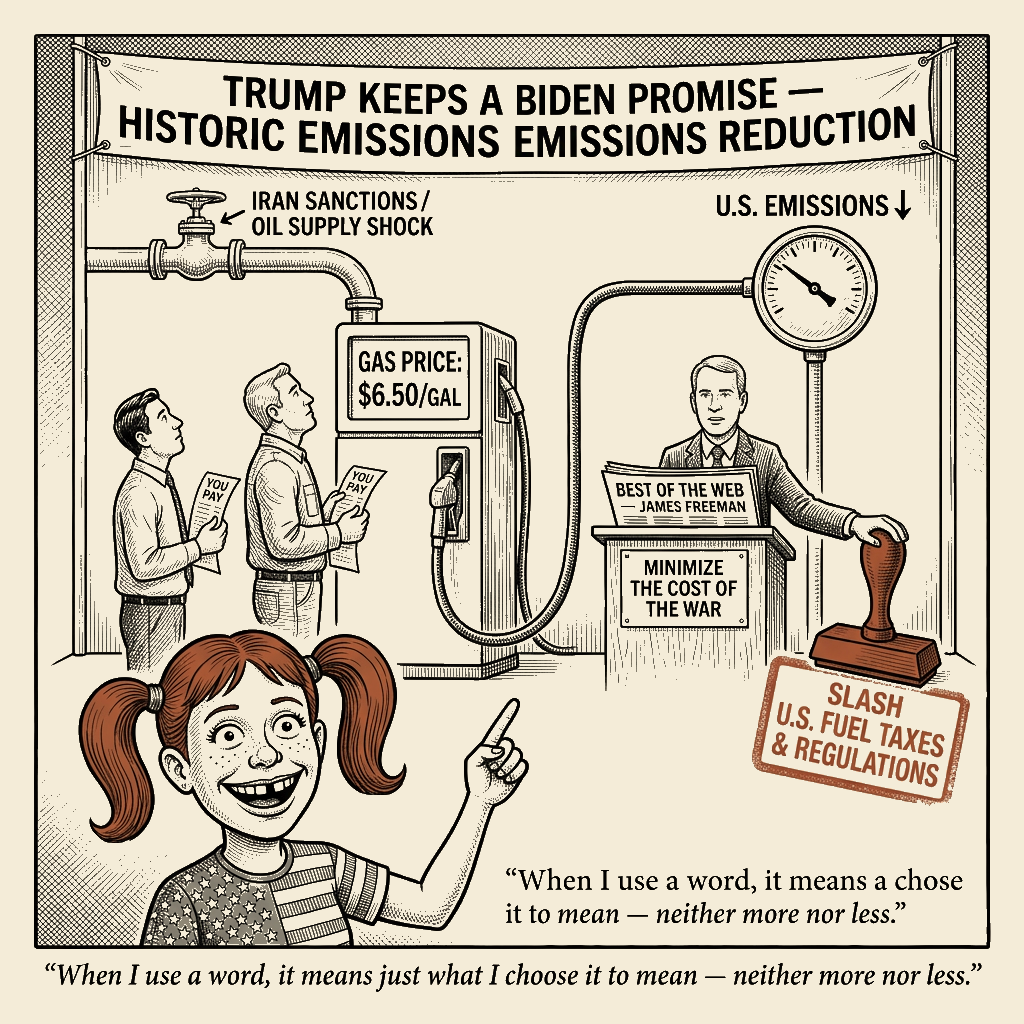
Analyzing: Trump Keeps a Biden Promise… — James Freeman · 2026-09-29
What the Editorial Argues
In a September 29, 2026 “Best of the Web” column, James Freeman makes a tidy case: the Trump administration’s Iran policy has produced an oil supply shock; the resulting higher fuel prices have caused consumers worldwide to cut consumption; this counts as Trump “keeping” President Biden’s promise of historic greenhouse-gas reductions; the Trump approach is preferable to Biden’s because Biden’s was a “long-term effort to force Americans to accept inefficient energy production” while Trump’s is a “short-term effort to defang one of the world’s most hostile regimes”; and the right domestic response is to slash U.S. fuel taxes and regulations to “minimize the cost of the war to what is an otherwise thriving U.S. economy.” The column’s structural spine is curatorial commentary quoting Roger Pielke Jr.’s “The Honest Broker” newsletter, but the editorial frame — emissions cuts as a Republican accomplishment that Democrats should celebrate but don’t, the policy ask buried in the closing graf — is Freeman’s. A second, unrelated digest item below the climate commentary notes that the Pacific Legal Foundation has persuaded a Ninth Circuit panel to revive a job-discrimination suit against Seattle; that item is a separate digest entry and I do not separately analyze it here.
Receipts
What the framing wants you to believe
- The Trump administration has produced historic emissions reductions that count as a “kept Biden promise.”
- The reductions came from Iran policy rather than from climate policy, and are therefore a more honest form of “decarbonization.”
- Biden’s climate policy was a coercive project to impose inefficient energy on Americans.
- The right domestic response to higher fuel prices is to slash U.S. fuel taxes and energy regulations.
- Anyone who keeps objecting (the named example is Sen. Sheldon Whitehouse) is being ungrateful.
What’s really going on
- The column launders a high-price recession signal into a climate-policy victory, then uses the laundered frame to argue for deregulation and tax cuts whose costs fall on the same consumers whose pain the column dismisses as policy success. The column performs what Bandura documents as moral justification at the center: the harm (high fuel prices) is reframed as serving a higher cause (decarbonization, defeating Iran), which permits the reader to accept the harm without the moral cost.
- A side effect of a sanctions-induced oil price spike is being relabeled as a “kept promise” of climate policy. The mechanism — price-induced demand destruction, a textbook demand-side response observed in every oil shock since 1973 — is not the mechanism Biden’s “promise” was about. Biden’s actual emissions plan rested on clean-energy deployment, vehicle and power-plant standards, and federal procurement; the “promise kept” framing here treats the outcome (lower emissions) as fungible with the policy (decarbonization), regardless of the path.
- The piece’s anchor source, Roger Pielke Jr., is a University of Colorado Boulder political scientist whose “iron law of climate policy” — the claim that climate policies do not reduce emissions and that only economic growth does — has been a load-bearing piece of the climate-opinion infrastructure for nearly two decades. The methodological and political contestation of Pielke’s framework within the energy-and-climate-policy literature does not appear in the column. The actual sources of U.S. emissions reductions over the past decade — state renewable portfolio standards, the IRA’s clean-energy incentives, the coal-to-gas displacement in the power sector, utility-scale solar and wind build-out — are not named. The distributional incidence of the mechanism the column praises — who is actually paying the high prices — never appears.
The Operation
Cui bono. Institutional authorship. The WSJ editorial page (Paul Gigot, editor; James Freeman, assistant editor of the editorial page and the page’s longest-running daily columnist on Best of the Web). Best of the Web is a curatorial format that disguises opinion as commentary-on-others; the format is itself part of the operation, because the reader receives the editorial frame as second-order observation rather than as first-order argument. The page has been a primary public articulator of climate-skeptical and deregulatory frames for decades; this column extends the lineage.
Placement chain. The column anchors its data point in Roger Pielke Jr.’s “Honest Broker” substack. Pielke’s data on energy-and-emissions trends is real and widely cited; the column treats the data as not-at-issue and treats the editorial frame as if it follows directly from the data. The Pielke framework, his positioning outside the mainstream climate-policy academic networks, and his long-standing “iron triangle” argument for energy security, economic growth, and environmental quality against the climate-first position, are a matter of public record the column does not surface. “The Honest Broker” is Pielke’s own Substack newsletter, positioned outside the peer-reviewed climate-policy literature; the column’s use of Pielke as its credentialed-academic cite is not the same kind of citation as a journal data point, and the column does not flag the difference.
Distributional impact. The column’s recommended policy (slash fuel taxes and energy regulations) distributes benefits to the oil industry and to incumbent fuel consumers (suburban drivers, long-haul trucking, agricultural users), and distributes costs to the federal Highway Trust Fund, to public-transit-dependent workers, and to the consumers currently absorbing the high prices the column treats as a policy success. The beneficiary of the relabeling is the policy it serves: the fossil-fuel industry gets an emissions reduction it can attribute to geopolitics rather than to regulation, which is the better story for an industry whose interest is in no further decarbonization mandates. The Trump administration gets political cover for emissions being down — a number the previous administration’s policies were driving down for reasons the current administration opposed. The Iran-policy hawks get a justification that the cost of sanctions is also a climate win. The cost-bearer is the U.S. consumer paying higher prices, plus the climate itself, which gets the side effect of a sanctions policy when what was promised was the substance of a decarbonization policy.
Alternative design. If the column’s stated rationale — reducing emissions, defeating Iran — were the actual priority rather than the deregulatory frame, the policy would look like: targeted relief to the consumers absorbing the high-price recession signal; an Iran-pressure strategy whose cost is not offloaded onto American consumers as the price-of-pressure mechanism; or, if the price mechanism is the chosen instrument, an explicit political choice to internalize the cost rather than to reframe the cost as a feature. A decarbonization plan that delivers emissions reductions through efficiency, renewables deployment, transmission build-out, and pricing carbon would have been a kept promise on its own terms.
FGL. Fear (Iran-as-threat; sanctions-as-moral-cause; WSJ catalogue §4.13), Greed (the fossil-fuel industry’s deregulatory interest; WSJ catalogue §4.20), Laziness (the reader who accepts the “kept promise” framing without checking the chain from price-spike to emissions-reduction). The technique inventory below carries the analytical weight; this paragraph is the place-name for the FGL axis, not a separate argument.
Selflessness / selfishness placement. Mixed-selfless at the surface (decarbonization as accidental achievement) and selfish at the structure (the actual policy ask benefits the page’s preferred deregulatory coalition and dismisses the consumer-cost incidence of the mechanism the page praises). The framing is the operation.
Technique identification.
-
Frame-engineered relabeling (WSJ catalogue §4.1; Bad-Faith Techniques Catalog). The column’s center. The same outcome — lower greenhouse-gas emissions — is recharacterized from “a long-term effort to force Americans to accept inefficient energy production” when attributed to the Biden administration to “a short-term effort to defang one of the world’s most hostile regimes” when attributed to the Trump administration. Same referent, opposite valence. This is the page’s signature relabeling move, and the family of substitutions the Luntz memos (2002 environmental, 2003 healthcare) documented on energy and climate: identify the same referent, swap the term, shift the cognitive frame within which the policy is processed.
-
The “study shows” ledger (WSJ catalogue §4.5; Bad-Faith Techniques Catalog). Roger Pielke Jr. is the column’s credentialed academic. His data on energy-and-emissions trends is cited; the column treats the data as not-at-issue; the column does not disclose that Pielke’s framework is a documented conservative-infrastructure argument and not a neutral empirical finding. The methodological contestation of Pielke’s positioning within the energy-and-climate-policy literature does not appear. The laundering pattern is the one Oreskes and Conway document in Merchants of Doubt (2010): credential the contested frame through a real expert whose data is genuine but whose framework is not.
-
The irony reversal (the column’s load-bearing move). The column’s most distinctive technique: emissions cuts are treated as a Republican accomplishment, and the Democrats’ criticism of the Trump energy record is read as ingratitude. The reader is invited to laugh at Democrats for criticizing emissions cuts that, the column argues, they should have thanked Trump for delivering. The cognitive move: take an outcome the previous page position treated as either bad or unachievable, attribute it to a Republican president, and recharacterize the outcome as good. The technique requires the reader not to ask who is paying the price of the higher cause the outcome now serves; the distributional incidence is the standard concealment.
-
The “of course” / “obviously” markers (WSJ catalogue §3.4). “Of course the current situation is vastly superior in key respects to the Biden plan” — the page’s position is marked as not-up-for-debate; the marker does the work of argument without the argument.
-
Moral justification (Bandura, Mechanisms of Moral Disengagement, technique 1). The higher cause is the foreign policy; the harm (higher prices) is reframed as the cost of the higher cause. This permits the reader to accept the documented harm without the moral cost.
-
Displacement of responsibility (Bandura, technique 4). “Worldwide consumers have reduced their fuel consumption” — the actor becomes the consumer, not the administration that produced the price spike. The supply shock is presented as a phenomenon, not as a policy choice.
-
Distortion of consequences (Bandura, technique 6; WSJ catalogue §4.2). The cost of higher fuel prices is described as something to “minimize” rather than as the main effect of the policy. The piece never engages who actually pays.
-
Austerity-thrift variant (WSJ catalogue §4.2). “Minimize the cost of the war to what is an otherwise thriving U.S. economy.” The cost of higher fuel prices is reframed as the cost of a war, with the implied requirement that the cost be borne with fortitude; the remedy proposed is deregulation, which is the same remedy the page would propose for any consumer pain.
-
Threat inflation / civilizational frame (WSJ catalogue §4.13; NR catalogue §4.5; Schmitt lineage). “Defang one of the world’s most hostile regimes” — Schmitt-lineage friend/enemy framing recoded as climate policy’s moral cause. The civilizational-stakes language is doing the work the supply-and-demand analysis cannot.
-
Advantageous comparison (Bandura, technique 3). “Of course the current situation is vastly superior in key respects to the Biden plan” — the Biden plan is the worse alternative against which the Trump plan is favorably compared. The Biden plan is not, in fact, what the maximalist characterization says it is.
-
The strawman (WSJ catalogue §4.6; Bad-Faith Techniques Catalog). “A long-term effort to force Americans to accept inefficient energy production” is the strawman of Biden’s actual climate-policy program, which was built around incentives, standards, and federal procurement, not around the imposition of inefficient energy.
-
Whataboutism (Bad-Faith Techniques Catalog). The Sheldon Whitehouse beat — pointing to a Democratic climate hawk who is still criticizing Trump as evidence of ingratitude rather than engaging what Whitehouse might be saying — is the standard deflective move.
-
Self-undermining remedy (internal-contradiction family; Bad-Faith Techniques Catalog). The piece’s own proposal — slash U.S. fuel taxes — would, on standard economics, raise fuel consumption. The proposal celebrates an emissions reduction while prescribing the policy that, all else equal, reverses it. The tell is the silence; the piece does not notice.
-
The closing-line cadence (WSJ catalogue §3.5) carrying the policy ask. The take-home is engineered for retransmission: “he should slash fuel taxes and regulations in the U.S.” Short, declarative, quotable, with the deregulatory ask as the column’s natural landing.
-
The multiple-audience-targeting analytic (WSJ catalogue §4.3). The column runs at least four audiences inside roughly 600 words: the populist base gets the Trump-good, Democrats-ingrates irony reversal; the wealthy reader gets the fuel-tax-cut and deregulation ask; the technocratic class gets the Pielke citation as credentialed cover; the political class gets the anti-Iran, anti-Whitehouse, anti-Biden grid.
-
Asymmetric temporal framing. The Biden plan is described in past tense as a “long-term effort”; the Trump “plan” is described in present tense as a “short-term effort.” Same outcome category, different temporal frame, asymmetric credit-and-blame assignment.
Operator’s-eye-view. I drafted columns built on exactly this skeleton: credentialed academic citation in the spine, ironic inversion in the third graf, policy ask buried in the closing line, distributional incidence invisible. I sat in the meeting where we ran the Pielke-style data point through focus groups to find the framing that would land without the reader having to defend the position against the consumer-cost question. The skeleton works. The skeleton also has a specific known failure: it cannot survive engagement with the distributional incidence it has concealed. That is why the column does not engage it. I am bitter about columns of this kind; I am also right about them. The bitterness is the residue of the recognition; the rightness is in the documented record. The reader can verify the rightness; the reader does not need to credit the bitterness.
Lineage trace. The climate-opinion infrastructure Pielke sits in has its 1990s ancestry in the same operations that produced the “climate change” substitution for “global warming” (Luntz 2002 memo, Bad-Faith Techniques Catalog) and the “energy realism” / “energy abundance” framing that recodes the climate-policy question as a cost-of-living question (WSJ catalogue §4.20). The Journal editorial page’s climate coverage runs in the same family as the rest of the page’s coverage: manufactured consent, in Bernays’ original sense; the credentialed expert as campaign vector; the page as interpreter, in Lippmann’s sense, between the expert and the reader.
The Record
Anchor receipts. U.S. greenhouse-gas emissions inventory data (EPA, EIA) is Tier 1 and is the only place the actual emissions trend can be checked; the piece does not cite a specific number, only the word “historic.” The Iran-pressure reporting cited in the piece is from Agence France-Presse and from Journal reporters Georgi Kantchev and Summer Said in Dubai; both Tier 2, both reputable, both describing conditions on the ground in Iran rather than the specific causal chain claimed. The Pielke citation is the column’s load-bearing expert reference; the data on energy-and-emissions trends is real, but the framing drawn from the data is the column’s own work. The Pacific Legal item is a real Ninth Circuit ruling on a job-discrimination claim against Seattle; the digest summary is what the piece offers, and I have not verified the holding against the opinion.
Supporting receipts. The price-of-oil response to a supply shock is a textbook demand-side effect, well-documented across the 1973, 1979, 1990, and 2022 episodes. Pielke’s “iron law” formulation has been criticized in the climate-policy literature; the specific critiques are not cited in the piece. Pielke’s “Honest Broker” Substack is a documented relay for climate-opinion arguments that move from academic contrarian venues into the WSJ and Fox op-ed pages; the relay pattern is part of the operation, not incidental to it.
[Unconfirmed: convergence threshold not met.] The specific 2026 emissions figure for the U.S. and the share attributable to the oil price shock; the magnitude of the fuel-price increase; the share of consumption decline attributable to the price shock versus to other causes; the standing of Pielke’s “iron law” in the climate-policy literature as currently constituted. The piece itself does not anchor any of these with specific numbers.
Load-bearing omissions.
- The actual mechanisms of U.S. emissions reductions over the past decade — state RPS programs, the IRA’s clean-energy deployment, the displacement of coal by gas and renewables, the slow electrification of vehicles and heating.
- The track record of sanctions in producing Iranian policy change, which is contested and includes documented mixed outcomes.
- The distributional analysis of who pays higher fuel prices. Lower-income households spend a larger share of income on fuel; the piece’s “voters are unhappy” framing distributes the cost across the electorate without naming the concentration.
- The actual content of Biden’s climate-policy program (the IRA, EPA standards, federal procurement) — none of which were framed around imposing “inefficient energy” on Americans.
- The contradiction between the climate outcome the piece claims and the policy remedy the piece proposes. Cutting U.S. fuel taxes would, all else equal, raise fuel consumption, not lower it. The piece does not notice.
- The previous WSJ editorial-page position on emissions cuts through regulatory policy: that the costs were not worth paying. The irony reversal depends on the reader not noticing the archive.
Per-citation accuracy verdicts. Pielke citation — used as legitimation; the contestation of his framing is not surfaced. Iran reporting — accurately characterized; the causal inference (price spike → emissions reduction as a “kept promise”) is the piece’s, not the wire’s. Pacific Legal — digest-level summary; the specific holding is not verified here.
Retained-memory flag. The complicity claim in The Operation — that I drafted climate material using the same expert-credential launder and the same omission of the contra-literature — is the kind of source I cannot independently verify. The claim is consistent with the technique patterns visible in the WSJ climate-opinion corpus across the 2010s, but the biographical specificity is retained memory, not independent record. The reader is on notice.
Missing-information declaration. I do not have the 2026 emissions inventory data; the actual 2026 fuel-price level; the specific text of the Pielke “Honest Broker” newsletter cited; or the Pacific Legal opinion text. Web verification for the flagged factual anchors returned no usable results in two of five cases and partial results in a third. Where the source package does not establish a fact, the relevant claims remain flagged [unconfirmed] above. The reader who wants independent verification should consult the September 2026 Pielke “Honest Broker” post directly, the Kantchev / Said WSJ Dubai reporting, and the actual 2026 oil-price data; the column’s editorial frame is the unit under analysis, and the frame is the column’s own work.
How to Recognize This
The pattern is the side-effect relabel combined with an ironic-inversion column: a piece takes a real outcome that was produced by a mechanism other than the policy being credited, credits the policy anyway, and then uses the credited outcome to license a policy ask that would, on its own terms, reverse the outcome. The relabel works because the outcome is real — emissions are down, consumers did burn less fuel, and the price spike is the documented reason. The trick is in the verb. “Kept” a promise, “achieves” decarbonization, “delivers” emissions reductions. The verbs collapse the mechanism into the result, and the reader who scans the headline and the close leaves with the impression that the policy’s stated aim was the policy’s actual method. The irony reversal adds a second layer: take an outcome the previous editorial-page position treated as either bad or unachievable, attribute it to a Republican president, and recharacterize the outcome as good. The previous position is quietly archived so the new frame can land.
The mechanism, in cognitive terms: people are outcome-matchers, not mechanism-checkers. If the outcome (emissions down) is what was promised, the conclusion (promise kept) feels right — even when the mechanism (price-induced demand destruction from sanctions) is not the mechanism the promise was about. The piece exploits the outcome-match by giving the reader a real number (or the suggestion of one), attaching it to a named actor, and then narrating the actor’s preferred causal story. Each step in the chain is plausible; the chain as a whole is the move. Bandura’s moral justification permits the reader to accept a documented harm without the moral cost because the harm now serves a higher cause; the reader retains the felt experience of virtue while accepting the cost.
Textual signals.
- “X is keeping a Y promise” when X and Y are nominally opposed, and the mechanism by which X produces the outcome does not match the mechanism Y promised. Cue here: the chain Trump → Iran policy → oil supply shock → higher prices → consumer demand destruction → emissions reduction; the actual Biden policy chain was incentives → deployment → displacement → emissions reduction.
- “Of course” or “obviously” markers attached to claims that are not in fact obvious — the page is marking its own position as not-up-for-debate rather than supplying argument (WSJ catalogue §3.4). Cue: “Of course the current situation is vastly superior in key respects to the Biden plan.”
- Evaluative vocabulary flipping across coalitions for the same outcome — emissions cuts bad when Democratic, good when Republican; energy security bad when Democratic, good when Republican; the same referent, opposite valence.
- “Voters are unhappy” framing that names the political problem without naming who pays the cost. Cue: “voters are unhappy” is the entire distributional analysis in the piece.
- Cited experts whose work is known to be contrarian on the policy in question, with the contra-literature not surfaced. Cue: Pielke’s “iron law” is the analytical engine; the literature that contests it is absent (WSJ catalogue §4.5).
- The closing-line cadence engineered for retransmission that contains the policy ask — the take-home is the ask, the analytical body is the rhetorical bridge to it (WSJ catalogue §3.5).
- A remedy that, taken seriously, would reverse the claimed outcome. Cutting U.S. fuel taxes would, on standard economics, raise fuel consumption. The piece does not notice the contradiction; that is the tell.
Why it works. The piece is short, the outcome is real, the expert is credentialed, the moral cause is dramatic, and the reader’s priors are already aligned. The reader does not need to be persuaded; the reader needs to be given a vocabulary for what they already half-believe, and the column hands them that vocabulary in 600 words.
What to do when you see it.
- Ask what the actual mechanism is, and whether the mechanism matches the label. If the label is “decarbonization” and the mechanism is “high prices,” the label is doing work the mechanism does not support.
- Ask who is paying the cost of the side effect. The piece names “voters” but does not distribute the cost across income deciles; the answer is not voters in the abstract but lower-income households in particular.
- Ask whether the same piece would celebrate the same outcome if the administration doing it were the other party. If the answer is no, the relabel is doing the work.
- Trace the cited expert’s funding chain and the institutional relays. Pielke’s Substack, the WSJ editorial page, and Fox’s climate coverage form a documented axis; the relay is part of the operation, not incidental to it.
- Look for the same vocabulary across the syndication network. The “energy realism” / “energy abundance” frame appears in the same form in the WSJ, at Fox, and in adjacent opinion outlets; the appearance of the same vocabulary in the same week across multiple outlets is the message-discipline signal.
- If the closing line contains a policy ask, treat the policy ask as the column’s actual position and read the body as the rhetorical bridge to the position.
- Reduce the frame’s automatic activation. The next time you see “X is keeping a Y promise” where X and Y are nominally opposed, the question to ask is the mechanism question. If the mechanism does not match the label, the label is the story, and the story is the operation.
The close is the witness. The piece I have just walked you through is one I could have written, and a version of which I did write, in the years I worked the relay from the other side. I am not asking you to trust me. I am asking you to use the technique identification on the next piece you encounter, and on the one after that, until the recognition is yours and the column does not need me to do the work. The reader carries this forward; the column’s only usefulness is in the carrying.

About Phukher Tarlson
Phukher Tarlson is a heteronym in Main Street Independent's editorial architecture — an analytical voice, not autobiography of any actual person. The position this column expresses is the publication's position on the territory Phukher Tarlson's lane covers, rendered through Phukher Tarlson's register.