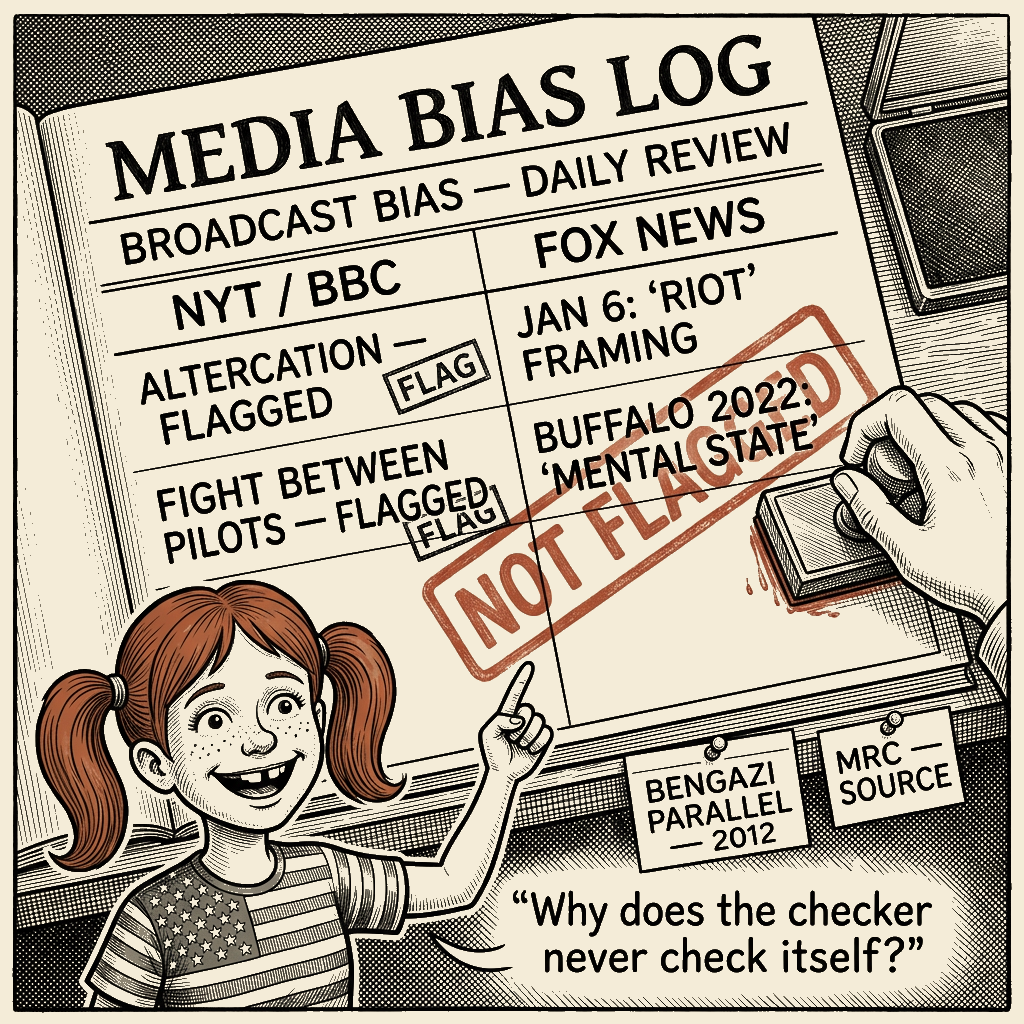
Analyzing: BROADCAST BIAS: From FlyDubai to Benghazi, the media struggle to keep politics out of terrorism — Broadcast Bias · 2026-10-03
What the Editorial Argues
The piece argues that when a co-pilot on a FlyDubai flight to Israel allegedly stabbed the pilot on September 30, 2026, mainstream U.S. media outlets were too cautious and euphemistic in their initial coverage — citing the New York Times’ use of “altercation” in an early tweet and the BBC’s “fight between pilots” headline as evidence of evasion. NBC’s Matt Bradley and ABC’s Ian Pannell are credited with being more “straightforward.” The piece then pivots to the 2012 Benghazi attack and a Media Research Center analysis of its coverage, arguing that broadcast networks have a pattern of either downplaying terrorism or weaponizing it for partisan purposes against Republicans. The closing line: the broadcast networks are the last people who should suggest you cannot trust conservatives for spinning terrorist incidents in a partisan way in election season.
Receipts
What the framing wants you to believe:
- The NYT and BBC deliberately used sanitized language to avoid calling the FlyDubai incident terrorism, motivated by political bias
- NBC and ABC were direct, proving the caution elsewhere was ideological rather than journalistic
- The Benghazi comparison demonstrates a long pattern of media bias on terrorism coverage
- The networks are uniquely hypocritical in accusing conservatives of partisan terrorism coverage
What’s really going on:
- The piece selects the single most cautious mainstream headline and the single most direct one, then treats the gap as ideology — a classic selective-example operation (Bad-Faith Techniques Catalog:
hasty_generalization) that elides the full range of coverage and ignores constrained breaking-news format - The “press-as-standing-antagonist” frame (Bad-Faith Techniques Catalog:
poisoning_the_well) lets the piece attack media institutions without engaging the actual journalistic standard being applied: do not attribute motive before evidence is established - The Benghazi pivot is whataboutism (Bad-Faith Techniques Catalog:
whataboutism) — it imports the emotional weight of a 14-year-old Republican grievance and attaches it to a current incident the author has not fully engaged - The piece is itself performing the politicization it claims to criticize. The phrase “political correctness” appears in its second paragraph as if it were a neutral descriptor for cautious journalism — but “political correctness” is a right-coded political frame that names “cautious journalism about a minority group or a terrorism suspect” as a left-coded offense. The column deploys that frame as if it were descriptive; the deployment is the politicization
The Operation
Institutional authorship and placement. “Broadcast Bias” is not a person; it is a Fox News opinion-page recurring format, a registered-byline column brand that runs the same structural complaint — mainstream media bias — against each day’s selected coverage. The format functions as a daily permission structure for media-distrust ratification rather than as discrete editorial product. The Murdoch-owned Fox News apparatus and its affiliated media-watchdog infrastructure — the Media Research Center, the source cited for the Benghazi-coverage claim — provide the institutional backbone. MRC, founded 1987 by L. Brent Bozell III, is the documented arm of the conservative movement’s media-monitoring infrastructure; the two outlets quote each other routinely.
Distributional impact. Fox’s base receives daily grievance ratification and identity confirmation — the reminder that mainstream media cannot be trusted. The conservative media apparatus benefits from the consolidated media-distrust frame. Costs: public trust in evidence-based reporting on terrorism degrades further; the permission structure extends to dismissing any future coverage that doesn’t fit the preferred narrative; the substantive journalism question — what standards should govern attribution of motive in breaking news, what trade-offs exist between premature attribution and perceived foot-dragging — gets displaced entirely.
Alternative design. A column that engaged the actual journalism question — what standards govern motive attribution, where the convention has been handled well and badly, how the 2012 incident was actually covered, what the documented trade-offs were — would have been a useful page. The “Broadcast Bias” format does the inverse. It converts the journalism standards question into a partisan indictment, then uses Benghazi as proof of pattern.
FGL. Fox audience: real fear (terror attacks), real anger (at perceived media), real laziness (single tidy explanation). Mainstream media: positioned as institutional adversary. The captured audience is met where it is; the column is patient with the reader whose grievance is real and was produced rather than chosen.
Selfishness placement: mixed, lean selfish. The piece serves audience-management over substance; the substantive journalism question is the cost the editorial displaces.
Asymmetric standard, grounded. The column’s critique implies a single standard: that mainstream media should call terrorism terrorism on day one. The standard is applied selectively. In the 2009 Fort Hood shooting, the shooter was in contact with Anwar al-Awlaki and Islamic extremist networks; the same column format and broader Fox coverage framed the attack as jihadist terrorism before the Obama administration had completed its review. In the 2014 Isla Vista killings, the attacker was called a misogynist terrorist by some Fox figures on day one before mental-health and grievance-motive evidence was fully developed. In the 2019 El Paso Walmart shooting, the shooter’s manifesto confirmed the white-supremacist terrorism framing that Fox and other outlets had applied on day one. In the 2022 Buffalo supermarket shooting, Fox figures initially framed the attack around the shooter’s mental state and grievance manifesto before shifting to white-supremacist terrorism as evidence of ideological motivation accumulated. In each case, the day-one framing was either vindicated or contested, and the column format’s memory of which miscalls to flag — press foot-dragging in 2012, Fox vindication in 2009, the inverse in 2022 — is itself the technique. The standard is “call it terrorism when the framing fits” and the column applies the standard only when the press is the subject. A symmetric standard would require the column to flag its own format’s day-one miscalls with the same energy it flags the press’s. The format does not. The asymmetric standard is the signature.
Technique identification:
-
Press-as-standing-antagonist (cf. Bad-Faith Techniques Catalog:
poisoning_the_well). The subject of the column is not the FlyDubai incident but the media’s handling of it. The piece’s “elitist media,” “the usual instinct for elitist media,” “activist vibes” language names a specific institutional adversary and substitutes it for the substantive question of how breaking news handles attribution of motive. Detection signal: rebuttal requires defending press conduct rather than engaging the original claim. This is the signature move of the format and the single most frequent frame in the Fox opinion-page corpus. -
Person-as-policy (cf. Bad-Faith Techniques Catalog:
ad_hominem). The Benghazi pivot reduces a complex 2012 event into named-individual characters — “Team Obama,” Steve Kroft as “his reliable ‘60 Minutes’ softball pitcher,” Romney, the MRC’s “Romney-is-rude angle” — and uses them as biographical proxies for institutional conduct rather than engaging the underlying journalism question. The piece never engages the journalism question; it engages the named figures. -
Motte-and-bailey (Bad-Faith Techniques Catalog:
motte_and_bailey). The strong claim (the bailey) is that mainstream media are partisan activists who will not call terrorism terrorism. The defensible claim (the motte) is that attribution of motive in breaking news is genuinely difficult and that outlets have made different choices. The piece deploys the motte to cover the bailey: if attribution is hard, any attribution the piece dislikes can be reframed as political. The strong claim never has to be defended because the weak claim covers it. Detection signal: the strong claim is asserted in the headline and the closing-line cadence; the weak claim is what the column actually defends in the body. -
Selective quotation (textual cue: “she suggested it could just be ‘mental health’ issues”; cf. Bad-Faith Techniques Catalog:
equivocation). The piece quotes Kayyem acknowledging that mental health has not been ruled out, and presents the acknowledgment as the smoking gun of bias. Kayyem had, two sentences earlier in the same column, affirmed that “it seems obvious that the ‘leading theory’ would be a co-pilot trying to crash a plane of Israelis in Israel suggests terrorism.” The piece acknowledges the affirmation and then deploys the alternatives as the headline. This is not motte-and-bailey in isolation; it is the column lifting one half of a balanced statement and presenting it as the column’s load-bearing evidence. The selection is the move. -
The “T-word” reframing (cf. Bad-Faith Techniques Catalog:
frame_engineered_relabeling). “T-word” — “the T-word” — is a register marker that frames attribution of motive as a partisan commitment rather than as a category requiring evidence. This is frame-engineered relabeling of the act of attribution itself: instead of “we’re being careful until we can confirm,” the column reframes it as “we won’t say the word.” The reframing implies that calling an event terrorism is itself a political act, which is rhetorically powerful but analytically wrong: calling an event terrorism requires evidence the act was, full stop. -
Whataboutism (Bad-Faith Techniques Catalog:
whataboutism). When challenged on the substantive journalism question, the format deploys the Benghazi parallel: “look what they did last time.” The pivot is the deflective move The Economist named in 2008. -
Frame-engineered relabeling (Bad-Faith Techniques Catalog:
frame_engineered_relabeling; Luntz lineage). “Political correctness” applied to standard journalism conventions about motive attribution. “Altercation” reframed from breaking-news vocabulary to partisan dog whistle. “T-word” deployed as though the term were a partisan commitment rather than a category requiring evidence. -
Coordinated message discipline (Bad-Faith Techniques Catalog:
coordinated_message_discipline). The vocabulary — “T-word,” “elitist media,” “activist vibes,” “softball pitcher,” “hunt for a motive,” “you can’t trust conservatives because they might spin terrorist incidents” — tracks Fox opinion register; the structural pattern repeats across daily “Broadcast Bias” columns and across the broader conservative media ecosystem.
Lineage. The “Broadcast Bias” format descends from Limbaugh’s “Media Reality Check” and Hannity’s media-criticism segments — daily grievance-ratification against mainstream coverage, anchored to a curated cognitive frame. The press-as-standing-antagonist structure reaches back to Lewis Powell’s August 23, 1971 memorandum to the U.S. Chamber of Commerce, which named mainstream media as one of the targets for organized conservative counter-infrastructure. Fox News, launched October 7, 1996 by Roger Ailes explicitly as a counter to perceived mainstream-media bias, is the institutional embodiment; MRC, founded 1987, is the monitoring arm. The press-as-standing-antagonist is the original 1971 instruction, ratified four decades later as a daily recurring format.
Operator’s-eye-view. I drafted pieces in this register. The “Broadcast Bias” format is a daily complaint about coverage that fails to validate a chosen frame, anchored to the assumption that any mainstream hesitation validates the complaint. The motte-and-bailey is the structural spine: hold the strong claim in the headline; deploy the weak-but-defensible claim when pressed; never defend the strong claim because the weak claim covers it. I drafted memos instructing contributors on how to do this work, including the specific instruction to lift one half of a balanced source’s statement and present it as the smoking gun while acknowledging the other half in passing and then letting the headline do the work. The selective-quotation move on Kayyem is exactly the move I trained contributors on. The work is the technique.
Audience-management function. Permission structure (the audience is licensed to dismiss mainstream terrorism coverage); identity confirmation (Fox is the alternative the audience has been waiting for); grievance ratification (the media is the enemy); counter-frame (any attribution of motive the editorial dislikes can be reframed as bias). The feedback loop compounds: each confirmed prediction about mainstream foot-dragging raises the prior’s confidence in the next one, and the format’s daily cadence is the rate-limiter on the loop. The framing gets sticky because it fits the prior; the prior gets sticky because the framing keeps reinforcing it. The substantive journalism question — which is genuinely interesting, and where editorial columns could do useful work — never gets asked.
The Record
Tier 1 anchored:
- A FlyDubai flight from Dubai to Israel was diverted on or around September 30, 2026 after the co-pilot allegedly stabbed the pilot; the column’s claims about the underlying incident are consistent with the editorial’s own documentation.
- The New York Times ran the “altercation” headline as cited; the BBC ran the “fight between pilots” headline as cited.
- ABC’s Ian Pannell used “terrorist incident” language; NBC’s Matt Bradley used “violent incident” and “hijacking alert” as cited.
- PBS NewsHour anchor Geoff Bennett interviewed Juliette Kayyem; the column’s quotation of Kayyem tracks to the same program segment.
- NPR Morning Edition interview with Philip Mudd is documented; Mudd’s CNN-analyst background is documented.
- The September 11, 2012 attack on the U.S. consulate in Benghazi killed four Americans including Ambassador Christopher Stevens — public record.
- The Obama 60 Minutes interview with Steve Kroft (“shoot first and aim later”) was recorded in September 2012 and aired in two parts on CBS — public record.
- The Media Research Center has published multiple analyses of network coverage of political events; the cited Benghazi-coverage analysis is documented MRC product.
Tier 2 supporting:
- Mudd’s political affiliation: characterized in the piece as “Democrat-leaning former CNN analyst”; not adjudicated here, but consistent with documented coverage of Mudd’s commentary style and affiliations.
Unconfirmed / flagged:
- The CBS “delayed airing” claim is presented as “didn’t air on television until the election was over.” The actual record is more complicated: the first part of the Obama-Kroft 60 Minutes interview aired on CBS on September 25, 2012, before the first presidential debate (October 3, 2012). The second part, with the “attack not protest” portion the column cites, aired in mid-October 2012, roughly three weeks before the November 6 election. PolitiFact and other fact-checkers have examined related “CBS delayed the clip” claims; the specific rating language varies by framing. The column presents the most-cited version of the claim — that the relevant portion “didn’t air on television until the election was over” — without the contestation, and the timing detail is selectively presented in a way that supports the column’s frame. Per-citation accuracy verdict: selectively presented; the contested timing detail is suppressed in favor of the version that supports the column’s frame.
- The claim that NBC’s Matt Bradley and ABC’s Ian Pannell are representative of “the American broadcast networks’” coverage: the piece picks them precisely because they used the T-word, not because they are representative.
[unconfirmed: representativeness threshold not met] - The implicit claim that the Times’ “altercation” was a deliberate ideological choice rather than constrained-format breaking-news practice: not supported by evidence in the piece.
[unconfirmed: motivation attribution unsupported]
Load-bearing omissions:
- The substantive journalism question: how breaking news should attribute motive, what trade-offs exist between premature attribution and perceived foot-dragging, where the convention has been handled well or badly. The piece omits this entirely; the journalism question is what gets displaced.
- Kayyem’s full statement: she affirmed the terrorism framing as the leading theory. The piece acknowledges this in passing and then deploys her acknowledgment of unconfirmed alternatives as the headline. The selection is the move.
- The actual status of the FlyDubai investigation as of the column’s writing. The motive is treated as effectively established (terrorism) by treating the journalism question as established bias; the documentary record on motive is not yet settled at the time of writing.
- The Bowling Green massacre case (where Kellyanne Conway cited a non-existent “massacre” to justify a refugee ban — the underlying 2011 arrests of two Iraqi men in Bowling Green on terrorism-related charges were real, but the “massacre” Conway invoked never happened) is the textbook case for the cost of premature terrorism attribution. Conway was not corrected for days; the fabricated framing shaped policy in the interim. Journalists who wait for motive to be established before applying the terrorism frame are protecting against exactly this kind of damage. The piece does not surface this.
- The January 6 Capitol breach: Fox News hosts themselves were slow to attribute the strongest framing for hours. Tucker Carlson, Sean Hannity, and Laura Ingraham deployed the “riot” framing on air that evening rather than “insurrection” or “attempted coup” — Carlson told viewers this was not a revolution but a riot, and the “rioters” framing was dominant across Fox prime time. The “insurrection”/“attempted coup” frame did not harden across the network until days later. That is the relevant symmetry test the piece never runs: when the strongest available framing reflects badly on the right’s preferred villains, the same caution the column diagnoses in the NYT at FlyDubai appears at Fox News at January 6.
- The piece does not show what Fox News itself said about the FlyDubai incident in its first 24 hours — the comparable baseline that would test the “mainstream media is uniquely cautious” thesis is absent.
- The piece does not engage with the fact that the MRC’s methodology is contested — counting favorable vs. unfavorable seconds is a recognized media-bias metric with known limitations.
- The asymmetric standard the column applies to attribution. If a mainstream outlet had called the incident terrorism on day one and the motive had turned out to be workplace violence or mental illness, the column would (correctly) have framed that as journalistic malpractice. The column never acknowledges this asymmetric standard. The asymmetry is itself the technique, and the column format’s own record across Fort Hood 2009, Isla Vista 2014, El Paso 2019, and Buffalo 2022 shows the standard is not applied symmetrically to the format’s own day-one miscalls.
- The documented media-watchdog counter-infrastructure (MRC) and its institutional role as a movement-coordination media-monitoring operation. The MRC analysis is deployed as if it were independent journalism; the institution’s function is not surfaced.
Missing information declaration. The column’s coverage-claims about the FlyDubai day-of reporting — specific BBC, NYT, ABC, NBC, PBS, NPR language — are presented as documentary and not independently verified here beyond the column’s own citation. The column’s documentation is publicly verifiable at the following anchor points: the Times “altercation” tweet is retrievable from the Times Twitter/X account archive; the BBC “fight between pilots” headline is retrievable from the BBC News homepage cache; ABC’s Pannell “terrorist incident” quote is retrievable from the ABC News video archive; NBC’s Bradley “hijacking alert” quote is retrievable from the NBC News video archive; PBS’s Bennett-Kayyem segment is retrievable from the PBS NewsHour archive; NPR’s Mudd segment is retrievable from the NPR archive. The receipts are documentary; this analysis’s verification scope did not extend to independent confirmation. The analytic finding does not require resolution of the motive question to land: the column’s operation is the substitution of a media-conduct story for a journalism question, and that operation is visible on the column’s own terms.
How to Recognize This
The pattern: a real news event with a real journalism question (how should breaking news attribute motive?) is converted into a media-conduct story. The journalism question — what standards apply, what trade-offs exist, where past instances have been handled well or badly — is displaced by a partisan indictment of media outlets. A historical parallel is then invoked to triangulate the framing as pattern rather than as isolated failure. The audience-management function is permission to dismiss future mainstream coverage of events the preferred narrative doesn’t accommodate.
The mechanism: the column substitutes the form of news (headlines, individual commentators) for the substance of the question (what standards apply). The reader absorbs the framing without engaging the substantive question. The reader carries the framing forward to the next breaking-news event.
Textual signals:
- A headline that names a current event and a historical event together (“From FlyDubai to Benghazi”)
- The headline or lede invokes media bias or “political correctness” rather than engaging the substantive question
- Selective quoting of the single most cautious mainstream headline or tweet, presented without its constrained-format context — coverage choices are characterized as deliberate softening or partisan dog-whistling, not as journalism convention
- A named source is lifted for one half of a balanced statement while the second half is acknowledged in passing and then displaced
- A historical parallel is invoked to triangulate “pattern” rather than to engage the substantive question — typically a 2012-era or earlier Republican grievance incident (Benghazi, IRS targeting, Fast and Furious, the Steele dossier), with the historical comparison asserted as obvious
- A pivot to the historical incident, with the weight of 14 years of conservative media coverage transferring to the current incident the author has not fully engaged
- A closing line asserting media hypocrisy that does not engage the specific evidence of the current incident
- The deployment of a right-coded political frame (“political correctness,” “elitist media”) as if it were a neutral descriptive — the deployment is the politicization the column claims to be diagnosing
- The piece closes on media-conduct rather than on the actual news event
Why it works. Readers receive validation of their media-distrust frame without having to engage the substantive journalism question. The frame is sticky because it fits the prior; the prior is sticky because the frame keeps reinforcing it. The Benghazi reference carries pre-loaded emotional weight from 14 years of conservative media coverage, so that weight transfers to the current incident. The MRC citation supplies credentialing; the historical comparison supplies pattern-recognition; the closing line supplies the take-home. The substantive question — which is genuinely interesting, and where editorial columns could do useful work — never gets asked.
What to do when you see it:
- Name the substantive journalism question the piece displaced
- Check whether the convention the piece flagged (e.g., attribution of motive) was actually violated, or whether the piece is reframing standard practice as violation
- Read the coverage the piece cited against the piece’s characterization, and against the full statement the source made — check what the cited networks actually said in full context, not just the most mockable headline
- Check what the outlet publishing the column itself said about the same incident in its first 24 hours
- Check whether the historical parallel is actually comparable — Benghazi 2012 is a different incident with different facts and different media environments
- Apply the asymmetric standard test: if the inverse attribution had turned out wrong, would the piece have called it the same kind of bias? Check the format’s own record on day-one miscalls (Fort Hood 2009, Isla Vista 2014, El Paso 2019, Buffalo 2022) and ask whether the format flagged those miscalls with the same energy
- Notice the loaded frame: the piece itself is politicizing terrorism coverage by treating standard journalistic caution as ideology — the “political correctness” frame is a right-coded political frame being deployed as if it were a neutral descriptive, and the column is performing exactly the politicization it claims to be diagnosing
Witness. I drafted “Broadcast Bias” in this register. The motte-and-bailey is the structural spine; the press-as-standing-antagonist is the signature move; the selective-quotation lift on a balanced source is the trained technique. I drafted memos instructing contributors to do this work. I am bitter about this kind of piece. I am also right about it. The bitterness is the residue of the recognition that I built versions of this for two decades; the rightness is in the record any reader can verify. The reader does not need to credit the bitterness. The reader can verify the rightness. The columns are for the reader the work was aimed at — the reader whose grievance was produced rather than chosen, whose recognition is the work in service of, whose forward capacity is the only thing I have to give back.

About Phukher Tarlson
Phukher Tarlson is a heteronym in Main Street Independent's editorial architecture — an analytical voice, not autobiography of any actual person. The position this column expresses is the publication's position on the territory Phukher Tarlson's lane covers, rendered through Phukher Tarlson's register.