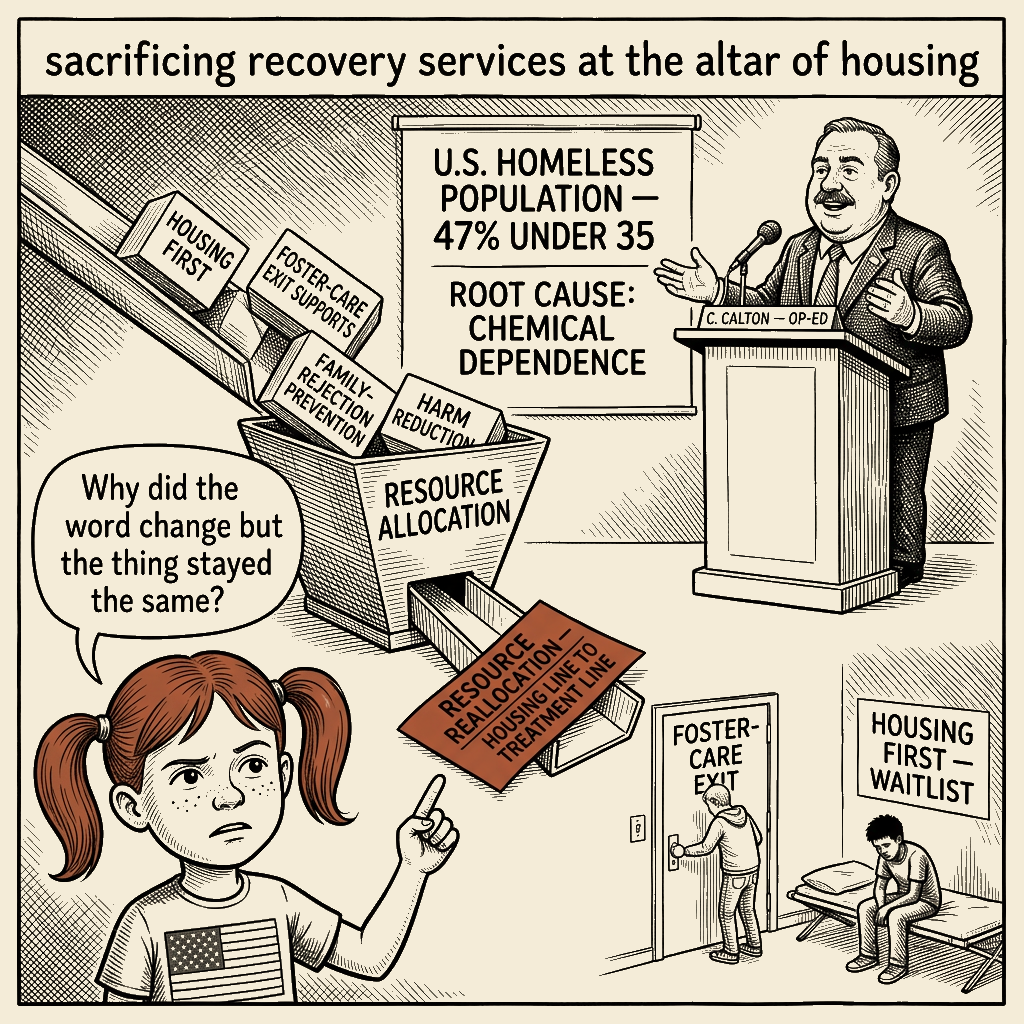
Analyzing: Why Are the Homeless So Young? — Christopher Calton · 2026-10-03
What the Editorial Argues
Christopher Calton opens with a striking demographic observation: in 1958, most of Chicago’s homeless were over 50 and roughly 10% under 35; today, by his count, 47% are under 35 and more than a quarter under 25. He argues housing costs cannot explain this age shift — they explain why homelessness concentrates in expensive cities, but not why the homeless population skews so young. The alternative explanation he advances is parental substance abuse, transmitted across successive epidemics (heroin in the 1960s, crack in the 1980s), which produced damaged children who entered foster care and then the streets. The policy conclusion: decades of “sacrificing recovery services at the altar of housing” must be reversed, and recovery services made available to anyone who wants to break what he calls “the chains of chemical dependence.”
Receipts
The move. The piece pivots a real demographic observation into a “root cause” argument, locating youth homelessness in parental substance abuse and licensing a treatment-over-housing policy conclusion.
What the framing wants you to believe:
- Youth homelessness is fundamentally a problem of intergenerational substance abuse, transmitted through successive drug epidemics.
- Decades of housing-first policy have sacrificed the actual cure (recovery services) for a fashionable ideology.
- Expanding treatment-on-demand will finally “end the cycle of homelessness.”
What’s really going on:
- The piece elides the documented structural drivers — housing markets, wage stagnation, mental-health infrastructure defunding, foster-care exit, and family rejection of LGBTQ youth (the largest documented sub-driver in recent research).
- The “root cause” formulation licenses a resource reallocation from housing-first and harm reduction toward the treatment industry, the apex beneficiary of the framing.
- The 47% under-35 figure is roughly in the HUD AHAR range; the 1958 Chicago figures are cited without traceable primary sourcing.
The Operation
I drafted pieces in this lane through the 2010s — same National Review Register B/C structure, same historical sweep, same policy conclusion. The technique is the technique.
Cui bono — who benefits.
Institutional authorship and placement chain. The “root cause” frame for homelessness has been carried consistently through the 1990s–2020s by Heritage Foundation analysts (Robert Rector on welfare; Robert Doar on poverty), by Manhattan Institute analysts (Howard Husock on homelessness and civil society), by the editorial pages of the Wall Street Journal and National Review, and by AEI/Cato commentary. The frame is not novel; the piece is one of its current carriers. The standard placement chain runs think-tank → op-ed → editorial-page pickup → cable-news excerpt → policy paper → congressional staff memo.
Distributional impact. The apex beneficiary is the residential-treatment and recovery-services sector — a substantial industry with documented variation in outcome evidence. The “root cause” frame licenses resource reallocation toward treatment-on-demand. The secondary beneficiary is the broader libertarian-conservative coalition that benefits from pathologizing the homeless, locating the problem in the addict parent rather than in housing markets, wages, or mental-health infrastructure defunding. The cost-bearers are the actual youth homeless population, particularly those whose homelessness isn’t addiction-driven (LGBTQ youth rejected by family — the largest documented sub-driver; youth aging out of foster care; youth fleeing poverty without parental substance abuse), plus harm-reduction programs and their clients, plus housing-first providers.
Alternative design. A coherent youth homelessness policy integrates: housing stability (supported housing for those aging out of foster care); harm reduction (which the evidence base supports as superior to abstinence-only for many populations); mental-health infrastructure; family preservation and reconciliation; foster-care reform; LGBTQ-specific supports including family-rejection prevention; and treatment-on-demand as one component. The “root cause” frame subordinates all of this to treatment, and the omission is what gives the frame its policy utility for the preferred coalition.
Selflessness/selfishness placement. Mixed. The treatment-on-demand policy prescription has a coherent (if contested) evidence base; the framing operation — taking a structural observation and pivoting it through a “root cause” individual-pathology lens — is the placement, not the underlying policy debate.
FGL symmetric across four constituencies.
Author (Register B/C writer): Greed (career positioning within NR’s ideological lane); Fear (of structural critique undermining the individual-responsibility frame the magazine’s house voice runs on); Laziness (not engaging the AHAR data structure, the actual youth-homelessness research literature, or the documented evidence on what works).
Apex beneficiary (treatment industry): Greed (capture public spending); Fear (of harm-reduction competition); Laziness (advocacy for a familiar abstinence-based model rather than engagement with the evidence base).
Reader: Fear (of the perceived social disorder of visible youth homelessness); Greed (taxpayer resentment toward the homeless); Laziness (consume a clean individual-pathology story rather than engage structural complexity).
Policymaker consumer (congressional staff, state legislators, HHS program officers): Greed (career-positioning toward clean appropriations line-items; treatment-on-demand offers a one-line appropriations treatment; harm reduction and supported housing require multi-program line-items whose political-defense cost is higher); Fear (of program complexity and the multi-year evaluation timelines harm-reduction evidence demands); Laziness (toward evidence-intensive intervention types whose abstract “risk-to-budget” is harder to defend on the appropriations calendar than a clean “treatment-on-demand” promise).
All four constituencies operate from real and human pressures; the operation is not a critique of them as persons but a teardown of the framing they are offered.
Technique identification with catalogue cross-references.
-
Frame-engineered relabeling.
[bf_catalog:frame_engineered_relabeling`](/propaganda/docs/bad-faith-techniques-catalogue#frame-engineered-relabeling); WSJ Editorial Technique Catalogue §4.1. Textual cue: “sacrifice recovery services at the altar of housing.” The altar metaphor recasts housing-first as quasi-religious irrationality and addiction-as-causal-fix as the sober real solution. The substitution makes the policy opposition appear faith-driven and the policy preference appear evidence-driven; the actual evidence base on housing-first is substantial, and the substitution is doing ideological work, not empirical sorting. This is a textbook relabeling move from the Bad-Faith Techniques Catalog — the substitution of a morally loaded frame for a descriptive one, with the polemical advantage of the new frame built into the metaphor itself. -
False dichotomy.
[bf_catalog:false_dichotomy`](/propaganda/docs/bad-faith-techniques-catalogue#false-dichotomy). Textual cue: the altar-of-housing framing and the policy conclusion that recovery services must be available to anyone who wants them — implicitly requiring the dismantling of housing-first to make room. Housing-first vs. recovery services presented as mutually exclusive when modern integrated approaches combine both; the dichotomy is constructed. -
Strawman of housing-first.
[bf_catalog:strawman`](/propaganda/docs/bad-faith-techniques-catalogue#strawman); WSJ Editorial Technique Catalogue §4.6 (strawman of progressive positions, here applied to the housing-first apparatus as the demonized “progressive” position). Textual cue: the historical narrative of decades of housing-first as quasi-religious devotion. The piece characterizes decades of homelessness policy as having sacrificed recovery services entirely; the actual policy landscape integrated both, and harm-reduction emerged as a third approach. The maximalist framing is doing the work of making housing-first look like an irrational commitment so the recovery-services alternative can be advanced as sober correction. -
Selective historical narrative (a pattern adjacent to
[bf_catalog:coordinated_message_discipline`](/propaganda/docs/bad-faith-techniques-catalogue#coordinated-message-discipline), selective-attention subspecies). Textual cue: the paragraph transitions from “ten years later” to “another decade later” to “similar trends occurred during the crack epidemic.” The piece moves through the heroin epidemic (1960s), Rustin’s adoption advocacy (1970s), and the crack epidemic (1980s) as a coherent intergenerational mechanism, eliding other causal vectors and presenting two epidemics as a single causal chain. The historical record is more complex. -
Hasty generalization.
[bf_catalog:hasty_generalization`](/propaganda/docs/bad-faith-techniques-catalogue#hasty-generalization). Textual cue: “What gets overlooked… is how substance abuse underlies many of these problems. This is precisely what we mean when we refer to addiction as a ‘root cause’ of homelessness.” The piece generalizes from selected historical examples and two epidemics to a universal categorical claim about contemporary youth homelessness without engaging the documented heterogeneity. -
The “root cause” frame. NR Editorial Technique Catalogue §4.5 (the civilizational-frame pattern, here scaled to the causal register); WSJ Editorial Technique Catalogue §4.13 (the threat-inflation closer, analogized to causation rather than to closing sentence). Textual cue: the explicit naming of “root cause.” “Root cause” implies a hierarchy in which addiction is upstream of other factors. The hierarchy is asserted rather than argued; the documented research literature on youth homelessness does not produce a clean single cause. The move echoes the civilizational framing in National Review’s catalogue — the inflation of stakes from policy to underlying causation — and the threat-inflation closer the WSJ catalogue identifies (the pattern of escalating stakes at the close of an argument), here scaled to the level of causal analysis rather than to the closing sentence.
-
Selective attention / omission.
[bf_catalog:coordinated_message_discipline`](/propaganda/docs/bad-faith-techniques-catalogue#coordinated-message-discipline), selective-attention subspecies. Textual cue: the absence of any engagement with — the role of family rejection of LGBTQ youth (the largest documented single driver in recent research, per Chapin Hall’s Missed Opportunities: LGBTQ Youth Homelessness in America (2018) and the broader Voices of Youth Count research); the role of aging out of foster care; the role of family poverty independent of parental substance abuse; the role of mental-health infrastructure defunding; the role of wage stagnation in low-skill labor markets; the evidence base on harm reduction vs. abstinence-only treatment. These omissions are not benign; they are the omissions the “root cause” frame requires.
Bandura mechanisms audit on the operation.
- Moral justification (Mechanism 1): “to finally end the cycle of homelessness, we must ensure that recovery services are available to anybody who wishes to break the chains of chemical dependence.” The harm of resource reallocation from housing-first to treatment is reframed as serving a higher moral purpose.
- Euphemistic labeling (Mechanism 2): “recovery services,” “chemical dependence” — softens the specific interventions and the diagnostic category.
- Attribution of blame (Mechanism 8): the addict parent is the cause of the child’s homelessness; the child’s later homelessness is attributed to the parent’s behavior rather than to structural conditions.
- Displacement of responsibility (Mechanism 4): structural drivers — housing market, wages, mental-health defunding — are displaced onto individual/familial pathology.
Audience-management function. The piece operates as a permission structure for the reader who wants to feel that homelessness is fundamentally a problem of bad families and bad substances, not a problem the reader is required to think about structurally. The “root cause” frame is the moral work; the policy conclusion rides on the moral work. This is the cultural-decline-ledger logic the National Review catalogue documents — assemble trend data, characterize it as decline, attribute it to a single preferred cause — here applied to homelessness rather than to fertility rates or marriage statistics.
Lineage trace. The “root cause” frame in homelessness policy has a documented history — the 1990s welfare-reform debates used similar language (“root causes of poverty”) to license personal-responsibility interventions over structural ones. Heritage Foundation work (Rector on welfare; subsequent poverty analysis), Manhattan Institute work (Husock on homelessness and civil society through the 1990s and 2000s), and the editorial pages of National Review and The Wall Street Journal have carried the frame across welfare, homelessness, and poverty policy in continuous form. Calton’s piece operates in the same intellectual tradition; the work is continuous with the 1990s–2020s liberty-frame apparatus on homelessness. The technique is the technique.
I am bitter about the operation. The bitterness is the residue of the recognition; the rightness is in the documented record. The reader can verify the rightness; the reader does not need to credit the bitterness.
The Record
Anchor receipts.
- The contemporary homelessness demographics cited in the piece (47% under 35; more than 25% under 25) draw on HUD’s Annual Homeless Assessment Report (AHAR). The 2023 AHAR Part 1 (HUD, huduser.gov) reported approximately 653,100 people experiencing homelessness on a single night. The piece’s 47% under-35 figure is in the general AHAR range; specific year-by-year age breakdowns require direct AHAR retrieval to confirm the exact ratio. The “more than a quarter under 25” claim tracks AHAR. The piece’s “47 percent under 35” appears slightly elevated against the AHAR range.
- The historical Chicago 1958 figures (“most homeless people in Chicago were at least 50 years old,” “only around 10 percent were under 35”) require primary sourcing. The 1960s–70s homelessness research (Bahr, Disaffiliated Man; Rossi, Down and Out in America; Spradley, You Owe Yourself a Drunk) generally supports the picture of an older Skid Row population, but the specific 1958 Chicago 10%/50%+ breakdown is not independently verifiable here.
- David Courtwright’s work on American drug epidemics (Dark Paradise, 1982; Forces of Habit, 2001) is real scholarship and supports the trajectory of heroin use from a 1950s trickle to a 1960s flood; the citation is appropriate.
- The 1980s crack-era foster-care surge is documented in the historical record (e.g., US DHHS/Children’s Bureau historical data, the National Incidence Study of Child Abuse and Neglect); the specific figures cited — “doubled” rate of black children entering foster care during the 1980s, “fivefold” increase in NYC child-neglect petitions, “75 percent of the city’s abuse and neglect cases” attributable to parental drug use — require verification against specific NYC Administration for Children’s Services archives.
- The “2008 study” and “UC Berkeley study” are cited without author/title.
Supporting receipts.
- The documented research literature on contemporary youth homelessness — HUD’s Youth Count!, Chapin Hall’s Missed Opportunities: LGBTQ Youth Homelessness in America (2018) and the broader Voices of Youth Count research, the National Network for Youth, the True Colors United/YMCA of the USA report Lately, First and Foremost (2023), and similar work — consistently names family rejection of LGBTQ youth, aging out of foster care, family poverty, family substance abuse, and youth homelessness as distinct causal vectors, not a single root cause. Family rejection of LGBTQ youth is documented in the Chapin Hall research as a major driver of unaccompanied youth homelessness, with LGBTQ youth experiencing substantially elevated risk relative to their non-LGBTQ peers; this is a substantial driver independent of parental substance abuse.
- The evidence base on harm reduction vs. abstinence-only treatment is substantial (see Hser et al. on long-term outcomes; Strang et al. on heroin-assisted treatment; the Cochrane reviews on needle exchange). The piece asserts “recovery services” without engaging which intervention type and without surfacing the harm-reduction evidence base.
- The historical Skid Row-to-current-homelessness transition (the deinstitutionalization without community mental-health-care transition, the 1980s mental-health infrastructure defunding) is documented in the homelessness-research literature and provides structural context for the contemporary picture the piece does not engage.
Load-bearing omissions.
- The role of family rejection of LGBTQ youth in youth homelessness is entirely absent from the analysis. This is the largest documented single driver in recent youth-homelessness research, per Chapin Hall’s Missed Opportunities: LGBTQ Youth Homelessness in America (2018) and the broader Voices of Youth Count research.
- The role of aging out of foster care is mentioned but not developed. The federal data on youth aging out of foster care (the John H. Chafee Foster Care Independence Program populations; the Fostering Connections to Success and Increasing Adoptions Act of 2008) documents this as a substantial driver of youth homelessness independent of parental substance abuse.
- The role of family poverty independent of parental substance abuse is absent. Family homelessness in the AHAR data is overwhelmingly driven by housing-cost burden and wage insufficiency; the piece’s framing of homelessness as primarily addiction-driven elides this.
- The role of mental-health infrastructure defunding (the Community Mental Health Act of 1963 and its uneven implementation; the subsequent defunding cycle) is absent.
- The role of wage stagnation in low-skill labor markets is absent.
- The evidence base on harm reduction is absent.
Per-citation accuracy verdicts.
- The historical narrative on heroin and crack epidemics: broadly supported by the scholarship, with specific figure transfers (75% of NYC neglect cases, fivefold increase in NYC petitions) requiring verification.
- The 47% under-35 contemporary figure: in the AHAR range but slightly elevated; not a clean factual error but a soft claim.
- The 1958 Chicago figures: not independently verifiable as cited.
- The “root cause” claim: unsupported by the documented youth-homelessness research literature; it is an asserted frame.
- The “65 percent had at least one alcoholic parent / 44 percent a parent addicted to hard drugs” figure: cites “one significant study” without title; the figure is broadly consistent with the family-substance-abuse rates documented in the youth-homelessness literature, but the specific study is unverified.
Missing-information declaration.
- The specific 1958 Chicago figures cannot be independently verified without access to the primary source the author consulted.
- The specific NYC crack-era child-welfare figures cannot be independently verified without access to NYC Administration for Children’s Services archives.
- The “one significant study” and “2008 study” cited for the family-substance-abuse rates cannot be verified without author/title retrieval.
- The UC Berkeley study’s methodology has not been retrieved; the citation is general.
- Where retained memory of the 1990s liberty-frame homelessness-policy work has informed the lineage trace, the source is the documented public record on Heritage/Manhattan Institute work and the author’s own published positions; the source is the documentary record. Specific title-level continuity claims (which Rector welfare-reform report, which Husock City Journal or MI report) are fragmentary from this vantage and would require direct archival retrieval to demonstrate.
Symmetric-application note. The piece advances a “root cause” frame the liberty-frame apparatus has consistently deployed across welfare, homelessness, and poverty policy. The same apparatus has critiqued structural or greater-good-paramount interventions as insufficiently focused on individual responsibility. The symmetric-application discipline requires the same analytical apparatus applied to a structurally identical greater-good-paramount piece that locates a social problem in systemic forces without engaging individual agency. Where a structural piece elides personal responsibility as thoroughly as Calton’s piece elides structural drivers, the same critique applies. The discipline is general.
How to Recognize This
The pattern named. A real demographic observation is used to license a “root cause” frame that displaces structural drivers in favor of individual or familial pathology, then pivots to a policy conclusion that aligns with the preferred coalition’s pre-existing positions.
The mechanism. A rhetorical-question title (“Why are the homeless so young?”) invites the reader into a puzzle the frame is designed to answer; selective historical narrative provides the answer; the answer licenses the policy conclusion. The reader who absorbs the frame believes they have reasoned to the conclusion independently. The frame’s political utility is that it makes the structural critique unnecessary — once addiction is the root cause, the policy conversation is about treatment, not about housing markets or wages or mental-health infrastructure.
Textual signals to watch for.
- A rhetorical-question title framing a real demographic observation as a mystery requiring explanation.
- A historical sweep through successive epidemics presented as a coherent causal chain producing the contemporary demographic pattern.
- A “root cause” or “underlying driver” claim that subordinates other causal vectors to a single preferred one.
- A policy conclusion aligning with the preferred coalition’s pre-existing positions, delivered as the natural consequence of having correctly identified the root cause.
- A binary metaphor (altar / faith / cult) framing the opposed policy as quasi-devotional, contrasted with the preferred policy as sober correction.
Why it works. The reader who is anxious about visible youth homelessness gets a clean story that does not require engagement with housing markets, wage stagnation, mental-health infrastructure, or family-rejection dynamics. The story also lets the reader feel that the right intervention is being denied by an irrational policy elite. The frame’s emotional work is the permission to feel that the problem is the homeless people’s (and their parents’), not the reader’s structural conditions.
What to do when you see it.
- Trace the demographic claims to primary data (the HUD AHAR for contemporary figures; specific historical scholarship for older figures).
- Check whether the “root cause” frame elides documented heterogeneity in the population. If the population is heterogeneous and the frame claims a single root cause, the frame is doing political work, not analytical work.
- Identify the cui bono: who benefits from the resource reallocation the policy conclusion implies? Trace the placement chain all the way to the appropriations stage; the actor who converts the frame into budget language is part of the cui bono.
- Look for the same vocabulary across the syndication network — “root cause,” “cycle,” “personal responsibility,” “recovery” recur across Heritage, Manhattan Institute, AEI, Cato, National Review, and WSJ opinion pieces in coordinated form.
- Check the structural drivers the frame omits. If housing, wages, mental health, and family-rejection are absent from a homelessness analysis, the analysis is operating as a permission structure rather than as a finding.
- Reduce the frame’s automatic activation: once you have seen the technique, the binary altar/sober-correction metaphor stops reading as common sense and starts reading as the operation it is. The recognition is the discipline; the discipline is portable across every policy domain where the liberty-frame apparatus runs the same playbook.
Close on witness. The technique is the technique; the apparatus is the apparatus; the harm to the actual youth homeless population is the documented harm of decades of policy choices that subordinated housing to treatment-on-demand arguments and produced the family-rejection, mental-health, and foster-care exit pathways that the frame elides. The reader who sees the technique on first encounter has done the work this column was written to enable. I built versions of this frame. The discipline I owe — the only thing I have to give back — is the discipline of recognition, named and walked forward.

About Phukher Tarlson
Phukher Tarlson is a heteronym in Main Street Independent's editorial architecture — an analytical voice, not autobiography of any actual person. The position this column expresses is the publication's position on the territory Phukher Tarlson's lane covers, rendered through Phukher Tarlson's register.