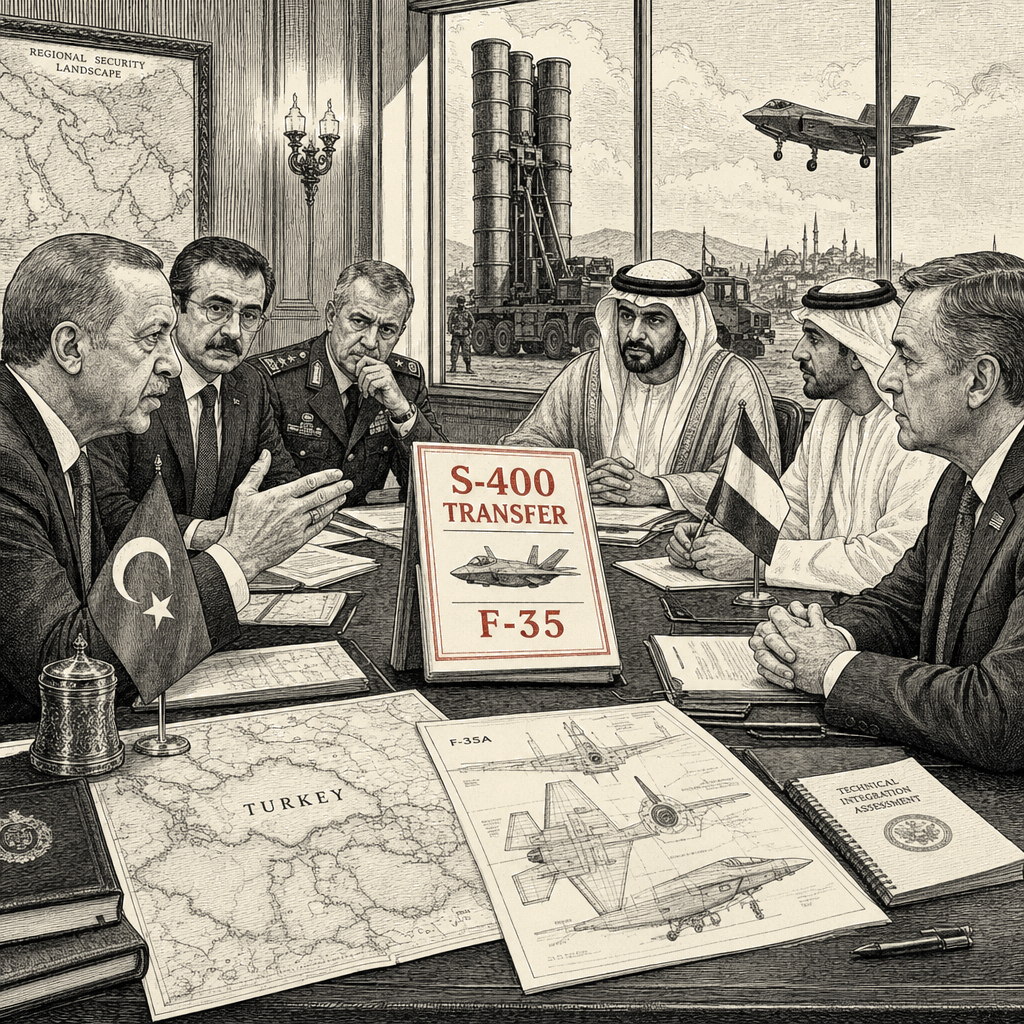
UAE seeks to bolster air defenses after Iranian attacks
The talks with the U.A.E. come after President Trump visited Turkey earlier this month for a summit of NATO leaders at which he said he planned to lift restrictions on the country’s purchase of the U.S. jets. Trump has embraced Turkey’s President Recep Tayyip Erdogan as a geopolitical partner who plays an outsize role in diplomacy in the Middle East and the Russia-Ukraine war.
The U.A.E. also clinched a deal with the U.S. to acquire the F-35, though that agreement has been stalled for half a decade, the Journal reported. The Trump administration maintains close ties with the U.A.E. and has lauded it for its role in supporting the U.S. in the war with Iran.
The White House declined to comment, referring to recent comments from Trump that he was considering selling the F-35 to Turkey. The U.A.E. did not reply to requests for comment. The Russian Defense Ministry and the Turkish Foreign Ministry did not respond to requests for comment.
A spokesman for the Turkish Defense Ministry told reporters Thursday that work on the issue was ongoing. The Kremlin confirmed earlier in July that it was in contact with Turkey about the S-400.
Despite the alignment of interests, the proposal faces a series of hurdles. Turkey would need Russian approval to re-export the S-400. The U.A.E. might also need a green light, explicit or otherwise, from Russia and the U.S. that it could receive the S-400 without triggering a diplomatic crisis with either party. Turkey also would likely seek U.S. guarantees that it could obtain the F-35 once the deal was complete, a complicated prospect that requires a certification that Turkey is in compliance with U.S. law. It could also face opposition from skeptical members of the U.S. Congress who have a role in approving major weapons sales.
Turkey is now one of only about half a dozen countries to have the Russian S-400 on its soil, along with China and India. The impasse around the system has driven a wedge between major allies in the North Atlantic Treaty Organization. In addition to the concerns about F-35 flight details, Western defense officials have been concerned about the possible integration of the Russian system into NATO air defenses and the potential presence of Russian personnel.
Congress sharply pushed back against Turkey’s decision to acquire the S-400, passing legislation that led to the imposition of sanctions on Turkey and blocked it from the F-35. Turkey had been part of the multinational program contributing to the development and construction of the F-35. The sanctions and removal from the program cost it billions of dollars in potential defense contracts.
U.S. lawmakers who visited Ankara earlier this month for the NATO summit said they supported a deal that would see Turkey remove its S-400s and obtain the F-35, according to the Journal.
“The rhetoric out of Ankara has changed nearly 180 degrees,” said Aaron Stein, president of the Foreign Policy Research Institute. “Whether or not that results in success and success quickly is something different, but at least they’re engaging on the topic.”
Some U.S. lawmakers have still voiced misgivings. Rep. Dina Titus (D., Nev.) co-authored a letter on July 6 to House leaders opposing Turkey’s readmission to the F-35 program in part over its “aggressive posture toward Greece and Cyprus,” the Journal reported.
U.S. and Turkish officials have discussed a range of solutions to the S-400 problem over the years, including sending it to a third country. Ukraine was proposed as one destination following the Russian invasion. The possibility of sending it to a Gulf country emerged during the war with Iran as Iranian missile and drone attacks strained U.S. allies’ air defenses, regional officials said. The U.S. and Turkey have also discussed the possibility of delivering the S-400 to American military personnel who could disable the system’s ability to threaten U.S. aircraft.
Erdogan in recent years has sought to leverage his ties to Russian President Vladimir Putin in attempts to broker peace in the war in Ukraine while also helping arm Ukrainian forces with Turkish-made drones, warships and armored vehicles.