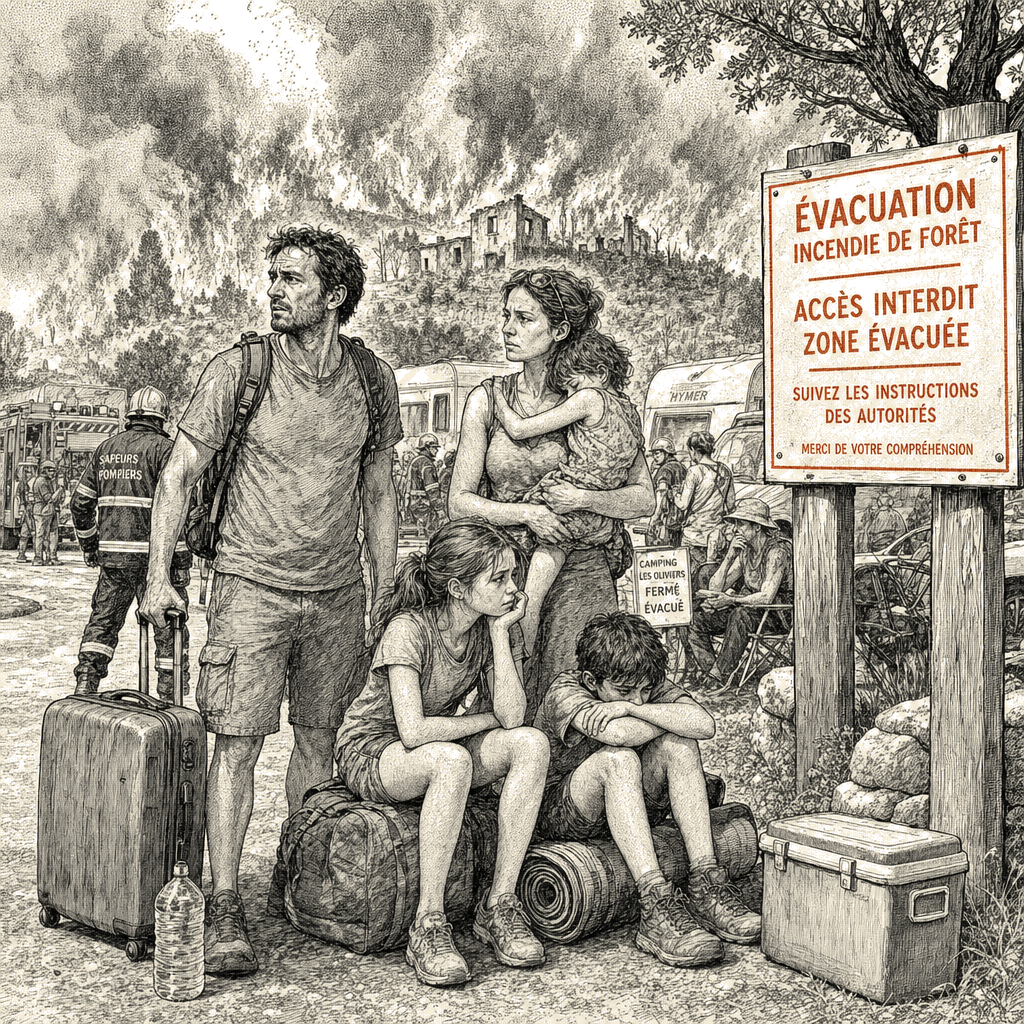
Over 300,000 evacuated as blazes continue across Spain and France
Wildfires in Spain and France have ripped through forests and scrubland, destroying homes and campsites and forcing the evacuation of over 300,000 residents and vacationers, according to The Wall Street Journal. The fires came as vacationers had filled towns on France’s Atlantic Coast for the summer holidays.
Spanish and French firefighters were still battling the blazes Friday, even as they made some progress containing them, the newspaper reported. The flames were no longer spreading uncontrollably, and thousands of people were able to return to their homes.
Rebecca Papin, a mother from Franklin, Tennessee, arrived at her family’s holiday home in Biscarrosse in June. France was in the grip of a heat wave. Papin, her 9-year-old daughter and 11-year-old son settled into a routine of horseback-riding lessons in the morning and surfing in the afternoon.
On the evening of July 23, Papin was at the beach with her children when police went door-to-door telling people to evacuate the coastal town. She did not hear the order. It wasn’t until the next morning, when she woke up to a town filled with smoke, that she realized she had missed the evacuation. “I thought there were still people around me. I was not aware we were alone,” Papin told the Journal.
The day before, at around 4 p.m., Papin had seen a plume of smoke rising from the thick forested area around Biscarrosse. She did not know what was burning and assumed it would be put out quickly. When she arrived home later that evening, she saw the magnitude of the danger. “When I looked out of my daughter’s bedroom, it looked like an inferno, an apocalypse,” she recalled. “I could see a wall of fire in the distance, a wall of solid orange, covered by gray clouds. There were water planes and helicopters flying above the flames.”
Papin decided to go back to the beach because she thought it was safer. Other vacationers were there, and no one seemed too worried. She concluded the situation wasn’t as bad as she had feared and returned home. Traffic going in the opposite direction was ominously heavy, but she figured French authorities would warn her if there was real danger.
When she woke up that Friday morning, ash was falling like snow, and pieces of burning wood were falling from the sky. A police officer buzzed the gate of her home and told her it was too late to evacuate — the roads out of Biscarrosse had been barricaded — and that the safest thing to do was to stay in the house.
Papin and her children were now stuck in Biscarrosse, just as one of the worst fires in recent French history raged near them. During the four days they were at home, they left only once, on Sunday, to buy frozen baguettes, orange juice and pasta from the one supermarket that had reopened. The only other customers were troops involved in the emergency response. From her home’s upstairs window, the flames appeared less threatening, but the air quality was terrible. Papin developed a bad cough.
By Tuesday, some secondary roads had reopened. Papin mapped a route to the airport in Bordeaux. At 5 a.m. the following morning, she and her children got in the car and left Biscarrosse. For the next two hours, Papin drove down country roads through a post-apocalyptic landscape. The smoke was thick like fog. There were security checkpoints and barricaded roads. She feared they would encounter a roadblock at any point and have to turn back. They drove through villages empty of cars or people. “They were like ghost towns,” she recalled. In the distance, she could see the billowing black smoke of a raging fire in nearby Gironde.
When she finally arrived at the airport and checked in for her flight, she burst into tears. “That is when I realized I was safe. I was maybe not fully aware of the danger up to that moment,” Papin said. As the flight took off, the captain said that if passengers looked out of their windows they could see the raging fires. Papin chose not to look.
Despite the ordeal, she said she is looking forward to returning to France at Christmas. “I love Biscarrosse. My children and I will continue to come,” she said.
Previously, MSI reported that French President Emmanuel Macron described the situation as “completely unprecedented” and said France faces its worst wildfire crisis since World War II, as the blaze in the Gironde region forced 220,000 people to evacuate. Read more.