Border guard posts kept crew-served weapons unloaded, separate review finds
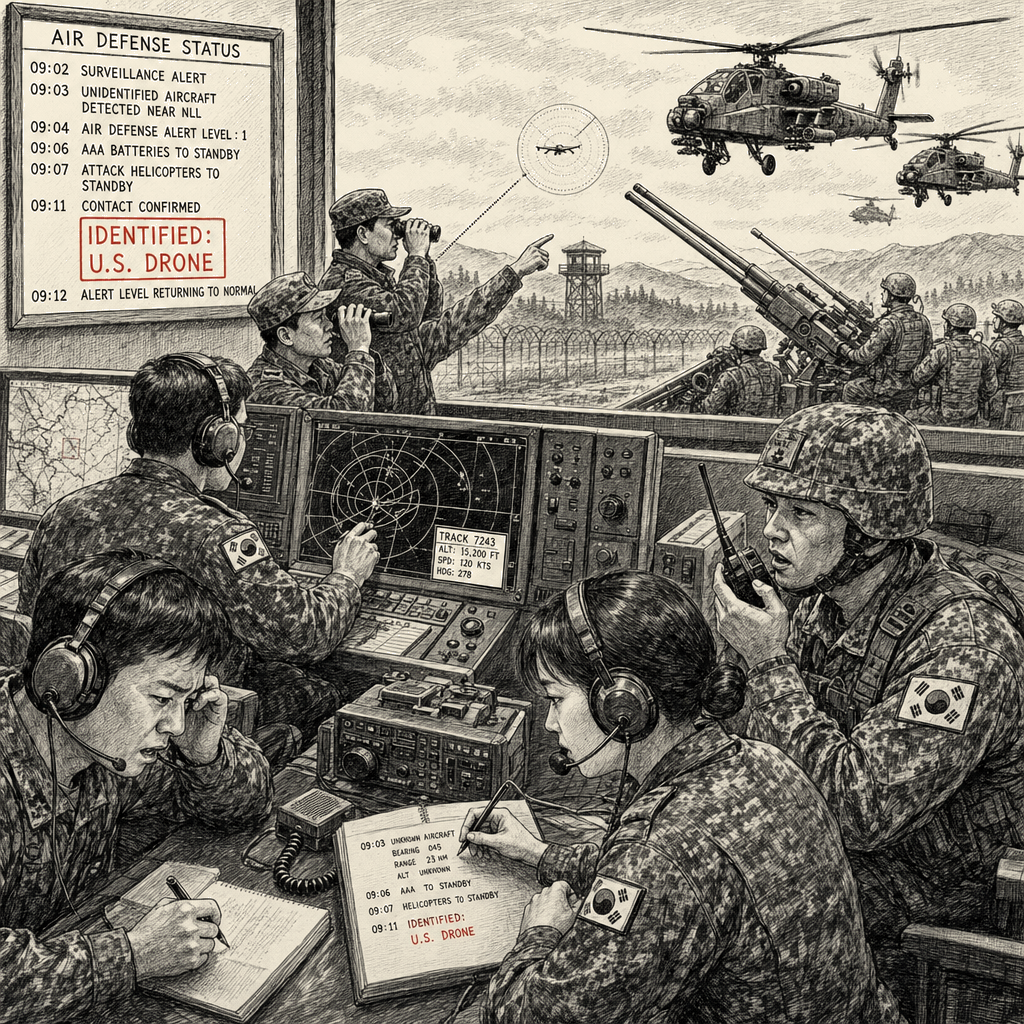
Military surveillance equipment detected the unidentified aircraft using thermal observation equipment and local air defense radar in an area north of the Civilian Control Line in Paju, Gyeonggi Province, according to defense and Joint Chiefs officials. The Ground Operations Command authorized I Corps to activate Durumi, an air defense posture used in response to a possible North Korean drone intrusion. South Korean forces placed ground-based air defense weapons on standby and prepared attack helicopters for a possible interception. No shots were fired.
The aircraft was tracked by thermal equipment and by an attack helicopter pilot dispatched to the area and was eventually identified as a U.S. Marine Corps reconnaissance drone participating in Korean Marine Exchange Program training at Story Range in Paju. The drill involved firing 81 mm mortar training rounds and using a drone to assess target-strike results. The Joint Chiefs announced at about 3:30 p.m. Thursday that the aircraft had been identified, ending the alert.
Residents of villages north of the Civilian Control Line in Cheorwon, Gangwon Province, received emergency text messages emphasizing that the alert involved an actual operational situation and advising them to prepare to evacuate.
The incident resulted from a failure to distribute the drone’s flight plan through South Korea’s military chain of command. Flights below 700 feet in the area fall within Army-controlled airspace and require authorization from the Ground Operations Command, with requests normally submitted through the Army corps responsible for the area. U.S. Forces Korea said it had communicated with I Corps, which oversees the training range, and delivered documentation related to the drone before the exercise. I Corps did not report the information to the Ground Operations Command, leaving the higher command unaware of the planned flight. The exercise proceeded without final flight authorization.
A military official said personnel at I Corps may have considered the activity routine because similar training takes place throughout the year and therefore failed to properly report it to higher headquarters. Questions also remain over whether the method used by U.S. forces to provide the information followed standard procedures.
The Joint Chiefs’ readiness inspection office visited I Corps on Friday to examine the entire response, from the initial detection of the aircraft to the reporting process and deployment of interception assets. The same office investigated I Corps after North Korean drones crossed into South Korean airspace in December 2022 and found delays in sharing flight-track information between I Corps and the Capital Defense Command, as well as failures in attempts to shoot down the North Korean aircraft. Military commanders received warnings following that review.
The Joint Chiefs plan to examine both the South Korean military’s internal reporting process and whether the U.S. notification was delivered through the proper channel. U.S. Forces Korea described the event as an incident and said it was reviewing the circumstances and coordination procedures, working closely with the South Korean military to establish the facts.
The incident follows a similar dispute in February, when U.S. F-16 fighters deployed in large numbers over the Yellow Sea during an encounter involving Chinese military aircraft. South Korean officials said at the time that U.S. Forces Korea had not shared the training plan in advance; U.S. officials responded that notice had been provided.
A former senior South Korean military operations official said routine notification was not enough if the information failed to reach the command with authority to approve and manage the operation. The official said allied aircraft could again be mistaken for hostile assets unless flight plans were consistently distributed to all relevant commands. The official said the military should examine the reporting structure rather than treating the case solely as individual negligence.
In a separate matter, I Corps was found to have kept ammunition in ammunition boxes rather than continuously loading it into crew-served weapons such as K6 heavy machine guns during border security operations since the first half of this year. The Ground Operations Command was aware of the practice, but the Joint Chiefs had not been informed. The command ordered an inspection of guard-post procedures and crew-served weapons across all front-line units Thursday and issued an emergency directive requiring ammunition to remain loaded in designated crew-served weapons. The ammunition directive was not a direct response to the U.S. drone incident.
Another security expert called for a comprehensive review of real-time allied flight-information systems, identification friend-or-foe capabilities, tactical data links, and command reporting procedures. The Joint Chiefs’ investigation is expected to determine how the U.S. notification was handled, why final authorization was not obtained, and whether changes are needed to prevent allied aircraft from being misidentified during future exercises.