Takaichi 2024 book called US nuclear entry ban unrealistic
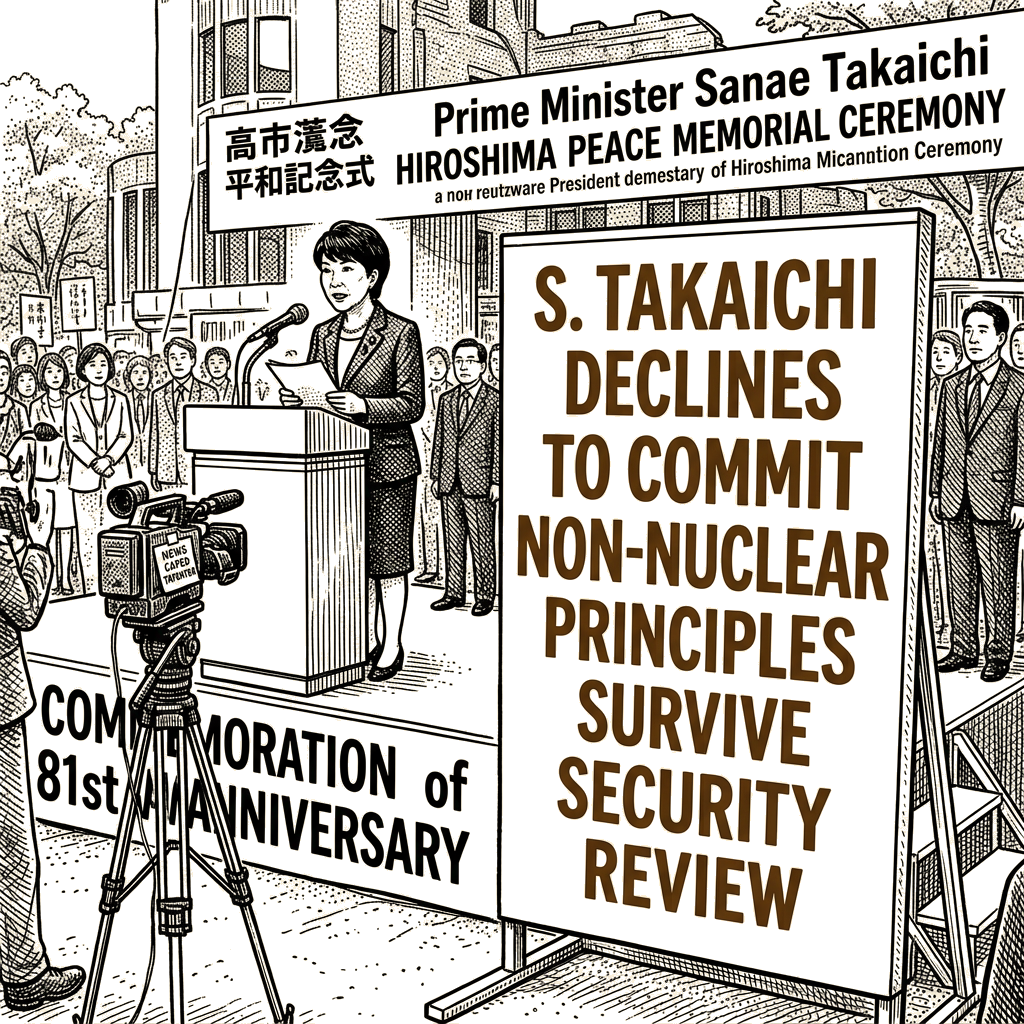
Japanese Prime Minister Sanae Takaichi made the remarks Thursday at the Hiroshima Peace Memorial Ceremony, the annual gathering marking the anniversary of the U.S. atomic bombing of the city. “Japan maintains the Three Non-Nuclear Principles and has a mission to continue efforts toward realizing a world without nuclear weapons,” she said.
Unlike previous prime ministers who pledged that Japan would “continue to uphold” the principles, Takaichi described the government’s current position without making an explicit commitment about the future, according to an Asia Today report translated by UPI. Her government plans to revise Japan’s three key national security documents — the National Security Strategy, National Defense Strategy and Defense Buildup Program — by the end of the year. At a news conference after the ceremony, Takaichi again said the government “maintains the Three Non-Nuclear Principles as a matter of policy,” but declined to commit that the principles would remain in the revised documents, saying she would refrain from prejudging the outcome.
The principles commit Japan not to possess nuclear weapons, not to produce them and not to permit their introduction into Japanese territory. They originated with a 1967 statement by then-Prime Minister Eisaku Sato and have remained central to Japan’s postwar nuclear policy.
Takaichi has questioned the third principle before. In a 2024 book, written before she became prime minister, she argued that Japan should retain the commitments not to possess or produce nuclear weapons but that an absolute prohibition on their introduction was unrealistic, saying that barring port calls by U.S. vessels carrying nuclear weapons could limit the effectiveness of the U.S. nuclear umbrella protecting Japan. She has also said she opposed including language committing Japan to the principles when the country’s current security documents were drafted in 2022.
There remains significant caution within the Japanese government and the ruling Liberal Democratic Party. Under existing government interpretations, Japan could respond flexibly in an extreme national emergency involving a U.S. vessel carrying nuclear weapons. Some within the ruling party question whether formally revising the principles would provide enough practical benefit to justify the political controversy it would create, and critics warn that changing the policy when Washington has not publicly demanded such a move could give China and North Korea additional grounds to portray Japan as expanding its military role. The Liberal Democratic Party has so far prioritized other defense issues, including higher military spending and long-range strike capabilities, and did not include a review of the principles in its recommendations for revising the security documents.
The Japan Innovation Party has called for a review of the third principle; in security policy recommendations submitted to the government in June, the party called for a “realistic review” of the ban on allowing nuclear weapons into Japan.
The debate comes as Tokyo and Washington deepen cooperation on U.S. extended nuclear deterrence. Japan and the United States held an Extended Deterrence Dialogue in Tokyo in June, where Washington reaffirmed its commitment to defend Japan using the full range of U.S. capabilities, including nuclear weapons. The two sides also discussed the modernization and adaptation of U.S. nuclear forces alongside Japan’s revision of its national security documents.
Any change by Japan could also carry implications for South Korea. Seoul and Washington coordinate U.S. extended deterrence through the bilateral Nuclear Consultative Group, and the United States has repeatedly committed to defending South Korea with the full range of its capabilities, including nuclear weapons. If Japan were to allow temporary entry by U.S. nuclear weapons or port calls by nuclear-armed vessels, Washington would gain additional operational options for its nuclear forces in Northeast Asia, which could strengthen deterrence against North Korea and China but could also intensify debate over the differences between the U.S. extended deterrence arrangements with Japan and South Korea. In South Korea, it could revive calls for the redeployment of U.S. tactical nuclear weapons, nuclear-sharing arrangements or an independent South Korean nuclear arsenal.
A revision of the principles would not by itself mean that U.S. nuclear weapons would be permanently stationed in Japan or South Korea, and Takaichi’s choice of language in Hiroshima falls short of signaling that Japan intends to acquire nuclear weapons. It more narrowly suggests her government wants room to reconsider restrictions that could affect the operation of the U.S. nuclear umbrella. How the principles are addressed in the revised security documents later this year could determine whether the issue develops into a broader debate over the future of extended nuclear deterrence among Japan, South Korea and the United States.