Peru’s Lake Palcacocha poses one of world’s most critical threats
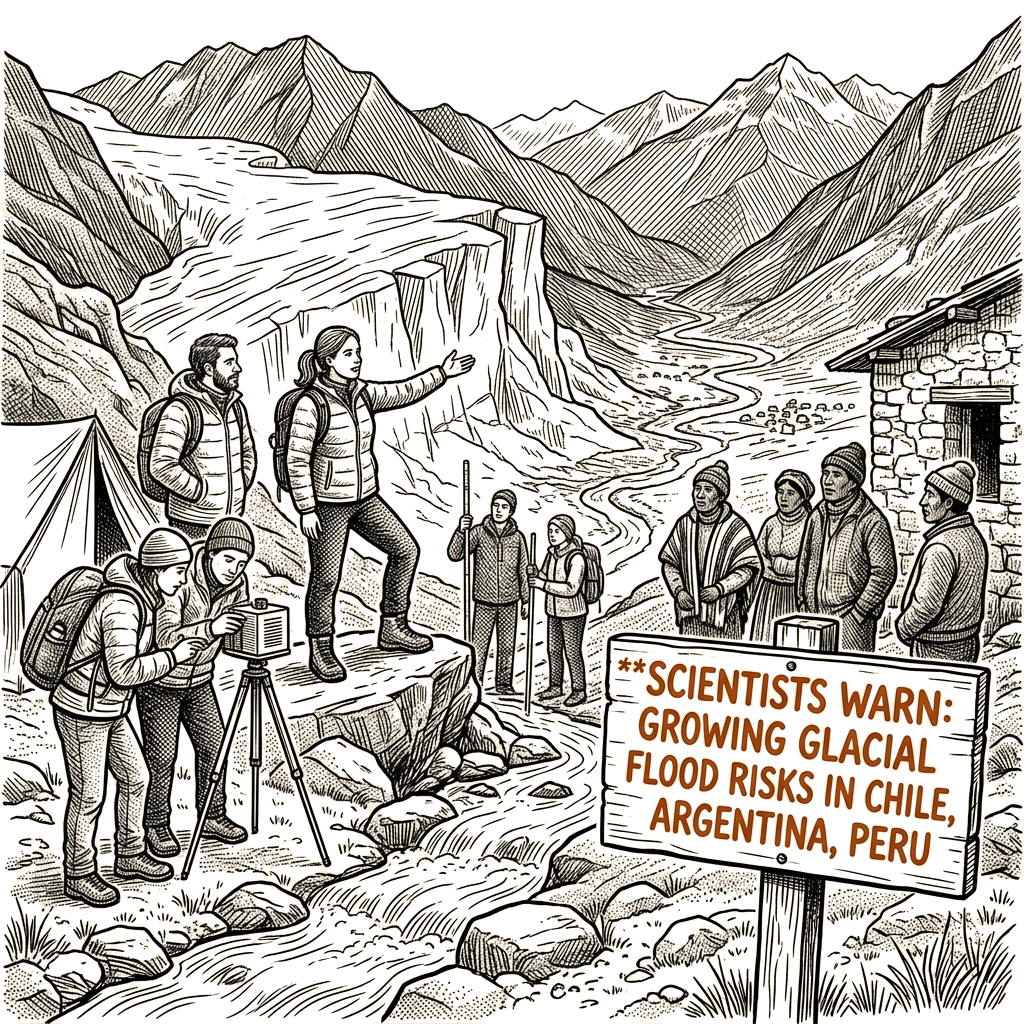
Following the Himalayan glacier collapse that has killed nearly 600 people and left more than 1,900 others missing, scientists and geologists across South America are warning that comparable risks are building in the Andes. The retreat of Andean glaciers has accelerated the formation of unstable lakes and exposed large slopes of loose rock that can collapse more easily as global temperatures rise, according to experts interviewed by regional outlets.
Fast-moving floods and mudslides through mountain valleys could directly threaten drinking water supplies, energy projects and the lives of thousands of people living in vulnerable areas of Chile, Argentina and Peru. The Himalayan disaster has focused attention on glacial lake outburst floods — known as GLOFs — and on the limits of the monitoring systems designed to detect them. Although monitoring and early-warning technologies exist, the speed and scale of outburst floods can make responding difficult, the experts said.
Argentina’s precedents and Patagonian exposure
Argentine researchers point to recent precedent. In November 2005, Laguna de los Erizos in San Juan province suddenly burst, releasing more than 1.1 billion cubic feet of water in just 67 minutes, according to Juan Pablo Milana, a researcher with Argentina’s National Scientific and Technical Research Council. Milana told Infobae that the flood traveled more than 155 miles, destroying crops and roads and isolating communities. No deaths were reported, he said, only because the area was sparsely populated.
“What happened in Nepal has already happened in Argentina,” Milana told Infobae.
The areas of greatest concern in Argentina today are concentrated in Patagonia. One of the most critical sites under observation is the tourist town of El Chaltén, where instability on the slopes of Cerro Solo directly threatens Laguna Torre. Lakes formed by the retreat of large ice masses also pose potential threats; in 2013, a collapse in the Upsala Glacier’s channel generated a destructive wave in Onelli Bay.
Argentina’s Geological and Mining Survey and research teams from the University of Buenos Aires monitor these threats, combining satellite imagery used to update the National Glacier Inventory with projects to establish ground-based early-warning systems. Those systems are designed to use weather stations and hydrological sensors to detect changes in water levels and unusual slope movements in real time.
Chile’s 26,000 glaciers and split risk profile
Chile is among the countries most exposed to GLOFs worldwide, with more than 26,000 glaciers and risks divided between two distinct geographic areas. The largest high-risk zone sits in remote Chilean Patagonia, particularly the Aysén and Magallanes regions, where the rapid retreat of the Northern and Southern Patagonian Ice Fields has increased the formation of unstable lakes held back by fragile natural dams. The region’s population density is low.
In central Chile, watersheds are smaller but the risk is significant because of the high concentration of infrastructure, including hydroelectric plants, mining operations and drinking water systems serving millions of people. Geographer Simón Inzunza told Chilean broadcaster T13 that the country has recorded GLOFs, particularly in Patagonia, as well as other emergencies associated with glacier melting and ice collapses.
Darío Ormeño, a geologist and professor at Andrés Bello University’s School of Earth Sciences, told BioBioChile radio that a mudslide is a real risk in Chile, although an event on the scale of the Nepal disaster is unlikely. “Our glaciers are much smaller and do not have such an extreme elevation difference,” Ormeño said.
Chilean government agencies monitor glaciers using a national inventory updated with satellite imagery and radar. The tools allow authorities to measure the growth of glacial lakes and detect cracks in Andean slopes in an effort to issue early warnings before a disaster occurs.
Peru’s high-altitude cities and Lake Palcacocha
Peru faces the highest risk in South America of disasters caused by GLOFs, with a history of deadly events and significant geographic vulnerability. Paola Moschella, director of glacier research at Peru’s National Institute for Research on Glaciers and Mountain Ecosystems, known as INAIGEM, told Exitosa radio that Peru has 528 lakes at risk of overflowing, including 58 considered high risk.
Unlike Patagonia and some high-altitude areas of Chile and Argentina, where glaciers sit in remote valleys, entire cities and critical infrastructure in the Peruvian Andes — particularly in the Áncash region — lie directly along potential flood and mudslide routes. Lake Palcacocha, in Peru’s Cordillera Blanca mountain range, is considered by scientists to be one of the world’s most critical cases because of its instability and proximity to the city of Huaraz, which has more than 120,000 residents.
The lake holds more than 599 million cubic feet of water and is fed by hanging glaciers susceptible to large avalanches as global temperatures rise. If a large block of ice were to collapse into the lake, it could generate a massive wave capable of breaching its natural barriers and triggering a destructive flood that could reach urban areas in less than an hour. The threat has a deadly historical precedent: in 1941, a similar outburst from the same lake destroyed about one-third of Huaraz and killed thousands of people.
Scientific monitoring in Peru has advanced significantly through the deployment of permanent personnel in high-altitude areas and the use of satellite surveillance systems, Moschella said. Experts warn, however, that physical mitigation infrastructure installed in previous decades is outdated or insufficient to contain current water volumes.
Across the region, researchers stress that monitoring and early-warning technologies exist but can be overwhelmed by the speed and scale of potential outburst floods. The 2005 Argentine event and the 1941 Peruvian disaster both demonstrate how rapidly a contained glacial lake can become a catastrophic flood — a margin the Nepal collapse has underscored.