UAW rejects escalation, cites Canada union ties
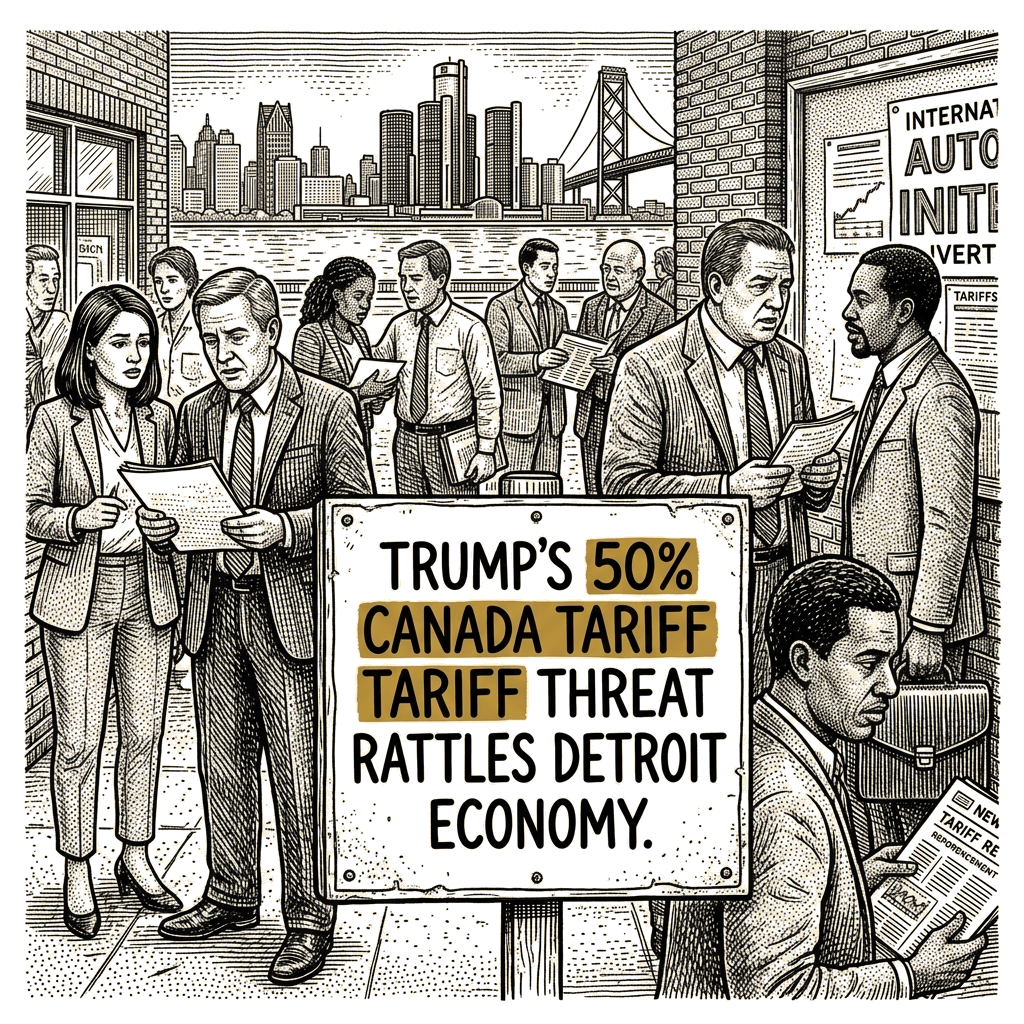
The Detroit-Windsor border crossing carries roughly $1 billion in goods each day, a flow that anchors both cities to North America’s integrated auto industry. News this week of President Donald Trump’s escalating trade dispute with Canada — and his threat to impose 50% tariffs on Canadian goods from January 1, covering everything from automobiles to honey to hockey sticks — has Detroit’s political and economic leaders warning of damage to the region.
Trump’s escalation lands in a state whose voters are already paying for the tariff program. Michiganders pay on average more than $3,200 annually for tariffs, about 142% more than the rest of the country, because of the state’s shared border with Canada, according to the Guardian’s reporting. A June Epic-MRA poll found residents oppose tariffs on Canadian goods by 63% to 31%, including 35% of Republicans. Nearly 75% of Michiganders said the tariffs are fueling high prices.
Political leaders and observers labeled the move “hubris,” blamed Trump’s “ego,” and called the escalation “insanity.” Michigan-based economist Patrick Anderson, of the Anderson Economic Group, said Canada would also suffer. “Both will suffer – there are no two ways about it,” Anderson told the Guardian.
Trump has cast the dispute as one-sided. “We don’t need Canada, they need us,” Trump declared. But Epic-MRA pollster Bernie Porn questioned the strategy. “I don’t understand what Trump is thinking,” Porn said. The dispute lands less than three months before midterm elections in which control of Congress could hinge on Michigan. The state has picked the presidential winner in five consecutive elections, alternating between Barack Obama, Trump, Joe Biden and back to Trump.
Democrats see the tariffs as an opening in the Senate race, where Democrat Abdul El-Sayed faces Trump ally Mike Rogers on November 3. El-Sayed has campaigned as an anti-establishment populist, and Porn said El-Sayed’s record against Rogers would likely focus on trade. “El-Sayed has proven to be very, very articulate on a number of issues,” Porn said. “I think that he is going to try and just throw bombs at Rogers [in an upcoming debate] because Rogers supports these tariffs and trade war. Trump’s low popularity is an anchor around Rogers’ neck.”
In a statement, El-Sayed said Trump “cares more about his ego and saber-rattling than addressing the affordability crisis.” Trump “is launching this trade war for his own vanity, and he’s asking Michigan families to pay the price,” El-Sayed added. “Trump has been failing Michigan through these chaotic tariffs and bad trade deals for far too long, and Mike Rogers won’t do anything but rubber-stamp them.” El-Sayed said he would push for “real, fair trade deals that create good-paying jobs.” Rogers’ campaign did not respond to a request for comment from the Guardian.
The tariffs’ unpopularity extends into organized labor. The United Auto Workers, which has 350,000 members in Michigan and is often a political kingmaker in the state, said it “rejects” the latest escalation, though it had previously supported some of Trump’s targeted tariffs. UAW President Shawn Fain said any further tariffs should target countries where automakers offshore jobs to low-wage labor markets. “If we’re going to increase tariffs anywhere, it should be on countries where automakers continue to offshore jobs because they can pay workers $3 an hour, force them to work in unsafe conditions, and crack down on independent unions,” Fain said. “Canada has strong unions, and the UAW supports those.” Fain added: “Tariffs work, but only if they are deployed intentionally to protect workers and grow our manufacturing communities, and it’s time to permanently end offshoring and the race to the bottom.”
The Guardian reported that the latest US tariff list includes feathers, sweaters, girls’ dresses and lobster. Anderson dismissed the package. “This is not a trade war. This is an annoyance list. Chest pounding,” he said. He called the US actions “rife with miscalculations, overreactions, and hubris,” and warned that the dispute could escalate further. The two countries’ auto parts cross the border an average of six times before reaching a final product, meaning a wider tariff fight would reverberate across the upper Midwest. Anderson estimated tariffs cost US auto companies about $12.5 billion in 2025.
The Canadian government has announced retaliatory tariffs on $20 billion of US goods starting January 1, the same date the new US tariffs take effect. Mexico and Canada currently face 25% US tariffs on autos, though partial exemptions in the free-trade agreement make the effective rate lower, according to the Guardian.
The political rhetoric has escalated alongside the trade measures. Trump signed an executive order Thursday to rename Lake Ontario “Lake America.” Vice President JD Vance referred to Canada as the 51st state. “Let me say with great understatement that this is not helpful,” Anderson said.
Windsor Mayor Drew Dilkens, who leads the Canadian border city of 230,000 people, took exception to Trump’s framing of the dispute, including his characterization of tariffs as a response to illegal immigration on the northern border, which Dilkens called “nonsense.” The latest escalation “is an aggressive move, one that could not be ignored by our country,” Dilkens said. “It’s just offensive that he launches these attacks at Canada, who is your largest trading partner, your closest ally, and your neighbor.”
Dilkens said Trump was harming Americans to pursue his tariff agenda. “What is really crazy is that he is willing to throw his own citizens under the bus to pursue his tariff agenda,” Dilkens said. “They have Donald Trump to thank.”
Even the typically pro-Trump Detroit chamber of commerce broke with the administration. “Escalating tensions and tariffs will only cause economic pain on both sides of the border, especially in Michigan and the binational Detroit-Windsor region,” the chamber said in a press statement, adding that “global competitors like China benefited most.” The chamber added: “Our economies are intertwined, interconnected, and stronger together; the sooner normalcy is restored the better.”
The Michigan chamber of commerce, which lobbies on behalf of the state’s largest corporations and normally vocally supports the president on economic issues, did not issue a statement or respond to the Guardian’s request for comment.
As MSI previously reported, Canadian Prime Minister Mark Carney announced retaliatory tariffs on roughly $20 billion in US goods after trade talks collapsed and 50% US tariffs on Canadian exports took effect earlier that week, and Trump’s tariff escalation had already widened days earlier ahead of border-state Senate elections.