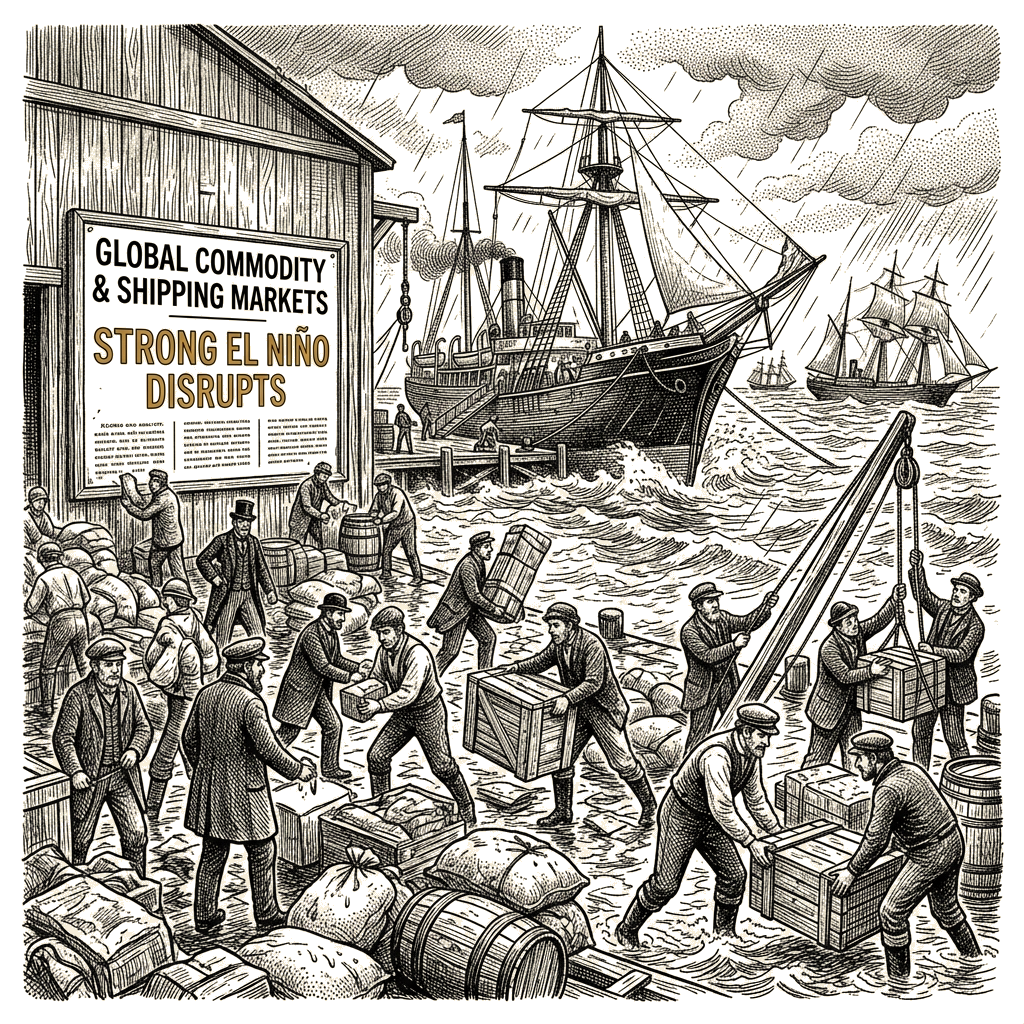
Peru’s anchovy halt and India’s monsoon shortfall ripple outward
The Wall Street Journal reported this week that the climate pattern — marked by spiking heat in the Pacific and named by Peruvian fishermen long ago for the Christmas-time disruption it brought to coastal fish stocks — is already leaving fingerprints across global commerce, from fish-meal and feed markets to canal tolls and copper mines, and could influence Asian rice fields.
Among the most visible disruptions is the Panama Canal. The waterway loses about 50 million gallons with each ship transit and is replenished by Lake Gatún, its main reservoir; rainfall in Panama between May and August was 34% below the historical average, according to the Journal. Panama Canal Authority administrator Ricaurte Vásquez Morales told the paper: “We are dealing with a climate crisis when we are at peak capacity, and we have to find new sources of water.” The Panama Canal Authority has hired the U.S. Army Corps of Engineers to upgrade the canal, which yielded $4 billion in tolls in 2025. Panama has earmarked $2 billion to divert as many as four rivers into the waterway, bolstering three that already feed it.
The drought-driven shipping crunch is one of several El Niño disruptions already visible in commodity markets. Antofagasta, the Chilean copper producer, reduced its production forecast after a storm described by meteorologists as consistent with a strengthening El Niño deposited about 5 million cubic meters of snow on its Los Pelambres mine in July, causing a stoppage. Analysts at research firm CRU told the Journal that dry weather linked to El Niño is already affecting river-borne logistics at a major copper mine in Papua New Guinea. Copper prices have been setting records, the Journal reported, driven by surging demand from electrification and the data-center build-out.
Agricultural markets are also bracing. India’s monsoon rain is running 13% behind the average for this time of year, and a recent international crop-monitoring report warned of growing dryness in Asia’s rice fields, according to the Journal. In 2023, India suspended some rice exports after El Niño dented the harvest, contributing to a run-up in global prices. “Rice in southern and southeast Asia is the big one,” Andrew Watkins, a climate scientist at Monash University in Australia, told the paper. A Bloomberg Economics study cited by the Journal found that consumer prices rise nearly 2 percentage points in Indonesia and the Philippines after an El Niño-influenced drought.
The shock to fish-meal markets came when Peruvian officials — the country is the world’s largest producer of anchovies used in fish meal — suspended this year’s catch early because of El Niño concerns. For French company Innovafeed, which breeds black soldier flies in northern France and turns the larvae into fish-feed ingredients, the price surge has been an opening. “In the last two months we have secured more demand than in the past two years,” chief executive Clément Ray told the Journal. The paper noted that fish meal underpins a $300 billion-plus aquaculture industry.
The El Niño pattern also picks winners. Strong events tend to suppress Atlantic hurricane activity, potentially benefiting insurers, and a mild European winter could reduce demand for imported liquefied natural gas, analysts at Rystad Energy told the paper. Vail Resorts issued a press release invoking Ullr, the Norse god of snow, in hopes that heavier Rocky Mountain snowfall will replenish the Colorado River reservoirs of Lake Powell and Lake Mead. Norwegian salmon producer Mowi, which lost millions of fish to algal blooms in Chilean fjords during the 2016 El Niño, has invested in measures such as using lights to lure salmon to cooler, deeper waters. “A brewing El Niño this year won’t make it any easier for us, but let’s see,” Mowi CEO Ivan Vindheim said on a recent earnings call. “Knock on wood.”
Hedge-fund manager Les Finemore of Moreton Capital Partners told the Journal he expects crop prices to rise and that companies like Hershey will be exposed if they are complacent. A Hershey representative told the paper that El Niño does not always mean a bad West African cocoa crop and that the company is diversifying its sourcing.
Indonesian President Prabowo Subianto, speaking against the backdrop of wildfires his government linked to El Niño, said the country has ample food. Economists at S&P Global Ratings said preparatory measures, from larger grain reserves to investments in water management, should shield exposed Asian economies, even if “El Niño’s wrath is unavoidable,” the Journal reported.
Christopher Callahan, the Indiana University climate scientist whose research suggests that El Niño events can cause trillions of dollars in lost income, particularly in tropical economies, told the paper that this event is shaping up as “potentially generationally strong.” El Niño is expected to persist into 2027, which is widely forecast to be the hottest year on record.