Tariffs, fuel costs, and Iowa’s fallen drive GOP defections
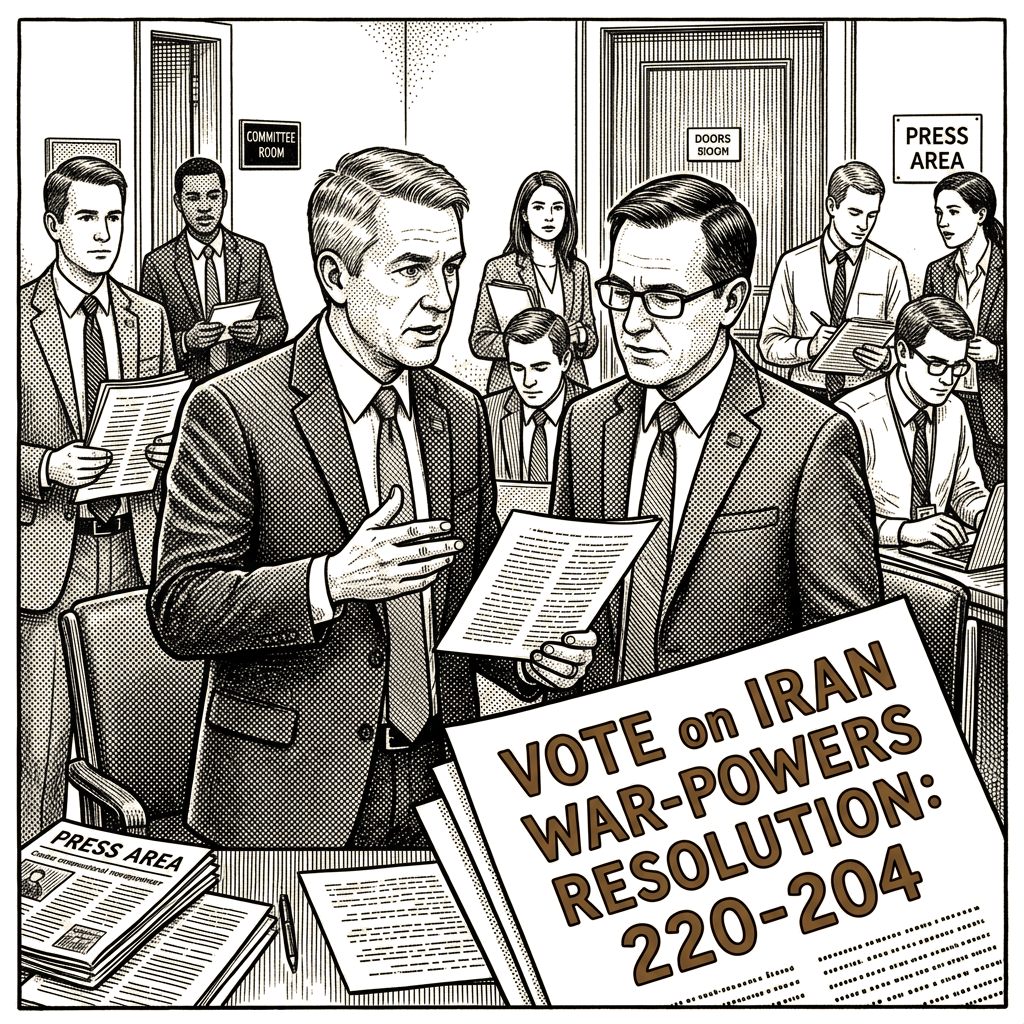
WASHINGTON — The House voted 220-204 on Tuesday to pass its third resolution directing President Trump to remove U.S. forces from hostilities against Iran, with seven Republicans joining all Democrats in support. The defections include two Iowa Republicans facing competitive re-election bids, underscoring how the war’s economic costs and its human toll are reshaping the politics of vulnerable House Republicans.
Reps. Zach Nunn and Mariannette Miller-Meeks — both rated as tossup races by nonpartisan analysts — joined five other Republicans in backing the measure: Warren Davidson of Ohio, Brian Fitzpatrick of Pennsylvania, Tom Barrett of Michigan, Thomas Massie of Kentucky, and Nancy Mace of South Carolina. Massie had backed a previous Iran war-powers resolution. Mace and Massie are leaving Congress after this session, while Fitzpatrick and Barrett are in competitive races this fall.
The vote expands the number of House Republicans backing such a measure from four to seven. War-powers resolutions are largely symbolic, as Trump could veto any measure that reaches his desk, but they have become an important indicator of GOP unity on the war.
Iowa has emerged as an unexpected battleground. Trump’s tariffs have placed a considerable burden on the state’s farm economy, while the Middle East conflict has driven up prices for gas, diesel, and fertilizer. Iowa backed Trump by 13 percentage points in the 2024 election.
Two servicemembers killed in a March drone strike in Kuwait also have Iowa connections: U.S. Army Reserve Sergeant Declan Coady is from Nunn’s district, and Army Reserve Major Jeffrey O’Brien lived in Nunn’s district and has ties to Miller-Meeks’s district.
Both Nunn, an Air Force Reserve colonel, and Miller-Meeks, a retired Army lieutenant and doctor, had voted no on previous war-powers resolutions. In a statement that referred to his combat missions in the Middle East, Nunn noted the “devastating price” his state has paid for the war and said Iran must be “held accountable” for its actions.
“Sustained combat operations now require congressional authorization,” Nunn said, adding, “I will not support another open-ended war.”
Nunn’s vote arrived roughly a month after he stood alongside Defense Secretary Pete Hegseth at the Iowa State Fair. At the time, Hegseth defended the war effort.
“There is a cost to doing very difficult things, to going out and defending your country and ensuring radical Islamist crazies don’t get a nuclear weapon,” Hegseth said. “I’m not willing to look my kids in the eye and say we had a chance to do something about it but didn’t.”
Like Nunn, Miller-Meeks stressed her more than two decades of military service in making her decision.
“Americans do not want another forever war,” Miller-Meeks said. “I will not vote to keep our soldiers in an open-ended war, with Iowans paying too much at the pump.” She called on Trump to present a plan to end the war.
Trump has largely ignored lawmakers on the war. In May, he notified Congress that hostilities against Iran ended in April, allowing the White House to bypass a 60-day deadline for lawmakers to approve the war, which began in February.
The Iowa delegation is now split. Reps. Randy Feenstra and Ashley Hinson voted no. Iowa Sens. Chuck Grassley and Joni Ernst have both voted no on similar Senate resolutions.
Both Nunn and Miller-Meeks face Democratic challengers who have used their Iran votes against them. Nunn is running against state Sen. Sarah Trone Garriott, a pastor, who has criticized him for previous pro-war comments. An anti-Nunn ad that ran before Tuesday’s vote accuses him of wanting the war to end “while voting for it.”
Miller-Meeks is facing law professor and former state representative Christina Bohannan for a third time. Bohannan has criticized Miller-Meeks on Iran, posting on X that Miller-Meeks’s previous war-powers votes have perpetuated the conflict.