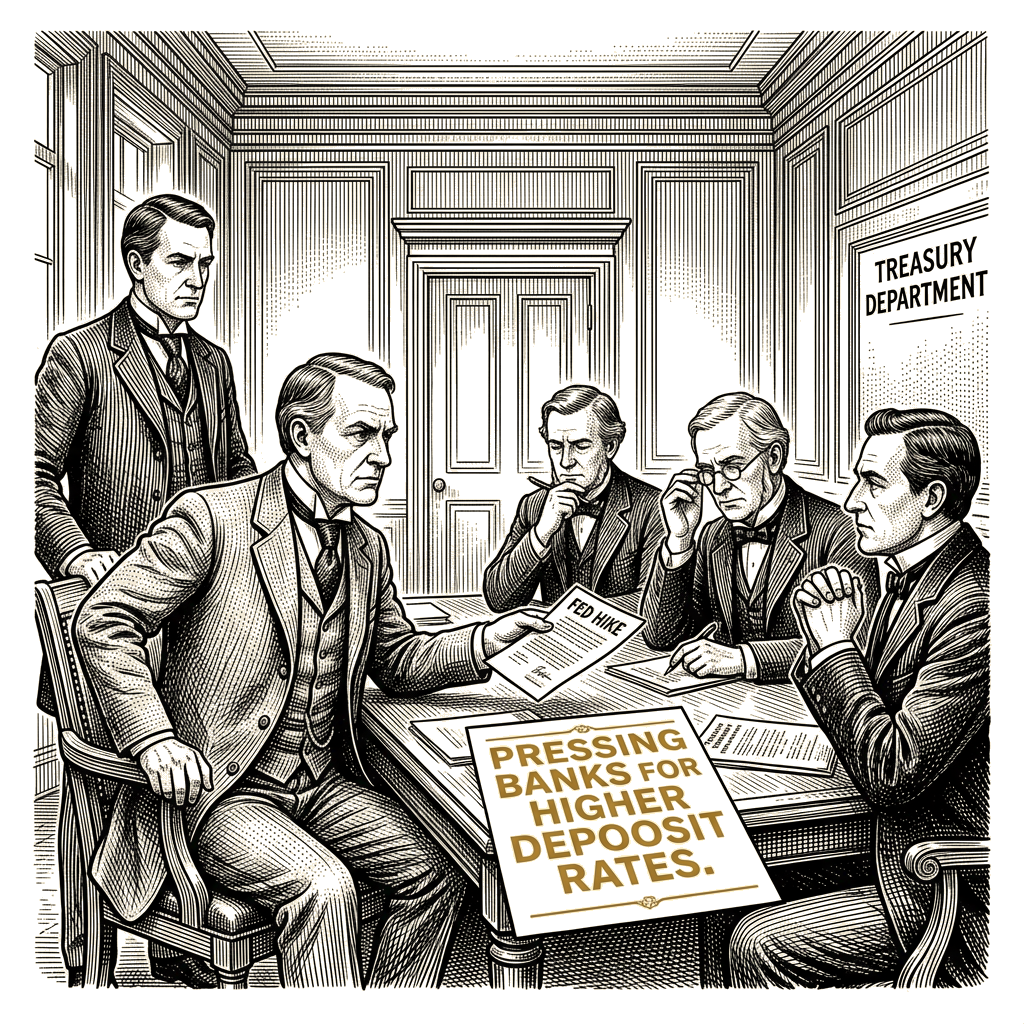
Banks expected to pass roughly 60% of rate increase to commercial deposits
The Federal Reserve raised its benchmark interest rate by a quarter point on Wednesday, the first increase in three years, and corporate finance teams are responding by pressing banks to pay more on their cash deposits.
The Fed lifted the federal funds rate to a range of 3.75% to 4%, ending a three-year pause in rate increases. Corporate treasurers, returning to a higher-rate playbook, are making deposit-rate negotiations their first priority, according to banking and treasury consultants interviewed by The Wall Street Journal’s CFO Journal newsletter.
“The immediate lever is pushing banks harder on deposit rates,” said Hardik Sheth, a partner and director at Boston Consulting Group, describing a priority for treasurers in regard to their cash portfolios. Top-performing finance executives typically have a keen sense for how much they can ask for based on factors such as the strength of their business, he said.
Banks are projected to pass through roughly 60% of the rate increase to commercial deposit customers, according to Curinos, a banking advisory firm — a pass-through rate known in the industry as a deposit beta. The projected pass-through for large corporate customers is higher, at nearly 90%, Curinos said. Both figures are roughly in line with what was seen at the end of the last rate-hiking cycle, following the pandemic.
Eric Czervionke, a partner in Oliver Wyman’s banking and financial services practice, framed the dynamics with an industry metaphor: “Banks pass rate cuts through to depositors by the elevator and rate hikes by the stairs.” Czervionke advised companies to approach their banks with a specific number in mind, taking into account how Treasury bills and government money-market funds are repricing, rather than waiting for banks to initiate the conversation.
In recent years, banks have improved their “relationship-based pricing practices” as companies have shifted cash away from non-interest-bearing accounts, said Peter Serene, a managing director at Curinos. Deposit repricing will happen relatively quickly after the Fed’s hike, Serene said.
Money-market funds, however, will take longer to reflect the full impact of the rate increase — typically about a month, according to Peter Crane, president of Crane Data. Most corporate treasurers, however, make decisions about where to park their cash based on how quickly they may need it in the future, he said. “If you need cash, you need cash. But higher rates are a bonus,” Crane said.
Beyond negotiating deposit rates, treasurers’ playbook for the new rate environment includes updating cash forecasts and quantifying the impact on floating-rate debt, said Tom Hunt, director of treasury practice at the Association for Financial Professionals. Treasurers are also reassessing whether their investment allocations remain appropriate. “This typically means more conversations with their banks,” Hunt said.
The bond market appeared to accept the Fed’s move. “I think the market is content with this, and it shows the Fed has a credible resolve to bring inflation down to 2%,” said Will Compernolle, macro strategist at FHN Financial, describing the reaction to Fed Chairman Kevin Warsh’s press conference Wednesday.
Most CEOs at Yale gathering disagree with Trump’s characterization of AI risks
In a separate item in the same newsletter, chief executives gathered at an invitation-only meeting in Washington this week rejected President Trump’s argument that AI’s threats to humanity are a hoax. At a Yale School of Management event attended by dozens of America’s top executives, business leaders overwhelmingly disagreed with the president’s assessment that dangers posed by artificial intelligence are being exaggerated. In a flash poll of attendees, 93% said Trump was incorrect in calling the technology’s potential catastrophic dangers a hoax, as he did earlier this week.
“It was stunning,” said Jeffrey Sonnenfeld, a Yale management professor who organized the CEO meeting.
Also on the economic calendar
The newsletter flagged two scheduled releases for the period ahead: the Census Bureau reports residential housing statistics for August, and the National Association of Realtors reports its Pending Home Sales Index for August.
Companies’ pension funding increased in August
In a separate item in the same newsletter, professional services firm Marsh reported that the estimated funding level of pension plans sponsored by S&P 1500 companies increased by 1 percentage point in August to 112% as a result of an increase in equity markets slightly offset by a decrease in discount rates. As of the end of August, the plans’ estimated aggregate surplus increased by $15 billion, to $175 billion, compared with a $160 billion surplus at the end of July, Marsh said.
“After a couple of bearish months, domestic equities bounced back in August on news of strong corporate earnings reports particularly from the energy and technology sectors,” said Marsh partner Matt McDaniel. “Interest rates were flat over the month as inflation remains elevated, and investors are carefully awaiting the Fed’s next move.”