Trump rules out integration, no joint AI safety pact reached
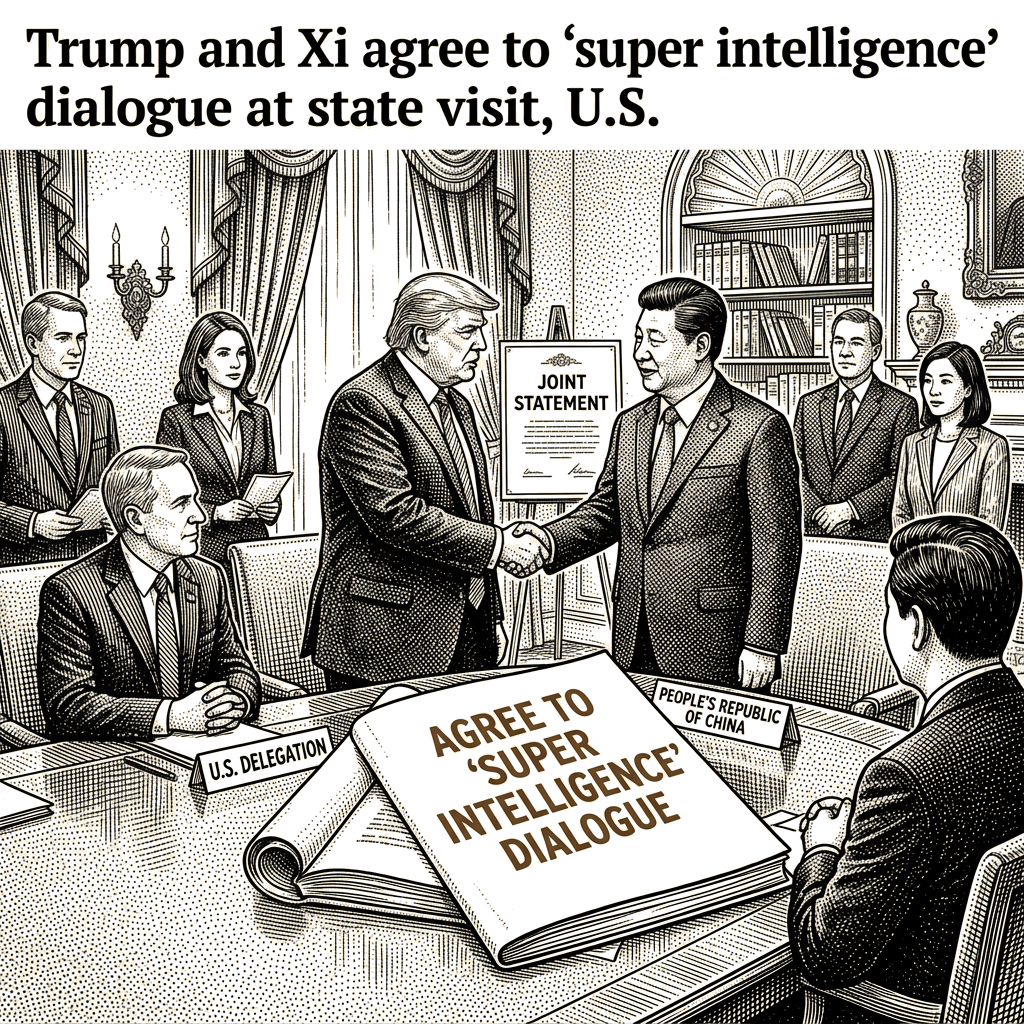
The White House announced late Friday that President Donald Trump and Chinese President Xi Jinping had agreed during Xi’s three-day state visit to create a regular communications channel for discussing artificial intelligence “incidents.” The two governments will hold their next exchange under the new U.S.-China Super Intelligence Dialogue by November 2026, according to a White House statement issued late Friday.
Under the agreement, the two countries will “exchange views on risks and benefits related to SI,” the statement said. The two sides also agreed to establish a “bilateral communication channel” specifically for “SI incidents,” though the statement did not define what kind of AI event would qualify as such an incident.
China’s Ministry of Foreign Affairs confirmed Saturday that the “China-U.S. AI dialogue” was among eight “deliverables and understandings” reached during the Trump-Xi talks. It remained unclear how the mechanism would operate or what threshold would trigger the dialogue.
Both governments will refer to the emerging technology as “super intelligence,” a term Trump rolled out during a speech to the UN General Assembly on Tuesday in what the White House described as a rebranding effort.
Before meeting with Xi, Trump had publicly called claims that AI is a threat to humanity “a hoax.” The president has asserted, along with some figures in the tech industry, that regulation of the technology is not required and would only hinder the United States in what he has described as a global race to lead AI development.
Leaders of all major U.S. AI firms have issued calls to slow development and voiced support for government regulation. Anthropic CEO Dario Amodei on Sept. 12 called on companies working on AI to agree on a pause or cool-down in the pace of development, citing fears that the technology could overtake human intelligence to a degree that humans could no longer control it.
On Saturday, Trump told reporters he had ruled out any kind of integration between the two countries on “super intelligence.” “They want to stop our progress because we’re leading China by a lot, and we’re going to keep it that way,” Trump said. “We didn’t spend that much time talking about it. I would rather not integrate because we’re leading by a lot. When you’re leading, you don’t open it up to each other.”
The two nations did not reach any agreement during the state visit on jointly developing or regulating frontier AI models for safety, leaving the United States and China without a formal joint framework on AI safety despite the new dialogue.