Missile share of Pentagon procurement seen doubling to 14% by 2031
The race to refill America’s missile stocks is running behind the wars that emptied them. Defense contractors are spending billions on new factories and assembly lines, but the production ramp will not translate into real gains for years, and most new missiles will arrive too late for any conflict in the next couple of years.
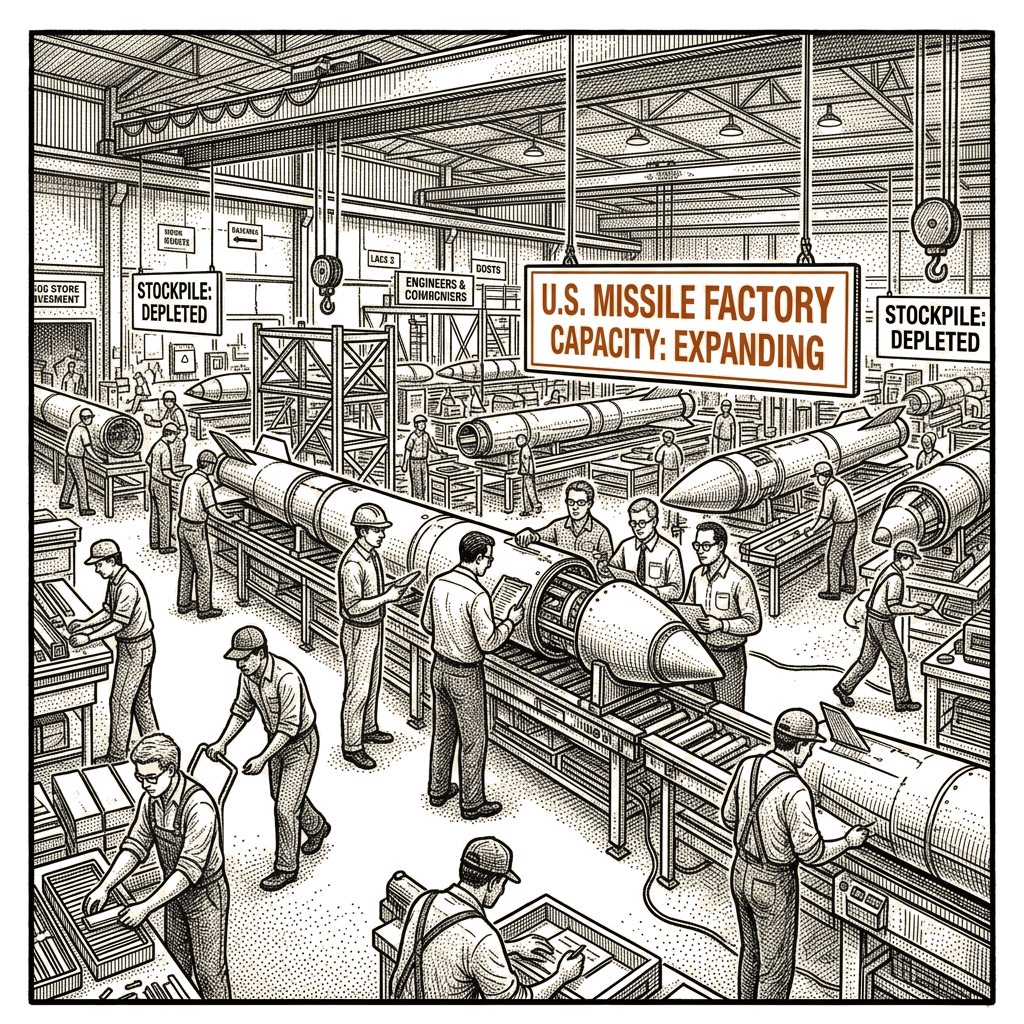
At an RTX plant in Tucson, Arizona, workers operate around the clock to increase production of Tomahawk and other missiles in short supply for U.S. operations against Iran. RTX said it has pumped about $900 million into the Tucson plant and two other factories over the past three years. Long-term government contracts have fueled a production boom at the roughly 1 square mile of factories, warehouses and offices that occupy a part of Tucson’s main airport, and around 670 positions are advertised on its website for roles including electrical engineers, explosive experts, chemists and software specialists. RTX is on track to produce more than 400 Tomahawk missiles this year, according to a person familiar with the matter, and an RTX spokesman said the contractor will continue investing to reach its long-term target of producing more than 1,000 Tomahawks annually. This year, the Pentagon has awarded billions of dollars worth of new contracts for the Tucson factory’s components and missiles that have all been in action in Ukraine and Iran.
Lockheed Martin is taking a parallel approach with Patriot interceptors. The company is adding hundreds of workers in Arkansas to triple its output of the much-needed interceptors, and subcontractors including Boeing, L3Harris and Northrop Grumman have broken ground on new assembly lines to meet soaring demand for the electronics, rocket motors and other components those weapons require.
Yet the spending has not closed the gap. American armed forces have used about one-third of their pre-Iran war Tomahawk inventory and roughly half of their high-end Patriot interceptors, according to the Center for Strategic and International Studies, a think tank. The U.S. fired more than 1,000 Tomahawk missiles in two months during its war with Iran, The Wall Street Journal has reported.
Pentagon missile orders for the Tucson factory dipped so low in recent years that further cuts risked shutting down the Tomahawk line, which has been in production since the 1980s. Contracts to retrofit old missiles with new navigation systems helped keep the factory busy. The Navy in August issued a $23 billion order spanning seven years for new Tomahawks, but even that request, after more than a year of negotiations, needs full congressional appropriations to become a final contract.
“Ministers of defense have fat wallets — they walk into the shops and there are empty shelves,” said retired Dutch Admiral Rob Bauer, NATO’s top military officer until last year. “They are frustrated.” After Russia’s 2022 invasion of Ukraine, government officials and weapons suppliers pledged a surge in production that has not kept up with demand, and Washington officials have been reluctant to place the big orders needed to justify investments in new production lines until recently. President Trump and European defense ministers have said companies need to pick up the production pace.
The frustration reflects an Army Science Board study of munitions production capacity conducted in the wake of Russia’s 2022 invasion of Ukraine. The board found an industrial base that had been hollowed out. “It’s a miracle that we have anything that blows up,” said Mackenzie Eaglen, a member of the panel coordinating the study.
Capital expenditures as a percentage of revenue barely budged between 2021 and last year at Lockheed Martin, General Dynamics and other large U.S. defense companies, even as 2026 spending forecasts are higher and order backlogs grow at a much faster rate. Between 1999 and 2025, missiles and munitions accounted for an annual average of 7.5% of the Pentagon’s procurement and research budget, according to Todd Harrison, a senior fellow at the American Enterprise Institute, a think tank. That compares with 23% for aircraft and 10% for shipbuilding. The munitions share is set to roughly double to an average of 14% between 2028 and 2031, Harrison calculated.
Pentagon spokesman Sean Parnell said the department’s pending budget request to Congress is designed to aggressively increase munitions stockpiles. “Since Deputy Secretary [Steve] Feinberg arrived at the Department of War, strengthening our munitions capabilities and revolutionizing the antiquated acquisition process has been his top priority,” Parnell said. The Pentagon declined to comment on the AEI findings.
The gap between munitions production and their battlefield use is not lost on U.S. officials as the conflict in Iran continues. “Across our weapons industrial base, this is absolutely a challenge,” Rear Admiral Ben Reynolds, the deputy assistant secretary of the Navy for budget, said in April. “We need and expect Raytheon to invest very, very heavily now to be able to ramp up production,” he said, referring to the RTX division that makes the Tomahawk.
Contractors face their own constraints. RTX has said critical positions have been hard to fill in Tucson and that supply-chain disruptions have affected access to rare-earth elements, microelectronics and other critical components. Sophisticated munitions like the Tomahawk hold thousands of parts and move through factories that look more like small workshops than automated production lines. A new robotic machine, the largest of its kind RTX says it has built, puts missile pieces through a battery of tests against heat, cold and other extreme conditions. The machine, which sits behind a chain-link enclosure around the length of a basketball court, should test missile parts 30% faster than manual methods, RTX said.