Kim Yo Jong calls finding ‘conspiratorial farce,’ threatens retaliation
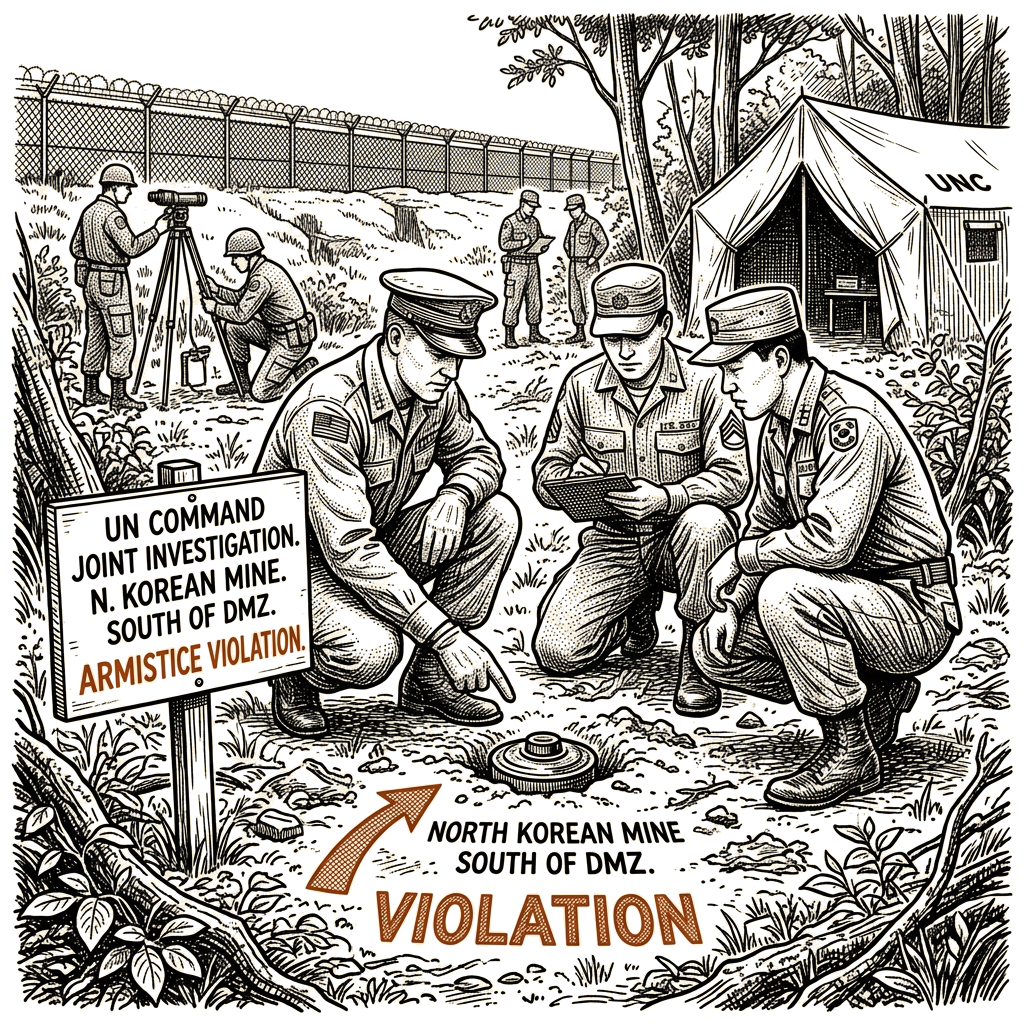
The U.S.-led United Nations Command and South Korea’s Joint Chiefs of Staff determined Wednesday that a North Korean anti-personnel mine found south of the Military Demarcation Line in the western section of the Demilitarized Zone constitutes a violation of the Korean War armistice agreement, concluding joint on-site investigations into September 21 explosions that wounded three South Korean service members.
The determination follows joint on-site investigations conducted by the UNC and the South Korean military in the western section of the DMZ. Two service members were seriously wounded in the blasts, including one who lost an ankle, and a third sustained minor injuries. In a statement emailed to reporters, the UNC said its investigation confirmed that “an Armistice Agreement violation occurred” and that “UNC is addressing the violation through established Armistice mechanisms.”
South Korea’s Joint Chiefs of Staff reached the same conclusion and demanded an apology from Pyongyang. “North Korea must immediately halt activities that escalate tensions on the Korean Peninsula, such as the so-called border fortification,” Lt. Gen. Kang Hyun-woo, chief director of operations at the JCS, said at a press briefing. “We strongly demand an apology and responsible measures from the North.” Kang said the border work had continued since April 2024 despite Seoul’s efforts to promote peaceful coexistence, and warned that North Korea bore “full responsibility” for any future consequences.
The Korean Armistice Agreement, signed July 27, 1953, halted fighting in the 1950-53 Korean War and established the roughly 155-mile DMZ across the peninsula. It prohibits hostile acts within, from or against the buffer zone and unauthorized crossings of the Military Demarcation Line.
The finding comes amid an extended North Korean campaign to harden its border with the South. After Kim Jong Un declared inter-Korean relations to be those of “two hostile states” in late 2023, Pyongyang began clearing land, reinforcing tactical roads, installing anti-tank barriers and laying large numbers of land mines near the MDL — work South Korean officials say has continued despite Seoul’s diplomatic overtures.
Earlier Wednesday, North Korea rejected preliminary findings released Monday by the JCS that North Korean anti-personnel mines were “highly likely” to have caused the explosions. Kim Yo Jong, the powerful sister of North Korea’s leader, called the allegations a “conspiratorial farce” and accused Seoul of using the incident as a pretext for military provocations.
“It is absurd that they made a conclusion about the origin of the said mine exploded in the barren land which they had never set foot for more than a half century,” Kim said in a statement carried by the state-run Korean Central News Agency.
Kim compared the incident to August 2015 explosions that seriously injured two South Korean soldiers and inflamed inter-Korean tensions. South Korean and UNC investigators concluded at the time that North Korea had planted wooden-box mines along a southern DMZ patrol route, an allegation Pyongyang denied.
Kim also threatened immediate retaliation if South Korean forces fired on North Korean troops working along the border. “When a single bullet is hit on our land, they must be prepared for a lot,” Kim said.