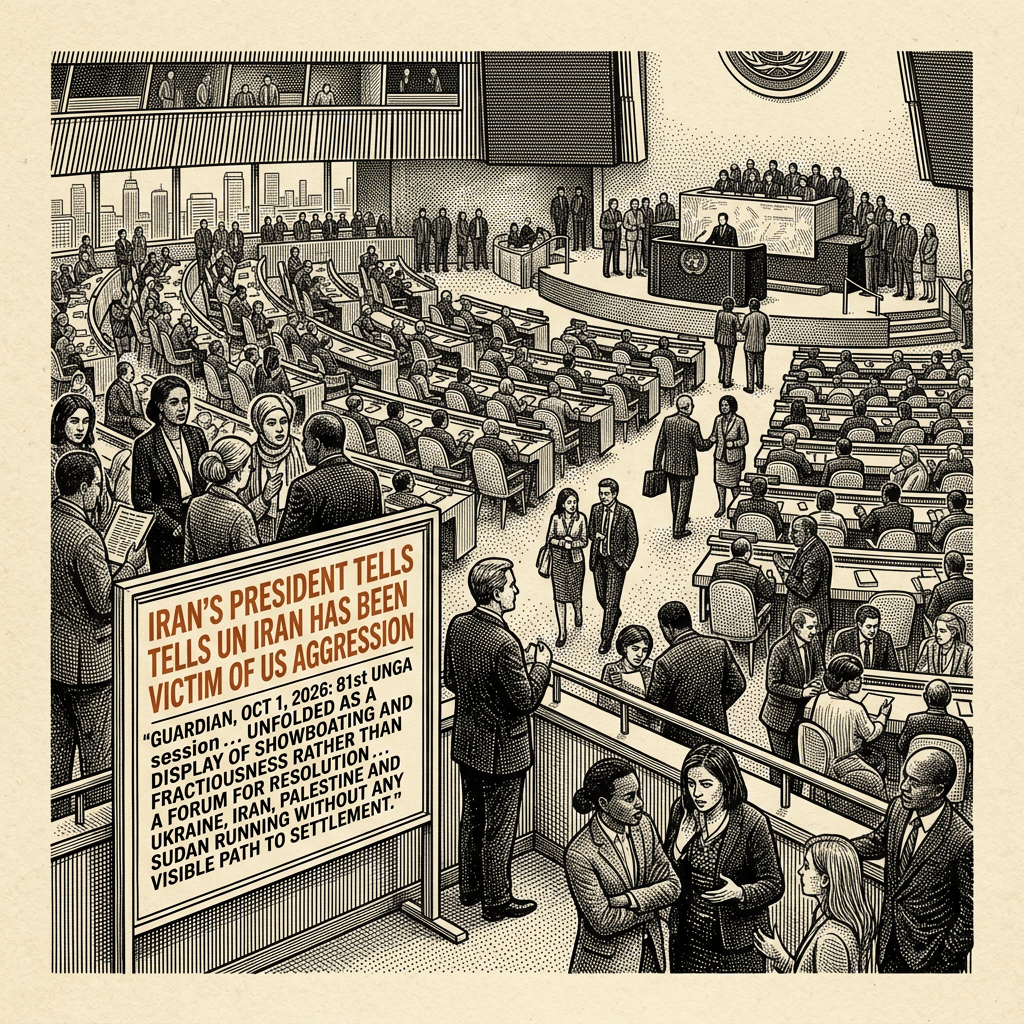
Column says four conflicts and international law’s decline defined the session
The column, published in The Guardian’s opinion section on October 1, reviews the 81st session of the UN General Assembly, which Trump addressed in New York on September 22. Malik wrote that this year’s meetings “encapsulated a world in flux and crisis, an international law and organisation structure that is falling apart, and a humanitarian order machine running hot.” What unfolded, she wrote, was “less a gathering for resolution and resolve than a display of showboating, frustration and fractiousness.”
On Ukraine, Malik reported that President Volodymyr Zelenskyy “delivered an account of five years of Russian aggression,” describing the staggering loss of life — hundreds of thousands killed on both sides — the porousness of the sanctions on Russia, and the “madness” of it all.
On Iran, the column said Trump once again threatened to “annihilate” Iran if it did not make a deal, a promise Malik wrote “has now been made so many times its restating only reveals its hollowness.” Pezeshkian responded in his own address by saying that Iran has been the victim of US terrorism and aggression and would defend itself with the “utmost strength.” The sole US delegation representative in the room walked out, the column reported.
On Israel and Palestine, Malik quoted King Abdullah II of Jordan as saying the Israeli government’s sense of impunity “has reached terrifying levels.” The king said: “It no longer feels compelled to ask, ‘Can we get away with this?’ It already knows the answer.” He added: “If international law can be ignored for decades, then what exactly is that law worth?” Malik wrote that Benjamin Netanyahu then became the only ICC-indicted leader to address the UN general assembly, in a speech she described as characteristically belligerent.
Malik wrote that the assembly was “subjected to the farce of the United Arab Emirates, the key player in Sudan’s war, piously preaching about how Sudanese people deserve peace and civilian rule, while the UAE’s leaders are accused of arming and funding the Rapid Support Forces (RSF), itself accused of genocide and ethnic cleansing.” She described the UAE as a close ally of the US and the UK that has extended Sudan’s war “without even a breath of censure” from either. A $500m investment in the Trump family’s cryptocurrency scheme and multibillion-pound partnerships with the UK, she wrote, “have seemingly captured the two states.” The column also reported that the US’s senior adviser on African and Arab affairs, identified as Tiffany Trump’s father-in-law, acknowledged foreign interests but refused to name any of the countries.
Malik wrote that the Trump administration “invoked its sovereign ability to decide who could attend and who could not,” wielding what she called “a sort of weaponisation of the visa system” that rendered the UN “not a neutral body with its own rules and protocols, but a tool to be leveraged for the interests of the US and its allies because it sits in US territory.” Palestinian President Mahmoud Abbas, who Malik noted is not ICC-indicted, and 80 other Palestinian officials were denied visas to attend for the second time under Trump’s watch. The head of the Sudanese government and Sudanese armed forces — described in the column as the antagonists to the UAE-backed RSF — was also denied a visa, which Malik characterized as an indication of successful Emirati manoeuvrings in Washington.
Amid that, Malik wrote, Tom Fletcher, the UN undersecretary-general for humanitarian affairs, moved between meetings with “a grittily sunny disposition,” posting social media clips about what could still be done. On a walk with Alexander De Croo, administrator of the UN development programme, De Croo described the problem as “crises piling up on one another.” Fletcher said: “The answer, to a lot of what we do is actually diplomacy. Getting those chokepoints open, Bab al-Mandab, the Black Sea, the strait of Hormuz, because otherwise we both have a much bigger development caseload and humanitarian caseload.”
Malik described Fletcher as representing an emerging model of international and humanitarian worker who navigates funding cuts, a lack of interest in peace and a politicised drawdown of international aid to keep some traffic of funds moving — to the millions, she wrote, labouring under war, the climate crisis, disease, poverty, hunger and predation, from winter aid in Gaza to containing the Ebola outbreak.
Malik argued that a further problem is the changing nature of military conflict itself. Wars, she wrote, “are becoming vastly less containable through the spread, sophistication and low cost of AI and drones,” conducted remotely and veering between high-intensity and low-grade assaults that render their beginnings and ends less decisive. She cited the Gulf held hostage to Iran’s response to US attacks, Sudan’s war without a clear frontline, and the ceasefire in Gaza as essentially a lower-grade assault.
Malik wrote that the 2026 meeting was “a study in so many things – the degradation of international law, the rickety system it has bequeathed, the acceleration of the demise of international community, and the importance of resolve to somehow attend to the victims.” She said what is more likely than any clean scenario is what was demonstrated in New York: “a messy prolonged state of constant stress under careless leaders giddy with what they realise they can get away with, no exit plan,” with the rest of the system left to work with and around those leaders to alleviate the consequences of their actions. “The new world order,” she wrote, “is one of active resignation.”