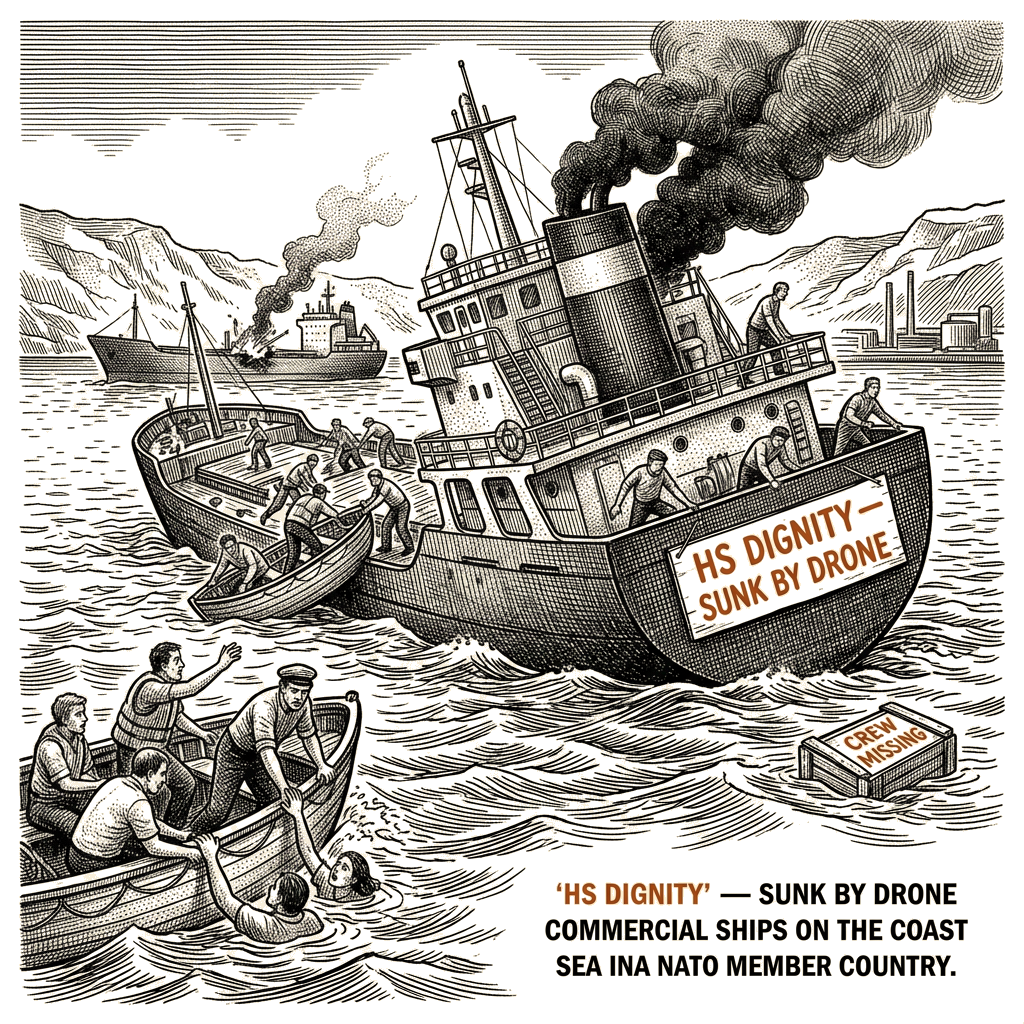
Eleven crew members remain missing after HS Dignity sinks off Bulgaria
The Malta-flagged Chelsea 3, a Ukrainian-owned vessel, was struck by three aerial drones that hit its deck and side some 18 nautical miles east of the Bulgarian shoreline, according to Radev. Video released later by Bulgarian authorities showed a border-police vessel pulling alongside the stricken ship in rough seas just before dawn as crews evacuated the ship. All 15 crew members — seven Ukrainians and eight Azerbaijanis — were transported to safety in the Bulgarian port of Varna, Radev said.
The second vessel, the HS Dignity, was struck 17 nautical miles east of the Bulgarian shore and sank, according to Bulgarian authorities. Five crew members were rescued; 11 remained missing. Russia’s Ministry of Defense did not immediately respond to a request for comment.
Radev summoned the Russian ambassador after the attacks, saying that while there was no conclusive evidence to blame a specific actor, logic pointed to Russian involvement. “The outcome benefits the Russian Federation,” Radev wrote on X. Ukraine blamed Russia for the attack on the Chelsea 3.
The Tuesday incident was the second assault on commercial shipping close to the NATO member in a week. A week earlier, aerial and maritime drones struck two merchant ships in Bulgaria’s exclusive economic zone, Radev said. A Togo-flagged vessel sank with no crew found by rescuers, and a Palau-flagged vessel was evacuated after a fire broke out.
That earlier strike came a day after a separate attack on a ship in Romania’s exclusive economic zone that killed two people and led to the rescue of 11 others, according to Romanian officials. Ukrainian President Volodymyr Zelensky said the Turkish-owned vessel was transporting corn and came under attack from two Russian drones.
NATO Secretary-General Rutte spoke with Radev about the latest attacks and reiterated that the bloc would work closely with allies in the Black Sea. “We have already strengthened our posture along the eastern flank and will continue to monitor the security environment, adjusting our deterrence and defense posture as needed,” Rutte wrote on X, without attributing blame.
The pattern of attacks on ships skirting NATO’s maritime borders marks a new phase in the Black Sea conflict, one of the world’s most important sea corridors. This summer, Russia and Ukraine set each other’s ships and port infrastructure ablaze in competing economic pressure campaigns. The latest strikes present the alliance with a fresh dilemma as European leaders, who have accused Russia of increasingly brazen attacks on their soil, now contend with strikes on vessels close to their waters.
Last month, Germany said Russia had sent an explosive drone to Leipzig airport, a transit hub for supplies to Ukraine. Russia denied involvement. In remarks to the Warsaw Security Forum on Monday, Zelensky warned European leaders about the persistent threat of hybrid attacks on their countries. “There is no such thing as a small act of destabilization,” Zelensky said. “Our intelligence services know that Russia is planning many aggressive hybrid operations against Europe.” He urged unity in defense.
Martin Vladimirov, director of the geoeconomics program at the Center for the Study of Democracy, a European public-policy institute, framed the Black Sea attacks as part of a broader campaign. “Russia’s drone attacks on commercial ships off in the Black Sea are the visible edge of a widening shadow war across Europe,” Vladimirov said. “Russia will expand its hybrid warfare not necessarily in preparation for an invasion but in order to undermine NATO’s unity and the support for Ukraine.”
Ukraine has maintained that it is ready for a ceasefire in the Black Sea that would reopen its lifeline to global markets. Zelensky said Kyiv discussed various options to protect food security and safe navigation with Egypt, India, and Turkey. “Ukraine is ready to do its part to ensure calm, safe shipping and food security in the Black Sea, if Russia is ready to take real steps toward de-escalation too,” Zelensky said in late September. “We have to start somewhere — and Russia has to start by respecting others.”