Fed weighs October rate decision as futures odds climb to 50%
The September consumer price report shows inflation broadening beyond energy, with prices rising in categories that are less sensitive to fuel costs even as energy remained the dominant driver of headline pressure, according to The Wall Street Journal.
Consumer prices were up 3.7% in September from a year earlier, the Labor Department said Wednesday, hotter than August’s gain of 3.4% and above the 3.6% increase expected by economists surveyed by the Journal. Prices excluding food and energy — the so-called core prices, which economists watch to gauge underlying trends — rose 2.6%, above forecasts for a 2.5% increase. Month over month, core prices rose 0.3%, surpassing economists’ 0.2% expectation.
“At this point we’re at dangerously elevated levels of inflation,” said Lindsey Piegza, chief economist at Stifel.
Energy drove much of the September jump. Gasoline prices last month rose 9.1% from the prior month — a faster pace than August’s 3.9% increase — and were up 34% over the past year. Fuel-oil prices were up 74% since last September. Airfare, which is highly sensitive to fuel costs, was up 22% from a year earlier. Prices have soared since the Iran conflict started at the end of February, the Journal reported, and high retail prices in October suggest pain at the pump will continue.
Food prices were flat from the prior month after rising 0.1% in August but were up 2.5% over the past year. Economists are watching food for signs that higher transportation costs are seeping through to prices of goods like meat and dairy. Used car and truck prices rose 0.7% month over month, up from 0.4% in August, but were down from a year earlier. Prices of goods like apparel and toys, which the Journal noted are often made from petrochemicals, also ticked up.
While oil was the main driver, price growth also picked up in less energy-sensitive categories. “This points to broad-based inflation pressure,” said Samuel Tombs, chief U.S. economist at Pantheon Macroeconomics. Recreation services like streaming rose, reflecting “buoyancy in consumer demand,” Tombs said. Hospital services also ticked up.
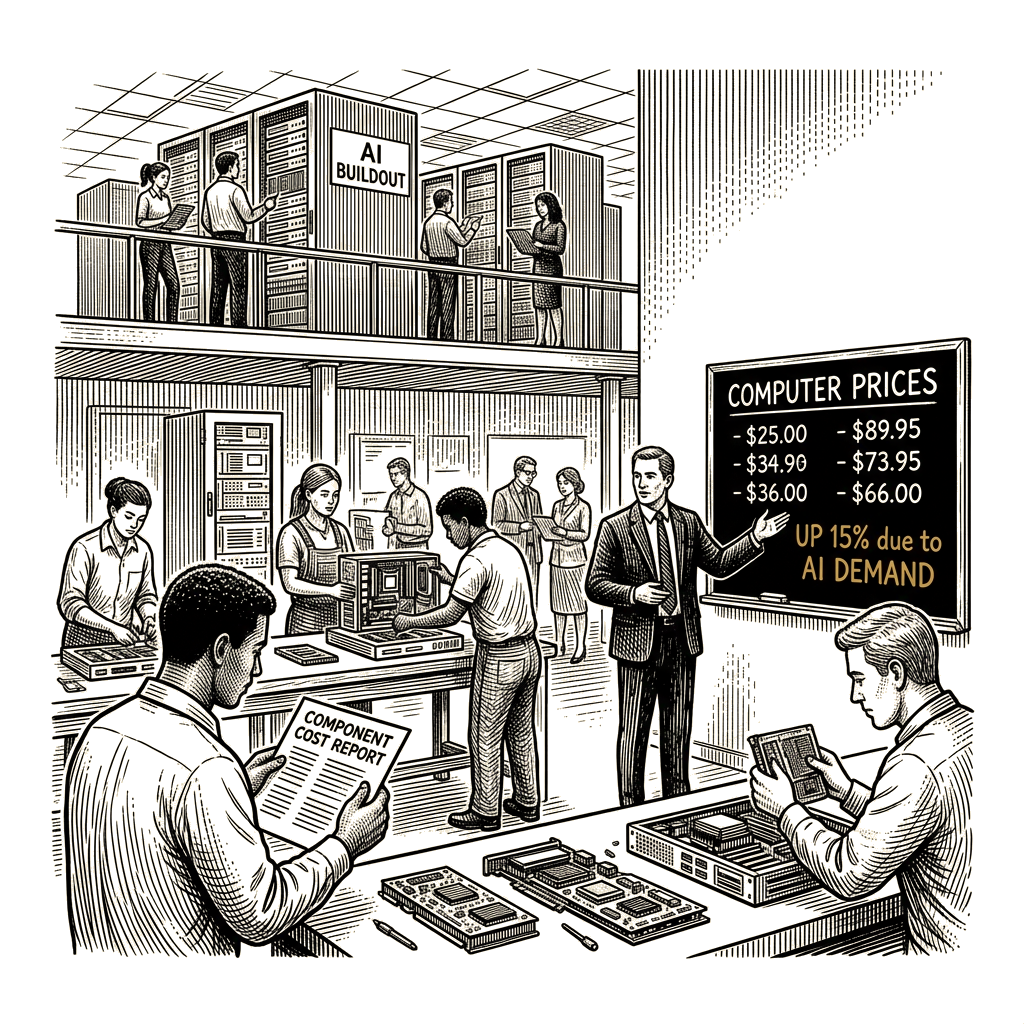
A notable source of price pressure sits outside the energy complex. The boom in data-center construction has pushed up semiconductor and other equipment costs, the Journal reported. Prices for computers, peripherals and smart-home assistants rose 9.7% in September from a year earlier, their biggest annual climb in data going back to 2006.
The challenge for the Fed, according to the Journal, is that higher interest rates may do little to ease that source of price pressure: hyperscalers are likely to continue building even if their debt costs rise, because the prospect of vast future AI profits is so enticing.
The September report raised two questions for Fed officials, the Journal reported. The more immediate is whether they can afford to wait until December to raise rates again after signaling recently that they did not anticipate moving at their meeting in late October. Some analysts argue there is little reason for the Fed to wait if officials expect to raise rates anyway, though officials have not signaled that one report would lead them to reconsider. Wall Street traders dialed up their bets that the Fed may indeed raise rates when officials meet in two weeks, the Journal reported, sending futures-market probabilities of an October rate increase to about 50% after the release before they eased back to about 33% later in the day.
The bigger question, according to the Journal, is how high rates ultimately need to go. That depends on whether pressures from higher energy prices and the AI investment boom are spreading into the broader economy.
Some economists described the September report as a worrying sign that the Iran war was not just a one-off price shock, the Journal reported, and argued that higher inflation is here to stay unless the Federal Reserve acts. “It’s already becoming a prolonged issue” seven months into the war, said Stifel’s Piegza.
Survey-based expectations of higher future inflation can become self-reinforcing if consumers rush to buy ahead of anticipated price increases. Respondents in the University of Michigan’s latest consumer survey said they expect inflation of 4.7% over the next year, up from 4.6% in last month’s survey. Five-year inflation expectations rose to 3.5% from 3.4%.
Other economists were more sanguine, the Journal reported, pointing to falling real wages as a sign that inflation is likely to come down. “Right now the labor market looks weak,” said Pantheon’s Tombs. Prices rose much faster than average hourly earnings, which increased 3% from a year earlier, marking the sixth consecutive month that inflation has outpaced wages — meaning many Americans are seeing their real incomes fall.
The Journal cited the strength of America’s consumers as a key reason inflation is stuck above the Fed’s target: buoyed by low unemployment and rising stock prices, households continue to spend despite rising prices, and that has made it easier for businesses to pass on cost increases to their customers. Executives at the country’s biggest banks said this week that higher rates so far have not dented consumer or business appetite to borrow and spend.
High prices have been a political flashpoint for Americans, who have grown fed up with more than five years of inflation, the Journal reported. The dynamic could be costly to Republicans as Americans cast their ballots, according to the Journal. President Trump’s critics say his policies have contributed to inflation: the Iran war on energy prices, tariffs on the prices of goods, and the artificial-intelligence buildout — of which Trump has been an enthusiastic backer — on computer-equipment costs. Trump’s advisers say rising prices reflect years of cumulative growth and that the White House’s deregulation push will lower prices. The U.S. economy, by many measures, remains resilient.