The bill expands biometric records and sets a 24-hour judicial review window
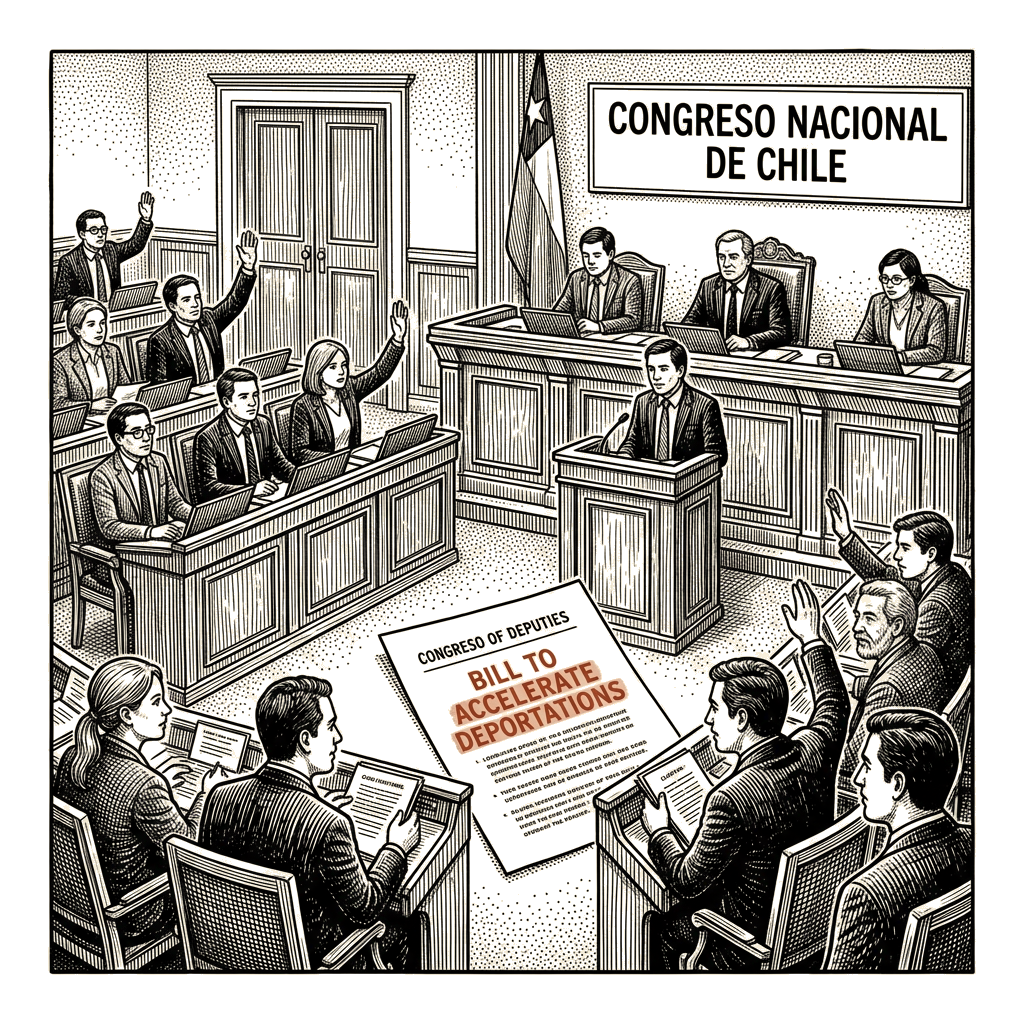
On Wednesday, lawmakers in both chambers of Chile’s Congress gave final approval to a bill intended to streamline and accelerate administrative deportations of immigrants living in Chile without legal status. The bill aims to facilitate enforcement of approximately 75,000 pending deportation orders. Congress still must prepare the final text and formally deliver it to the president’s office; once that happens, President José Antonio Kast would have 10 days to sign it into law.
The bill was introduced in 2024 under former President Gabriel Boric and gained momentum under the current administration of President José Antonio Kast. An estimated 330,000 people are living in Chile without legal immigration status.
Under the reform, Chile’s Investigative Police can request written judicial authorization to enter a property and detain a person subject to a deportation order. Judges must rule on those requests within 24 hours.
The legislation also increases the minimum period during which deported foreigners are barred from re-entering Chile from three to five years and expands the use of biometric records. It allows access to information held by public and private institutions to facilitate deportation notifications, while excluding information concerning children younger than 18 and educational and healthcare institutions.
The legislation comes as the government struggles to increase deportations. According to data from Chile’s Interior Undersecretariat and National Migration Service, authorities had carried out 1,874 deportations in 2026 as of Oct. 10, while more than 75,000 deportation orders remained pending. About half of the pending orders involved Venezuelan nationals.
Jaime Abedrapo, an international relations expert, international law professor and director of the Center for Public Law and Society Studies at San Sebastián University, said the legislation received support from nearly all political sectors except the Communist Party. He described the law’s major change as its effectiveness, allowing authorities to locate, notify and detain individuals. Abedrapo said, “This could increase the number of deportations.” He added that the law was far from reaching 300,000 in four years and that authorities issue too many deportation orders relative to the state’s limited capacity to enforce them. He said additional resources were essential to implementing the new measures.
Hernán Campos, a political science professor at Diego Portales University, said the legislation complements border control efforts and measures aimed at discouraging irregular migration by accelerating deportation procedures. He said that if irregular migration declined as a result of the law by the end of the administration, it could become a legacy that would be used in subsequent elections.
Campos said the law’s success would depend heavily on international cooperation to receive deported migrants. Abedrapo said the recent restoration of consular relations between Chile and Venezuela could facilitate deportation procedures, but cautioned that this would not necessarily allow mass deportations.
Francisca Vargas, director of the Migrants and Refugees Legal Clinic at Diego Portales University, argued that the reform weakens judicial protections for foreign nationals. She said, “This law takes another step toward the criminalization of migrants and the reduction of their rights and due process protections.” Vargas warned that the measures could discourage migrants from providing personal information and push them further into hiding, creating additional security challenges for the state. She said, “The more barriers are imposed, the more people are pushed into hiding.”
Vargas said irregular immigration status is often a condition of vulnerability, involving people who entered through unauthorized border crossings without committing any crime. Other issues that must also be addressed include the situation of children whose parents are deported.
On border enforcement, irregular entries into Chile fell 93.5% between January and August, according to police data published by Chilean investigative news outlet CIPER.