Cleveland pilot will subsidize wages for five van-driving workers
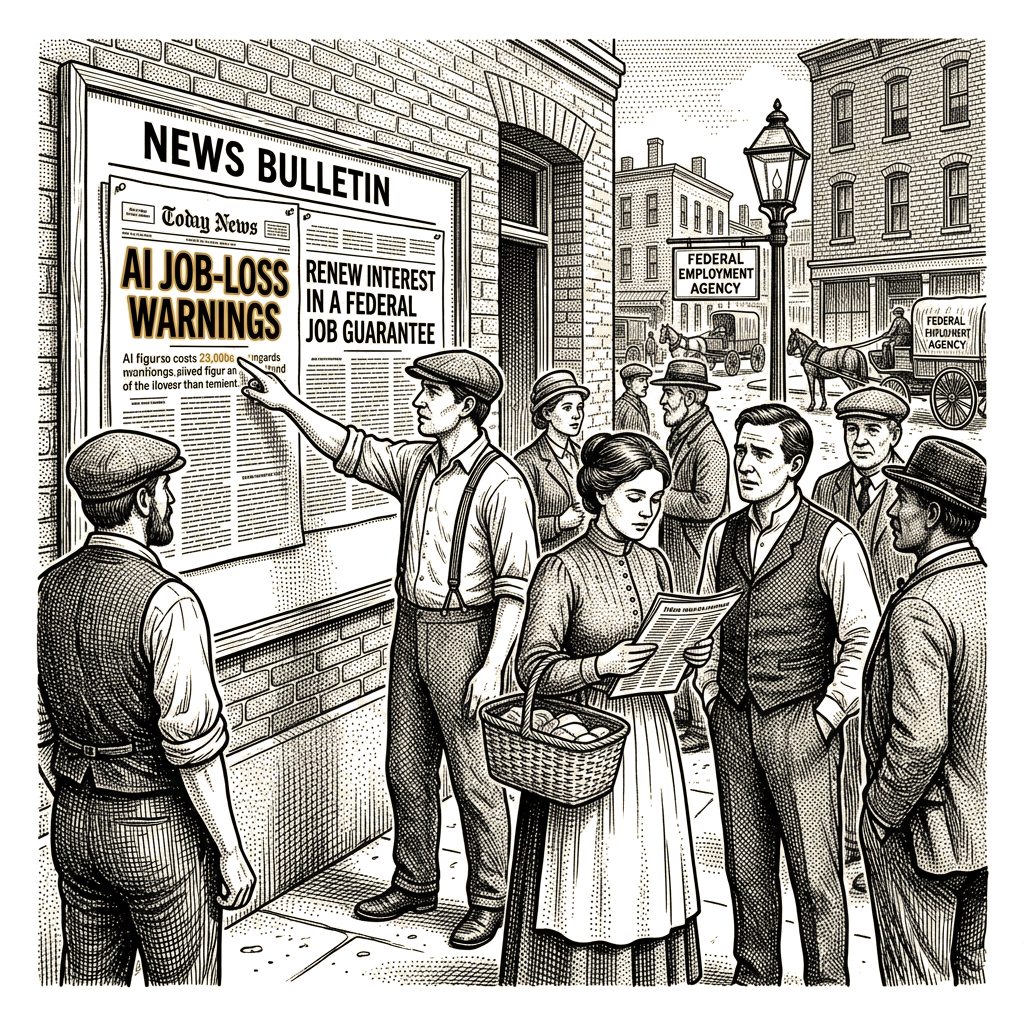
A federal job guarantee is drawing renewed attention as influential figures warn that AI could trigger widespread unemployment. The Guardian said a job guarantee could directly mitigate the problem whether a crisis of mass AI-related job loss turned out to be actual or perceived. Democratic U.S. Rep. Ayanna Pressley of Massachusetts reintroduced a congressional resolution in September calling for a federally funded but locally administered guarantee, reviving a proposal she first advanced in 2021. The measure would pay participants at least $25 an hour and adjust the wage regularly for changes in living costs.
Jobs under Pressley’s plan would include emergency preparedness, relief and recovery after natural disasters, care for children and seniors, and public art projects modeled on the Works Progress Administration’s Federal Art Project.
The Guardian says the most ambitious form of a job guarantee would ensure that anyone who wants work is guaranteed a meaningful, decently paid job.
Supporters say that creating a public option for employment could protect millions of people from the financial and psychological damage of joblessness and mobilize a vast labor force to tackle urgent societal problems, including infrastructure and climate adaptation, elder care and childcare. The idea has a history as both an ideal and an actual policy.
Article 23 of the 1948 Universal Declaration of Human Rights states: “Everyone has the right to work, to free choice of employment, to just and favourable conditions of work and to protection against unemployment.” During the Great Depression in the 1930s, Franklin D. Roosevelt established the Works Progress Administration, which employed millions of Americans on public works that constructed roads, bridges, sewers, playing fields and other facilities. France, India and Argentina have more recently launched versions of a job guarantee.
In the preface to his book Capitalism and Freedom, American economist Milton Friedman observed that crises can propel once-fringe ideas into the political mainstream. “Only a crisis – actual or perceived – produces real change. When that crisis occurs, the actions that are taken depend on the ideas that are lying around,” he wrote. He argued that the job of intellectuals, thinktanks and economists was to refine the quality of ambient ideas so good ones would be ready when disaster struck.
Bill Gates has declared that AI will advance so rapidly that within a decade, humans will not be needed “for most things.” Anthropic CEO Dario Amodei has warned that the technology could cause widespread unemployment within one to five years, eliminating many positions in law, tech, finance and other white-collar professions. The Guardian noted that even if those predictions prove wrong, investors who have bet heavily on AI could conclude that it is a bubble, which the outlet said could itself cause a recession and widespread job loss.
In FRED’s raw series vintage dated Oct. 23, 2026, the official U-3 unemployment rate stood at 4.2%, while the broader U-6 rate was 7.6%. The broader U-6 measure includes discouraged workers and people working part time involuntarily.
Although job guarantees and universal basic income are often grouped together, a recent global survey found greater support for job guarantees than universal basic income. Polling of Americans by Democratic strategist David Shor showed the same pattern, with greater support for well-paid jobs than direct income support. Venture capitalist and civic activist Nick Hanauer said “jobs represent so much more than income in human societies. They represent connection and dignity and enfranchisement and participation.” Algernon Austin, director for race and economic justice at the Center for Economic and Policy Research, said: “A job guarantee is significantly preferable to UBI because work is more than just income. When you have a job, you gain work experience and you gain skills and you gain a network.”
Calculating the cost of a job guarantee depends on a holistic assessment of its effects, The Guardian said. At a U.S. Senate hearing on affordability in June, Republican Sen. John Kennedy of Louisiana suggested that a job guarantee would cost trillions of dollars and was impossible. Dr. Julie Margetta Morgan, president of the public policy thinktank the Century Foundation, told Kennedy that she supported a federal guarantee. He replied: “Do you believe in the Easter bunny?”
Max Kasy, an Oxford economics professor who studied a recent job-guarantee experiment in Austria, said participant wages represent a cost but programs could also reduce spending on other benefits. “The cost saving comes from the fact that you don’t have to pay unemployment benefits, or maybe disability benefits or early retirement benefits. Then people who are working pay taxes and make social insurance contributions, so that’s additional revenue for the state. And then they hopefully do something that’s actually useful for society,” he said.
The Guardian reported that participants in the Austrian experiment also experienced social and psychological benefits. Bard College economics professor Pavlina Tcherneva said the monetary value of that improved well-being is difficult to quantify but remains important. “Providing a good job to a person is absolutely transformative,” she said. She also cited health problems associated with precarious and long-term unemployment, saying: “It’s not only affordable, it’s an investment.”
Another recent proposal would directly tax AI companies to finance a federal guarantee. Democratic U.S. Reps. Greg Casar of Texas, Valerie Foushee of North Carolina and Sara Jacobs of California support taxing large AI companies on whichever is higher: the value of their “tokens,” described as units of data used in AI models, or their revenue from AI products. The tax rate would rise if the unemployment rate increased.
In a written statement, Casar said, “AI CEOs are openly predicting their technology could put millions of Americans out of work, and our government is doing nothing to save jobs and protect working people.” The proposal links possible AI-driven job losses to a mechanism intended to finance employment for people who lose their jobs.
In Cleveland, Ohio, nonprofit Universal Basic Employment is launching a small pilot with a cohort of five workers who drive vans at a transportation company. According to founder and CEO Devin Cotten, the program will subsidize existing private-sector jobs rather than create new positions from scratch. Universal Basic Employment calls the wage threshold an “autonomous wage,” meaning the level at which workers are no longer eligible for most social safety-net benefits.
In Cleveland, that threshold was just over $27 an hour. At a cost of almost half a million dollars for one year, UBE’s pilot will split the cost of that wage level with employers. The drivers currently make about $15 an hour, so the employer will save money and the workers will receive a sizable raise.
UBE’s pilot is not meant to replace other forms of assistance such as housing vouchers, Cotten said. Paying workers through wages rather than isolated benefits could help them build credit, perhaps qualify for a mortgage and keep more money circulating in the local economy to revitalize poor neighborhoods. He said a work-based model may attract broader political support: “Work is a shared value across political lines. I think crafting a solution based on work allows us to be a bipartisan solution.”