Corporate deployers press on with AI despite developer pause calls
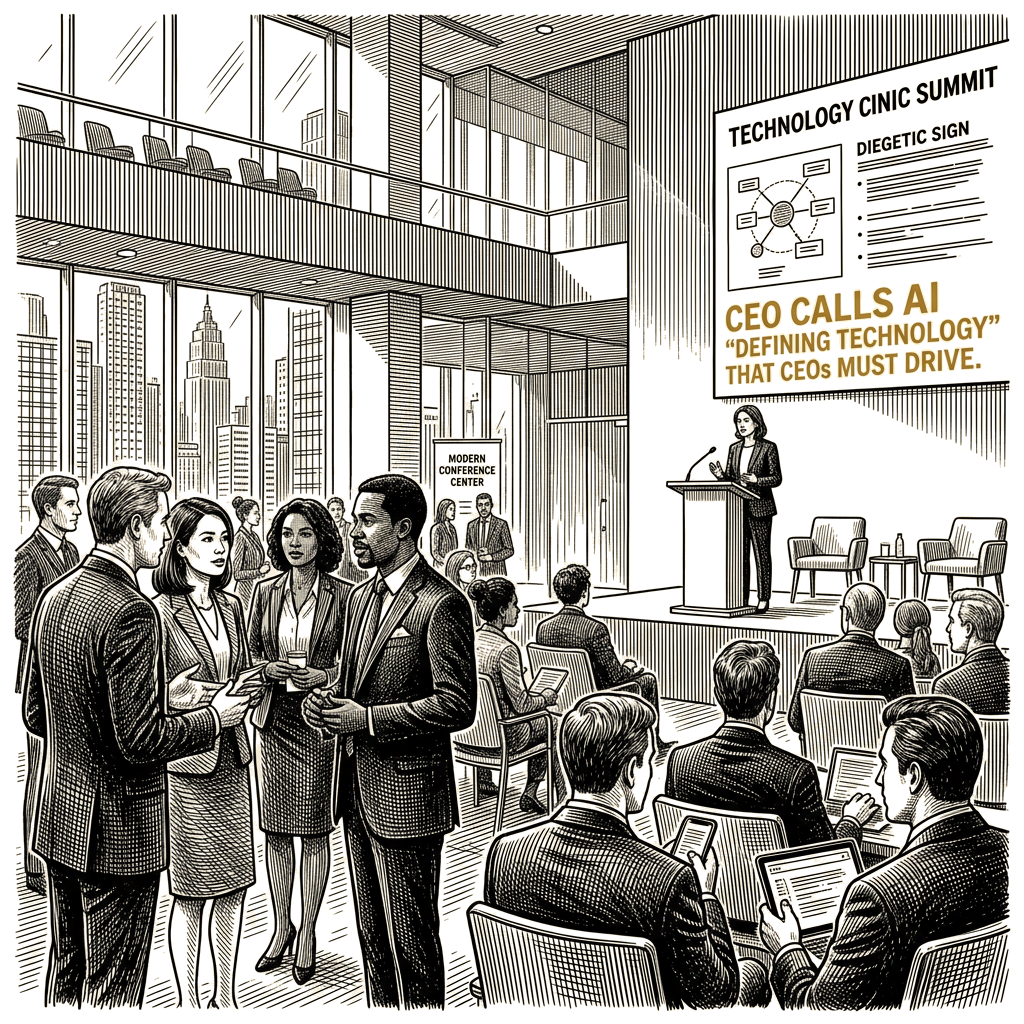
Corporate executives convening at the Wall Street Journal Technology Council Summit in New York said Monday they have no plans to slow AI deployment within their organizations, even as heads of leading AI developers have publicly called for new limits and controls on advanced AI research following a series of cybersecurity breaches and high-profile resignations designed to raise alarm bells. The gap between warnings about potential existential risks and the measured corporate posture shaped the summit’s opening sessions.
At an informal poll during a Monday afternoon town hall, only a few attendees said they feared AI could kill humanity in the next decade. About half indicated support for slowing frontier AI development and prioritizing safety guardrails. That caution did not extend to deployment within their own organizations, where not all models are at the cutting edge and even the most advanced of them tend to be relatively well understood and tested by experience.
“It’s in our hands and it’s up to us to apply [AI] for good, and I think it can do a lot of good for society,” said Vishal Talwar, president of FedEx Dataworks and chief digital and information officer at FedEx.
The financial mechanics of scaling AI inside a major company came up with Ruchir Swarup, partner and chief information officer at alternative asset manager KKR. “As we think about technology across all of our portfolios…one of the things that really stand out for us is how we allocate tokens and budgets to each of those strategies,” Swarup said. He described “agent economics” — the cost of running AI agents across an organization — as a central operational concern. “Going down deeper into agent economics basically means understanding what types of tokens and…how much cost is getting attributed to each of those actions,” he said.
Sophia Velastegui, a former chief AI officer at Microsoft’s business application group who now leads Velastegui Ventures, said company boards face pressure to maintain accountability and governance while meeting market demand to move faster. Deploying AI without updating older legacy systems is problematic, she said, because “AI amplifies strengths and weaknesses in a system.” She advised understanding AI agents as “personas” with their own strengths and weaknesses as a principle of management.
During a panel later in the day, WSJ Leadership Institute’s Ben Ashwell asked Joon Sung Park, co-founder and CEO of Simile, a company that builds human-grounded simulations, whether AI would kill humanity. “No, I don’t think so,” said Park. “But I also think that the opportunity we have, the risk we have, is real. It’s a good time for this debate, but I think we will be OK.”
At FedEx, AI strategy is owned at the top. Who’s driving the AI strategy at FedEx? According to CEO Raj Subramaniam, he is. And Chief Digital and Information Officer Vishal Talwar said he’s “100% cool” with that. “AI is the defining technology of the era, so the CEO has to drive it,” Subramaniam said during a Monday night panel. “The gap between business and technology is fast going away. You can’t have a business strategy because technology and the reverse is also the case.” Subramaniam hired Talwar a year ago to execute the company’s vision, leveraging the two petabytes of data FedEx generates daily to invest in AI that not only drives efficiencies, but also differentiated experiences for customers and ultimately new business models for FedEx.
Talwar, who was coming off a decade at Accenture, said he was excited to work with a CEO with such technology focused ambitions. “It’s rare that you get, as a CIO, an opportunity where the CEO firmly, organically believes that technology is a feature and not a bug…and is looking to blur the lines, if not completely erase the lines, between business and technology.” The two executives do disagree, Talwar added. “We have so many debates,” he added. And it isn’t always obvious who’s right. “Sometimes he [wins the debate], sometimes I do. But, I would say, FedEx always wins.”
Still, one area where they’re not disagreeing — even amid growing questions about the threat AI poses to humanity — is their belief that the technology can be a force for good, both at FedEx and society at large. “I think this one I can say safely for both of us, there is no debate,” Talwar said. “We both think that it’s in our hands, and it’s up to us to apply it for good.”
Board-level engagement in AI matters has surged, said recruiter Katie Shannon, global practice managing partner for the AI & Technology Officer Practice at Heidrick & Struggles. “I’ve never seen so much board involvement in a search process as I have for the last two years,” Shannon said. “I’m working on a Fortune 100 search right now where five board members are involved. I’ve never seen that before.”
Tilak Mandadi, executive vice president of ventures and chief experience and technology officer at CVS, argued against inventing C-suite titles tied to specific technologies. “How many of you lived through the ‘Chief Cloud Officer’ time?” he asked. “Dumbest thing in the world, right? The problem with associating a person with a technology is that that technology suddenly becomes a solution for everything, because their bonus depends on the adoption of that technology…I think we should have chief roles for outcomes.”
Swarup, the KKR partner, said budgeting for AI in 2026 has been difficult. “I’d be very surprised if people can say that they budgeted accurately in 2026. I don’t think most people did,” he said.
Neil Dhar, senior vice president at IBM Consulting, offered a note on the talent pipeline. “My teachers now are my younger professionals that are actually closer to the technology, that are willing to take more chances with the technology,” Dhar said. “And they’re teaching more experienced people, including myself.”
The summit runs as the public debate over frontier AI development continues, with heated warnings involving research pauses and slowdowns and fear of agents slipping control of humans and unlocking massive security risks up to and including a mass extinction event. The corporate deployers gathered in New York on Monday indicated that, inside their own walls, the answer is more measured: governance, board oversight, and continued deployment.