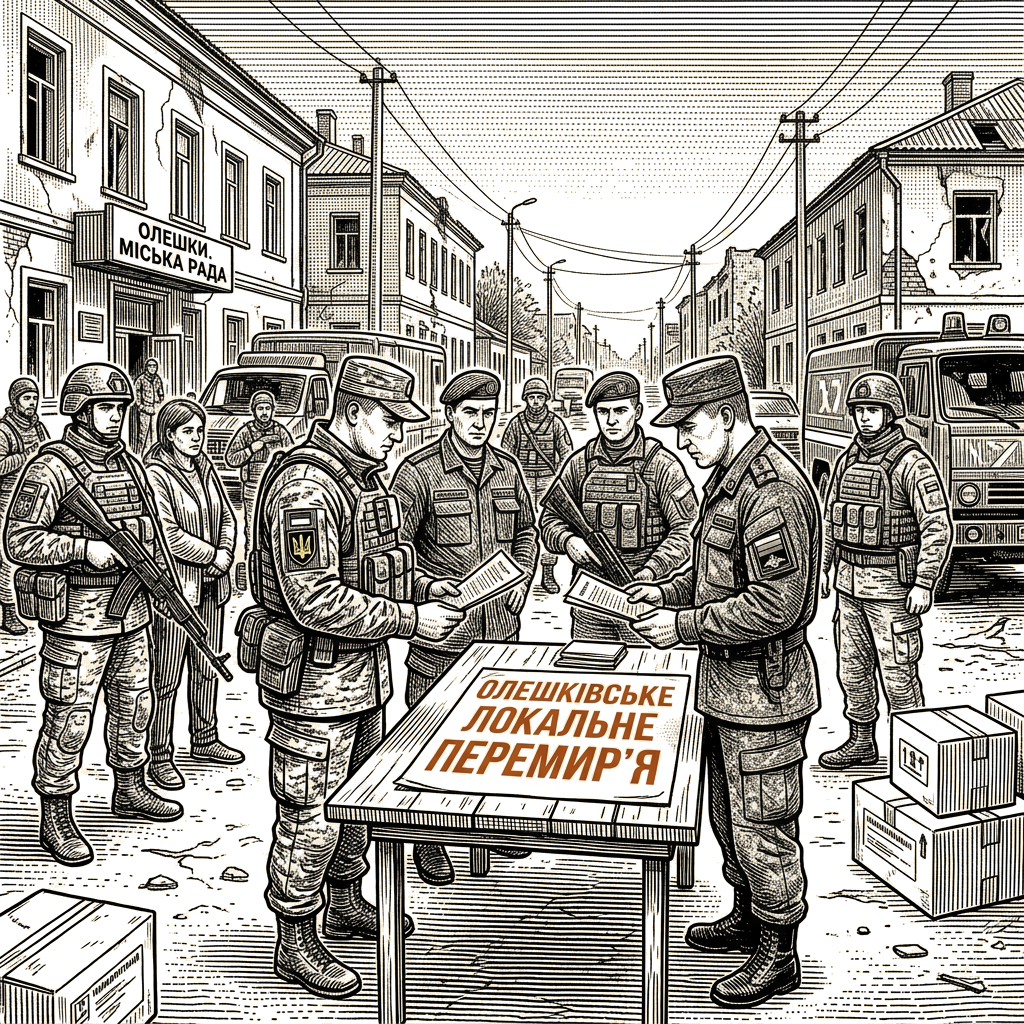
Civilian leaders visit, assess residents’ needs; evacuees receive coordinated support and transport
The White House said First Lady Melania Trump had “successfully secured” a localized ceasefire between Russia and Ukraine in Oleshky, a Russian-occupied city in Ukraine’s Kherson region. Ukraine and Russia later confirmed that a ceasefire had been agreed. The statement said the truce would begin on 29 October but did not say how long it would last.
The White House said Trump and her representative had worked “directly with Russian and Ukrainian leadership to define the terms of the localised ceasefire.” The statement described Oleshky as a “front-line war city on the brink of disaster” and said the remaining population consisted primarily of elderly residents who urgently needed medical attention, medicine, food and clean water. Melania Trump said residents had limited electricity, lived amid mined roads and endured regular military attacks.
Under the announced terms, non-military civilian leaders from both countries will visit residents in their homes and determine the level of assistance they require. Separately, the statement said: “Residents who wish to evacuate will receive coordinated support and transportation to their preferred destination. I anticipate some will want to go to Russia, and some to Ukraine.” Melania Trump also said, “without my intervention, the possibility to bring humanitarian aid into the city and to evacuate the elderly would be impossible.” An accompanying BBC video item was headlined “Trump: First lady’s ‘initiative’ led to truce for Ukraine city.” In the item, President Donald Trump credited his wife’s initiative with bringing about the agreement.
Davyd Arakhamia, a Ukrainian MP who heads President Volodymyr Zelensky’s party in parliament, said “an operation to unblock the settlement of Oleshky and its surroundings will begin in the near future.” He tied the operation to the ceasefire announced by Melania Trump, saying, “To achieve this goal, a ceasefire will be achieved in the near future, as announced by the First Lady of the United States, Melania Trump.”
In Russia, President Vladimir Putin’s spokesman Dmitry Peskov confirmed that the truce had been agreed. Peskov said, “The military is currently working to coordinate the timings of a ceasefire,” and that “Those who wish to do so will be able to leave this settlement.”
An image in the BBC report, credited to Ksenia Arkhipova, was captioned “These residents were able to get out of Oleshky in spring this year.” The caption referred to spring 2026 and showed that some residents had already been able to leave before the evacuation support announced with the truce. Residents have recently resorted to eating garden weeds to survive. Last month, some remaining residents told the BBC they were surviving in a city being constantly shelled and cut off from food and water. They said children remaining in wider Oleshky were suffering from malnutrition, lacked medical services and were “degrading” without access to education. Many also said only one hospital was partially operational, opening a few days a week to perform critical amputations.
Ukrainian Foreign Minister Andrii Sybiha said the local population was living under a “full blockade” by Russian forces. Ukraine said it had attempted to deliver supplies to the area but had not succeeded in recent months. In September, the Kremlin acknowledged that Oleshky was facing a “critical situation” and “problems with supplies of food and medicine,” said Russia’s military was working to resolve them and blamed Kyiv.
Oleshky is trapped between the Dnipro River, which separates it from Ukrainian positions, and Russian forces. Russian forces seized the city during the first days of the full-scale invasion in February 2022. The city was home to 24,000 people before the invasion, while Ukraine now estimates that some 6,000 people remain in the city and surrounding areas, including 200 children. Another image caption said Oleshky has been without gas or electricity since 2023, so residents had to find other solutions.
The BBC described Melania Trump as relatively lower-profile than some of her predecessors and only occasionally seen at White House events, but said she had become involved in humanitarian issues arising from the Russia-Ukraine war. In August 2025, she wrote to Russian President Vladimir Putin, telling him it was “time to protect children and future generations worldwide.” Although the letter did not mention Ukraine by name, days later at the White House, President Volodymyr Zelensky handed over a letter from his wife, Olena, thanking Trump for her efforts on children.
In a rare public appearance in October 2025, Melania Trump said Putin had answered her directly in writing and that her representatives were working with the Russian president’s team to repatriate Ukrainian children from Russia and vice versa. The BBC reported that some 34 children have reportedly been returned since 2025, including five that July.
According to US President Donald Trump, his wife had privately expressed skepticism about Putin and his desire to achieve peace. Trump said in July 2025 that, after returning home, he would tell Melania, “First lady, I had the most wonderful talk with Vladimir. I think we’re finished.” He continued: “And then I’ll turn on the television, or she’ll say to me one time, ‘Wow, that’s strange because they just bombed a nursing home’.”
The Oleshky agreement covers a localized humanitarian arrangement that provides for aid assessments, possible evacuations and coordination between military authorities while leaving the truce’s duration unspecified. Residents’ reported shortages, limited medical care and exposure to shelling and mined roads remain the immediate stakes.