FAA places primary responsibility for community concerns on operators and local leaders
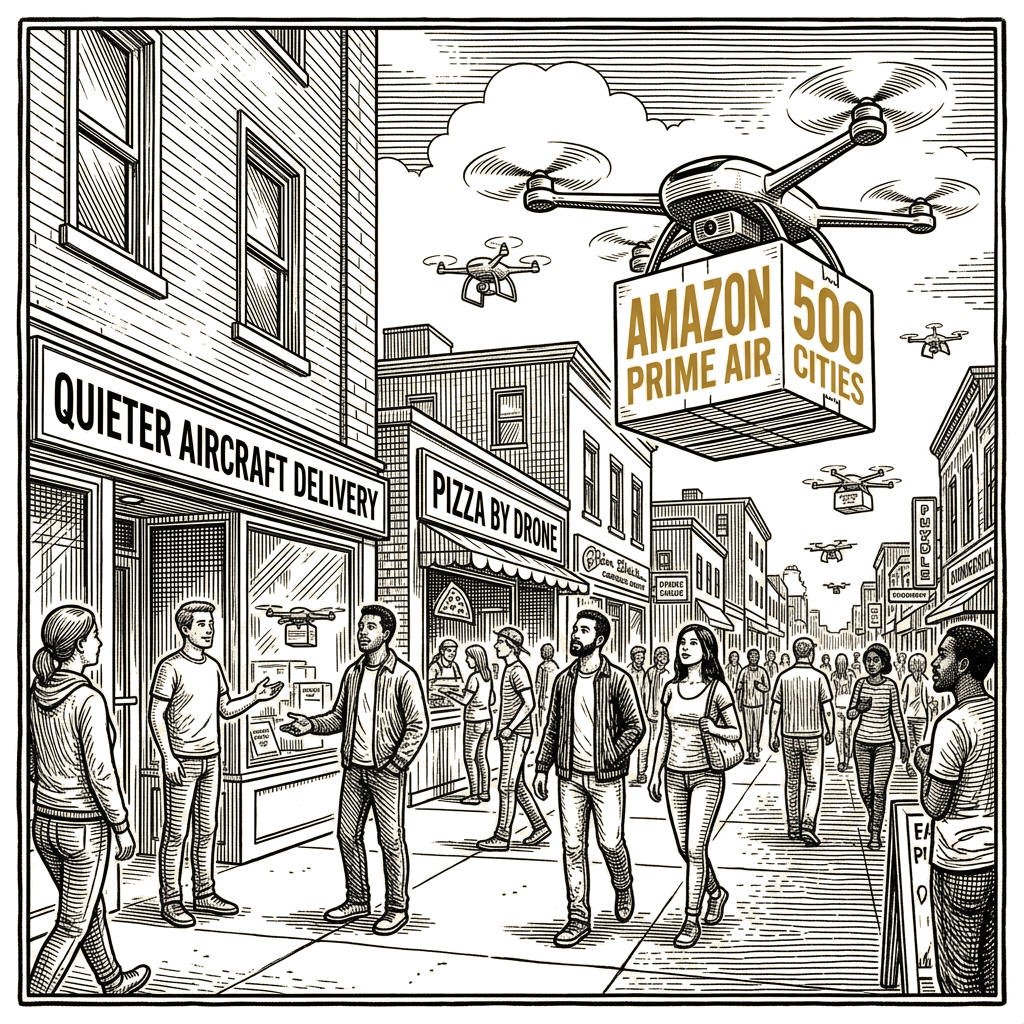
Amazon Prime Air is expanding deliveries to nearly 500 US cities and towns, adding to a service launched to customers in and around Darlington in the north of England. The company delivers items that fit into a space the size of a shoe box. In some US cities, customers can also order flying treats from local pizza joints or ice cream parlors through smaller delivery services. What was recently a novelty is becoming part of everyday life for many people as companies seek to speed up home deliveries.
A buzz that ended garden time and bike rides
Ashley Schmidt, a 44-year-old administrative assistant in the Dallas suburb of North Garland, no longer spends much time in her garden. She has also given up cycling to local parks where she previously enjoyed taking close-up photos of bugs, lizards and toads. She attributes both changes to drones delivering her neighbors’ online orders overhead. “They emit this very annoying buzz. It triggers my fight or flight response,” she said. “You can hear the drones on approach and you can hear them inside your home when they pass directly overhead and then you hear them as they leave,” she said.
Why drone noise stands out to residents
Schmidt is one of a growing number of residents living with noise from drones dispatched by companies including Amazon and Walmart. Even where traffic already forms a steady background, the sudden whine of a drone’s rotors can pierce the everyday hum. Antonio Torija Martinez, a professor in acoustic engineering and psychoacoustics at the University of Salford, said the sound tends to be “particularly noticeable, even when overall sound levels are relatively low.”
Unlike planes, drones operate at low altitudes and may fly directly over residential areas. “They can expose communities that have not previously experienced significant aircraft noise, and who may therefore be more sensitive to changes in their local soundscape,” Martinez said. Martinez cited research showing that people respond strongly to a noise when they consider the source to be “novel, intrusive or frequent.” People who benefit from a drone delivery service, for example, may be less bothered by its noise.
Martinez expects complaints to grow with the sector: “At the moment we are seeing some of these problems localised in some areas, but… as the drone sector expands, more and more of these complaints will happen.” In the US, the FAA regulates commercial drones, but its handling of noisy delivery operations has drawn criticism. The FAA says operators and local community leaders have primary responsibility for addressing any community concerns.
Schmidt’s preferred solution remains a complete halt in drone deliveries near her home. “I would like them to completely stop until they figure out how their services stop being a nuisance,” she said.
Quieter designs change propellers and rotors
One technology company is targeting both the level and frequency of the sound. London-based Greenjets set out to tackle both “noise level and the frequency of that noise,” as Darren James, the company’s future technologies lead, said. Greenjets says its propulsion system can reduce drone noise by at least two thirds. Unlike standard drones, which use spinning propellers that slice through open air and create a high-pitched buzz, Greenjets encloses its spinning blades in a pod. The pod muffles the sound and directs noise away from the ground, while slower rotor speeds and materials that reduce vibration noise provide further quieting.
Detroit-based entrepreneur Greg Sharrow started on quieter propellers while trying to broadcast a classical music performance in 2012. He needed to film a violinist from a difficult angle, and a drone seemed like the only solution, but he expected it would be far too noisy. “I knew that most of the noise from the drone was coming from the propeller, not the motor,” he said. Sharrow realized that the tips of the propeller blades were producing the noise as they swiped through the air, and that realization led him to consider a tipless propeller. “I asked myself a very simple question, what would a tipless propeller look like and how would it function?” he said. The result was a propeller with twisted, loop-shaped blades and no points.
Testing it in water was easier than repeatedly flying a drone, so he first developed a less noisy boat propeller. His company, Sharrow Engineering, now focuses on developing “ultra-quiet” drone rotors. “We have validated that the technology works in drone applications and that it is dramatically quieter,” Sharrow said.
An Amazon spokesperson said the company has made “measurable sound improvements” and that its latest designs use custom-designed propellers “that produce almost half the perceived sound of the prior generation, with a milder tone.” Wing, which provides the vehicles for Walmart deliveries, said its propellers are designed to minimize noise. It also varies flight paths to prevent repeated overflights over any single home or neighborhood.
Quieter drones also serve security, conservation and military users
Greenjets’ low-noise technology has been used by police and harbour security teams in Germany and by conservationists in Africa who track poachers from above without being detected. On battlefields, quiet drones can also avoid alerting an enemy to an approaching vehicle. Robert Tollast, a research fellow at Whitehall think tank the Royal United Services Institute, said: “There are some efforts to reduce the sound of drones. The US Special Forces are interested, at an experimental stage.” He said speed, rather than stealthiness, generally comes first for larger drones used in the war between Russia and Ukraine: “Make it faster, not less quiet, seems to be the approach.”