First-ever Senate election observer program draws more than 100 staff
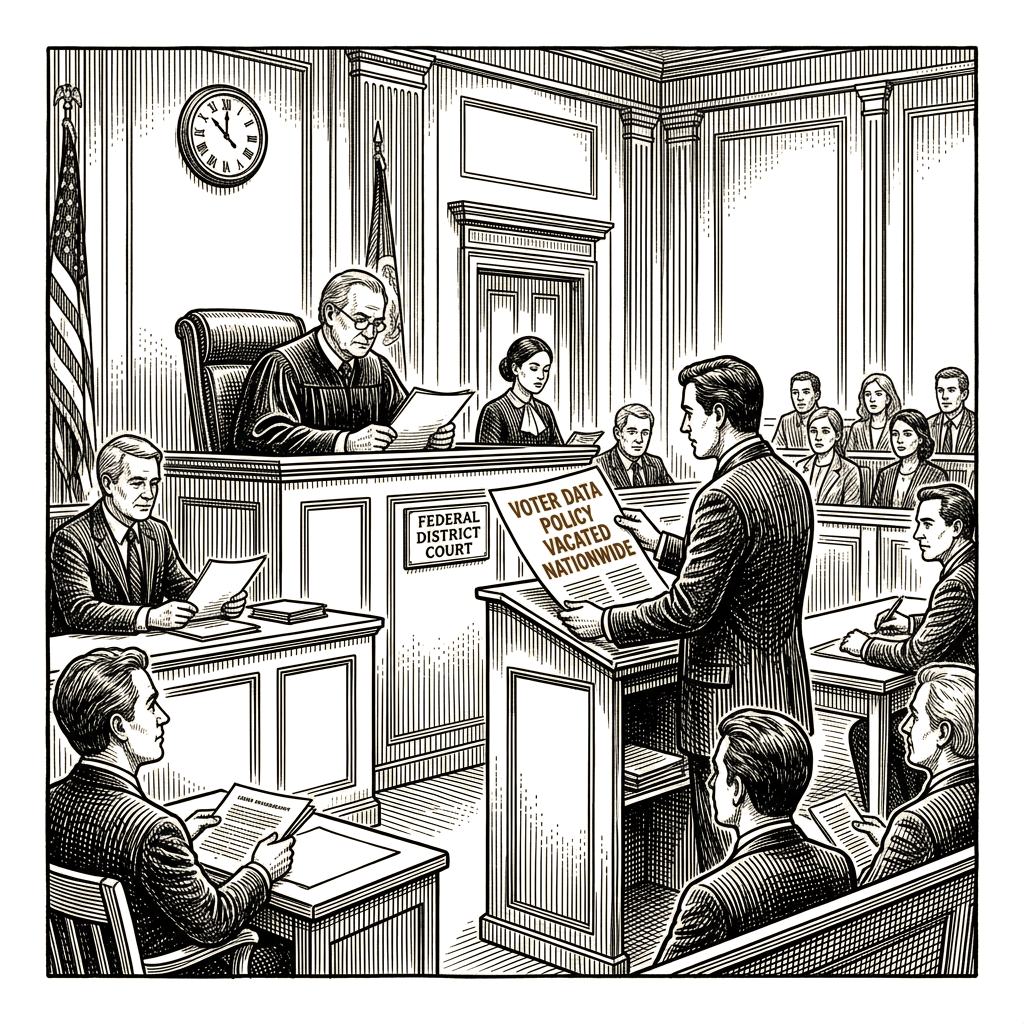
A federal district court ruled on October 9, 2026, that the Justice Department’s voter data collection policy exceeds the agency’s authority, is arbitrary and capricious and violates federal law, and vacated the policy nationwide. The ruling reaches states that resisted the Justice Department’s efforts to obtain their voter records as well as states that had already voluntarily complied, and the department has appealed to the U.S. Court of Appeals for the D.C. Circuit. Common Cause, a nonpartisan nonprofit organization, had challenged the Justice Department’s voter data collection program in court as a violation of federal law.
The ruling comes after months of conflict over federal demands for state voter files. The Department of Homeland Security has worked for months to gather state voter rolls, which it says it is using to find noncitizens who are illegally registered to vote. A tally by the State Democracy Research Initiative at the University of Wisconsin-Madison has tallied 31 federal lawsuits from the administration seeking state voter data, and states have largely refused to comply, citing privacy laws and the Constitution, which expressly delegates election administration to the states subject to congressional oversight.
Congressional oversight offers a separate line of protection. Despite their minority status, Democrats do have access to some oversight tools. The House of Representatives has an active staff election observer program that dates to the 1980s, and this year will see the first-ever Senate election observer program. Staff designated by lawmakers of both parties can be dispatched to observe voting and tabulating locations, with the goal of keeping lawmakers informed for oversight work and in case of contested results. Those who volunteer to participate will not advocate for candidates, participate in vote counting or interfere with voters or election staff.
“I am committed to using every tool to protect free and fair elections, and the new Senate Election Observer Program will do just that,” Padilla, the top Democrat on the Senate committee that oversees election administration, said in a statement announcing the program. Senate Democratic Majority Leader Schumer and Padilla announced this month that more than 100 staff had agreed to participate. Sen. Mitch McConnell, R-Ky., who chairs the committee, has not addressed whether Republican staffers would participate.
Those tools sit alongside a broader election-protection effort that NPR spoke with more than a dozen people about this summer, in reporting first published in August and updated since. Those participants have formed what they describe as an election protection task force, a coordinated effort between Democratic lawmakers and their staffers, election litigators, scholars and nonpartisan good governance organizations. Their primary goal is to prepare the public and their state and local counterparts to act when necessary to ensure election results are honored. Task force members acknowledged there is no magic “protect democracy” button tucked away in a Capitol cloakroom, and each emphasized the power of legislators as messengers and organizers.
Some members are now prepared for worst-case scenarios, working from prewritten legal briefs and a Rolodex of key contacts in places they believe to be high risk. Their lists include areas in which election officials may have echoed the president’s election denial rhetoric, where results are expected to be close or slow to count, and where Trump has focused scrutiny in the past, like California, Illinois and New York.
Limited in their ability to exercise hard power, Democratic lawmakers have exercised power in other ways. Primarily, they are focused on being the connective tissue between their state and local counterparts involved in the mechanics of administering elections and the good governance groups involved in ensuring the integrity of that process. “We recognize that elections are run at the local level, at the state level, and we want to be able to partner — and continue to partner — with our state authorities as they carry out their duties,” Sen. Lisa Blunt Rochester, D-Del., told NPR in August. “But we also know that, especially at this moment, there are civil society organizations, there are attorneys, there are community leaders who are all coming together and saying we’re each going to do our part to ensure that this election is safe, reliable, strong, that workers at the polls are protected, that our voters can get out there and vote,” she said.
The preparation follows a midterm cycle in which the Trump administration has gathered millions of state voter records for law enforcement purposes, endeavored to restrict mail-in voting nationwide, declined the typical practice of inviting international election observers and repeatedly raised the idea of dispatching armed federal personnel to voting locations. The Trump administration broadly describes its actions as an effort to ensure the integrity of the American democratic system after the president’s signature election overhaul effort, the SAVE America Act, failed in the GOP-led Senate. Task force members say the administration has also long worked to undermine public trust in a secure and transparent election system and has, without constitutional authority, inserted the executive branch into the state-led election process.
President Donald Trump set the tone in a July address from the East Room of the White House. “We have very important elections coming up,” Trump said. “We want those elections to be honest.” He used the speech to call on Congress to pass the SAVE America Act, which would, among other measures, require voters to show proof of citizenship when registering to vote and a photo ID before they can cast a ballot. “How easy is that to do, unless you want to cheat? The only reason you wouldn’t do it is you want to cheat because your policies are so bad, and your candidates are so pathetic that you can’t get away or can’t get elected any other way,” he said. Task force members said the remarks should be understood as an effort to make voter fraud — which studies and investigations have found to be vanishingly rare — seem plausible. Those involved also worry that the administration will point to normal, but poorly understood, parts of American election infrastructure, including slow vote counting in California and Alaska, as evidence of fraudulent behavior.
Justin Vail, a leader at Protect Democracy, a cross-ideological group that says it uses litigation, advocacy and research to protect American elections, is a member of the task force. Vail previously served as a special assistant to President Joe Biden, working on democracy issues. He told NPR that Trump’s speech was an effort to sow doubt in November’s elections, a first step in what his organization characterizes as a three-step playbook: deceive, disrupt and deny. “First, he deceives Americans, manufacturing false claims about voter fraud and the security of our elections,” Vail said. “Second, he seeks to disrupt the normal state and local management of elections,” he continued, “in an attempt to coerce them to enact policies that threaten the eligible voters’ access. And if that’s all not enough, Trump is prepared to outright deny election results that he doesn’t like.”
Democracy Forward, a legal nonprofit that says it works to advance democracy and social progress through litigation, policy and public education, has written that the Trump administration’s efforts “harness the president’s longstanding and baseless conspiracy theories in pursuit of discovering so-called ‘election fraud’. These actions are reckless and run the risk of intimidating and disenfranchising voters.” The White House pushed back. In a statement to NPR in October, White House spokeswoman Lauren Bis said that “President Trump has done more than any other President to ensure we have free and fair elections. While extreme Democrats and the media continue to dismiss concerns about voter fraud, the Trump Administration is taking decisive action to protect our elections including prosecuting election crimes, strengthening election infrastructure security, and protecting vulnerable voters from fraud and coercion.”
Marc Elias, the prominent election litigator and a member of the task force, describes the election protection effort on a continuum. “It begins with voter registration, then you have people voting, then you have Election Day,” Elias said. “You have tabulation of ballots, you have local certification, and ultimately you have seating.” Elias said his firm has been at the leading edge of election-related litigation against the administration and has been involved in dozens of lawsuits spanning every state, combating what he views as the first stage of an ongoing election interference effort. “History has shown that Donald Trump is willing to weaponize power against all points of that process,” Elias said. “This is not something that we wait until election subversion has taken place.” A primary fight centered on mail-in ballots. Trump ordered the Postal Service to deliver mail-in ballots only to registered voters on those lists — an effort that was ultimately halted by the Supreme Court.
Multiple election law experts consulted for the story, none of whom are involved in advising congressional lawmakers or candidates, broadly agreed that the president has no role in election administration, which the Constitution delegates explicitly to the states and Congress. Several members of the task force noted that over the last year, Trump has attempted to dramatically expand direct federal involvement in elections and asserted unprecedented authority over election administration. “Remember, the States are merely an ‘agent’ for the Federal Government in counting and tabulating the votes,” he wrote on Truth Social last August. “They must do what the Federal Government, as represented by the President of the United States, tells them, FOR THE GOOD OF OUR COUNTRY, to do.”
Elias believes Congress could play a larger role in protecting elections if it were able to speak with a unified, bipartisan voice, but “it’s not doing that because Mike Johnson and John Thune aren’t doing it,” he said, referring to the top Republicans in the House and Senate, respectively. “Imagine,” Elias said, “a brief that was submitted by the House of Representatives itself, the U.S. Senate itself, telling the courts that Congress was jealously guarding its authority” over elections. “That, I think, would frankly be an incredibly useful thing and would have a real impact.” NPR’s account characterizes GOP legislators as broadly echoing the president’s election fraud narratives, and party leaders as showing little desire to push back on his election-related actions, while congressional Republicans have focused much of their attention on trying to pass the SAVE America Act.
Despite the risks they see, many of those involved in congressional Democrats’ election preparations felt optimistic that, in the end, the voice of the American public would win out. Vanita Gupta, formerly Biden’s associate attorney general and now director of the Center for Law and Public Trust at New York University’s law school, is among those optimistic voices. “Hundreds of nonpartisan organizations have been preparing over the past year to do everything in our power to protect the integrity of our elections,” Gupta told NPR in August. “Maybe the process of getting from here to a new Congress may be messier than any of us would like, perhaps filled with a lot more litigation and organizing than we might have thought was necessary, but we are going to have free and fair elections so long as people don’t take for granted their right to vote.”