Bolsonaro family entered the United States under one-year humanitarian parole
Less than 24 hours after losing Brazil’s presidential election, Flávio Bolsonaro left his home in Brasília on Monday evening in a convoy of four dark cars, despite a Supreme Court order barring him from leaving. The vehicles split in different directions, leaving journalists and authorities to determine which one carried him. By the next afternoon, allies were telling reporters he had reached Florida while Brazilian and international outlets reported that he had left Brazil; Flávio Bolsonaro was still in the country, and a private jet waited across the border in Argentina. The getaway relied heavily on deception and decoys, leaving even some of his closest allies in Washington and Brazil in the dark about his whereabouts. According to The Wall Street Journal, a small circle of Trump allies, senior U.S. officials and Argentine President Javier Milei helped secure the escape.
On Tuesday, Flávio Bolsonaro, his wife and their two daughters headed hundreds of miles to the Argentine border. At 10:50 p.m. local time, the family crossed the Tancredo Neves International Bridge into Puerto Iguazú, Argentina, near where the borders of Brazil, Argentina and Paraguay meet, according to Argentine authorities. After crossing, Bolsonaro’s vehicle was escorted by Argentina’s airport security police to the immigration checkpoint at Iguazú Falls International Airport.
The coordination involved Argentine President Javier Milei’s top aide. Santiago Caputo monitored the operation from Puerto Iguazú, according to a former Argentine intelligence chief, and was in direct contact with Eduardo Bolsonaro to coordinate, according to a person involved in the operation. A small group including Trump adviser Jason Miller worked with Eduardo Bolsonaro to secure the charter jet from Argentina to Florida, according to The Wall Street Journal. Milei is a close ally of both the Trump administration and the Bolsonaro family. In July, he attended a campaign rally for Flávio Bolsonaro in Brazil and called da Silva a “thief,” prompting Brazil to recall its ambassador to Argentina.
At Iguazú Falls International Airport, a private jet owned by Baires Fly, a charter airline, was waiting after arriving from Buenos Aires a day earlier, according to flight-tracking data. Flávio Bolsonaro boarded the Gulfstream at 11:30 p.m.; an Argentine flight manifest reviewed by The Wall Street Journal identifies flight LV-JQW and lists Bolsonaro, traveling on an Italian passport, alongside his wife and two daughters. The flight departed shortly after midnight with two pilots and one flight attendant aboard. The Gulfstream G400 took off from Puerto Iguazú at 12:21 a.m. Wednesday and flew to Guayaquil, Ecuador, to refuel on the way to the United States.
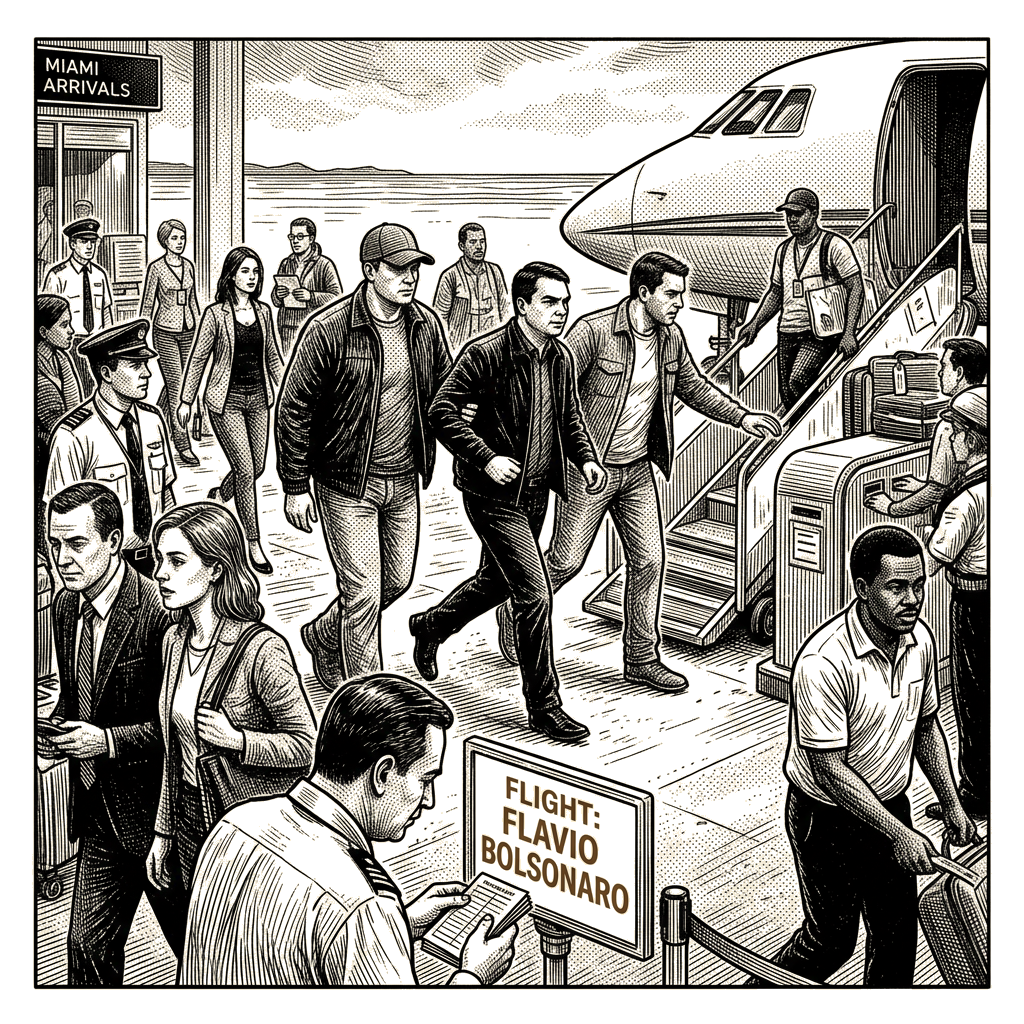
The jet landed at Miami-Opa Locka Executive Airport around 9:30 Wednesday morning. Flávio Bolsonaro stepped off in a navy polo shirt and backpack. Uniformed officers used umbrellas to shield him and his family from cameras, and the group was hurried into a waiting SUV.
After Trump personally approved admitting the family on Tuesday, Secretary of State Marco Rubio moved to issue them visas, according to people familiar with the arrangements. The Bolsonaro family ultimately entered under humanitarian parole, which the people said allows them to remain in the United States for one year.
Referring to himself as the “leader of Brazil,” Flávio Bolsonaro thanked President Trump for welcoming him to a “land of freedoms” and Milei for his “courage” and “sense of justice” in a Wednesday statement from Miami. Trump declined to comment when reporters asked about Bolsonaro declaring himself the rightful president of Brazil. “I thought they were treated very unfairly,” Trump said Wednesday about the Bolsonaros, whom he had described as “very fine people” earlier in the day. He added, “But I won’t get involved—it was a very strange election, that’s for sure.”
The operation took shape on Monday as allies grew concerned that Flávio Bolsonaro could face arrest. Criminal investigations into him predated the election, but the Supreme Court order barring his departure and requiring him to surrender his passports came shortly after his defeat. The order fueled accusations by the Bolsonaro family that President Luiz Inácio Lula da Silva was determined to punish his political rival.
Da Silva’s victory in Sunday’s runoff against Flávio Bolsonaro was recognized by more than 50 countries, including Latin American leaders across the political spectrum. He defeated Flávio by more than 4.4 million votes, a margin international observers said left no doubt about the integrity of the country’s electoral data. Trump, however, had so far refused to formally recognize da Silva’s victory and suggested, without evidence, that the results might have been rigged.
Trump has drawn parallels between Brazil’s elections and the prosecution of the Bolsonaros as part of the same struggle against a leftist “witch hunt.” At a campaign rally in Texas on Tuesday, he accused Democrats of being “the greatest cheaters of elections in history” before adding, “although Brazil is doing a pretty good job also, aren’t they?”
People involved in discussions with Flávio Bolsonaro said he intended to set up a political operation in exile from the United States. With midterm elections days away, the White House had given little indication that it intended to go beyond offering refuge or that Trump would expend political capital challenging da Silva’s re-election victory, despite pressure from allies in Washington, according to two people involved in the discussions.
Flávio Bolsonaro’s arrival followed his father into the United States. In December 2022, Jair Bolsonaro landed at Orlando International Airport after losing an election to da Silva and refusing to concede. He stayed for around three months, living at the home of a friend before returning to Brazil. He was later convicted of plotting a coup to stay in power; the plot culminated in an uprising in Brasília that drew comparisons to the Capitol riots of January 2021.
The Trump administration’s decision to provide refuge marked the culmination of the family’s yearslong lobbying campaign to enlist Donald Trump and his inner circle in the family’s legal and political battles at home. Spearheaded by Eduardo Bolsonaro, the campaign stretched from Mar-a-Lago dinners and CPAC conferences to White House meetings. At Donald Trump’s inauguration last year, Eduardo Bolsonaro embraced Donald Trump Jr. after attending a dinner hosted by Vice President JD Vance.
With help from influential allies, including Jason Miller and former Trump strategist Steve Bannon, the Bolsonaros cast their legal fights back home into a broader campaign of political persecution that resonated with Donald Trump. Bannon said, “People in the United States who think politics are going to get easier haven’t seen anything,” and warned, “This is only going to get nastier, more partisan and more aggressive.”
The Wall Street Journal characterized the personal alliance between the Trump and Bolsonaro families as having reshaped U.S.-Brazil relations. Last year, Trump imposed steep tariffs on Brazil, citing Brazil’s treatment of Bolsonaro, and sanctioned the same Supreme Court justice who barred Flávio Bolsonaro from leaving. The report described the episode as a test of how far Trump was willing to wield American power for a foreign political dynasty, with potentially far-reaching consequences for Brazil, the second-largest democracy in the Americas. Under the arrangement described in the report, Flávio Bolsonaro and his family were in the United States under humanitarian parole, while the White House had given little indication that it planned to challenge da Silva’s victory.