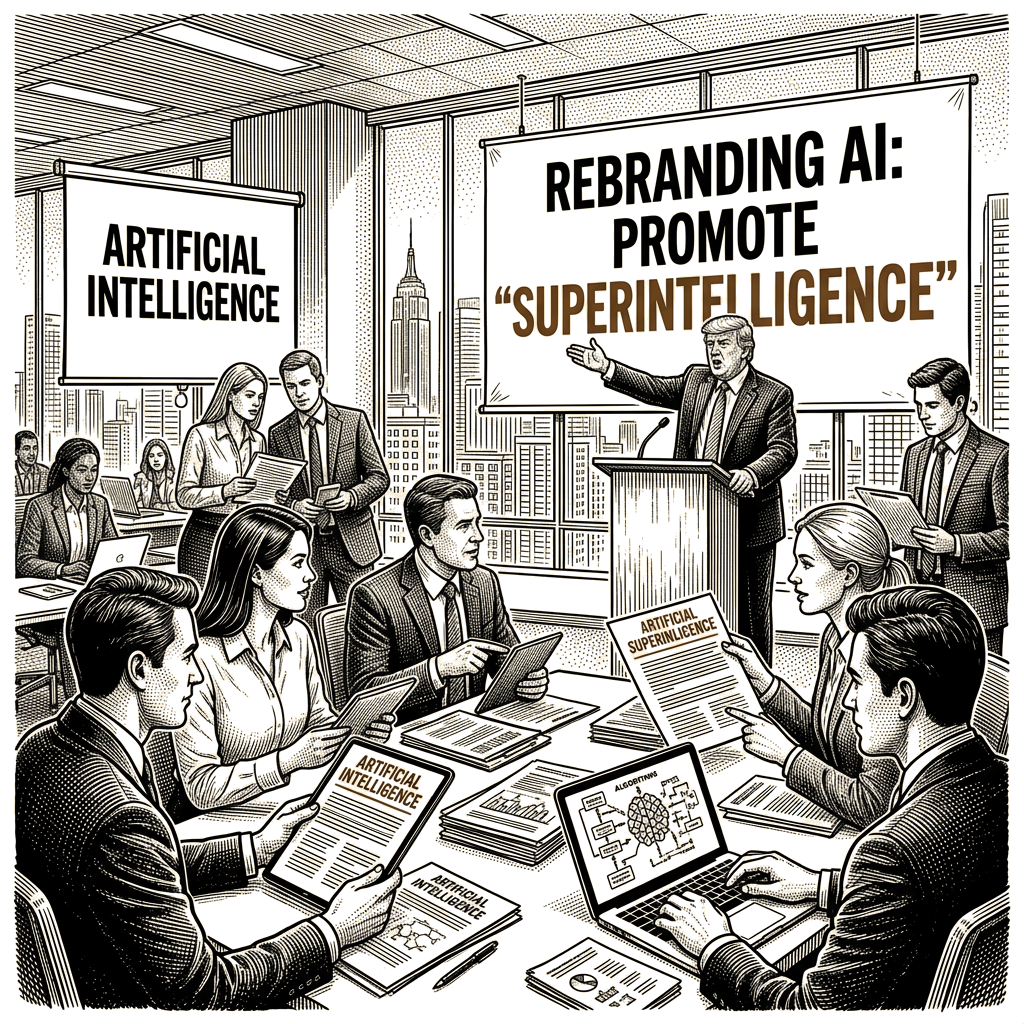
Five of 119 S&P 500 companies discussing AI used the White House’s preferred term
President Trump’s campaign to make “superintelligence” the White House’s preferred name for artificial intelligence has produced an uneven industry response. Technology executives have alternated between the two terms in podcasts, investor calls, securities filings, social media posts and product announcements. The result is not a completed terminology shift but a patchwork that leaves “AI” in place as the broad label for chatbots, advanced models and other technology.
Trump said at the United Nations General Assembly in late September that “artificial” makes AI sound fake, adding, “It is not fake. It’s actually amazing.” Days later, he signed an executive order requiring all government documents using the disfavored wording to be renamed. In a Truth Social post last month, he escalated the instruction: “The White House considers anyone that uses the term, ‘Artificial Intelligence,’ as opposed to the highly accepted new and more accurate term, ‘Super Intelligence,’ THE ENEMY!”
The stakes differed for companies that had built products, brands and public messages around AI. Tech leaders who count among the White House’s most frequent visitors also signed a pledge there to keep the technology safe, placing them in a position where the president’s terminology carried political as well as promotional weight. The challenge was especially visible after tech-industry earnings reports, Anthropic’s public-offering filing and what The Wall Street Journal called “last week’s stock-market meltdown over AI, or SI, spending” gave executives new settings in which to choose their words.
Microsoft President Brad Smith tried to straddle both terms in an October podcast, asking, “What should a building code for AI safety—or SI safety—look like?” A Microsoft spokeswoman said the company uses a range of terms for the technology. The exchange captured the broader corporate problem: executives could use the preferred word for a particular audience while retaining AI where it described existing products or established language.
Nvidia Chief Executive Jensen Huang, who has a close relationship with Trump, has also used the labels selectively. The day after he and other tech leaders signed the White House safety pledge, Huang wrote on X, “The future of Super Intelligence will be shaped not only by what it can do, but by the confidence it earns.” A few weeks later at a conference in Berlin, he returned to the broader term: “Every company in Europe will become an AI company.”
Elon Musk took to the new terminology almost immediately. SpaceX’s AI division will become SpaceXSI, he declared, while a Tesla securities filing said mentions of SI “refer to the technologies and activities that we previously described as ‘artificial intelligence’ or ‘AI.’” Salesforce Chief Executive Marc Benioff also changed a product name, saying on X that the company’s AIForce platform was now SIForce: “The era of super intelligence is here.”
OpenAI CEO Sam Altman, by contrast, said the company would not change its name. “Brands are sticky,” he told Politico. His comment highlighted why the terminology campaign could not become a simple organization-wide switch: companies have staked their futures, and in some cases their names, on AI.
A Wall Street Journal analysis found that five of 119 S&P 500 companies discussing the technology on investor calls, securities filings or news releases used some variation of “superintelligence.” The review covered investor calls, securities filings and news releases from Sept. 29 through 4 p.m. ET on Nov. 2, drawing on company securities filings, PR Newswire and Business Wire press releases accessed through Factiva, and Quartr transcripts accessed through Factiva. Some companies used one word, others used two, and companies also differed on whether to capitalize the term. The review came amid a wave of tech-industry earnings reports, Anthropic’s public-offering filing and what The Wall Street Journal described as “last week’s stock-market meltdown over AI, or SI, spending.”
Brendan Steinhauser, chief executive of the nonprofit Alliance for Secure AI, which advocates for AI-safety policies, said, “People are muddling through.” He described companies as trying not to be “oppositional to the White House” while saying they would “continue to talk about this in the way we have talked about it.” Steinhauser said the organization aimed to preserve the existing meaning of “superintelligence” and keep “AI” as the more general term.
His group had a reason for wanting the terms kept distinct. “Superintelligence” was already widely used in AI circles to describe, so far, hypothetical models more cognitively capable than the most gifted humans. The Alliance for Secure AI posted on X in October, “Yes, we will continue to be called The Alliance for Secure AI,” borrowing Trump’s signature signoff: “Thank you for your attention to this matter.”
Trump also singled out The Wall Street Journal last week for continuing to refer to “artificial” intelligence, calling the name “a very bad and inaccurate name.” The newspaper said it uses “AI” for the general technology powering chatbots and advanced models and reserves “superintelligence” for the higher, hypothetical level of machine intelligence.
The terminology shift was not uniform inside the White House orbit. A recent Facebook post from first lady Melania Trump’s account announcing a computing challenge for students referred to AI instead of SI in one instance; a commenter wrote, “I’m still correcting myself also.” On the “All-In” podcast, co-hosted by Trump’s former AI czar David Sacks, the hosts noticed listeners scrutinizing their returns to “AI.” A late-October episode was titled “AI Cyber Panic.” Sacks later joked to cohost Jason Calacanis, “You’re getting some shade for that.”
The difficulty also appeared in technical and government settings. At a Washington conference on robotics, Craig Schlenoff, who leads the National Institute of Standards and Technology’s AI research, measurement and standards division, opened a panel with an acknowledgment: “No question I’m going to slip up at some point.” He added, “I haven’t completely cleared my cache yet, so muscle memory is going to jump in and AI is going to come in.”
Across the records reviewed, companies did not uniformly replace AI. Microsoft and Nvidia used both terms, Tesla used SI in a securities filing, Salesforce changed a platform name, and OpenAI kept its name. Musk, meanwhile, declared that SpaceX’s AI division will become SpaceXSI. The result left “superintelligence” visible in public and corporate language while “AI” remained the general term in many other settings.